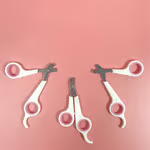
The "Other Cleaning and Beauty Products" category encompasses a broad range of personal care and environmental cleaning items designed to meet diverse daily cleaning and beautification needs. These products come in various forms, such as liquids, solids, powders, or sprays, with their primary functions varying from basic skin, hair, and oral hygiene to home environment maintenance. In terms of composition, these products may include different substances like surfactants, antibacterial agents, moisturizers, and fragrances, aiming to achieve specific cleaning, moisturizing, or aromatic effects. When selecting, consumers can choose suitable "Other Cleaning and Beauty Products" based on personal habits, intended use, and ingredient preferences to maintain personal hygiene and environmental cleanliness. This category also includes various auxiliary cleaning and beauty tools to enhance ease of use and effectiveness.
Miscellaneous cleaning and beauty products encompass a diverse range of items designed for various hygiene, sanitation, and aesthetic maintenance tasks, frequently extending beyond conventional personal care or standard household cleaning supplies.
This article aims to describe the structural attributes, material composition, and usage context within this product category, without providing product recommendations or comparing advantages among specific items.
Miscellaneous Cleaning and Beauty Products: Classification by Application Context
The classification of miscellaneous cleaning and beauty products often aligns with their intended application context, which can broadly be divided into several functional areas. One primary division is between products primarily for environmental sanitation and those for direct application to surfaces or living beings. Within environmental sanitation, products may be further categorized by the type of contaminant they address, such as odors, microbial agents, or physical debris. For instance, some items are formulated specifically for odor neutralization in enclosed spaces, while others target disinfection of hard, non-porous surfaces. Another contextual distinction relates to the type of surface or material being treated; products designed for fabric care differ significantly from those intended for ceramic or metallic surfaces. The presence of living organisms, such as pets, introduces another layer of classification, with specialized formulations developed to address pet-specific hygiene needs, such as waste management or topical cleaning. These products often feature formulations that consider potential exposure to animals, ensuring compatibility and safety. Furthermore, some miscellaneous cleaning and beauty products are designed for specialized equipment maintenance, addressing residues, scaling, or biological film buildup in machinery or appliances. The operational environment, whether indoor residential, outdoor, or commercial, also dictates specific product characteristics, including concentration, application method, and overall chemical profile. Products for professional use, for example, typically feature higher concentrations of active ingredients and are accompanied by industrial safety guidelines compared to consumer-grade items. This contextual differentiation is fundamental to understanding the varied landscape of miscellaneous cleaning and beauty products.
Miscellaneous Cleaning and Beauty Products: Material Composition and Formulation Methods
The material composition and formulation methods employed in miscellaneous cleaning and beauty products exhibit considerable variation, driven by their diverse functional requirements. Surfactants form a fundamental component in many cleaning formulations, acting to reduce surface tension and aid in the emulsification and removal of soils. These can include anionic, cationic, non-ionic, and amphoteric types, each with specific properties regarding foaming, detergency, and compatibility with other ingredients. Disinfectant products frequently incorporate active antimicrobial agents such as quaternary ammonium compounds, chlorine-based compounds, alcohols, or peroxy compounds. The selection of the antimicrobial agent is contingent on the target microorganisms, desired contact time, and material compatibility. Odor control products often rely on chemical neutralization agents, encapsulating agents, or absorbent materials. Chemical neutralizers react with odor molecules to transform them into non-odorous substances, while encapsulating agents physically trap odor molecules. Absorbent materials, such as activated carbon or zeolites, physically adsorb odor-causing compounds. Many miscellaneous cleaning and beauty products also contain chelating agents to sequester metal ions, preventing them from interfering with surfactant performance or causing scale buildup. pH adjusters, such as acids or bases, are incorporated to optimize the efficacy of active ingredients and ensure material compatibility. Emulsifiers and stabilizers are crucial for maintaining the homogeneity and shelf-life of multi-phase formulations, preventing separation of oil and water components. Thickeners or rheology modifiers are used to control the viscosity of liquid products, influencing their application characteristics and cling time on surfaces. Abrasives, typically fine particulate solids, are present in certain cleaning products to enhance mechanical scrubbing action for stubborn deposits. The manufacturing processes for these products range from simple blending of liquid components to more complex reactions involving multiple synthesis steps, depending on the chemical nature of the active ingredients. For instance, the production of a multi-component spray involves precise metering and mixing of aqueous and non-aqueous phases, often under controlled temperature and pressure conditions to ensure stability and uniform distribution of active compounds. Solid or semi-solid products, such as wipes or gels, involve impregnation or gelling processes to achieve their final physical form. The specific combination of ingredients and their ratios are meticulously engineered to achieve the desired performance attributes while adhering to safety and regulatory standards for miscellaneous cleaning and beauty products.
Miscellaneous Cleaning and Beauty Products: Variable Properties Across Usage Environments
The properties of miscellaneous cleaning and beauty products can vary significantly depending on the specific usage environment or conditions. Environmental factors such as temperature, humidity, and airflow directly influence product performance and stability. For example, disinfectant efficacy can be affected by ambient temperature; some biocides exhibit optimal activity within a specific temperature range, while excessively high temperatures might lead to degradation of active ingredients. Humidity levels can impact the drying time of liquid cleaners and the evaporation rate of volatile components, which in turn affects contact time for disinfection or the persistence of fragrance. In environments with high airflow, airborne odor neutralizers may disperse more rapidly, requiring more frequent application or higher concentrations to maintain efficacy. The nature of the surface being treated is another critical variable. Porous surfaces, for instance, may absorb cleaning solutions differently than non-porous surfaces, affecting contact time and the penetration of active ingredients. The presence of organic load, such as dirt, grease, or biological fluids, can significantly reduce the effectiveness of many disinfectants and cleaners, as these substances can neutralize active ingredients or create barriers that prevent contact with target microbes. Products designed for pet waste management, for instance, must contend with high organic loads and specific chemical compositions of urine and feces, necessitating formulations that can break down these complex matrices. Water hardness is another factor, particularly for products that rely on surfactants. Hard water, containing high concentrations of mineral ions like calcium and magnesium, can reduce the foaming and cleaning power of some surfactants, requiring the inclusion of chelating agents in the formulation. The presence of specific contaminants, such as molds, mildew, or particular types of bacteria, dictates the selection of active ingredients and their concentrations in miscellaneous cleaning and beauty products. Furthermore, indoor versus outdoor usage presents distinct challenges. Outdoor products may need to withstand UV radiation, rain, and wider temperature fluctuations, requiring more robust formulations and packaging. Indoor products, conversely, often emphasize lower volatile organic compound (VOC) emissions and gentler fragrance profiles due to enclosed spaces and human proximity. Understanding these environmental interactions is crucial for predicting and optimizing the performance of miscellaneous cleaning and beauty products.
Miscellaneous Cleaning and Beauty Products: Product Characteristics based on Sales Ranking
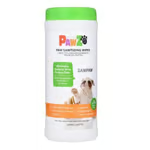
Rank 1: Dogcatstar Wet Wipes (GC804) — These wipes are composed of a non-woven fabric material impregnated with a liquid solution. The fabric typically consists of a blend of synthetic fibers, such as polyester, or natural fibers, like cellulose, or a combination thereof, designed for absorbency and durability during use. The liquid solution commonly contains purified water as the primary solvent, along with mild surfactants for cleaning, humectants to maintain moisture, and frequently, preservatives to prevent microbial growth within the package. Some formulations may include pH adjusters to ensure compatibility with skin or surfaces. The product is packaged in a resealable container to prevent the drying out of the wipes, maintaining their moisture content for effective delivery of the cleaning solution.
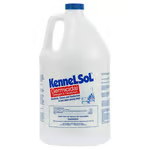
Rank 2: KennelSol Disinfectant Household Formula Wintergreen Scent 473ml (KS-57404) — This product is a liquid disinfectant formulation. Its primary active ingredients are typically quaternary ammonium compounds, which function as broad-spectrum antimicrobial agents. These compounds are positively charged molecules that disrupt the cell membranes of bacteria, viruses, and fungi. The formulation includes water as a solvent and may incorporate non-ionic surfactants to enhance wetting and cleaning action. Chelating agents might be present to mitigate the effects of hard water. The wintergreen scent is imparted by fragrance components, which are specific chemical compounds chosen for their olfactive properties. The product is designed to be diluted with water prior to use for disinfection of hard, non-porous surfaces. It is packaged in a plastic bottle with a volume of 473 milliliters.
Rank 3: Dr.Vet 99.9% Pet Home Antibacterial Deodorizing Spray 500ml (dv02444) — This is a liquid spray formulation designed for antibacterial and deodorizing applications within a pet-owning household. The antibacterial efficacy, stated as 99.9%, is achieved through the inclusion of specific antimicrobial agents. These agents could be various compounds such as quaternary ammonium compounds, biguanides, or certain organic acids, selected for their efficacy against common household bacteria and viruses. Deodorizing action is often a result of a combination of mechanisms, including chemical neutralization of odor molecules, enzymatic breakdown of odor-causing organic matter, or physical absorption by agents like zinc ricinoleate or cyclodextrins. The formulation primarily uses water as a carrier. It is contained within a spray bottle, allowing for fine mist dispersion over surfaces. The volume of the product is 500 milliliters.
Rank 4: Divine Pets Urine Odor Spray 250ml (DP_250_PUE) — This product is a liquid odor eliminator specifically formulated to address urine odors. The active components generally include enzymatic agents, bacterial cultures, or chemical odor neutralizers. Enzymatic formulations contain specific enzymes (e.g., proteases, lipases, amylases) that break down the complex organic molecules found in urine into smaller, non-odorous compounds. Bacterial cultures introduce beneficial microbes that consume odor-causing organic matter. Chemical neutralizers, such as zinc salts or complexing agents, react directly with odor molecules to render them inert. The base of the spray is typically water, and it may include mild surfactants to help penetrate surfaces and allow the active ingredients to reach the odor source more effectively. The product is dispensed via a spray mechanism and is provided in a 250-milliliter container.
Rank 5: ODOUT Odor Roll Pet Antibacterial Urine Stain Remover for Cats and Dogs 500ml (91602529) — This product is a liquid formulation designed for both antibacterial action and the removal of urine stains and odors caused by pets. Its composition typically includes a combination of cleaning agents, odor neutralizers, and antibacterial compounds. The stain removal component often involves surfactants to lift urine residues and potentially mild oxidizing agents or enzymes to break down chromophores responsible for yellowing. For odor elimination, it may employ enzymatic systems, bacterial digesters, or chemical odor neutralizers. The antibacterial aspect is achieved through the inclusion of biocides effective against common bacteria found in pet environments. The product is aqueous-based and packaged in a 500-milliliter bottle, likely with a spray or pour dispenser for application to soiled areas.
Miscellaneous Cleaning and Beauty Products: Quality Standards and Labeling Norms
Quality standards and labeling transparency are fundamental aspects governing miscellaneous cleaning and beauty products, ensuring product integrity and informing consumer choice. These standards are typically established by governmental regulatory bodies or industry associations and encompass various parameters, including ingredient safety, manufacturing practices, performance claims, and environmental considerations. For disinfectants and sanitizers, regulatory agencies often mandate specific efficacy testing against a range of microorganisms, requiring products to meet defined kill rates under standardized laboratory conditions. The active ingredients must be listed, along with their concentrations, and specific contact times for achieving disinfection must be provided. For products with deodorizing claims, substantiation may involve sensory evaluation protocols or chemical analysis demonstrating the reduction of specific odor-causing compounds. Material safety data sheets (MSDS) or safety data sheets (SDS) are often required for industrial or commercial formulations, detailing chemical properties, hazards, and safe handling procedures. Consumer products, while not always requiring full MSDS, must adhere to labeling regulations concerning hazard warnings, first aid instructions, and proper disposal methods. Ingredient lists are generally mandated to be comprehensive, though the level of detail can vary by region and product type. For miscellaneous cleaning and beauty products containing fragrances, specific allergens might need to be declared. Manufacturing practices are often governed by Good Manufacturing Practices (GMP) guidelines, which ensure consistent quality, purity, and safety of products through controls over facilities, equipment, personnel, and processes. Environmental certifications or eco-labels may be present, indicating adherence to criteria related to biodegradability, sustainable sourcing of ingredients, or reduced environmental impact during manufacturing or use. Packaging materials themselves may also be subject to standards regarding recyclability or the absence of certain harmful substances. The presence of certification marks from recognized third-party organizations can further attest to a product's adherence to specific quality or environmental benchmarks. These comprehensive frameworks provide a structured approach to ensuring the reliability and safety of miscellaneous cleaning and beauty products in the market.
Miscellaneous Cleaning and Beauty Products: Factual Insights
One verifiable factual insight regarding miscellaneous cleaning and beauty products is the principle of microbial resistance. Prolonged or inappropriate use of certain antibacterial agents, particularly broad-spectrum ones, can contribute to the development of microbial resistance. This phenomenon occurs when microorganisms adapt to survive exposure to an antimicrobial agent, rendering it less effective over time. This is a significant consideration in the formulation and recommended usage of disinfectants and sanitizers, leading to guidelines on proper dilution, contact time, and rotation of active ingredients to mitigate this risk. The chemical structure of the active ingredient directly influences its mode of action against microbial cells, and variations in these structures can lead to different resistance mechanisms in bacteria and viruses. Consequently, for miscellaneous cleaning and beauty products focused on disinfection, the selection and concentration of the active biocide are critical to ensuring both immediate efficacy and long-term sustainability of antimicrobial action.
Another factual insight pertains to the mechanism of enzymatic odor removal in miscellaneous cleaning and beauty products. Enzymes are biological catalysts, which are highly specific proteins that accelerate chemical reactions. In the context of odor removal, specific enzymes are formulated to break down complex organic molecules that cause odors, such as proteins, starches, and fats found in urine, feces, or other organic waste, into simpler, non-odorous compounds like carbon dioxide and water. This is distinct from masking odors with fragrances or chemically neutralizing them. The activity of these enzymes is highly dependent on environmental factors such as pH and temperature; deviations from optimal conditions can reduce their catalytic efficiency. Therefore, enzymatic odor removers are often formulated with buffering agents to maintain a stable pH and are designed for use within typical ambient temperature ranges. This biological approach to odor elimination offers a different pathway compared to purely chemical or physical methods often found in other miscellaneous cleaning and beauty products.
The category of miscellaneous cleaning and beauty products encompasses a broad array of formulations and applications, each characterized by specific material compositions and intended usage parameters.
......View All