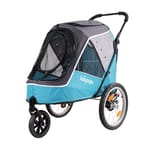
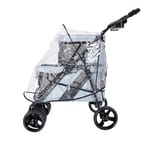
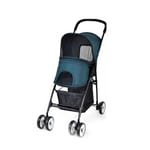
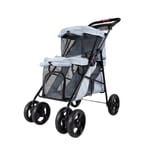
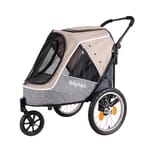
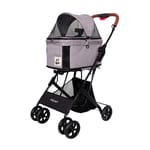
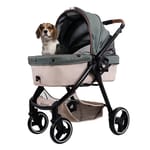
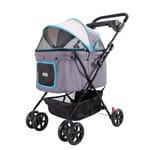
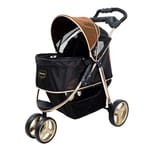
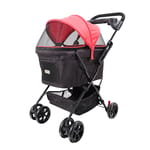
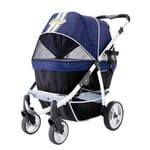
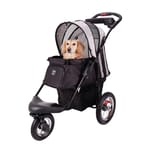
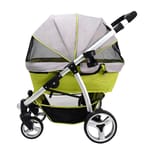
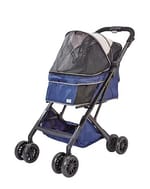
Pet strollers are specialized carriers designed for transporting pets outdoors, functioning similarly to baby strollers by providing a comfortable space for animals. This category encompasses various forms, including lightweight, foldable, and shock-absorbing models, catering to diverse usage scenarios. The design considerations for pet strollers often include weight capacity, interior dimensions, ventilation, and material choices, with some models featuring removable cushions or safety leashes. Depending on the pet's size, the market offers small models, such as mini pet strollers, as well as robust pet strollers capable of accommodating large dogs. These transportation devices facilitate outdoor mobility for pets while ensuring their safety and comfort. The selection of a pet stroller is diverse, allowing for choices based on the pet's weight, size, and the owner's specific needs.
A pet stroller is a wheeled conveyance designed for transporting animals, typically domesticated pets, incorporating a structured enclosure for containment and safety during mobility.
This article aims to describe the structural attributes, material compositions, and usage contexts within the pet stroller category. It will present objective information regarding their design and function, without offering product recommendations or comparative evaluations of performance.
Pet Stroller Classification by Design and Function
Pet strollers are commonly divided based on their intended use and structural configuration. One primary classification distinguishes between models designed for single pets versus those accommodating multiple animals. Single-pet strollers typically feature a smaller, more compact cabin, optimized for one animal's dimensions and weight. Multi-pet strollers, conversely, offer larger enclosures, often with internal partitions or increased cargo capacity to safely transport two or more pets simultaneously. Another common differentiation arises from the size of the pet they are designed to carry. There are models specifically engineered for small pets, featuring lightweight frames and compact dimensions, while large pet strollers are built with robust frames, reinforced axles, and larger wheels to manage substantial weight capacities. The structural elements, such as the chassis material and wheel diameter, are directly influenced by these load-bearing requirements. Specialized designs also exist, such as jogging pet strollers, which integrate enhanced suspension systems and larger, often pneumatic, wheels for stability and comfort during higher-speed movement. These structural variations dictate the range of activities for which a pet stroller is suitable. Furthermore, some pet strollers are designed with detachable carriers, allowing the enclosure component to be separated from the wheeled base for use as a car seat or portable crate, thus offering modular functionality. The overall form factor, whether a compact foldable design or a more robust, non-collapsible frame, also serves as a classification criterion, driven by storage and transport considerations for the owner. Each design choice reflects a specific set of operational parameters and user requirements within the pet transportation category.
Pet Stroller Material Composition and Structural Forms
The material composition and structural forms of a pet stroller are fundamental to its functionality, durability, and safety. The frame, which constitutes the primary load-bearing structure, is typically constructed from lightweight yet strong metals such as aluminum alloy or steel. Aluminum frames offer a favorable strength-to-weight ratio, contributing to easier maneuverability and portability, especially for compact pet strollers. Steel frames, while heavier, often provide increased rigidity and weight capacity, making them suitable for larger pet strollers designed for heavier animals. The fabric components, forming the pet's enclosure, are commonly made from durable synthetic materials like polyester or nylon. These fabrics are selected for their tear resistance, ease of cleaning, and often, their water-resistant properties. Some higher-end models may incorporate treated fabrics that offer UV protection, a feature particularly relevant for outdoor use. Mesh panels, integrated into the enclosure, are typically made from a fine, yet sturdy, woven synthetic material, ensuring adequate ventilation while preventing pet escapement. The wheels of a pet stroller vary significantly in material and construction. Smaller, more basic models might feature plastic wheels with solid rubber tires, suitable for smooth, even surfaces. More advanced or heavy-duty pet strollers often utilize rubber wheels, sometimes pneumatic (air-filled), which provide better shock absorption and traction across varied terrains. The wheel hubs and axles are generally constructed from steel or durable plastics, designed to withstand repetitive motion and load. Handles are commonly made from foam-padded plastic or rubber-wrapped metal, providing ergonomic grip. Fasteners, such as zippers, buckles, and snaps, are typically made from plastic or metal, chosen for their reliability and ease of operation. The folding mechanisms, present in most collapsible pet strollers, incorporate steel or aluminum hinges and locking components, designed for secure deployment and compact storage. The overall structural form can range from a simple three-wheeled design, emphasizing agility, to a four-wheeled configuration, prioritizing stability. Some designs feature convertible elements, allowing the carrier portion to detach from the frame, transforming the pet stroller into a car seat or portable carrier, showcasing a multi-functional structural approach. The selection of these materials and the specific arrangement of structural components directly impact the pet stroller's performance characteristics and its suitability for various applications.
Pet Stroller Property Variations Across Usage Environments
The properties of a pet stroller exhibit variations depending on the specific usage environment and conditions. For urban environments, where smooth pavements and confined spaces are prevalent, pet strollers are often designed with compact footprints, smaller wheel diameters, and enhanced maneuverability features such as swivel front wheels. The focus here is on ease of navigation through crowded areas, public transport compatibility, and efficient storage in smaller living spaces. Material choices might lean towards lighter frames for frequent lifting and carrying. Conversely, for outdoor or off-road environments, such as parks with unpaved trails or uneven terrain, the properties of a pet stroller shift towards robust construction. This includes larger, often pneumatic, wheels for superior shock absorption and traction, a more rigid frame to withstand impacts, and advanced suspension systems to provide a smoother ride for the pet. The fabric components may be selected for increased durability against abrasion and enhanced water resistance. The overall stability of the pet stroller becomes a more critical design parameter in these settings. In environments with varying weather conditions, such as regions experiencing frequent rain or strong sun, pet strollers often incorporate features like rain covers made from waterproof PVC or PU-coated fabrics, and adjustable canopies with UV-protective materials. These additions alter the environmental protection properties of the pet stroller. For travel, particularly involving air or car journeys, the collapsibility and weight of a pet stroller become paramount. Models designed for travel prioritize compact folding mechanisms and minimal weight, often adhering to specific airline or vehicle cargo dimensions. The ease of assembly and disassembly is also a key property in these contexts. The internal comfort properties, such as padding and ventilation, are universally important but may be emphasized differently. For extended periods of use, such as long walks or outings, the quality of internal cushioning and the efficiency of the ventilation system within the pet stroller become more significant to maintain the pet's well-being. Therefore, the design parameters, material specifications, and structural features of a pet stroller are directly correlated with the intended environmental context of its operation.
Pet Stroller Product Characteristics Based on Sales Ranking
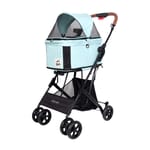
Rank 1: Japanese Combi Compet Pet Stroller for Multiple and Small Dogs (Blue-Green) — This pet stroller features a multi-pet design, indicating a reinforced frame structure capable of supporting the combined weight of several small dogs or one medium-sized pet. The frame is likely constructed from a lightweight aluminum alloy for maneuverability, while the fabric components are expected to be durable polyester. The enclosure design suggests multiple entry points and ventilation panels, typical for multi-pet configurations. The blue-green color refers to the specific aesthetic finish of the fabric. The design implies a focus on urban portability and ease of handling for owners with multiple smaller animals.
Rank 2: Japanese Combi Compet Milimili Pet Stroller Hood Replacement (Pink-Blue) — This item is a replacement component, specifically a hood or canopy, for a Combi Compet Milimili pet stroller. It is made from fabric, likely polyester, in a pink-blue color scheme. Its function is to provide overhead protection from environmental elements such as sun or light rain. As a replacement part, it indicates a modular design for the original pet stroller, allowing for component exchange and maintenance. The material composition would prioritize UV resistance and water repellency, consistent with outdoor exposure.
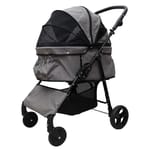
Rank 3: Japanese COCOHEART Four-Wheel Pet Stroller Large, 30kg Capacity (Grey) TBS — This four-wheel pet stroller is characterized by its substantial weight capacity of 30 kilograms, indicating a robust frame construction, possibly steel or a heavy-gauge aluminum alloy. The four-wheel configuration provides enhanced stability for larger pets. The grey color refers to the fabric and frame finish. The design would incorporate a spacious enclosure suitable for a large single pet or multiple medium-sized pets. The wheels are likely larger and more durable to handle the increased load and provide smoother mobility. The "TBS" designation might refer to a specific model series or structural enhancement for durability.
Rank 4: Japanese COCOHEART Four-Wheel Pet Stroller Large, 30kg Capacity (Dark Red) TBS — Structurally identical to the Rank 3 product, this pet stroller shares the same robust four-wheel design and 30kg weight capacity. The primary difference is the aesthetic finish, with the fabric components presented in a dark red color. This reinforces the focus on stability and durability for transporting larger pets, with the material composition and frame reinforcement designed to support significant weight without compromise to structural integrity. The "TBS" likely denotes the same specific model series or structural features as its grey counterpart.
Rank 5: Japanese Piccolo Cane Liona UV Protection Pet Stroller (Grey) — This pet stroller highlights a specific functional attribute: UV protection. This indicates that the canopy and perhaps other fabric components are treated or woven with materials designed to block ultraviolet radiation, protecting the pet from sun exposure. The grey color refers to the overall aesthetic. The "Liona" designation likely indicates a specific model line. While the weight capacity is not specified, the emphasis on UV protection suggests an outdoor-oriented design. The frame would be constructed to support typical pet weights, and the fabric would prioritize both durability and UV-blocking properties.
Pet Stroller Quality Standards and Labeling Norms
Verifiable quality standards and labeling norms for pet strollers provide objective information regarding their construction, safety, and performance. While a universal, legally mandated international standard specifically for pet strollers does not exist across all jurisdictions, various regional and industry-specific guidelines inform their design and manufacture. Many manufacturers adhere to internal quality control protocols that often mirror or adapt standards from related product categories, such as children's strollers or luggage, where applicable structural and material safety principles can be cross-applied. For instance, stability tests, load-bearing capacity assessments, and material durability evaluations are common practices. Material safety is a significant aspect, with manufacturers often ensuring that fabrics, plastics, and metals used in a pet stroller are free from harmful substances, adhering to regulations such as REACH in Europe or specific directives concerning lead and phthalate content. Labeling on a pet stroller typically includes essential information such as the maximum weight capacity, which is a critical safety parameter derived from structural integrity tests. This capacity is usually expressed in kilograms or pounds and indicates the upper limit of the animal's weight that the pet stroller can safely transport. Another common label element is the "recommended pet size" or "dimensions of the enclosure," providing clear guidance on the physical space available for the animal. Warnings regarding proper assembly, folding mechanisms, and maintenance are also frequently included, often presented through pictograms or concise textual instructions. Information on fabric composition, such as "100% polyester" or "nylon blend," is often provided, informing consumers about the material properties related to cleaning and durability. Some pet strollers may carry certifications from independent testing bodies for specific attributes, such as UV protection ratings for canopies or fire retardancy for fabrics, though these are not universally mandated. The country of manufacture is a standard labeling requirement in many regions. Furthermore, instructions for cleaning and care are typically present, detailing appropriate methods to maintain the cleanliness and longevity of the pet stroller without compromising its structural integrity. The transparency of this labeling allows owners to make informed decisions based on objective, verifiable product characteristics, aligning the pet stroller with their specific needs and safety expectations.
Pet Stroller Factual Insights
The development of the modern pet stroller can be traced to the late 20th century, evolving from a market demand for convenient animal transport in urban environments. Early designs often adapted existing baby stroller frames, modifying the enclosure to accommodate pets, rather than children. This initial adaptation influenced the structural forms and folding mechanisms seen in many contemporary pet strollers. The integration of features such as swivel front wheels and adjustable handlebars, common in baby strollers, was subsequently incorporated into pet stroller designs to enhance maneuverability and user ergonomics. This historical context illustrates a direct lineage in design principles, where established engineering solutions for human mobility aids were reapplied to animal transport. Another verifiable insight concerns the thermal regulation properties of pet stroller enclosures. The specific weave density and material composition of the mesh panels and fabric can significantly influence internal airflow and heat dissipation. For example, a pet stroller utilizing a dense, tightly woven fabric with minimal mesh areas will inherently offer less ventilation compared to a design incorporating extensive mesh panels constructed from a more open-weave material. This difference directly impacts the internal temperature and humidity within the pet stroller, a factor that is often a design consideration, particularly for models intended for use in warmer climates or for pets with specific thermal sensitivities. The choice of materials, therefore, is not solely about durability but also about managing the microclimate within the pet stroller's enclosure. These structural and material choices are concrete aspects of pet stroller design.
This article has provided an overview of pet stroller classifications, material compositions, structural forms, and property variations across different usage contexts. It has also presented characteristics based on sales ranking and discussed relevant quality standards and labeling norms. The information presented is factual and objective, focusing on the fundamental attributes of pet strollers without offering any form of recommendation or comparative analysis.
......View All