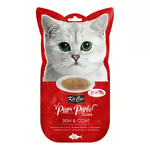
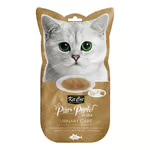
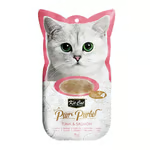
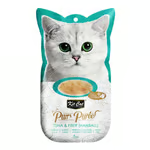
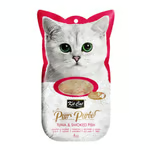
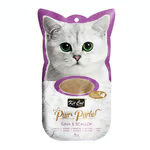
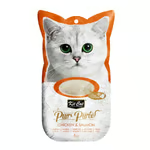
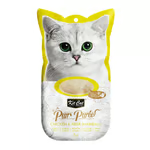
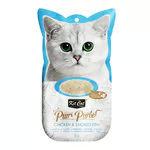
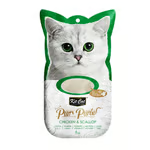
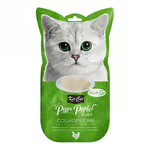
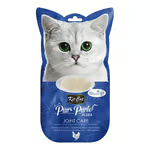
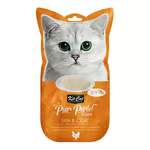
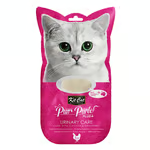
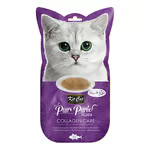
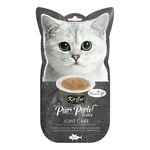
Kit Cat cat treats encompass various forms, designed to offer diverse options for cats. Products within this category primarily include different textures of snacks such as meat puree and soup cans, with Kit Cat meat puree and Kit Cat soup cans being common items. These treats are typically supplied in small packages, making them convenient for pet owners to portion. In addition to common meat bases, some Kit Cat cat treats may incorporate special flavors like Kit Cat Yogurt, enhancing product diversity. Overall, the Kit Cat cat treats range provides options with varying textures and flavors, meeting cats' additional needs beyond their main meals. The design of these products focuses on providing supplementary feeding, rather than serving as a primary food source.
Kit Cat cat treats are a category of supplementary food products designed for feline consumption, primarily functioning as an addition to a cat's regular diet rather than a complete nutritional source.
This article aims to describe the structural attributes, material composition, and usage context within the Kit Cat cat treats category. It will not recommend specific products or provide comparative analysis of their advantages.
Kit Cat Cat Treats: Classification by Form and Function
The classification of Kit Cat cat treats is commonly based on their physical form and their intended functional attributes within practical use scenarios. One primary distinction is between semi-moist purées and more solid, chewable forms. Semi-moist purées, often presented in tubes or sachets, are characterized by their high moisture content and smooth, easily consumable texture. These are frequently utilized for hydration support or as a vehicle for specific dietary supplements. Solid forms encompass a broader range, including crunchy kibble-like pieces or softer, more pliable bite-sized items. These often focus on dental health benefits or provide a different textural experience for the cat. Further classification can occur based on the primary ingredient source, such as varieties derived from fish, poultry, or other protein sources. The method of delivery also contributes to classification, distinguishing between products intended for direct feeding versus those designed for use within puzzle toys or as training rewards. Another layer of classification relates to specific health-supportive functions, such as formulations for hairball control, joint health, or immune system support. These functional classifications are typically indicated on product packaging through specific labeling and ingredient declarations. The physical presentation of Kit Cat cat treats, whether as a liquid, gel, or solid, directly influences their palatability and the ease with which cats can consume them, which in turn impacts their application in different feeding contexts. Understanding these structural and functional divisions provides a framework for comprehending the range of products available within the Kit Cat cat treats category.
Kit Cat Cat Treats: Material Composition and Processing Techniques
The material composition of Kit Cat cat treats exhibits variability, primarily determined by the target nutritional profile and desired physical properties. A significant component in many formulations is animal protein, often sourced from fish such as tuna and salmon, or from poultry like chicken. These protein sources contribute essential amino acids and palatability. The specific form of these proteins can vary, from finely ground meals to whole muscle or organ meats, which undergo different processing methods. For semi-moist purées, the protein is typically processed into a paste or emulsion, often combined with water or broth to achieve the characteristic smooth texture. Thickeners, such as starches or gums (e.g., guar gum, xanthan gum), are frequently incorporated to maintain consistency and prevent separation of ingredients. Certain formulations may include plant-based ingredients, such as pea fiber for hairball control, or various fruits and vegetables for additional vitamins and minerals. Vitamins and minerals are often added in synthesized forms to ensure a balanced nutritional supplement. Flavor enhancers, which can be natural or artificial, are also common to increase feline appeal. The processing techniques employed for Kit Cat cat treats involve steps such as grinding, mixing, extrusion, and heat treatment. Grinding reduces raw ingredients to a uniform particle size. Mixing ensures even distribution of all components. Extrusion, particularly for solid forms, shapes the product and applies heat and pressure. Heat treatment, such as cooking or sterilization, is crucial for ensuring product safety and shelf stability by eliminating pathogenic microorganisms. Drying processes are used for solid treats to reduce moisture content and extend shelf life. For liquid or semi-moist products, aseptic packaging or retort sterilization is often utilized to preserve freshness without extensive drying. The specific combination of ingredients and processing methods directly influences the final texture, moisture content, nutritional density, and shelf stability of each type of Kit Cat cat treats, differentiating them across the product range. These manufacturing processes are critical in delivering the intended characteristics of Kit Cat cat treats to consumers.
Kit Cat Cat Treats: Properties in Diverse Usage Environments
The properties of Kit Cat cat treats demonstrate varied performance and utility across different usage environments and conditions. The physical state of the treat, whether liquid, semi-moist, or solid, significantly influences its application. Liquid or semi-moist purées maintain their consistency best in controlled indoor environments at room temperature, where they are less prone to drying out or solidifying. In warmer, more humid conditions, these products might require refrigeration after opening to prevent spoilage and maintain their intended texture. Their high moisture content makes them suitable for encouraging hydration, particularly for cats with lower water intake, or for administering medication by mixing it into the treat. Solid, crunchy Kit Cat cat treats, on the other hand, are generally more stable across a wider range of ambient temperatures and humidity levels. Their lower moisture content inherently grants them a longer shelf life once opened, provided they are stored in an airtight container. These solid forms are often preferred for outdoor training sessions or as rewards that can be easily carried without risk of spillage or mess. The structural integrity of solid treats also allows them to be used effectively in puzzle feeders, where they can withstand manipulation and provide extended engagement for the cat. In environments where dental hygiene is a concern, certain solid Kit Cat cat treats with abrasive textures are formulated to assist in plaque reduction during chewing. The aroma profile of Kit Cat cat treats is another property that interacts with the usage environment. Stronger aromas can be advantageous in stimulating appetite in finicky eaters or in distracting cats during stressful situations like vet visits. However, in enclosed or sensitive environments, an overly potent aroma might be considered undesirable. Packaging design for Kit Cat cat treats also plays a role in their performance in various environments, with resealable pouches or twist-off caps contributing to product preservation and ease of use, regardless of the immediate surroundings. Understanding these environmental interactions is key to appreciating the full spectrum of characteristics of Kit Cat cat treats.
Kit Cat Cat Treats: Product Information from Sales Ranking
This section details the material and structural characteristics of Kit Cat cat treats based on their sales ranking, without providing usage recommendations.
Rank 1: Kit Cat Purr Puree Wellness Tuna + Salmon 60g (KC-836) — This product is a semi-moist purée, primarily composed of tuna as the main protein source, supplemented with salmon. The formulation typically includes water for consistency and various gelling agents to achieve its smooth, squeezable texture. Essential vitamins and minerals are incorporated to support general feline wellness. The product is packaged in a 60-gram sachet, designed for single-serving or controlled portion delivery. The protein content is derived from marine sources, specifically tuna and salmon, which contribute to its flavor profile and nutritional value. The texture is uniform and homogeneous, allowing for easy consumption.
Rank 2: Kit Cat Purr Puree Wellness Tuna + Hairball Control 60g (KC-843) — This variant of Kit Cat cat treats is also a semi-moist purée, with tuna as the primary animal protein. Its distinguishing feature is the inclusion of ingredients aimed at hairball control, commonly a source of dietary fiber such as pea fiber or psyllium husk. These fibers are integrated into the purée matrix to facilitate the passage of ingested hair through the digestive system. Water and gelling agents maintain the purée consistency. The product is also supplied in a 60-gram sachet. The structural integrity of the purée is maintained through processing that ensures uniform distribution of fiber components without altering the smooth texture significantly.
Rank 3: Kit Cat Purr Puree Wellness Tuna + Smoked Fish 60g (KC-850) — This Kit Cat cat treats formulation is a semi-moist purée centered on tuna, with the addition of smoked fish to enhance its palatability through a distinct flavor profile. The smoked fish component contributes to the overall protein content and provides a unique aromatic characteristic. The base structure remains a high-moisture purée, achieved through a blend of tuna, water, and thickening agents. The processing involves incorporating the smoked fish in a finely comminuted form to maintain the smooth texture of the purée. It is packaged in a 60-gram sachet, consistent with other purée products in the line. The combination of ingredients aims to deliver a specific flavor experience.
Rank 4: Kit Cat Purr Puree Wellness Tuna + Scallop 60g (KC-867) — This specific Kit Cat cat treats product is a semi-moist purée that features tuna as the primary protein source, augmented with scallop. The inclusion of scallop contributes a distinct marine protein and flavor component to the formulation. Like other purées in this series, it contains water and gelling agents to achieve its characteristic smooth, squeezable consistency. The scallop is processed to integrate seamlessly into the purée, ensuring a uniform texture. This product is also presented in a 60-gram sachet. The material composition emphasizes a blend of two distinct marine protein sources, impacting the overall nutritional and sensory profile of the Kit Cat cat treats.
Rank 5: Kit Cat Purr Puree Wellness Chicken + Salmon 60g (KC-874) — This Kit Cat cat treats variant is a semi-moist purée, but unlike the higher-ranked products, its primary protein source is chicken, complemented by salmon. This represents a shift from a purely marine-based protein profile to one incorporating poultry. Water and standard gelling agents are used to create the purée texture. The chicken and salmon are processed to a fine consistency, allowing for a smooth and homogeneous product suitable for feline consumption. It is packaged in a 60-gram sachet, aligning with the common format for Kit Cat cat treats purée products. The combination of chicken and salmon offers a different flavor and amino acid profile compared to the tuna-centric formulations.
Kit Cat Cat Treats: Quality Standards and Labeling Norms
The quality standards and labeling transparency for Kit Cat cat treats adhere to established norms within the pet food industry, which are designed to ensure product safety, nutritional accuracy, and consumer information. Manufacturers of Kit Cat cat treats typically follow guidelines set by regulatory bodies in the regions where their products are sold, such as the Association of American Feed Control Officials (AAFCO) in North America or equivalent European Union regulations. These standards dictate minimum and maximum levels for various nutrients, acceptable ingredient sourcing, and manufacturing practices. Labeling norms require a clear and comprehensive listing of all ingredients, typically in descending order by weight, on the product packaging. This allows consumers to identify the primary components of Kit Cat cat treats. Nutritional analysis, often presented as a guaranteed analysis, provides information on crude protein, crude fat, crude fiber, and moisture content. This data offers a quantitative insight into the product's macronutrient profile. Furthermore, the inclusion of a "best before" date or expiration date is a standard requirement, indicating the period during which the product is expected to maintain its quality and safety under specified storage conditions. Batch numbers are also commonly printed, enabling traceability in the event of a product recall or quality control issue. Claims regarding specific health benefits, such as "hairball control" or "wellness formulation," must be substantiated by the manufacturer through scientific evidence or adherence to specific ingredient guidelines. The country of origin and the manufacturer's contact information are also standard labeling elements. Packaging materials for Kit Cat cat treats are selected to maintain product integrity and prevent contamination, often involving multi-layered foils or plastics. These layers provide barriers against oxygen, moisture, and light, which can degrade product quality over time. Adherence to these quality standards and labeling norms provides a verifiable framework for understanding the composition and characteristics of Kit Cat cat treats.
Kit Cat Cat Treats: Factual Insights on Feline Nutrition
One verifiable factual insight regarding Kit Cat cat treats and feline nutrition concerns the obligate carnivore nature of cats. Cats require specific nutrients found almost exclusively in animal tissues, which are incorporated into Kit Cat cat treats through ingredients like tuna, salmon, and chicken. Their digestive systems are adapted to metabolize a diet rich in protein and fat, with a limited capacity for carbohydrate digestion. This physiological characteristic means that essential amino acids, such as taurine, and certain fatty acids, like arachidonic acid, cannot be synthesized by cats in sufficient quantities and must be obtained directly from their diet. The inclusion of animal-derived protein sources in Kit Cat cat treats directly addresses these specific dietary requirements. A second factual insight relates to the role of moisture in feline diets. Domesticated cats often have a low thirst drive, an evolutionary trait inherited from their desert-dwelling ancestors who obtained most of their hydration from prey. Consequently, many cats do not consume adequate amounts of water independently, which can contribute to urinary tract issues. Semi-moist Kit Cat cat treats, with their high water content, can contribute significantly to a cat's daily fluid intake, thereby supporting renal and urinary system health. This characteristic distinguishes them from dry kibble and highlights their functional utility beyond mere caloric provision. These insights underscore the foundational principles guiding the formulation of products like Kit Cat cat treats within the broader context of feline dietary needs.
This article has provided an overview of Kit Cat cat treats, examining their classification, material composition, processing, environmental properties, and relevant quality standards. The information presented is based on objective characteristics and industry norms.
......View All