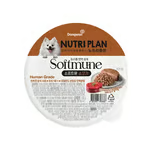
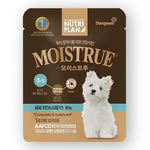
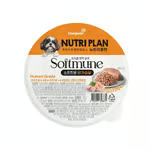
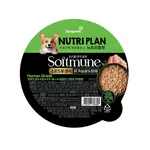
The Nutriplan dog wet food category encompasses various canned meal options specifically formulated for canines. These products are typically presented in convenient can packaging, containing a blend of ingredients such as meats, vegetables, and grains. Dog wet food comes in diverse textures and can serve as a primary meal or be supplemented with dry kibble, catering to different dietary requirements of dogs. The formulations within the Nutriplan dog wet food range are developed to supply essential daily nutrition for dogs, ensuring a balanced diet. The storage and preparation methods for these products prioritize ease of use, facilitating mealtime for pet owners. Selecting appropriate Nutriplan dog wet food can enhance the variety in a dog's diet.
Dog wet food, often referred to as dog canned food, constitutes a category of prepared pet sustenance characterized by high moisture content and typically presented in sealed containers.
This article aims to describe the structural attributes, material composition, and usage context within the category of dog wet food. It does not provide product recommendations, selection advice, or comparative analyses of specific products.
Dog Wet Food: Classification by Preparation Form
Dog wet food products are commonly categorized based on their preparation form, which influences their textural and structural properties. One primary division is between paté-style and chunky or stew-style formulations. Paté-style dog wet food consists of finely ground ingredients that are blended into a smooth, homogenous paste. This form typically undergoes extensive milling and emulsification processes to achieve its uniform texture. The material composition in paté formulations often includes finely minced meats, organs, and sometimes vegetables, all processed to a consistent particle size before cooking and canning. Another significant classification is chunky or stew-style dog wet food. This type features distinct pieces of meat, vegetables, or grains suspended in a gravy or broth. The structural integrity of individual ingredients is largely maintained in these preparations, offering a different textural experience. Manufacturing processes for chunky formulations involve less comminution of ingredients, with components often cut into specific shapes and sizes before being combined with a liquid base and then subjected to thermal processing within the can. A further distinction can be made based on whether the dog wet food is a complete and balanced meal or a complementary food. Complete and balanced formulations are designed to meet all nutritional requirements for a specific life stage, adhering to established dietary guidelines. Complementary foods, conversely, are intended to be fed alongside other food sources and do not provide a full nutritional profile on their own. These distinctions in preparation form and nutritional completeness define fundamental structural characteristics within the dog wet food category.
Dog Wet Food: Material Composition and Processing Techniques
The material composition of dog wet food is diverse, encompassing various protein sources, fats, carbohydrates, vitamins, and minerals. Protein sources frequently include muscle meats such as chicken, beef, lamb, and fish, as well as organ meats like liver and heart. These materials contribute essential amino acids and are often selected based on their nutritional profiles and palatability characteristics. Fat sources typically derive from the animal ingredients themselves or are added as specific oils, such as fish oil or sunflower oil, providing essential fatty acids and concentrated energy. Carbohydrates, when included, often come from grains like rice or barley, or from vegetables such as peas and carrots. These components are incorporated to provide dietary fiber and additional energy. The processing techniques employed in the production of dog wet food are crucial for both preservation and nutrient availability. The most common method involves a 'cook-in-can' approach. In this process, raw or partially cooked ingredients are filled into cans, which are then hermetically sealed. The sealed cans are subsequently subjected to high-temperature, high-pressure sterilization, a process known as retorting. This thermal treatment eliminates pathogenic microorganisms and spoilage agents, ensuring product safety and extending shelf life without the need for chemical preservatives. The retort process also gelatinizes starches and denatures proteins, which can affect the digestibility and texture of the final dog wet food product. Some formulations may involve pre-cooking ingredients before canning, particularly for chunky styles where maintaining ingredient integrity is desired. The precise temperature and duration of retorting are meticulously controlled to achieve commercial sterility while minimizing nutrient degradation. Furthermore, the selection of specific ingredients and their ratio directly impacts the overall nutrient density and caloric content of the dog wet food.
Dog Wet Food: Properties Across Usage Environments
The properties of dog wet food can exhibit variations depending on the environmental conditions and methods of storage and presentation. For instance, the textural integrity of chunky formulations may be influenced by temperature fluctuations; extreme cold can lead to increased viscosity of gravy components, while prolonged exposure to higher ambient temperatures before opening can affect the aroma profile. The high moisture content inherent in dog wet food, typically ranging from 70% to 85%, contributes to its specific physical properties. This moisture level means that once opened, the product is susceptible to microbial growth if not stored properly. Refrigeration is generally required for opened dog wet food to maintain its safety and physical characteristics. The container type, often a metal can, provides an anaerobic environment that prevents spoilage prior to opening, preserving the product's chemical stability and nutrient profile for extended periods. However, the internal surfaces of these cans are typically coated with a protective layer, which prevents direct contact between the food and the metal, mitigating potential reactions and preserving the dog wet food's integrity. The consistency and palatability of the dog wet food can also be perceived differently based on its temperature when served; some dogs may exhibit preferences for room temperature food over refrigerated portions. The specific blend of fats and proteins in dog wet food can also affect its behavior in different environments, such as its tendency to separate or congeal under varying thermal conditions. These factors highlight how external conditions interact with the inherent structural and compositional attributes of dog wet food.
Dog Wet Food: Product Characteristics from Sales Ranking
Rank 1: Nutriplan Nutritional Plan Adult Dog Wet Food Chicken for Beautiful Coat Formula Omega-3+ AAFCO 80g (64510) - Limited Time Offer — This dog wet food is formulated with chicken as a primary protein source. It includes Omega-3 fatty acids, which are lipids typically derived from sources such as fish oil or flaxseed, incorporated into the ingredient matrix. The formulation adheres to AAFCO (Association of American Feed Control Officials) nutritional standards for adult dog maintenance, indicating it is designed as a complete and balanced meal. The product is provided in an 80g unit.
Rank 2: Nutriplan Dog Wet Food Softmune Soft Texture Series Chicken 100g (64887) — This dog wet food features chicken as a core ingredient, contributing to its protein content. It is characterized by a "Softmune Soft Texture," indicating a specific processing method designed to achieve a pliable and easily consumable consistency. The product is supplied in a 100g unit.
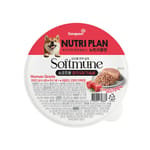
Rank 3: Nutriplan Dog Wet Food Softmune Soft Texture Series Beef 100g (64888) — This dog wet food utilizes beef as its primary protein component. Similar to the chicken variant in the same series, it is formulated to possess a "Softmune Soft Texture," suggesting a uniform and pliable physical structure. The product is presented in a 100g unit.
Rank 4: Nutriplan Dog Wet Food Softmune 7 Billion Postbiotics Probiotic Formula Chicken and Vegetables 100g (Green) (64889) — This dog wet food incorporates chicken and various vegetables, providing a blend of protein and plant-derived ingredients. A key characteristic is the inclusion of 7 billion postbiotics and probiotics, which are non-viable microbial cells and live microorganisms, respectively, added to the formulation. These components are integrated into the overall matrix during the manufacturing process. The product is packaged in a 100g unit.
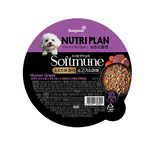
Rank 5: Nutriplan Dog Wet Food Softmune 7 Billion Postbiotics Probiotic Formula Beef and Vegetables 100g (Purple) (64890) — This dog wet food contains beef and a selection of vegetables, forming a mixed ingredient base. It is distinguished by the inclusion of 7 billion postbiotics and probiotics, similar to the chicken and vegetable variant. These microbial components are part of the overall formulation. The product is available in a 100g unit.
Dog Wet Food: Quality Standards and Labeling Norms
The quality and safety of dog wet food formulations are typically governed by established regulatory standards and industry norms. In many regions, the Association of American Feed Control Officials (AAFCO) provides guidelines for pet food labeling and nutritional adequacy. AAFCO publishes nutrient profiles for different life stages (e.g., adult maintenance, growth, gestation/lactation) that define the minimum and maximum levels of essential nutrients required for a dog wet food to be considered "complete and balanced." A product labeled as "complete and balanced" must meet or exceed these AAFCO profiles through laboratory analysis or by formulating with ingredients that have already met these profiles. The labeling on dog wet food products is also subject to specific regulations, requiring accurate declaration of ingredients by weight in descending order, guaranteed analysis (minimum percentages of crude protein and crude fat, maximum percentages of crude fiber and moisture), and caloric content. The manufacturing process for dog wet food is often conducted under Good Manufacturing Practices (GMPs), which are a set of guidelines ensuring consistent quality and safety in production. Facilities producing dog wet food may also be subject to inspections by regulatory bodies to ensure compliance with food safety regulations. Transparency in labeling extends to the declaration of specific ingredients rather than broad categories, allowing consumers to understand the material composition. Furthermore, the country of origin for the dog wet food and its ingredients may also be required on the label, providing additional information regarding sourcing. These standards and labeling norms are critical for ensuring product consistency and consumer trust in dog wet food.
Dog Wet Food: Factual Insights
A verifiable factual insight regarding dog wet food relates to its typical water activity (aw) levels. While the moisture content of dog wet food is high, its water activity, a measure of unbound water available for microbial growth, is typically controlled during processing. Despite the high overall moisture, the thermal processing (retorting) and packaging in hermetically sealed containers reduce the water activity to a level that inhibits the proliferation of most spoilage microorganisms and pathogens, thus ensuring a long shelf life at ambient temperatures prior to opening. Another factual insight concerns the role of carrageenan, a common ingredient in some dog wet food formulations. Carrageenan is a type of linear sulfated polysaccharide extracted from red edible seaweeds. It is often used as a thickener and stabilizer in dog wet food to achieve specific textural properties, such as maintaining the consistency of paté-style products or preventing the separation of ingredients in gravy-based formulations. Its inclusion is primarily for its functional properties in modifying the rheology of the dog wet food, contributing to the desired structural characteristic of the product.
This article has described the structural and compositional aspects of dog wet food, including its classification, material components, processing methods, and relevant industry standards. The information presented is objective and focuses on verifiable characteristics of the category.
......View All