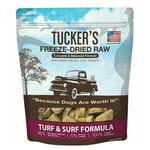
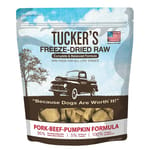
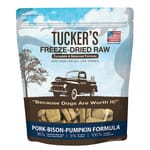
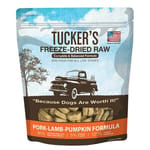
The TUCKERs dog food range encompasses various formulations designed to meet the diverse needs of different canines. These products typically aim to provide balanced nutrition, with ingredients comprising meats, grain-inclusive or grain-free options, vegetables, and other nutritional supplements. The texture and kibble size of the dog food may vary according to the dog's age, size, and activity level, such as specific formulas for puppies, adult dogs, or senior dogs. Some TUCKERs dog food products also offer choices for particular dietary requirements, such as recipes for sensitive stomachs or specific protein sources. This category of dog food, through different combinations, supplies the daily energy and essential nutrients required by dogs, supporting their normal physiological functions. The primary product form is dry kibble, which is convenient for storage and feeding, ensuring dogs receive adequate nutrition.
TUCKER'S dog food encompasses a range of formulations designed for canine dietary requirements, primarily characterized by its freeze-dried format.
This article aims to describe the structural and compositional attributes of TUCKER'S dog food, focusing on its manufacturing methods, material components, and classification parameters. The information presented herein is intended to provide a factual overview of the category without offering product recommendations or comparative evaluations.
TUCKER'S Dog Food: Classification by Processing Method
The primary classification of TUCKER'S dog food is determined by its processing method, which predominantly involves freeze-drying. This technique removes moisture from raw ingredients through sublimation, preserving nutrient profiles and structural integrity without requiring high temperatures. Freeze-dried dog food represents a distinct category within the broader pet food industry, differing significantly from kibble, wet food, or air-dried formulations. The freeze-drying process begins with raw ingredients, which are typically ground, mixed, and then frozen at extremely low temperatures. Following freezing, the product is placed in a vacuum chamber where the ice converts directly into water vapor, bypassing the liquid phase. This method results in a lightweight, shelf-stable product with a porous structure. The resulting freeze-dried TUCKER'S dog food is intended for rehydration prior to feeding, though it can also be provided in its dry form. This processing method influences the texture, density, and rehydration properties of the final product. Further subdivisions within this category may arise from the specific protein sources or supplemental ingredients incorporated into the base formulation. The consistent application of freeze-drying defines the fundamental structure of all TUCKER'S dog food offerings.
TUCKER'S Dog Food: Material Composition and Formulation Techniques
The material composition of TUCKER'S dog food is centered around specific protein sources, typically combined with various fruits and vegetables. The formulation approach emphasizes a high proportion of animal-derived ingredients, reflecting a dietary philosophy often referred to as 'prey-model' or 'biologically appropriate.' Common protein sources include muscle meat, organs, and sometimes bone, sourced from animals such as pork, beef, lamb, bison, chicken, and salmon. These protein components provide essential amino acids, fats, and micronutrients. Complementary ingredients, such as pumpkin, are frequently included to supply dietary fiber, vitamins, and minerals. The selection of these ingredients is based on their nutritional contribution and digestibility for canines. For instance, pumpkin is often incorporated for its fiber content, which can support digestive function. The precise ratios of protein, fat, and carbohydrate vary between specific TUCKER'S dog food formulations, but all adhere to a general framework of nutrient density. The raw materials undergo minimal processing prior to freeze-drying, preserving their inherent nutritional properties. The absence of grains, artificial preservatives, and synthetic colors is a consistent characteristic across the TUCKER'S dog food range, reflecting a deliberate formulation strategy. This material composition directly influences the overall nutritional profile of each TUCKER'S dog food product.
TUCKER'S Dog Food: Properties in Varying Usage Contexts
The properties of TUCKER'S dog food exhibit specific characteristics across different usage environments and preparation methods. When presented in its dry, freeze-dried state, the product is lightweight and has a low moisture content, making it suitable for storage without refrigeration prior to opening. This low moisture content contributes to its extended shelf life. Upon rehydration, typically with water, the freeze-dried material absorbs liquid and expands, returning to a texture closer to its original raw form. The degree of rehydration can influence palatability and dietary moisture intake for the canine. In environments with limited access to water, the dry form of TUCKER'S dog food can be offered directly, providing a concentrated nutrient source, although adequate external hydration for the animal remains important. The structural integrity of the freeze-dried pieces allows for portion control and easy measurement. The porous nature resulting from the freeze-drying process facilitates rapid rehydration, allowing for quick preparation. The stability of the TUCKER'S dog food in varying temperatures, within specified storage guidelines, is a direct result of its minimal moisture content. Environmental humidity levels can affect the storage of opened packages, necessitating appropriate sealing to prevent moisture absorption and maintain product quality. The specific protein and fat content in TUCKER'S dog food also dictates its caloric density, which is a factor in determining appropriate feeding amounts based on a dog's activity level and physiological state. The versatility in preparation, either dry or rehydrated, allows for adaptation to different feeding preferences and logistical requirements, making TUCKER'S dog food a flexible option for various canine dietary needs.
TUCKER'S Dog Food: Product Characteristics by Sales Ranking
The following describes the material and structural characteristics of TUCKER'S dog food products, ordered by sales ranking, without implying preference or comparative advantage.
Rank 1: TUCKER'S Freeze-Dried Dog Food Pork-Beef-Pumpkin 14oz — This formulation features a primary protein blend of pork and beef, complemented by pumpkin. Pork contributes a specific amino acid profile and fat content, while beef provides another distinct set of amino acids and minerals. The inclusion of pumpkin adds dietary fiber and specific vitamins. The product is processed using freeze-drying, resulting in a low-moisture, porous structure. The ingredient list typically includes muscle meat, organs, and bone from pork and beef sources, alongside pumpkin, and may contain other minor botanical ingredients for nutritional supplementation. The 14oz unit represents the net weight of the freeze-dried product.
Rank 2: TUCKER'S Freeze-Dried Dog Food Pork-Bison-Pumpkin 14oz — This TUCKER'S dog food variant combines pork and bison as its primary animal protein sources, with pumpkin as a vegetable component. Bison offers a distinct protein and fat composition compared to more common red meats, often characterized by leanness and a different fatty acid profile. Pork provides a complementary nutritional contribution. Pumpkin is included for its fiber and nutrient content. The manufacturing process involves freeze-drying, yielding a product with minimal moisture and a stable, lightweight form. The ingredient composition emphasizes raw, animal-derived materials from pork and bison, along with pumpkin, and any additional naturally occurring vitamins or minerals. The 14oz packaging denotes the total weight of the freeze-dried TUCKER'S dog food.
Rank 3: TUCKER'S Freeze-Dried Dog Food Pork-Lamb-Pumpkin 14oz — This TUCKER'S dog food formulation integrates pork and lamb as the primary animal proteins, with pumpkin as an additional ingredient. Lamb provides a unique protein and fat profile, often considered a novel protein source for some canines. Pork contributes its specific macronutrient composition. Pumpkin serves to supply dietary fiber and other micronutrients. The product undergoes the freeze-drying process, which preserves the raw ingredients' nutritional integrity while creating a shelf-stable, low-moisture format. The characteristic porous texture is maintained. Ingredients consist primarily of pork and lamb muscle meat, organs, and bone, combined with pumpkin and other minor components. The 14oz weight indicates the quantity of the freeze-dried TUCKER'S dog food.
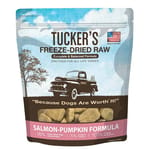
Rank 4: TUCKER'S Freeze-Dried Dog Food Salmon-Pumpkin 12oz — This TUCKER'S dog food product utilizes salmon as its sole animal protein source, paired with pumpkin. Salmon is a source of omega-3 fatty acids, eicosapentaenoic acid (EPA) and docosahexaenoic acid (DHA), in addition to its protein content. Pumpkin is included for its fiber and vitamin contributions. The processing method is freeze-drying, which results in a lightweight, stable, and rehydratable product. The ingredient list focuses on salmon, including muscle and often bone, combined with pumpkin. The 12oz package size reflects a specific net weight for this particular TUCKER'S dog food formulation.
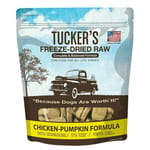
Rank 5: TUCKER'S Freeze-Dried Dog Food Chicken-Pumpkin 14oz — This TUCKER'S dog food variant features chicken as the primary animal protein, supplemented with pumpkin. Chicken is a common and digestible protein source, providing essential amino acids. Pumpkin adds dietary fiber and various vitamins. The manufacturing process involves freeze-drying, which maintains the nutritional composition of the raw ingredients and creates a stable, low-moisture product. The texture is porous, designed for rehydration. The ingredient profile centers on chicken, including muscle meat, organs, and bone, combined with pumpkin, and potentially other natural supplements. The 14oz unit specifies the net weight of the freeze-dried TUCKER'S dog food.
TUCKER'S Dog Food: Quality Standards and Labeling Norms
Quality standards for TUCKER'S dog food are typically governed by regulatory bodies responsible for pet food safety and labeling. In regions such as the United States, this includes adherence to guidelines set by the Association of American Feed Control Officials (AAFCO). AAFCO provides model regulations for pet food labeling and ingredient definitions, which manufacturers voluntarily adopt. These guidelines specify requirements for guaranteed analysis, ingredient lists, feeding instructions, and product claims. The guaranteed analysis on TUCKER'S dog food labels provides minimum percentages for crude protein and crude fat, and maximum percentages for crude fiber and moisture. These values indicate the nutrient content of the product as sold. The ingredient list is presented in descending order by weight, before processing, which informs the consumer about the primary components. For freeze-dried TUCKER'S dog food, the low moisture content is a critical characteristic reflected in the guaranteed analysis. Manufacturers are also expected to provide a statement of nutritional adequacy, indicating whether the product is formulated to meet the nutritional levels established by AAFCO Dog Food Nutrient Profiles for a specific life stage (e.g., maintenance, growth, all life stages). Transparency in sourcing of ingredients, particularly the animal protein components, is often communicated through marketing materials, though specific regulatory requirements for such disclosures vary. Batch numbers and expiration dates are standard labeling elements, providing traceability and indicating product freshness. Compliance with these established norms ensures a consistent level of quality and provides consumers with verifiable information regarding TUCKER'S dog food.
TUCKER'S Dog Food: Factual Insights
One verifiable factual insight regarding TUCKER'S dog food, and freeze-dried pet food in general, is that the process of sublimation, central to freeze-drying, occurs at temperatures below the freezing point of water. This means that the ingredients are not subjected to high heat during moisture removal, which can help preserve certain heat-sensitive nutrients such as specific vitamins and enzymes. This low-temperature processing distinguishes freeze-dried methods from conventional kibble production, which typically involves extrusion at high temperatures and pressures. Another insight is that the rehydration ratio for freeze-dried TUCKER'S dog food can significantly alter the volumetric and caloric density per serving. For example, a small volume of freeze-dried product, when rehydrated, will yield a much larger volume of moist food, while the total caloric content remains constant. This characteristic is relevant for managing portion sizes and ensuring adequate hydration for canines, as 1 gram of freeze-dried product may absorb several grams of water. This physical property of TUCKER'S dog food directly results from its manufacturing process.
This document has provided a detailed classification of TUCKER'S dog food, outlining its structural attributes, material composition, and processing methods. The information presented is objective and focuses on verifiable characteristics, adhering strictly to a factual and neutral description of the category.
......View All