

Quick answer: After a cat goes missing, the first 72 hours are the golden search period. Indoor cats usually do not go far and mostly hide within 100 metres of where they went missing. The most important things are to stay calm, call softly in your normal tone, focus on hiding spots and high places, and search from evening to late night. At the same time, place items with the cat's scent and food to guide it back, and notify nearby neighbours and building management as soon as possible.
When you realise your cat is missing, your heart really skips a beat! Whether it is a window left open, a door suddenly opened, or the cat slipping out while playing, every cat owner dreads this anxiety and worry. But if it does happen, do you know the most correct way to search?
Many cat owners' first reaction is to shout the cat's name and search frantically, but this may actually make the cat more frightened and hide silently! PetChill has put together a complete lost-cat search guide, covering the first 72-hour action timetable, 5 key search tips, microchipping and prevention measures, all in one place.

What to do in the first 72 hours after a cat goes missing
Research and search experience both show that lost cats mostly hide near where they went missing. The first 72 hours are the golden window; the sooner you act, the higher the chance of finding them. Here is a suggested action timetable:
| Time | Key actions |
|---|---|
| Immediately (first 1 hour) | Calmly check every corner of the home (under the bed, on top of cabinets, behind the washing machine); once you confirm the cat is really missing, take an item with the cat's scent and search downstairs immediately |
| First evening | Call softly in your normal tone; focus on hiding spots and high places; place cat litter, food and the cat's bed at the door or near the point where it went missing |
| Days 2–3 | Repeat searches from evening to late night; put up lost-cat posters; notify building management, neighbours, nearby pet shops and veterinary clinics |
| After day 3 | Expand the search area; regularly check whether the food you left has been eaten; keep up the scent trail |
⚠️ Important: After discovering the cat is missing, never just wait for it to come back on its own. Indoor cats are unfamiliar with the outside environment; the longer you wait, the more likely it is to panic and wander further.
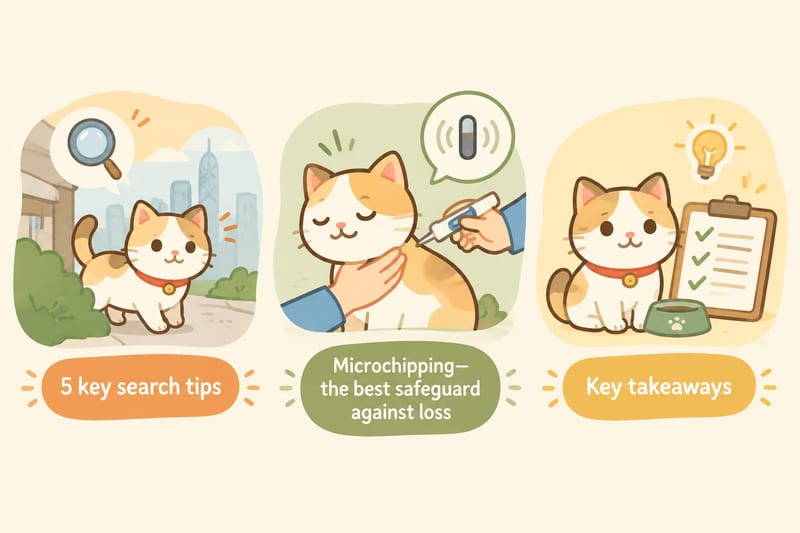
5 key search tips
Tip 1: Stay calm! Do not shout
When you discover your cat is missing, the most important thing is to stay calm. In an unfamiliar environment or when frightened, a cat hearing its owner shout will become even more scared and hide silently.
The right approach is to call the cat's name softly using your normal tone, just like calling it for dinner. Only when the cat hears a familiar and calm voice will it feel safe enough to come out.
Tip 2: Look in hiding places, and look up!
After going missing, cats usually hide in concealed spots near where they went missing. Common hiding places include:
- Behind air-conditioning units
- Under vending machines
- Under car chassis
- In bushes and flower beds
- Corners of back stairs and piles of clutter
But many cat owners overlook one thing: cats also climb to high places! Trees, tops of shelves, eaves and wall tops are all favourite hiding spots. So when searching, remember not to just look down—look up as well!
Tip 3: Use scent to guide the cat back
Cats are animals that navigate by scent. You can:
- Bring an item with the cat's scent (such as its towel or bed mat) when searching
- Place the cat's usual food near where it went missing
- Sprinkle a little of the cat's used litter around the food
- Leave an owner's clothing: clothes with your scent can also help the cat find its way
Familiar scents make the cat feel safe and increase the chance it will come out on its own.
Tip 4: The golden search time is evening to late night
Cats are crepuscular animals, most active from evening to late night. During the day it is too bright and there are too many people and vehicles, so cats usually hide and stay still. At night, when the environment is quieter, cats dare to come out and move around.
So if you cannot find it during the day, do not lose heart! Start again in the evening, bring a torch (the torchlight will reflect in the cat's eyes, making it easy to spot), and the success rate will be much higher.
Tip 5: Expand your network and mobilise the community
Besides searching yourself, remember to mobilise the people around you:
- Put up lost-cat posters: clearly state the cat's features, where and when it went missing, and a contact number; add a photo if possible
- Notify building management and security: ask them to watch the back stairs, plant rooms and car parks
- Contact nearby veterinary clinics and pet shops: cats handed in are usually sent to these places first
- Ask for help on social media: post in local groups and pet pages; neighbours' eyes and ears are often very useful
How far will a cat travel? Will it come home on its own?
These are the two questions cat owners ask most. According to veterinarians and search experience:
- Indoor cats: after going missing they are usually extremely frightened and mostly hide within 100 metres of where they went missing, sometimes even just in the corridor or back stairs of the same building
- Cats with outdoor experience: their range may be larger, but usually not more than a few hundred metres
- Will it come home on its own: some cats will, but the odds are not high, especially for strictly indoor cats. Do not rely on this possibility and give up active searching—many successful recoveries are the result of owners persisting for days or even weeks
Even if the cat has been missing for over a month, do not give up. Cats' survival abilities are stronger than you might think, and there are many real cases of successful reunions after weeks.
Microchipping—the best safeguard against loss
When it comes to preventing loss and increasing the chance of recovery, the most effective method is to have your cat microchipped. A real case: a cat went missing in Hawaii, and when a veterinarian scanned it, they found a Japanese microchip; the owner was eventually contacted, and the cat made it home safely even after moving from Shinjuku, Tokyo, to Hawaii!
Benefits of microchipping:
- It will not fall off: collars can be pulled off or damaged, but a microchip is implanted in the body and is permanently effective
- Globally recognised: microchip numbers follow an international standard format, so there is a chance of finding the owner wherever the cat goes missing
- Useful in disasters: in emergencies such as earthquakes and fires, microchips help shelters contact owners quickly
Implantation process and things to note
- Process: the veterinarian uses a special syringe to implant a rice-sized microchip under the skin at the back of the neck, just like a vaccination; it takes only a few seconds and no anaesthesia is needed
- Does it hurt: the cat feels only mild discomfort, similar to a normal injection
- Cost: in the Hong Kong market, microchipping including registration generally costs a few hundred dollars; actual fees vary by clinic, so it is best to ask your veterinarian directly
- Must-do after implantation: confirm the microchip details are registered under your name, and update the details after moving house or changing phone number—most cases of microchips failing to find owners are due to outdated registration details
5 preventive measures to stop cats going missing
Prevention is always better than search. The following measures can greatly reduce the risk of loss:
- Install window screens: windows are the number one cause of cats going missing. All frequently opened windows should have sturdy screens or protective nets, and sliding windows should have their locks checked
- Create a buffer habit at the door: watch where the cat is before opening or closing the main door; you can use a gate to create a buffer zone in the entrance area
- Microchip and regularly update details: if the worst happens, the microchip is the last line of defence for reunion
- Neutering: unneutered cats are driven by mating instincts and have a much stronger urge to run away; neutering can significantly reduce this risk
- Daily companionship and environmental enrichment: if the cat has an outlet for its energy (cat trees, toys, interactive play), it will be less likely to want to dash out the door to explore
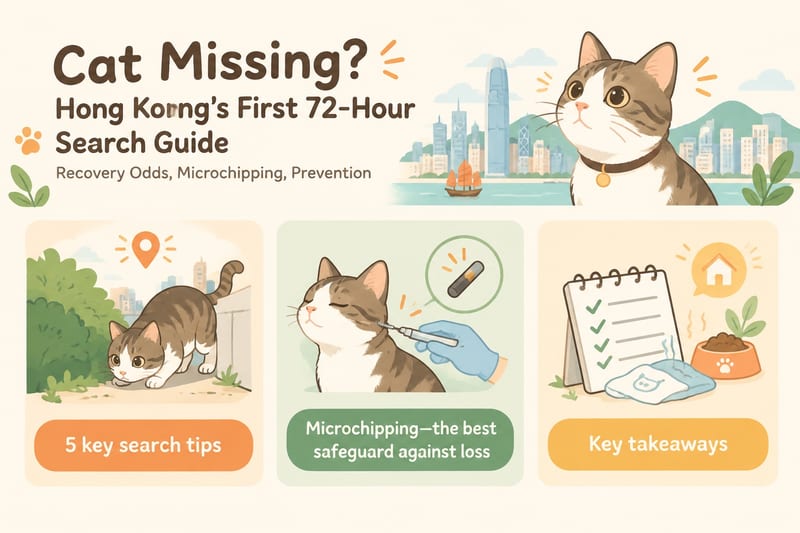
Key takeaways
- ✅ The first 72 hours are the golden search time; act immediately when you discover the cat is missing
- ✅ Call softly in your normal tone; do not shout
- ✅ Indoor cats mostly hide within 100 metres of where they went missing; focus on hiding spots and high places
- ✅ Evening to late night is the best search time; remember to bring a torch
- ✅ Use the scent of cat litter, food and owner's clothing to guide the cat back
- ✅ Microchipping is the best safeguard for reunion after loss
- ❌ Do not just wait for the cat to come back on its own; active searching is the most effective
Frequently asked questions (FAQ)
Q: Within how long after a cat goes missing is the chance of finding it greatest? A: The first 72 hours are the golden window. Cats (especially indoor cats) usually do not travel far and mostly hide within 100 metres of where they went missing. Act immediately; do not wait.
Q: Will a missing cat come home on its own? A: Some cats do, but the odds are not high, especially for strictly indoor cats. Indoor cats are unfamiliar with the outside environment and easily panic and get lost. Active searching is the most effective method; do not rely on the cat returning by itself.
Q: How far will a missing cat travel? A: Indoor cats usually hide within 100 metres of where they went missing, sometimes even near the back stairs or plant room of the same building. Cats with outdoor experience may roam further, but usually stay in the nearby area.
Q: If it has been missing for more than a few days, is it still possible to find it? A: There is still a chance. Many cats missing for weeks or even longer are eventually reunited. Keep searching regularly, maintain scent trails and community notices, and do not give up easily.
Q: Does microchipping hurt? Will the cat resist? A: The microchipping process is like a vaccination, taking only a few seconds, and the cat feels only mild discomfort. The veterinarian uses a special syringe to implant the chip under the skin at the back of the neck; no anaesthesia or stitches are needed.
Q: Will a neutered cat still run away from home? A: Neutering can significantly reduce the urge to run away because the cat is no longer driven by mating instincts. But neutering is not a 100% guarantee; window protection and door habits still need to be maintained.
Q: What should I do if a kitten goes missing? A: Kittens are small and timid, and usually hide in very close concealed spots (under bushes, under cars, behind air-conditioning units). Search more carefully and start scent guidance as soon as possible—kittens respond more strongly to the scent of their mother and owner.
Q: How can I prevent my cat from going missing? A: Five measures: install window screens, watch the cat's position before opening the door, microchip and update details, neuter at the appropriate age, and enrich the home environment with toys and cat trees to reduce the urge to escape.
This article is compiled from general advice from veterinarians and pet search experts; actual situations vary by cat. If your cat has been missing for more than a week, consider consulting a professional pet search service or a local animal welfare organisation.
PetChill's Reminder: A missing cat is every cat owner's nightmare, but by taking preventive measures (microchipping, securing doors and windows) and mastering the correct search methods, you can greatly increase the chance of finding your cat!