Quick answer: The core of oral care is not "fresh breath" but preventing plaque from hardening into tartar. Daily brushing with pet-specific toothpaste is the only home prevention method with evidence; once plaque hardens into tartar, only a vet can remove it under anaesthesia with ultrasound and subgingival debridement, and dental X-rays are needed to see lesions below the gumline.
Information checked as of 2026-10-12 · Sources: American Animal Hospital Association (AAHA) dental guidelines, American Veterinary Medical Association (AVMA) citing American Veterinary Dental College (AVDC) periodontal staging, VOHC (Veterinary Oral Health Council) accepted products list, local veterinary clinic published price lists
Dental problems are the most common and most easily overlooked chronic disease in cats and dogs. The reason is simple: pets won't say they're in pain, and dental pain often shows only as subtle signs like "eating a bit slower" or "not so keen on hard food", easily mistaken for fussiness. This is a comprehensive pillar guide to oral care, covering causes, staging, home checks, brushing practice, tool comparison, scaling procedures, and Hong Kong price ranges, to help you build a long-term oral care routine.
1. Why oral care is a whole-body health issue
Many people think tartar is just a cosmetic issue, at most causing bad breath. In reality, the mouth is an environment full of bacteria; when gums are chronically inflamed and periodontal tissues damaged, bacteria and inflammatory mediators can affect other organs through the bloodstream. The veterinary dental community is generally concerned about the long-term burden on the heart, kidneys and liver, which explains why vets are so careful about blood tests before scaling.
The cost of chronic dental pain is also real. Pain from gingivitis and periodontitis can reduce appetite, cause weight loss, worsen temperament, and even make pets resist having their face touched. Many owners only realise after scaling that "he was eating slowly because of pain", and appetite returns immediately after removing problem teeth.
To understand the scale of oral care, you need to know the number of teeth: dogs have 42 permanent teeth (28 deciduous puppy teeth), cats have 30 permanent teeth (26 deciduous kitten teeth). These numbers are also the basic reference for vets assessing "how long scaling takes, how many extractions are needed".
One final key fact: dental problems are not a disease of old age. A commonly cited survey statement from multiple veterinary dental organisations is that most cats and dogs over three years old already show signs of periodontal disease. Such figures are survey-based and don't mean every pet will be severe, but they suffice to show that oral care should be part of daily life from the completion of adult dentition.
2. How bad breath and tartar form: from plaque to periodontal disease
This process has a clear timeline; understanding it explains why "brushing every few days" is not enough.
Step one, plaque. After eating, food debris, bacteria and salivary proteins form a transparent film on the tooth surface and gumline — plaque. Within about 1 to 2 days, the biofilm matures and thickens, and the bacterial community becomes more complex. At this stage it can be completely brushed away, and this is the window where home brushing truly works.
Step two, tartar. If plaque is not brushed away, calcium and phosphorus in saliva deposit into the plaque, mineralising and hardening it. Once tartar forms, its surface is rough and full of micropores, and it can no longer be brushed off — only a vet can shatter it with ultrasound. Tartar is brownish-yellow and is the most common cause of "yellow teeth".
Step three, gingivitis. Tartar and the bacteria accumulating on it constantly irritate the gum margin, making gums red, swollen and bleeding on light touch. At this stage the gums can still fully recover, provided the source of irritation is removed.
Step four, periodontitis. Inflammation spreads from the gums to the tissues that anchor the teeth — the periodontal ligament and alveolar bone. Periodontal pockets deepen, gums recede, tooth roots become exposed, teeth loosen and eventually fall out. Once alveolar bone is lost, it does not grow back.
A note on breath. Most bad breath originates from tartar and periodontal infection in the mouth itself, but odour can provide extra clues: a urine or ammonia smell warrants attention to the kidneys; a sweet or fruity smell warrants attention to metabolic problems; a foul smell is mostly associated with ulcers, necrotic tissue or severe infection. If breath noticeably worsens in a short time, or is accompanied by changes in drinking and urination or weight loss, don't treat it as ordinary bad breath.
3. Periodontal disease staging: 0 to 4 comparison table
Staging is determined by a vet under anaesthesia or conscious examination, using a periodontal probe to measure pocket depth, assess mobility, and take dental X-rays — not by naked eye alone. Below is a simplified comparison of the five-level framework commonly used by the American Veterinary Dental College (AVDC), to help you understand what your vet means by "stage one, stage three".
| Stage | Clinical findings | Reversibility | What you can do at home |
|---|---|---|---|
| Stage 0: Healthy | Gums pink and tight against the tooth, no tartar, no odour | — | Maintain daily brushing, annual oral assessment |
| Stage 1: Gingivitis | Gum margin red and swollen, bleeds easily on light touch, pockets not deepened | The only stage that can be fully reversed | Increase to daily brushing, recheck within 1 to 3 months |
| Stage 2: Early periodontitis | Obvious tartar, deepened pockets, early mild alveolar bone loss | Already irreversible, can only be controlled | Book scaling plus dental X-rays, then daily brushing |
| Stage 3: Moderate periodontitis | Gum recession, exposed roots, teeth starting to loosen, obvious bad breath | Irreversible | Scaling plus subgingival debridement, some teeth may need extraction |
| Stage 4: Severe periodontitis | Teeth severely loose or already lost, abscesses, massive alveolar bone loss | Irreversible, affects the whole body | Seek veterinary care promptly, usually extraction plus long-term follow-up |
A practical judgement: stages 1 to 2 are the "still in time" range; from stage 3 it becomes the "rising cost of treatment" range. This is why vets constantly emphasise early examination rather than waiting for teeth to fall out.
4. Home oral examination: 5 steps + weekly record
To detect problems early, you don't need any equipment — just a fixed examination ritual, once a week, two to three minutes each time.
- Choose the timing. Pick a time when your pet is relaxed, just after eating or waking up, with good lighting. Don't examine when they are excited from play.
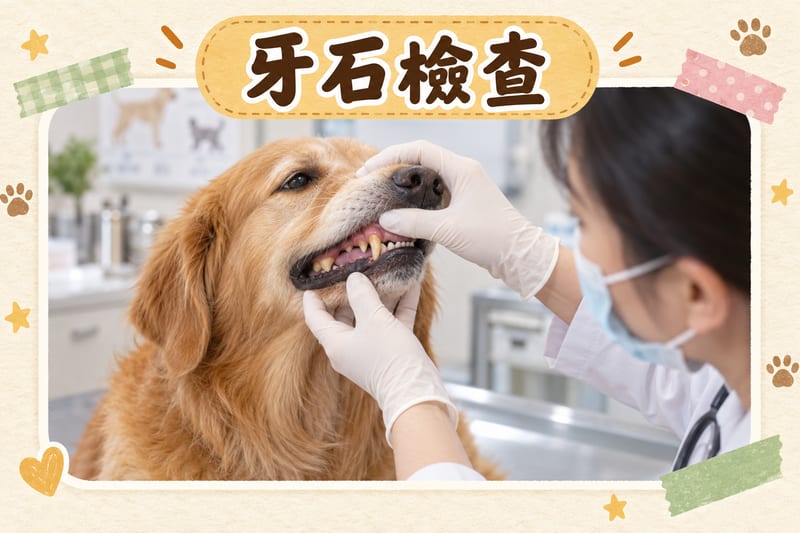
- Support the chin. Gently support the lower jaw from the side with one hand, and lift the upper lip with the thumb of the other hand — don't force it, don't pinch the nose.
- Look at the tooth surface. Start with the canines and back molars on the outside, checking for brownish-yellow hard deposits, chipped surfaces, food stuck between teeth.
- Look at the gums. Healthy gums are pink and tight against the tooth. Redness, swelling, a bleeding line at the margin, or gums "creeping" up over the tooth are warning signs.
- Smell the breath. No need to put your nose right up; record the odour level: normal, mild, obvious, urine-like or foul. If the same level keeps worsening, it's worth booking a check.
During the check, also note changes in eating and behaviour: eating slowly, holding food without swallowing, chewing on one side, pawing at the mouth, suddenly not allowing face touching, increased drooling. These are indirect signs of oral pain. It's advisable to briefly record the date, odour level and new findings after each check, and hand it to the vet at follow-up — far more accurate than memory.
5. Brushing practice: teach cats and dogs separately
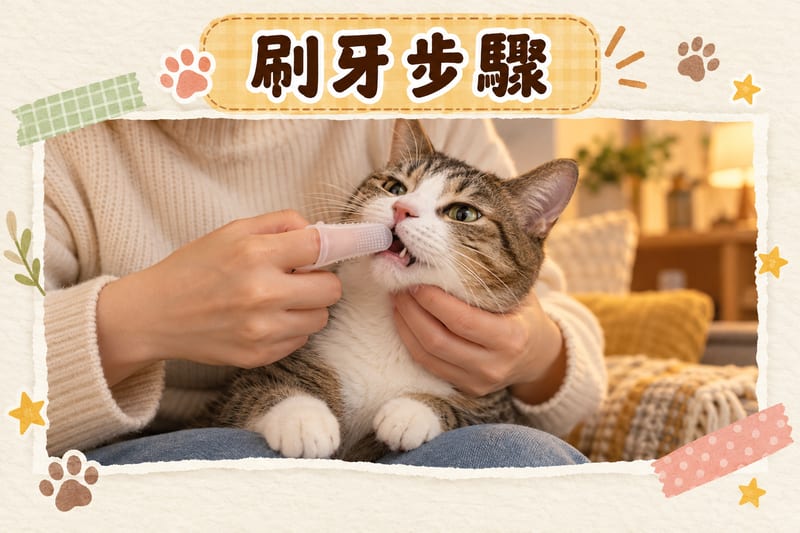
Tool preparation is shared: a soft-bristled pet toothbrush or finger brush, plus pet-specific toothpaste. Human toothpaste must never be used — it contains fluoride, and some also contain xylitol, both toxic to cats and dogs, and pets will inevitably swallow some during brushing. Pet toothpaste does not need rinsing; most are meat or cheese flavoured, designed to be swallowed.
Cats: seven-day desensitisation plan
Cats are highly sensitive to having their mouths touched, so treat it as a training project, not a chore.
- Days 1 to 2: Just touch the face and lift the lip for one second, then immediately praise and treat, then let go.
- Day 3: Dip a finger in a little pet toothpaste and let the cat lick it, building the association that "toothpaste is good".
- Day 4: Use a finger or gauze-wrapped finger to briefly wipe the outside of the front canines.
- Days 5 to 6: Switch to a finger brush or small-headed soft toothbrush, brush only the canines and a few front teeth, a few seconds each side.
- Day 7: Gradually extend to the back molars, keeping the whole session under one minute, and stop immediately after brushing.
The key is speed and order: start with the outer tooth surface (the lingual and inner surfaces are hardest and can be tackled later), angle about 45 degrees to the gumline and gently circle, focusing on the gum-tooth junction. Don't scrub up and down forcefully, don't prolong the session. Adult and senior cats can do this too; it just takes more patience.
Dogs: six-step standard routine
Dogs generally accept brushing better than cats and can use a toothbrush directly, but progression should still be gradual.
- Let the dog sniff the toothpaste and toothbrush first; don't put them in the mouth straight away.
- Squeeze a pea-sized amount of toothpaste onto the brush, or put some on a finger for licking.
- Support the chin with one hand, lift the lip with the other, starting at the canines.
- Angle the bristles 45 degrees to the gumline, make small circles, about ten seconds per area.
- Cover the upper left and right outer surfaces, lower left and right outer surfaces in order, and only then try the inner surfaces.
- Praise and reward immediately after brushing; don't re-examine the teeth at the end, to avoid creating negative associations.
Brushing frequency is not "the more the better" but "consistency matters most": once daily is ideal, with a minimum of 2 to 3 times per week. If your pet has had dental treatment or is prone to tartar, your vet may recommend daily. For resistant cases, see the detailed brushing and oral care for cats and the dog version of brushing steps; both have more detailed desensitisation techniques.
6. Dental tool comparison: which ones actually work
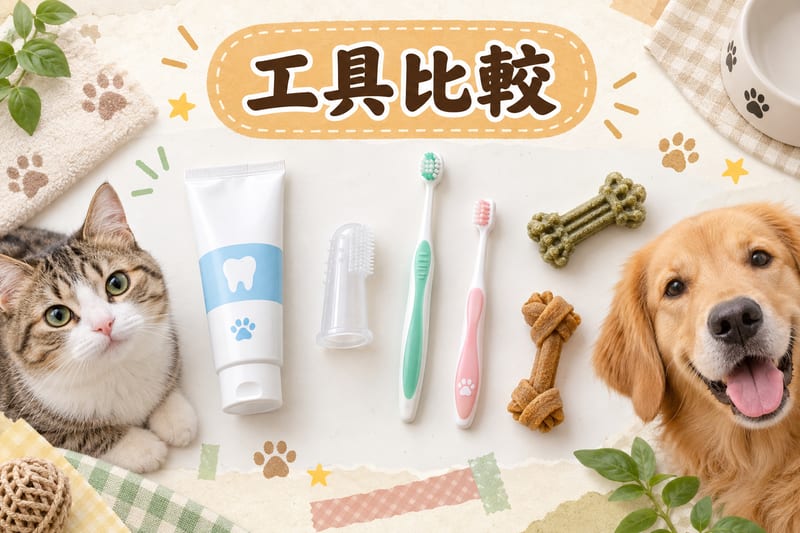
Dental products on the market are numerous and vary greatly in value. The one judging principle: is there evidence of third-party review. The US Veterinary Oral Health Council (VOHC) reviews each product and only accepts specified claims (e.g. inhibits plaque, reduces tartar); this is currently the most practical screening standard.
| Tool | Mechanism | Evidence | Suitable for | Notes |
|---|---|---|---|---|
| Pet soft toothbrush | Physically removes plaque at the gumline | Gold standard for home prevention | Cats and dogs already accepting brushing | Replace when bristles deform or show stains, about every 2 to 3 months |
| Finger brush, gauze | Friction on tooth surface, easy for owner to control pressure | Effective during training, weaker cleaning | Resistant to toothbrush, early training | Hard to reach between teeth and back molars |
| Single-tuft brush | Targets back molars and tight spots between teeth | Requires skill, often recommended by vets | Existing interdental problems or periodontal pockets | Ask your vet to demonstrate technique first |
| Pet toothpaste (VOHC accepted) | Inhibits plaque, slows mineralisation | Third-party reviewed list available | Used with any toothbrush | Human toothpaste is toxic, must not be used |
| Dental chews, dental diets | Abrasion during chewing | Choose VOHC accepted products | As reward and supplement | Cannot remove formed tartar |
| Water additives, oral sprays | Reduce oral bacteria | Mainly supplementary | Cases completely resistant to brushing | Less effective than brushing, not a substitute |
| Dental toys, raw bones | Chewing | Toys can be chewing rewards | Dogs that like to chew | Bones splinter easily, may puncture mouth and gut, not recommended |
To be clear: dental chews, dental diets, sprays and additives can only slow plaque and tartar formation; none can replace brushing, and none can remove calcified tartar. If your pet truly cannot be brushed, the correct approach is dental products as a supplement plus more frequent veterinary checks — not buying a pile of products and considering the job done.
7. Scaling (COHAT): when to do it, what the procedure involves
What vets call scaling is formally COHAT (Comprehensive Oral Health Assessment and Treatment), essentially a medical procedure, not a grooming service. The American Animal Hospital Association (AAHA) dental guidelines are clear: only under anaesthesia can a full-mouth examination, full-mouth dental X-rays and cleaning below the gumline be performed; in a conscious state only visible tartar on the tooth surface can be removed, leaving lesions below the gums untouched. The American Veterinary Medical Association (AVMA), citing the American Veterinary Dental College (AVDC), says the same: non-anaesthetic scaling can neither clean nor examine below the gumline. Services marketed as "non-anaesthetic scaling" are generally not recommended by the veterinary community — besides not reaching lesions, the process of forcibly restraining the pet carries risks of fear and injury.
A complete procedure usually includes five parts:
- Pre-anaesthesia: History, physical examination, blood tests (complete blood count plus biochemistry to assess liver and kidney function and anaesthetic risk); senior or chronically ill cases may have additional thyroid testing, heart auscultation or even echocardiography. Fast as instructed by the clinic before the procedure.
- During anaesthesia: Gas anaesthesia with endotracheal intubation (to prevent water and debris from scaling entering the lungs), with dedicated monitoring of heart rate, blood pressure, oxygen saturation and temperature throughout.
- Examination and imaging: Probing periodontal pocket depth tooth by tooth, recording mobility, and taking dental X-rays to assess roots and alveolar bone.
- Cleaning: Ultrasonic shattering of crown tartar, plus subgingival debridement (the real battleground of periodontal disease), then polishing to smooth micro-scratches on the tooth surface and slow plaque re-adhesion.
- Decision and follow-up: Decide whether to keep or extract teeth based on X-rays and probing, treat on the spot if needed, and provide pain relief plan and follow-up arrangements.
Regarding age, many owners worry most that "anaesthesia is dangerous for old cats and dogs". In fact, anaesthetic risk depends mainly on pre-operative assessment and control of chronic disease, not age itself: older cats and dogs that pass checks and are stable can undergo the procedure; conversely, delaying until periodontal disease is severe and leaving them with chronic infection and pain places a greater burden on the heart and kidneys. For details — including feline tooth resorption (roots eroded from within, which can occur even when the tooth looks normal) and a full breakdown of the procedure — see cat teeth cleaning cost and risks explained; for overall care of senior pets, see the senior cat care guide.
8. Hong Kong scaling price ranges + 5 questions to ask for a quote
Quotes for scaling at Hong Kong veterinary clinics can vary widely, not because "one is more expensive" but because the items included in the quote are fundamentally different. Below are common ranges compiled from local veterinary published price lists and pet information platforms; these are market observations, not quotes — actual prices are subject to itemised quotes after examination at the clinic.
| Item | Common range in Hong Kong (HKD) | Notes |
|---|---|---|
| Anaesthetic scaling (including pre-op checks) | About 1,000 to 3,000 | From local veterinary published data; depends on weight, dental condition and clinic positioning |
| Range of quotes across districts | About 1,200 to 7,000 | The difference mainly comes from whether anaesthesia, blood tests, X-rays, fluids are included |
| Pre-operative blood tests (CBC plus biochemistry) | About 500 to 800 | Especially important for senior or chronically ill pets |
| Dental X-rays | Usually charged separately, depending on full-mouth or local | Some packages include it; ask clearly when quoting |
| Extraction | From about 350 to 500 per tooth | Higher for root infection, multiple extractions or surgical extraction |
| Post-operative medication, follow-up | Depends on clinic arrangement | Often charged separately; don't assume included |
When getting quotes, ask the following five questions item by item, and compare totals after aligning the quotes from two clinics:
- Does the total include anaesthesia and full monitoring? What anaesthetic method is used?
- Are pre-operative blood tests included or extra? What items are tested?
- Are dental X-rays done? Full-mouth or local? Where is the cost counted?
- If extraction is needed during the procedure, how much per tooth? Will you call to confirm first?
- Are post-operative medication and follow-up extra? Is pain relief included?
A common trap: a "scaling package" for a thousand or so may not include blood tests, X-rays or pain relief, and the final bill may be similar to a fully inclusive plan of two thousand plus, but with less protection. Compare items, not just the dollar figure.
For cat scaling costs, anaesthetic risk and tooth resorption, there is a dedicated article: Cat Teeth Cleaning Cost Hong Kong | Price Range, Anaesthetic Risk, Tartar and Tooth Resorption.
9. Prevention schedule: what to do daily, weekly, yearly
Prevention doesn't need a complex plan, just layered execution.
- Daily: Brush once (minimum 2 to 3 times per week); brushing after wet food meals is more effective because wet food clings to the tooth surface.
- Weekly: Do a home oral examination, record breath level and new findings; also weigh your pet — weight loss is an important clue to oral pain.
- Monthly: Check whether the toothbrush is deformed, and stock of dental chews and dental diet; if using dental water or spray, check how much is left. Multi-pet households should use separate tools to avoid cross-contamination.
- At least once a year: At the health check, proactively ask the vet to assess the mouth, including breath, tartar, gum condition and changes in eating. This is a component that should be included in pet health checks; don't wait for the vet to bring it up.
- Depending on assessment: Scaling once every 1 to 3 years is a common range, but individual variation is huge. Pets with good teeth and daily brushing may not need it for years; those prone to tartar and with sensitive gums may need it every 1 to 2 years. Follow the vet's oral assessment; don't treat it as a fixed number.
Regarding diet, dry food does not automatically clean teeth — kibble shape, size and hardness are key, and foods with genuine dental claims should be checked for VOHC acceptance. Things chewed regularly (dental toys, dental chews) can help, but don't feed bones; the risk of splintering far outweighs any chewing benefit. Daily body check habits can be built alongside cat grooming; while grooming, lift the lip and you'll see changes.
10. High-risk groups: which cats and dogs are especially prone
The same care standard does not mean the same level of risk. Pay special attention to these groups:
- Small and toy breeds: Crowded teeth and narrow interdental spaces make plaque accumulate easily, and periodontal disease appears early and fast.
- Brachycephalic (flat-faced) dog breeds: Compact oral structure, crowded dentition is common, and home cleaning is more difficult.
- Flat-faced cat breeds: Short jaw, crowded dentition, plus cats' high resistance to brushing, making chronic low-grade inflammation likely.
- Long-term soft or wet food diet: Lack of chewing abrasion means plaque accumulates faster.
- Senior pets: Years of accumulated tartar plus changes in immunity mean the proportion of stage 3 to 4 cases rises noticeably; also watch for oral tumour risk.
- History of stomatitis or tooth resorption: A group needing more frequent follow-up; oral condition can change quickly.
This list is not meant to scare, but to decide check frequency: if your pet falls into one of these categories, don't wait for the annual check to look at the mouth — increasing to every 3 to 6 months is safer.
11. When to see a vet immediately
Don't wait in the following situations; arrange a veterinary examination as soon as possible: facial or chin swelling, pus or blood flowing from the mouth, complete refusal to eat or holding food without swallowing, excessive drooling or blood-tinged saliva, obviously loose or traumatically broken teeth, red fleshy tissue growing at the tooth margin, sudden severe bad breath. These may indicate abscesses, spreading infection, tooth resorption or tumours, and require professional diagnosis and imaging.
In an emergency, contact your vet immediately; this article is for reference only and cannot replace veterinary diagnosis. Also note: all medications — including antibiotics, painkillers, oral rinses — must be prescribed by a vet according to body weight and condition; any dosage questions must be decided by the vet. Do not buy human medications yourself, and do not adjust doses or stop early on your own.
12. Getting started: choosing toothpaste and toothbrush
If you're starting a brushing habit today, the tool list is short: a soft-bristled pet toothbrush of suitable size (or a finger brush initially), plus a pet-specific toothpaste. Choose a toothpaste with VOHC accepted list backing, a flavour your pet accepts, and one that doesn't need rinsing.
PetChill's online store has a few options you can pick up directly:
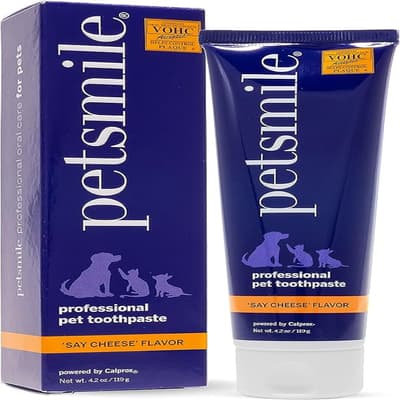
- petsmile Professional Pet Toothpaste Cheese Flavour 4.2oz — HK$242 (price subject to the online store's current listed price). The Petsmile Professional range is on the VOHC accepted list (accepted claim: inhibits plaque); the cheese flavour is more accepted by most cats and dogs, and the no-rinse formula is also suitable for use with a finger brush or gauze during the stage before your pet fully accepts a toothbrush.
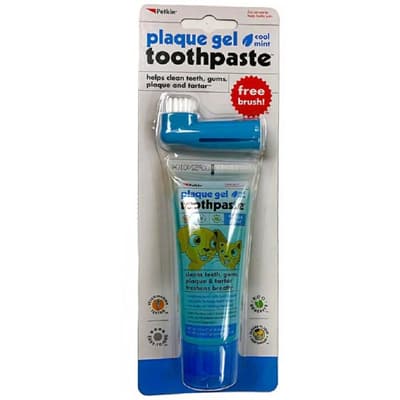
- Petkin Aloe Mint Gel Toothpaste + Finger Brush — HK$98 (price subject to the online store's current listed price). The set includes a finger brush, suitable for cases just starting training and not yet having a suitable toothbrush, with lower entry cost.
Buying toothpaste doesn't solve the problem; remember to pair it with correct technique and a consistent frequency. If your pet already has obvious tartar, book a veterinary assessment first — don't try to solve it by changing toothpaste.
Key takeaways
- The goal of oral care is to prevent plaque from maturing and calcifying, not just to improve breath.
- Stage 1 gingivitis is the only stage that can be fully reversed; alveolar bone loss from stage 2 onwards does not grow back.
- Home check once a week: look at tartar, gum colour, breath level, plus changes in eating and behaviour.
- Aim to brush once daily, minimum 2 to 3 times per week; human toothpaste is toxic, always use pet-specific.
- Dental chews, dental diets and sprays are supplementary only; they cannot remove calcified tartar and cannot replace brushing.
- Anaesthetic scaling is a medical procedure (COHAT); conscious scaling cannot clean below the gumline and is generally not recommended by the veterinary community.
- In Hong Kong, anaesthetic scaling including pre-op checks commonly costs about HK$1,000 to 3,000, with a range up to HK$7,000; the key is to ask clearly what the quote includes.
- If facial swelling, pus, complete refusal to eat, loose teeth occur, see a vet immediately.
 Fuji One full guide →