Quick answer: Choosing food isn't about price or big words on the packaging — it's about three numbers: protein percentage on a dry matter basis, phosphorus percentage on a dry matter basis, and calorie density per kilogram. With these three numbers you can calculate how many grams to feed per day, judge whether the food suits a kidney cat or sensitive stomach, and fine-tune using weight trends.
Information verified as of 2026-10-12 · Sources: AAFCO dog and cat nutrient standards, WSAVA Global Nutrition Guidelines, ACVIM consensus statements, IRIS chronic kidney disease staging guidelines, PetChill product database
Many owners ask "which food is best", but there's no standard answer because it depends on your cat or dog's weight, age, activity level and medical history. What you can actually learn and control is a decision-making method: understand the numbers on the packaging, calculate daily calories yourself, and know what terms like "low phosphorus" and "hydrolysed protein" really mean. This is an overview that breaks down each step; for details we link to other articles on the site rather than repeating what's already been written.
Step one: read the packaging — three tables, three units
Most people only look at the big words on the front of the bag, but the useful information is all in the small print on the sides and back. A complete label actually has three parts: expected Analysis, calorie statement (kcal ME), and Ingredient List. You need to look at all three together, not rely on just one.
expected Analysis: these are "wet weight" numbers
The expected Analysis lists minimum or maximum percentages of protein, fat, fibre and moisture. These numbers are calculated on the product as it leaves the factory, i.e. "wet weight" or "as-fed". Here's the problem: dry food is about 10% moisture, while wet food can be as high as 78% to 82% moisture. The same piece of meat might be 34% of a dry food but only 11% of a wet food, yet the actual nutrient density can be similar.
To compare fairly, you must convert to a dry matter basis (DM). The formula is:
Dry matter percentage = wet weight percentage ÷ (100 − moisture percentage) × 100
Example: a dry food labelled 34% protein, 10% moisture converts to 34 ÷ 90 × 100 = 37.8%. A wet food labelled 11% protein, 78% moisture converts to 11 ÷ 22 × 100 = 50%. On the surface the dry food's "34" is bigger than the wet food's "11", but in fact the wet food has higher protein density. This conversion is the most basic step in judging food quality, and the most commonly overlooked. For a more detailed guide to reading ingredient lists and nutrient lists, see Cat Nutrition Complete Guide.

Calorie statement: kcal ME/kg and kcal/cup are very different
Calories are usually written as "3,800 kcal ME/kg" or "380 kcal ME/cup". Note the difference between kg and cup: a cup of dry food is about 90 to 110 grams, depending on kibble size and density. If one food is labelled per kg and another per cup, you can't compare them without converting. It's best to standardise to kcal ME / 100 grams, because feeding amounts are usually in grams.
As for typical values, dry food is roughly 3,300 to 4,200 kcal ME/kg, canned food about 700 to 1,200 kcal ME/kg, and freeze-dried can exceed 4,500 kcal ME/kg before rehydration. The higher the calorie density, the fewer grams needed for the same nutritional requirement, so the question "how many grams to feed" can't be answered without reference to calorie density.
Ingredient list: ordered by weight, but "wet weight"
Ingredients are listed by weight from most to least, but note two things. First, fresh meat is about 70% water, so "fresh chicken" listed first doesn't mean it contributes the most protein; "chicken meal" or "dehydrated chicken" listed later may contribute more protein because the water has been removed. Second, the ingredient list can be "split" — the same material listed under several names, so "corn, corn flour, corn gluten" can occupy the top few places without being obvious.
| Label term | What it actually means | What to watch |
|---|---|---|
| expected Analysis | Minimum/maximum percentages, on a wet weight basis | Can't compare across products directly; convert to dry matter first |
| Moisture | Product water content | Needed for dry matter conversion |
| Calories kcal ME/kg | Metabolizable energy per kilogram | Standardise to kcal/100g before comparing |
| Complete food | Meets AAFCO complete nutrition standards | Can be the sole diet |
| Complementary food | Does not meet complete standards | Occasional feeding only, not a staple |
| By-product | Organs, bone and other non-muscle parts | Not inherently bad, but quality varies widely |
| Grain-free | No grains, but may use potatoes | Doesn't mean low-carb or hypoallergenic |
One more point: "meets AAFCO adult maintenance standards" and "meets all life stages standards" are two different things. Kitten food and all-life-stages food have higher requirements for protein, fat and calcium-phosphorus ratio, and adult maintenance food should not be fed long-term to kittens.
Calculating calories: the RER and MER formulas
The basis of weight management is calories, and calories can be calculated rather than guessed. The veterinary starting point is Resting Energy Requirement (RER):
RER (kcal/day) = 70 × body weight (kg) to the power of 0.75
The 0.75 exponent reflects the relationship between body surface area and metabolism; it's not linear. After calculating RER, multiply by a life-stage or activity factor to get the daily maintenance energy requirement (MER). Approximate ranges: indoor neutered adult cat about 1.0 to 1.2 times; active or unneutered adult cat about 1.2 to 1.4 times; growing kitten about 2.0 to 2.5 times; cat needing weight loss about 0.8 times (calculated on ideal body weight, not current weight).
| Weight | Cat RER (kcal/day) | Indoor neutered adult (×1.1) | Growing kitten (×2.2) |
|---|---|---|---|
| 2 kg | about 118 | about 130 | about 260 |
| 3 kg | about 160 | about 176 | about 352 |
| 4 kg | about 198 | about 218 | about 436 |
| 5 kg | about 234 | about 258 | about 515 |
| 6 kg | about 268 | about 295 | about 590 |
Dog factors are generally higher: neutered adult dog about 1.6 times, active dog about 1.8 to 2.0 times, young or working dogs can be higher. For a 10 kg adult dog, RER is about 394 kcal; times 1.6 is about 630 kcal/day.

Converting calories back to grams
After calculating daily calories, divide by the food's calorie density to get grams. For a 4 kg indoor neutered cat needing about 218 kcal per day: if the dry food is 3,800 kcal ME/kg (i.e. 3.8 kcal/g), that's about 57 grams per day; if feeding a 900 kcal ME/kg canned food (i.e. 0.9 kcal/g), that's about 242 grams per day, roughly three 80 g cans. This gap explains why "will a cat eat more on canned food" is a false question — canned food is heavier but has lower calorie density.
Weight loss must use ideal body weight, not current weight
If a cat weighs 6 kg but ideal weight is 5 kg, the target calories should be calculated on 5 kg, not 6 kg. Also control the speed: a cat should lose no more than 1% to 2% of current body weight per week. Rapid dieting in cats can trigger hepatic lipidosis, a potentially fatal condition, so never drastically starve or put a cat on a very low-calorie diet on your own; weight-loss plans should be set and monitored by a veterinarian.
Weight monitoring: choosing equipment and BCS scoring
Weight is the easiest and most honest health indicator. A single number means little; the trend line is what matters. So the point isn't how expensive the scale is, but consistency: same scale, same time (ideally morning before food), same conditions.
| Measurement method | Accuracy | Cost | Suitable for |
|---|---|---|---|
| Baby scale / pet-specific scale | High (error about 10 to 20 g) | Medium | First choice for cats and small dogs |
| Bathroom scale holding the cat (weigh twice and subtract) | Medium (error can exceed 100 g) | Low | Alternative when no pet scale |
| Veterinary clinic scale | High | Consultation fee | Record monthly or at each recheck |
| Tape measure chest circumference | Low (trend only) | Low | Supplementary reference for cats that can't be weighed |
Besides weighing, you need to check Body Condition Score (BCS) by hand. On the internationally used 9-point scale, 4 to 5 is ideal: ribs can be felt but not seen, there's a waistline, and the abdomen has a slight tuck. 7 and above is overweight, 8 to 9 is obese; below 3 is underweight. Long-haired cats are especially easy to misjudge, so you must feel with your hands, not just look.
If weight drops more than 5% in two weeks for no reason, or keeps rising without any change in feeding amount, both need veterinary assessment.
Protein: more than just a percentage
Protein is the most important nutrient for cats, but "what percentage" is only half the question; the other half is quality and source.
AAFCO minimum standards are: adult maintenance protein not less than 26% dry matter, growth not less than 30% dry matter; adult dog maintenance not less than 18% dry matter, growth not less than 22.5% dry matter. These are "minimum thresholds", not ideal levels. In practice, healthy adult cat foods are generally 30% to 40% dry matter, and higher for kittens and highly active cats.
A few points to note:
- Animal protein first: cats are obligate carnivores with absolute requirements for taurine, arginine, arachidonic acid and others, which plant proteins cannot fully replace.
- Plant proteins can "pad" the number: pea protein and corn gluten can raise total protein percentage, but the amino acid profile is different.
- High protein doesn't mean kidney damage: for cats and dogs with normal kidney function, there is currently no established evidence that moderately higher protein causes kidney damage. But for animals already diagnosed with kidney disease, the "amount" and "quality" of protein must be adjusted according to stage and veterinary advice.
- Older cats actually need enough protein: muscle loss is common in cats over 7, and premature drastic protein restriction may accelerate sarcopenia, so senior food isn't necessarily low-protein food.
If you're choosing food by breed characteristics, such as differences between Persian, Maine Coon and Ragdoll, see Breed-specific nutrition needs; for hands-on brand selection and price comparison, see Hong Kong cat food brand comparison.
Phosphorus: the most critical number for kidney cats
Phosphorus is the one key point this article most wants to leave you with. For cats with chronic kidney disease (CKD), controlling phosphorus is no less important than controlling protein, because high blood phosphorus accelerates kidney damage and is linked to reduced appetite and weight loss. The International Renal Interest Society (IRIS) staging guidelines use blood creatinine and blood phosphorus to stage 1 to 4, and recommend phosphorus intake targets for each stage.
The problem is: "low phosphorus" is not a legal label and has no unified threshold. Two foods both labelled "low phosphorus" can differ twofold in actual phosphorus content. So there's only one approach — check the actual phosphorus percentage on the packaging and convert to a dry matter basis for comparison. Example: a dry food labelled 0.8% phosphorus, 10% moisture, is about 0.89% dry matter; a canned food labelled 0.20% phosphorus, 78% moisture, is about 0.91% dry matter. They look far apart but are actually similar. Renal prescription foods generally achieve about 0.3% to 0.5% dry matter, depending on the product and stage.
Also consider the source of phosphorus. Meat naturally contains phosphorus, and processed meat products, some treats and additives (e.g. phosphates) have particularly high phosphorus absorption. So treats for kidney cats must also count toward the daily total phosphorus, not just the main food.
Hydrolysed protein: how it works and when it applies
"Hydrolysed protein" is another commonly misunderstood term. The principle is to use enzymes or hydrolysis technology to break whole proteins into small peptides (the industry generally achieves below 10 kDa), making it harder for the immune system to recognise the original allergenic protein structure, thereby reducing allergic reactions.
A few common misconceptions to clear up:
- Hydrolysed doesn't guarantee hypoallergenic: if hydrolysis isn't fine enough, reactions can still occur.
- Hydrolysed food mainly targets adverse food reactions, including itchy skin, chronic diarrhoea and chronic intestinal inflammation; it's also commonly used for elimination diet trials when food allergy is suspected, usually requiring 8 to 12 weeks of continuous feeding with no other food or treats, otherwise the trial is invalid.
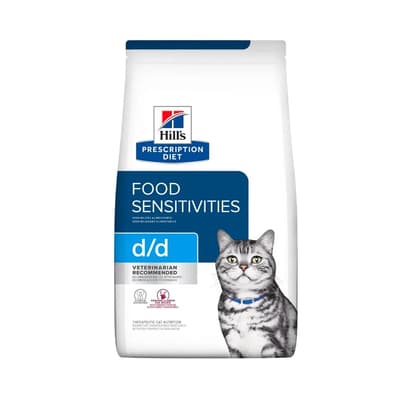
- Another route is "novel single protein": using protein sources the animal rarely encounters (e.g. venison, rabbit, crocodile, kangaroo) to reduce exposure to known allergens. A common example on the market is Hill's Prescription Diet d/d Skin & Food Sensitivities Venison & Pea 8.5lbs, priced at HK$923 (price subject to the online store's current listed price), a limited-ingredient design suitable as an elimination diet or long-term management after veterinary assessment. These formulas must be used under veterinary guidance because the nutritional completeness and duration of use of limited-ingredient foods require consideration.
- Sensitive guts aren't necessarily allergy: many loose-stool cases are actually related to fibre ratio, eating speed, parasites or stress, and switching to hydrolysed food before investigating is a waste of money and time. Such cases may benefit from probiotic products, e.g. Nulo Probiotic Digestive Support Dog Treats 90 count, priced at HK$380 (price subject to the online store's current listed price), as support rather than treatment.
Summary table of selection logic for special needs
Below is a decision reference table to help you clarify direction before seeing the vet. Note the rightmost column: any prescription-level adjustment must be decided by a veterinarian after diagnosis and recheck.
| Situation | Nutritional focus | Which number to check on the label | Who decides |
|---|---|---|---|
| Healthy adult cat/dog | Complete, moderate calories, sufficient animal protein | Protein, fat, kcal/100g | Owner chooses |
| Indoor, prone to obesity | Lower calorie density, slightly higher fibre | kcal/100g, daily feeding guide | Owner calculates plus regular weighing |
| Kittens/puppies | Growth standards, DHA, calcium-phosphorus ratio | Whether labelled growth or all life stages | Owner chooses, vet reviews |
| Cats over 7 | Enough protein to prevent muscle loss, watch phosphorus | Protein, phosphorus (dry matter basis) | Vet advice after regular blood tests |
| CKD stage 2 and above | Limit phosphorus, moderate protein quality | Phosphorus (dry matter basis) about 0.3% to 0.5% | Must be vet prescribed |
| Suspected food allergy | Hydrolysed protein or novel single protein | Protein source, whether hydrolysed is stated | Elimination trial under vet guidance |
| Chronic intestinal inflammation | Highly digestible, limited ingredients | Ingredient list length, fat content | Vet prescription plus recheck |
| History of pancreatitis | Low fat first | Fat (dry matter basis) | Must be vet assessed |
| Heart disease | Depends on stage, some need sodium restriction | Sodium content, taurine | Must be vet prescribed |
| History of urinary stones | Adjust minerals by stone type | Magnesium, calcium, phosphorus, urine pH target | Must be vet diagnosed stone type |
Transitioning food: at least seven days
Even if the new food is clearly more suitable, you can't switch all at once. Gut flora need time to adapt, and a sudden change easily causes vomiting or diarrhoea, making it hard to tell whether the new food is unsuitable or the switch was too fast. The standard approach is a gradual transition over seven to ten days:
- Days 1 to 2: new food 25%, old food 75%
- Days 3 to 4: new food 50%, old food 50%
- Days 5 to 7: new food 75%, old food 25%
- Day 8 onwards: fully new food
If loose stool occurs during the transition, go back to the previous ratio for two more days. If there is repeated vomiting, bloody stool or complete refusal to eat, stop and contact your veterinarian.

When to see a vet immediately
Nutritional problems are sometimes surface symptoms of disease. In the following situations you should stop adjusting food yourself and seek veterinary care promptly: complete refusal to eat for more than 24 hours (especially dangerous for cats, may trigger liver problems), repeated vomiting or blood in vomit, severe diarrhoea or bloody stool, unexplained weight loss of more than 5% in two weeks, sudden excessive drinking and urination, obvious abdominal distension or tenderness, persistent itching causing hair loss or broken skin.
In emergencies, contact a veterinarian immediately; this article is for reference only and cannot replace veterinary diagnosis. Any questions about dosage, prescription food or supplements must be decided by a veterinarian based on your pet's actual situation.
Key takeaways
- Before comparing any two foods, convert to a dry matter basis; otherwise wet food numbers will always be underestimated.
- Start daily calories with RER = 70 × weight^0.75, multiply by life-stage factor, then divide by kcal/g to get grams.
- Weight loss must be calculated on ideal body weight; cats should lose no more than 1% to 2% of body weight per week.
- Weight monitoring should be consistent and tracked as a trend, together with hands-on BCS scoring, ideally 4 to 5 (9-point scale).
- Phosphorus is the most critical number for kidney cats; "low phosphorus" has no legal threshold, so trust only the actual label and convert to dry matter basis.
- Hydrolysed protein targets adverse food reactions and requires an 8 to 12 week elimination diet trial; it's not a universal solution for digestive upset.
- All prescription-level nutritional adjustments must be decided by a veterinarian after diagnosis and recheck.
To learn more about forbidden foods and poisoning risks, read Pet Food Toxicity and Forbidden List; details of daily feeding arrangements and forbidden ingredients remain in the original nutrition articles.
PetChill's Reminder
Nutrition is a skill you can learn; you don't need to rely on feelings. Starting today, try doing three things for your pet: convert the dry matter numbers of the food you have, calculate daily calories once, and then weigh every two weeks and record it. After three months you'll have a weight trend line for your own pet, and that line is more useful than any advertisement. If you have any health concerns, remember to consult your veterinarian first.
 Hill's full guide →

 Fuji One full guide →