
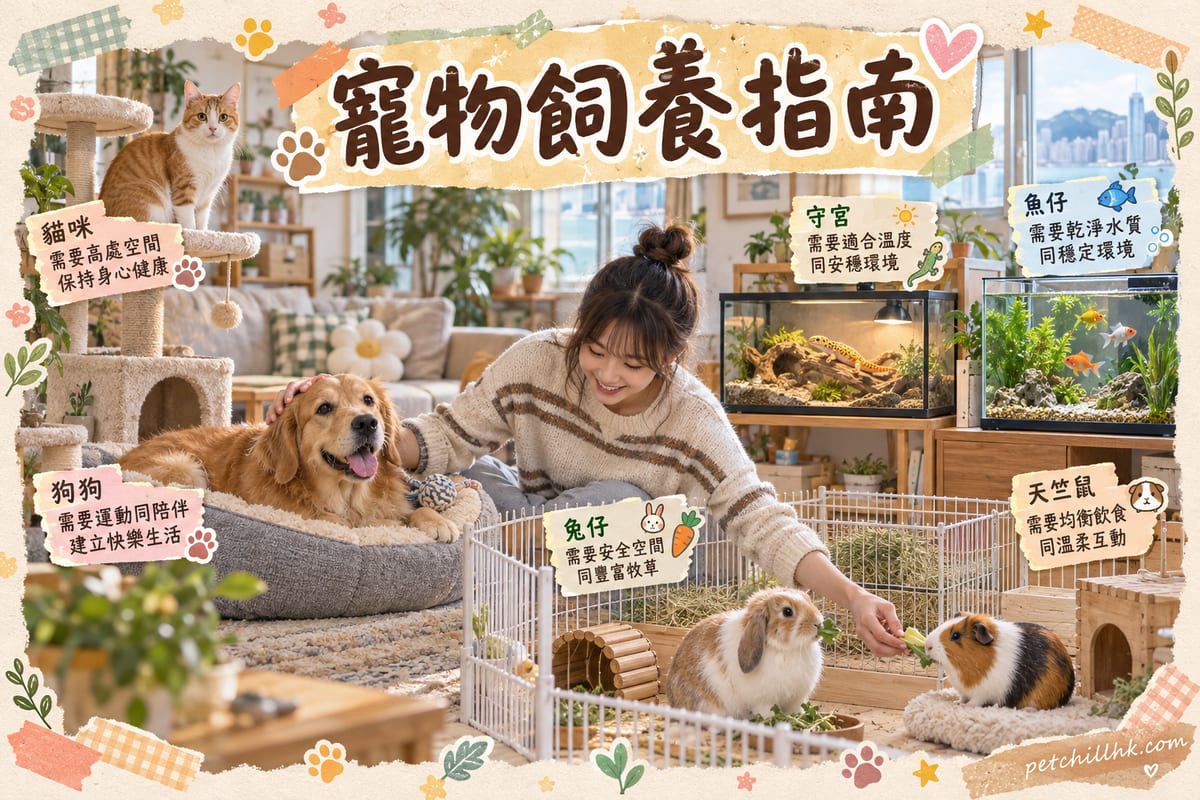
Hong Kong people have a wider choice of pets than you might think: besides cats and dogs, there are small animals, aquatics, reptiles and birds. These six groups differ enormously in their space, temperature, humidity and veterinary needs, and a flat that suits a cat may not suit a rabbit or a gecko.
For the full version on heat gradients, substrate and refusal-to-eat handling, see the corn snake breed guide.
For a complete rundown of cages, diet and toxic food lists, see the budgerigar breed guide.
Quick answers
A pet care guide generally covers six groups: cats, dogs, small animals (rabbits, hamsters, guinea pigs), aquatics (ornamental fish such as guppies), reptiles (geckos, horned frogs, skinks, corn snakes) and birds (budgerigars, canaries). Before choosing, beginners should work out three things: how much time you can give each day for interaction and cleaning, how much stable space at home you have for a cage or tank, and whether Hong Kong's humid, air-conditioned environment suits the species. With zero experience, start with species that need little space and tolerate environmental swings, such as cats, guppies or geckos. See the pet articles overview for all categories.
Overview of the six pet groups
The table below is a general comparison of the six groups. Difficulty refers to the buffer time if something goes wrong: when water quality or tank temperature deteriorates, aquatics and reptiles can crash within a day or two.
| Species | Space needs | Temperature and humidity | Diet focus | Difficulty |
|---|---|---|---|---|
| Cats | Vertical space, window screens | Avoid direct air-conditioning | Mainly animal protein | Low to medium |
| Dogs | Daily walks outdoors | Prevent heatstroke in summer | Regular, measured meals | Medium |
| Small animals | Ventilated cage or pen | Avoid high heat and humidity | Herbivorous or mixed food | Medium to high |
| Aquatics | Stable power for the tank | Stable water temperature | Dedicated fish food, less is more | Medium |
| Reptiles | Glass tank plus heating equipment | Temperature gradient and humidity zones | Live or frozen prey | Medium to high |
| Birds | Room to fly | Stable temperature | Formulated food as the base | Medium |
Before choosing, look at your home's most stable conditions: constant air-conditioning and low humidity do not suit high-humidity species; without lamps, choose species with low UVB needs. Further reading: health articles.
Key points for cat care
Cats are the most common choice in Hong Kong's small flats: no need for walks, toileting indoors, and space can go upwards. But "no walks" does not mean "no space": cats need places to jump, hide and look out of the window; if there is only floor and a food bowl, stress shows up as over-grooming and inappropriate urination. High-rise flats need window screens.
On diet, cats are obligate carnivores with animal protein at the core, and wet food can add moisture; the key is regular measured meals and watching drinking and urination changes.
- Cat breed encyclopedia · Cat category overview
- British Shorthair · Maine Coon
- Ragdoll · Persian
- Domestic Cat · Calico
- Siamese · Bengal
- Complete beginner pet care guide
Key points for dog care
The core need for dogs is daily outdoor time and exercise, and Hong Kong's living environment makes this the biggest variable. Medium and larger dogs need enough walking time and sniffing opportunities; insufficient exercise turns into behavioural problems such as destructive chewing, barking and pulling.
Size is tied to living environment: large dogs need more room to move around the home, while small dogs are easier to accommodate, but that does not mean they can skip walks. In Hong Kong summer the hot pavement can burn paws, so avoid walks at midday.
For walking routes, see the territory-wide pet park district list and favour shaded spots.
- Dog breed encyclopedia by size and exercise needs
- Shiba Inu · Corgi
- Poodle sheds less
- Labrador · Golden Retriever
- Chihuahua · Pomeranian
- Domestic Dog is the main adoption choice
Key points for small animal care (rabbits / hamsters / guinea pigs)
Small animals share small size, fast metabolism and sensitivity to environmental change. A room temperature that feels only slightly cool to a person may already be stressful to a hamster or rabbit; a room without air-conditioning in a Hong Kong summer is the most common high-risk scenario. The first requirement is not food but a cool environment and ventilation.
Space and social needs differ: rabbits and guinea pigs are social and should be given enough activity space and considered for companions; hamsters are solitary and adults often fight when housed together. Feeding ratios, forbidden foods and cage setup have dedicated articles:
Key points for aquatics care (guppies and others)
The most common beginner mistake in aquatics is not choosing the wrong fish but adding fish before the tank is ready. A tank must first complete the nitrogen cycle: the filter running and beneficial bacteria established, during which water quality fluctuates; skip this step and fish quickly develop fin rot, white spot or even die.
Guppies are the most common starter choice: they tolerate water changes well, adapt to hard water, and being livebearers they breed quickly. But "easy to keep" has a cost: a pair can become a tankful in a short time, so think about what to do with surplus fish, and never release them into the wild. Routine management includes regular water changes (about 20 to 30 percent each time), not overfeeding and monitoring water temperature.
Key points for reptile care (geckos / horned frogs / skinks / corn snakes / mantises)
The core of reptile care is using equipment to replicate the native environment: as long as the tank provides the correct temperature gradient and humidity zones, the same room can house a desert-type gecko or a tropical horned frog. The standard is not a room temperature that feels comfortable to people but the thermometer and hygrometer inside the tank.
Geckos (leopard geckos) are desert-type and active at dusk and at night; the key points are belly heat, a humid hide to help shedding, and D3 calcium powder with live prey. Horned frogs are ground-dwelling and need a moisture-retaining substrate plus a shallow water dish and higher humidity. Most skinks are diurnal and need a UVB lamp and a higher basking spot. Corn snakes need a cool end and a warm end plus escape-proofing. Mantises need ventilation and climbing branches.
Parameters vary widely between species, so check the temperature, humidity and UVB requirements for that species before buying. Further reading: health articles.
Key points for bird care (budgerigars / canaries)
Birds are the most underestimated group: "small and in a cage" looks simple, but their social and air-quality needs are high. Budgerigars are social birds and, if kept alone, need daily interaction from the owner; canaries can relatively tolerate being alone.
Birds need room to actually fly; a perch-only cage leads to deteriorating muscles and feathers, so if you cannot provide that, increase out-of-cage time. Noise is a real issue in small flats: birds are usually loudest at dawn and dusk.
On environmental safety, birds' respiratory systems are very sensitive to cooking fumes, sprays, incense and high-temperature non-stick fumes, so keep them away from the kitchen. For diet and cage setup, see the other article: small animal care and feeding guide.
Special notes on Hong Kong's climate and living environment
Hong Kong's climate affects pet keeping more than in most places: humidity is high all year and summers are hot and muggy, making mould, skin problems and spoiled food especially likely; in winter, the dryness and temperature swings of air-conditioned rooms are especially noticeable for reptiles, aquatics and small animals.
On humidity, store substrate, bedding and food sealed, and monitor tank humidity with a hygrometer; too damp causes mould and skin problems, too dry leads to failed sheds. The biggest problem in air-conditioned rooms is temperature fluctuation: direct airflow from vents chills small animals and reptiles repeatedly.
Ventilation in small flats is the third key point: aquariums and small animal cages let moisture and ammonia build up, and an exhaust fan plus a dehumidifier is a workable combination. Before renting or moving, check whether the building's rules allow pets; see the complete beginner pet care guide for details.