

Quick Answer: The Abyssinian's coat color is unique in the cat world: ticked tabby—no spots, no stripes. Each hair shaft changes from light to dark and back to light, creating multiple color bands along its length, resembling a wild rabbit's pelt. The CFA recognizes four main color families: Ruddy, Sorrel, Blue, and Fawn. Ruddy is the most common, while Fawn is the rarest. A kitten's color isn't fully set until six months old, and what people call a "black Abyssinian" is often either a dark ruddy individual or a Bombay cat.
Want to learn everything about the Abyssinian cat? Start with the Abyssinian Breed Profile.
1. Understanding "Ticked Tabby": Why They Have No Stripes
Most tabbies have necklaces, leg bracelets, and body stripes. Abyssinians have none—because the ticked pattern (Agouti and Ta genes) causes color variation along the hair shaft rather than forming patterns on a patch of fur. The effect: from a distance, they appear a uniform warm color; up close, each hair shows three or four bands of light and dark, with a metallic sheen in sunlight. TICA's standard for this breed specifically describes it as a "ticked coat." This gene also explains why adopted mixed-breed "wild rabbit-colored cats" are often mistaken for Abyssinians: the ticked tabby pattern is dominant, and mixed breeds can express it up to 80% accurately. The key indicators aren't stripes, but: the number of bands on the hair shaft, the absence of a chest spot, and the color harmony between paw pads and nose leather—all three must be present for it to be breed-standard.
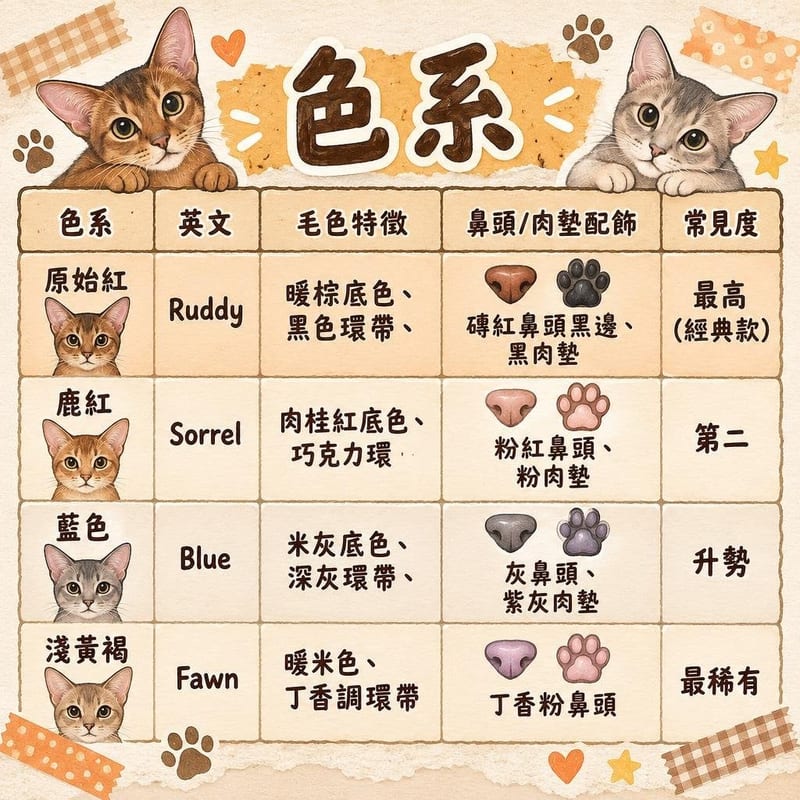
2. Detailed Guide to the Four Color Families
| Color Family | English Name | Coat Characteristics | Nose Leather/Paw Pads | Rarity |
|---|---|---|---|---|
| Ruddy | Ruddy | Warm brown base, black ticking, copper sheen | Brick red nose with black edge, black pads | Most common (the classic look) |
| Sorrel | Sorrel | Cinnamon-red base, chocolate ticking | Pink nose, pink pads | Second most common |
| Blue | Blue | Warm beige base, dark gray ticking, silver sheen | Blue-gray nose, mauve-gray pads | Increasing in popularity |
| Fawn | Fawn | Warm beige, lilac-toned ticking | Lilac-pink nose | Rarest |
Two additional points: First, Blue and Fawn are diluted-gene variations of Ruddy and Sorrel, so they often appear in the same bloodlines. Second, TICA recognizes more colors than CFA (including silver variations), as the standards of the two associations differ. If buying, always clarify the registry with the breeder.
3. Color Variation: Cats That "Change Color"
The Abyssinian's color has two time dimensions. In kittenhood: the color sets between three to six months. The kitten coat is often lighter and grayish, with insufficient ticking bands, and may look like a "washed-out domestic cat," which is normal. After six months, the hair shafts fully replace themselves, revealing the mature color and metallic sheen. In adulthood: the hair tips can oxidize and take on a copper tone from sun exposure (more noticeable on lighter colors), which is reversible; poor nutrition or shedding seasons can quickly cause the coat to lose its luster. Therefore: don't judge a kitten by its "kitten color." Ask the breeder to show you photos of the adult parents and littermates once their color has set. For adult adoptions, judge the cat as-is, since the color is already stable.

4. Rarity and Budget: How to View Color Premiums
Current Hong Kong market overview: Ruddy supply is the most stable, with prices in the standard range; Sorrel is the next most stable; Blue has become trendy on social media for its "high-end look," leading to a premium in recent years; Fawn is the rarest, and catteries often have waiting lists. Two practical tips: First, paying a premium for a rare color is acceptable, but the premium should prioritize "PK genetic testing and heart screening records being complete"—health records are more valuable than color (see the price guide's checklist for verification). Second, from an adoption perspective, you have little choice. Most ticked tabby mixes have a ruddy base. Instead of fixating on color, wait for a cat whose personality matches your lifestyle.
5. The "Black Abyssinian" Mystery: Two Correct Explanations
Friends searching for "black Abyssinian cat," you are mostly seeing two things: One, a dark Ruddy individual—with a high proportion of black ticking and a deep brown base, it can appear nearly black indoors, but the ticking bands and sheen are still visible in sunlight. This falls within the Ruddy spectrum and isn't a disqualification. Two, a Bombay cat—pure black, copper eyes, and an Abyssinian-like muscular build. It's essentially an independent breed that is a "black version of the Abyssinian phenotype." True Abyssinians do not have a recognized solid black color. If you encounter a case claiming to be a "black Abyssinian with papers," first verify the registry, then judge accordingly. Similarly, a "white Abyssinian" does not exist—what you see is either a mix or a mislabeling.
6. Care Differences: Sheen as a Health Report
The care routine for all four color families is identical: short hair with no undercoat, brushing once a week with a rubber brush to remove loose hair, and infrequent bathing (they groom themselves very well). Color doesn't affect care, but sheen does affect interpretation: the Abyssinian's metallic ticking sheen is a health indicator. It glows when protein intake is adequate, there are no parasites, and skin health is good. A sudden loss of luster should prompt a check of nutrition and health. Additionally, the copper-oxidation issue from sun exposure (more common in lighter colors) can be managed with light-blocking curtains. During shedding season, the amount of loose hair is visually most obvious on darker colors. For homes with dark furniture, choosing Blue or Fawn means less visible fur (a joke, but practical).

7. Practical Advice for Choosing a Color
Three summary points: First, prioritize health (PK records, lineage, seeing the cat in person); color is secondary. Second, preferences for Ruddy's steadiness, Sorrel's warmth, Blue's elegance, or Fawn's rarity are all valid, but understand you must wait for the color to set to see its true form. Third, consider your home environment—lighter colors look best under warm light, darker colors show less shedding, and photography enthusiasts can directly ask the breeder for photos of littermates after six months. The breed's beauty ceiling is that "wild rabbit sheen," and all four colors are simply different color temperatures of that same sheen. You can't go wrong with any.
7. Color × Home Decor: The Real Question Many People Have
None of the four color families are right or wrong, but how they pair with your home's lighting, wall color, and sofa fabric is a practical visual project. Consider your home environment when choosing a color:
| Home Condition | Recommended Color Family | Reason |
|---|---|---|
| Mainly warm halogen/tungsten lighting | Ruddy, Sorrel | Warm light enhances the red-brown tones; Blue can look dull and gray under warm lights. |
| North-facing window/cool white light | Blue, Fawn | The silver-gray and lilac-beige tones look cleanest in cool light; Ruddy can appear dark. |
| Dark sofa/black fabric upholstery | Blue, Fawn | Minimal visual burden from floating fur during shedding (dark cats "vanish" on dark furniture). |
| Light wood/oatmeal white as main colors | Ruddy, Sorrel | The warm browns harmonize with wood tones, making photos look best. |
| Photography enthusiast, want to capture the coat's sheen | Ruddy (top choice) | The black ticking provides the most contrast, and the metallic sheen is most dramatic in sunlight. |
Two additions: First, the impact of lighting is greater than you think—ask the breeder for photos of the same cat under different lights. The same Sorrel can look completely different under a warm lamp versus in morning light. Second, in homes with inconsistent color temperatures (warm living room, cool bedroom), choose a middle ground like Ruddy, which works under both. Extremely pale colors like Fawn can "disappear" under the wrong lighting. This isn't being fussy; it's an investment in your daily visual enjoyment for the next ten years. One practical note: color preference may fade with time, but the bond through personality deepens. If torn between the two, let the personality assessment (see the "Disadvantages" article's seven-question self-check) cast the deciding vote. Among the four recognized colors, simply picking the one you find pleasant is enough—this breed has no "ugly" color.
Frequently Asked Questions
How many colors are there? CFA recognizes four main color families: Ruddy, Sorrel, Blue, and Fawn, all presented with the ticked tabby pattern.
Which color is the most common? Ruddy has the largest population; Blue has been the most sought-after with a premium in recent years; Fawn is the rarest.
Why doesn't my kitten's color match the photos? The color isn't fully set until three to six months old. A lighter kitten coat is normal. Looking at photos of the adult parents is most accurate.
What is a black Abyssinian? It's not a recognized color. It's usually a dark Ruddy or a Bombay cat.
Is care different for different colors? No, the routine is the same. Lighter colors require attention to sun-induced copper tones, and sheen is the health indicator.
Which color is hardest to judge at cat shows? Generally considered to be Ruddy: it requires a warm brown with black ticking ("wild rabbit color"); being too red or too black results in point deductions.
Key Takeaways
- ✅ Unique Ticked Tabby: No stripes, multiple bands on each hair shaft, the "wild rabbit sheen" is the breed's signature.
- ✅ Four Color Families: Ruddy, Sorrel, Blue, Fawn—the latter two are dilute-gene variations of the first two.
- ✅ Color Sets at Six Months: For kittens, look at photos of the adult parents; for adult adoptions, judge the cat as-is.
- ✅ Prioritize Health Screenings over Premium Colors: Rare colors can have a premium, but health records come first.
- ✅ "Black Abyssinian" = Dark Ruddy or Bombay Cat: No solid black is a recognized color.
- ✅ Coat Sheen is a Health Report: A sudden loss of luster warrants a check for nutrition and parasites.

Related Reading
- Full List of Abyssinian Disadvantages
- Abyssinian Personality Unveiled
- Abyssinian Price & Adoption Guide in Hong Kong
- Rubber brushes, high-protein cat food, fish oil for skin/coat: Get everything from PetChill Pet Supplies.
This article's color classification follows the CFA/TICA breed framework. Market prevalence and premiums are based on general observations in Hong Kong as of 2026 and are for reference only.