Quick answer: Kitten care follows four checkpoints: 0 to 4 weeks, focus entirely on warmth, kitten milk replacer and daily weighing; 3 to 8 weeks, transition from milk gruel to kitten food; 6 to 16 weeks, complete the core vaccine and deworming programme; 4 to 6 months, arrange neutering. Record weight weekly throughout the kitten period, keep resting respiration below 40 breaths per minute, and see a veterinarian immediately if there is food refusal, low body temperature or open-mouth breathing.
From birth to one year, a kitten grows from around 100 g to 3 to 5 kg, and its immune system, teeth, digestion and behaviour patterns all go through several versions. One mistake during this time often only shows up in adulthood; get the first few months right — warmth, feeding, disease prevention and socialisation — and the next ten-plus years are far easier.
This is the pillar guide to kitten care, laying out every step from 0 to 12 months as a timeline: milk volume and feeding frequency, the weaning transition, vaccination and deworming schedules, neutering timing, the socialisation window, weight and respiratory rate references for each stage, and finally the mistakes new owners make most often and the warning signs that mean see a veterinarian immediately. All reference values here reflect general veterinary practice; actual arrangements should follow your veterinarian's judgement.
Information checked to 2026-10-12. Sources: international veterinary consensus documents on vaccination and kitten care (WSAVA vaccination guidelines, AAFP feline life stage guidelines), Hong Kong Agriculture, Fisheries and Conservation Department dog licensing and rabies vaccination requirements, PetChill product database
The full 0-12 month kitten timeline
See the whole picture first, then work through each stage. The table below is the main task list for a kitten's first year — print it out or screenshot it and stick it next to the cat carrier.
| Stage | Age | Main tasks | Easiest thing to miss |
|---|---|---|---|
| Newborn | 0 to 2 weeks | Warmth, feeding every 2 to 3 hours, stimulating elimination, daily weighing | Low temperature and dehydration, which often worsen within half a day |
| Transition | 2 to 4 weeks | Eyes and ears open, learning to walk, first deworming, first taste of milk gruel | Weaning too early causing diarrhoea |
| Weaning | 3 to 8 weeks | Milk gruel to semi-moist food to kitten food, using the litter box, the socialisation golden window | Once the socialisation window passes it cannot be recovered |
| Vaccination | 6 to 16 weeks | Core vaccine every 3 to 4 weeks, internal and external deworming, building nail-trimming and tooth-brushing habits | Taking the kitten out to meet other cats before the vaccine course is finished |
| Growth | 3 to 6 months | Teething, rapid weight gain, arranging neutering, behaviour boundaries | Treating hand-biting as cute and letting it become an attack habit |
| Adolescent | 6 to 12 months | Annual vaccine booster, gradual switch to adult food, weight stabilising | Assuming a bigger cat means adult food, leading to insufficient calories |
Weeks 0 to 4: the three most critical things in the newborn stage
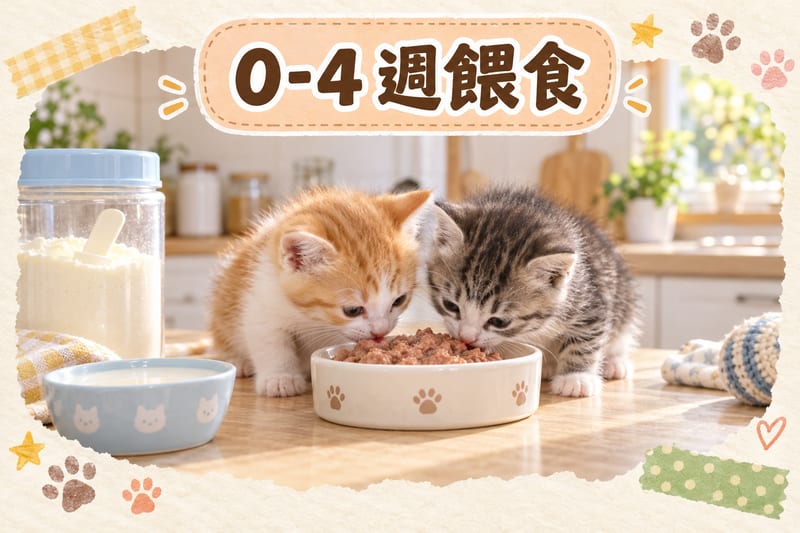
Newborn kittens cannot regulate their own body temperature, cannot eliminate on their own, and cannot fill themselves up in one feed — everything depends on the mother cat or a human standing in. At this stage, success is 90% about warmth, feeding and weighing.
Body temperature and warmth
In the first two weeks, a kitten's thermoregulation is still immature, and too low an ambient temperature directly stops gut motility and drops blood sugar. The general approach is to provide a nest where the kitten can choose its own temperature: warm on one side, cooler on the other, so it can crawl to a comfortable spot — do not seal the whole enclosure.
- In the first week, keep ambient temperature at around 29 to 32 degrees; around 27 degrees in weeks 2 to 3; around 24 degrees from week 4; then close to room temperature
- When using a hot water bottle or heat pad, always wrap it in a towel and leave an unheated area to avoid burns and overheating
- A kitten's normal body temperature is around 37.5 to 39.2 degrees; cold paws, a stiff body and weak crying are all warning signs of low temperature
- Do not point a fan or air-conditioning directly at the kitten, and do not place it on the floor beside an air-conditioning vent
Milk volume and frequency
Mother's milk is ideal; if the mother is not around, use a dedicated kitten milk replacer (cat formula). Never substitute cow's milk or human milk powder, because kittens are generally lactose intolerant and it causes diarrhoea and dehydration. Follow the packaging instructions for mixing ratio, temperature and storage time, and follow veterinary advice.
| Week | Approximate volume per feed | Feeding frequency | Daily total reference |
|---|---|---|---|
| Week 1 | 2 to 6 ml | Every 2 hours (including overnight) | About 30 to 40 ml |
| Week 2 | 6 to 10 ml | Every 2 to 3 hours | About 55 to 70 ml |
| Week 3 | 10 to 14 ml | Every 3 to 4 hours | About 80 to 100 ml |
| Week 4 | 14 to 18 ml | Every 4 to 5 hours | About 100 to 130 ml |
These are general references; adjust actual amounts to the kitten's weight, alertness and the milk replacer packaging — do not force the numbers. Feed with the kitten lying belly-down and the teat pointing towards the front of the mouth; never feed on its back, to avoid milk entering the lungs. After feeding, hold it upright and pat gently, wipe the mouth and nose clean, and do not let it roll around and play straight away.
Stimulating elimination and daily weighing
Before three weeks of age, kittens cannot urinate or defecate on their own. After each feed, gently wipe the genital and anal area with a lukewarm damp cotton ball, mimicking the mother's licking, until urine or stool appears. Record the colour, firmness and smell of the waste; runny, bloody, or no bowel movement for more than a day all warrant asking a veterinarian.
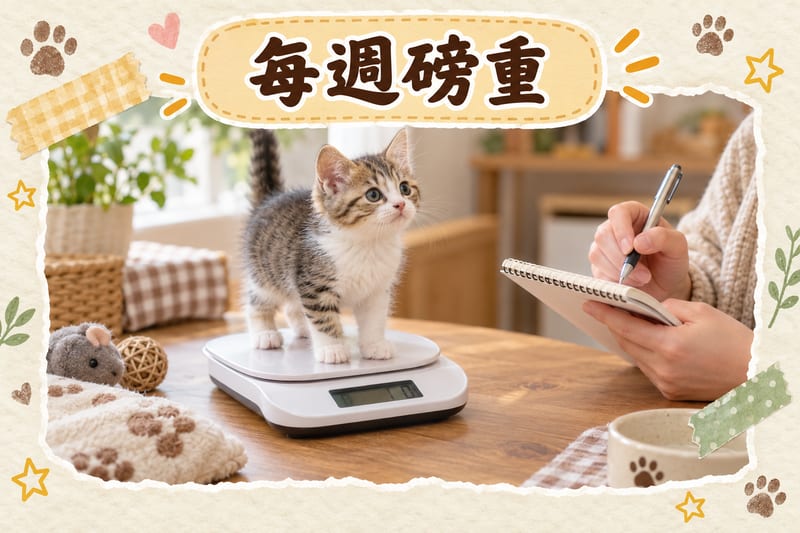
Weighing is the easiest and most valuable monitoring tool. Birth weight is generally around 90 to 120 g, with gains of about 10 to 15 g per day in the first two weeks, speeding up to 15 to 20 g after that. Two consecutive days without gain, or a drop, is the earliest and most reliable sign in a newborn kitten that a veterinarian is needed.
Weeks 3 to 8: how to manage the weaning transition
Weaning is not "stopping milk" but gradually diluting the milk and adding solids, giving the gut time to adapt to changes in enzymes and flora. Rushing weaning is the most common human cause of diarrhoea in kittens.
The general three steps:
- Weeks 3 to 4: Mix kitten milk replacer into a gruel, add a little kitten wet food or softened kitten kibble, to a yoghurt-like texture, and let the kitten lick it
- Weeks 4 to 6: Gradually reduce the milk proportion and increase the solids, adjusting every 3 to 4 days; also provide a shallow dish of fresh water and teach the kitten to drink
- Weeks 6 to 8: Fully switch to kitten food / kitten wet food, 3 to 4 meals a day; from eight weeks, free-feeding dry food is generally fine, or feed on a schedule as your veterinarian advises
If soft stool appears during the transition, go back a step in proportions and observe for one to two days — do not push on. The weaning period is also when kittens learn to use the litter box: use a low-sided, uncovered box in a quiet corner, put the kitten in after meals, praise success, and never scold for accidents.
What to feed a kitten: milk, weaning food and choosing kitten food
The biggest differences between kitten and adult food are energy density, protein, fat, calcium-phosphorus ratio and DHA content. When choosing food, first check whether the packaging says "kitten" or "All Life Stages" and whether it meets AAFCO or FEDIAF growth-stage nutrition standards, then consider price and palatability.
- From weaning to four months, a kitten's calorie needs are roughly two to three times those of an adult cat; a common estimate is about 200 to 250 kcal per kg of body weight per day, adjusted to the bag label, body condition and veterinary assessment
- Before six months, free-feeding is generally fine, or 3 to 4 meals a day; after six months, gradually reduce to 2 to 3 meals
- Dry and wet food can be mixed; wet food helps increase water intake; fresh clean water must always be available
- Transition foods over 7 to 10 days: start with 10% new food and build up to full, watching the stool throughout
- Human food, raw egg white, onion, garlic, chocolate, grapes and alcohol must never be given to a kitten
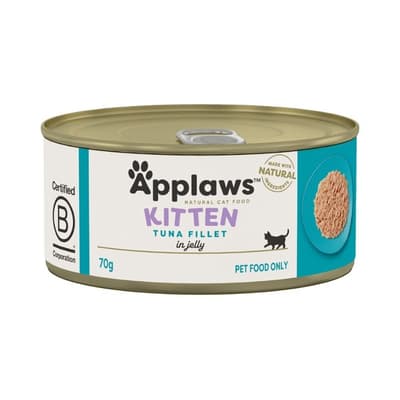
If you want a ready-made kitten staple, see Nature's Protection Cat Food Kitten Newborn Kitten Formula 400g, HK$55.8 (price subject to the current online store price) — the small pack suits a newly weaned kitten trying it out; to add wet food and boost appetite, Applaws Kitten Canned Food Jelly Series Tuna 70g is HK$14 per can (price subject to the current online store price), making portion control easy meal by meal. To compare more brands and formulas, see the kitten food buying guide.
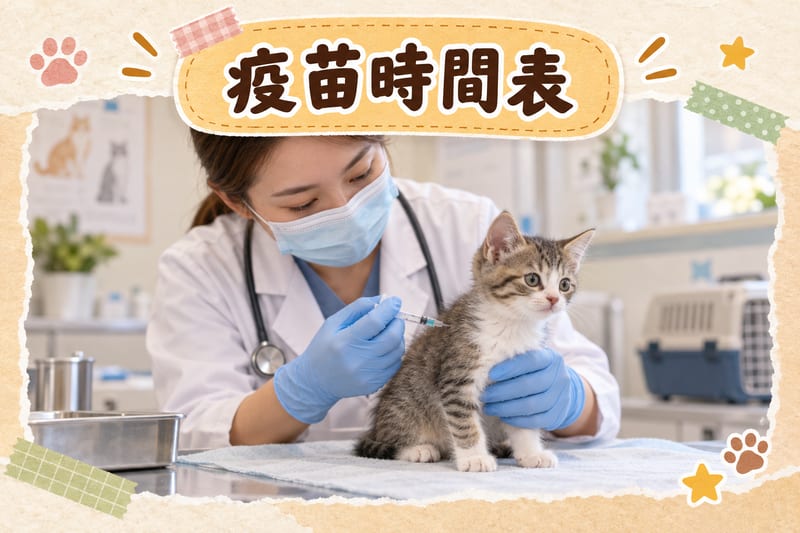
Weeks 6 to 16: the vaccination schedule
A kitten vaccination programme is not finished with one injection — it runs to around 16 weeks of age, because maternal antibodies affect vaccine response and finishing too early may not build enough protection. The general approach is as follows:
| Item | Recommended timing | Notes |
|---|---|---|
| First core vaccine (feline trivalent) | 6 to 8 weeks of age | Feline herpesvirus, calicivirus, panleukopenia |
| Second core vaccine | 3 to 4 weeks after the first | Usually at 10 to 12 weeks of age |
| Third core vaccine | 3 to 4 weeks after the second | Finish at around 16 weeks of age |
| Feline leukaemia vaccine | Per risk and veterinary advice | Higher risk for outdoor and multi-cat households |
| One-year booster | 12 months of age | Then periodic boosters as your veterinarian advises |
| Rabies vaccine | Per veterinary advice | Hong Kong law only mandates vaccination and licensing for dogs |
Vaccination notes:
- On vaccination day, avoid bathing, long journeys and changing food, to reduce extra stress
- Before the vaccine course is complete, do not let the kitten meet cats of unknown origin, and avoid high-risk areas such as pet shops and catteries
- In the 24 to 48 hours after vaccination, slightly reduced energy, appetite or mild swelling at the injection site is a common reaction
- If swelling lasts more than one to two weeks, keeps growing or discharges pus, or the kitten has a fever, refuses food or breathes rapidly, see a veterinarian immediately; any lump present for more than three weeks should be checked by a veterinarian
- Vaccine types, number of doses and intervals should be decided by a veterinarian based on the kitten's health; see the cat vaccination guide for details
Deworming: both internal and external
Kittens can pick up parasites from the mother, mother's milk, fleas and the environment, so deworming starts early. The general approach is a first deworming at around 2 to 3 weeks, then every 2 weeks until 12 weeks, monthly until 6 months, then quarterly depending on lifestyle; external parasite (flea, tick) products are usually usable from 8 weeks, with some labelled from 6 weeks — always follow the packaging and veterinary instructions.
Three key points:
- Dose by body weight, use kitten-specific products, never split an adult cat dose in half, and never use human medication
- Record the date and product name so your veterinarian can track it; do not stack multiple products on your own at the same time
- Treat the environment too: wash bedding, vacuum, treat carpets — fleas spend 90% of their time off the cat, so treating only the cat leads to repeat infestations
For the detailed schedule and product types, see the complete cat deworming guide. Any dosage question must be decided by a veterinarian.
Months 4 to 6: neutering timing and preparation
In Hong Kong the common practice is neutering at 4 to 6 months of age and around 2 kg or more, with the actual timing assessed by a veterinarian based on health, breed, living environment and anaesthetic risk. Neutering a female cat before her first heat is generally recommended, greatly reducing the risk of uterine infection and mammary tumours; neutering a male cat also helps reduce spraying, roaming and fight injuries.
What to do before and after surgery:
- Before: fast as your veterinarian instructs (usually 8 to 12 hours), confirm vaccination and deworming are complete, and prepare a quiet post-operative rest space
- First 24 hours after: anaesthesia has not fully worn off and body temperature is low — keep the cat warm, prevent jumping and stairs, and watch the wound for bleeding
- 3 to 7 days after: use a cone to prevent licking the wound, check daily for redness, discharge and opening; do not bathe or get the wound wet
- Warning signs: refusing food for more than 24 hours, persistent vomiting, bleeding or pus from the wound, rapid breathing or extreme weakness — seek veterinary care immediately
The socialisation window: what to do from 2 to 9 weeks
A kitten's socialisation window is generally given as 2 to 9 weeks (some literature narrows it to 2 to 7 weeks); it can still be topped up at 14 to 16 weeks, but with diminishing effect. The people, sounds, objects and handling a kitten meets during the window directly shape how bold and people-friendly it is as an adult.
- Short, frequent sessions daily: 5 to 10 minutes each time, gently touch paws, ears, mouth and tail, then reward with a treat, building "being touched = good things"
- Sounds and scenes: vacuum cleaner, doorbell, rain, carrier, traffic — play them starting quietly, paired with treats
- Hand and foot training: use fingers instead of toys to teach that biting hurts, and stop play the moment it bites; never hit with your hand or frighten with loud noises — punishment only teaches a cat to fear people
- Carrier: do not let it appear only for veterinary visits. Leave it open in the living room with a familiar towel and treats inside, so the carrier becomes a safe den
- Nail trimming and tooth brushing: start at 8 to 12 weeks, doing just one or two nails or a few seconds of brushing each time, paired with rewards, and build up slowly
For arrival preparation and a supplies list, see the new cat supplies checklist and prepare everything at once with the Hong Kong new cat owner guide.
Weight, respiratory rate and heart rate references by stage
The table below gives general reference ranges for kittens from birth to one year. Breed differences are large: large breeds such as Maine Coons and Norwegian Forest Cats are noticeably heavier than local shorthairs, and within a litter males are usually heavier than females. Use the table to spot trends, not to score individual numbers.
| Age | Weight reference | Resting respiration (breaths/min) | Heart rate (beats/min) | Notes |
|---|---|---|---|---|
| Birth | 90 to 120 g | 20 to 40 | 200 to 260 | Cannot regulate own temperature |
| 1 week | 150 to 200 g | 20 to 40 | 200 to 260 | Gains 10 to 15 g per day |
| 2 weeks | 250 to 350 g | 20 to 40 | 200 to 260 | Eyes starting to open, not yet steady on feet |
| 4 weeks | 400 to 500 g | 20 to 35 | 180 to 240 | Weaning begins, learning the litter box |
| 8 weeks | 700 to 900 g | 20 to 35 | 180 to 240 | First two vaccines |
| 3 months | 1.2 to 1.8 kg | 18 to 32 | 170 to 230 | Teething begins |
| 5 months | 2 to 3 kg | 16 to 32 | 160 to 220 | Approaching neutering timing |
| 6 months | 2.5 to 3.5 kg | 16 to 30 | 150 to 220 | Permanent teeth in, body lengthening |
| 12 months | 3 to 5 kg | 16 to 30 | 140 to 220 | Roughly close to adult size |
How to measure respiratory rate
When the cat is fully relaxed or asleep, watch the chest: one rise and one fall counts as one breath — count for a full 30 seconds and double it for breaths per minute. Do not measure during play, stress, hot weather or just after eating, when the number will always be high. Adult cats usually rest at 16 to 30; kittens are faster. Persistently above 40, open-mouth breathing, obvious abdominal effort, a stretched neck or a bluish tongue are all emergencies.
How to use weight and growth curves
- Weigh at the same time each week, on the same scale, in the same state, and record it in a table or phone app
- In the kitten stage you can roughly follow the rule of thumb of "about 450 g per month", slowing from around five months
- Two weeks without gain, weight loss, or obviously protruding ribs all warrant asking a veterinarian
- Conversely, fast weight gain is not the same as health; from six months, adjust portions based on body condition score
- Keep all records — showing the growth curve at a veterinary visit is far more accurate than describing it
When to see a veterinarian immediately
Kittens deteriorate fast, and many situations cannot wait until the next day. If any of the following signs appear, treat it as an emergency — do not self-medicate or wait for it to "get better on its own".
| Sign | May indicate | What to do |
|---|---|---|
| Refusing food for more than 12 to 24 hours (especially kittens) | Low blood sugar, infection, mouth pain | Seek veterinary care immediately; kittens cannot go without food |
| Low body temperature, cold paws, stiff body | Hypothermia, risk of sepsis | Keep warm and take to the veterinarian immediately |
| Resting respiration above 40, open-mouth breathing | Respiratory or heart problem | Seek veterinary care immediately |
| Persistent vomiting, bloody or black diarrhoea | Gastroenteritis, parasites, foreign body | Keep a photo of the sample and seek veterinary care immediately |
| Two consecutive days without weight gain or a drop (newborn stage) | Insufficient milk, dehydration, infection | Contact a veterinarian the same day |
| Pus-like eye or nose discharge, persistent sneezing | Upper respiratory infection | Seek veterinary care as soon as possible to avoid worsening |
| Seizures, sudden collapse, loss of consciousness | Neurological or metabolic emergency | Take to the veterinarian immediately |
| Post-vaccine lump lasting more than three weeks or growing | Abnormal reaction needing veterinary assessment | Book a check-up |
Important: In an emergency, contact a veterinarian immediately; this article is for reference only and cannot replace a veterinary diagnosis. Any medication, dosage, deworming product or vaccination arrangement must be decided by a veterinarian based on your kitten's actual situation — do not use human medication or adult cat medication on your own.
12 common mistakes new owners make
- Feeding kittens cow's milk: kittens are lactose intolerant, and the usual result is diarrhoea and dehydration — use cat milk replacer or mother's milk
- Skipping warmth: newborn kittens cannot regulate temperature, and when cold they stop eating and digesting; wrap hot water bottles in a towel and leave a cooler zone
- Bathing too early: bathing is not recommended before the vaccine course is complete and thermoregulation is mature; use damp cloths for spot cleaning if needed
- Rushing weaning: jumping straight from milk to dry food burdens the gut; transition in stages with milk gruel
- Not weighing: without a growth curve there is no way to catch insufficient intake or health problems early
- Going out before vaccines are complete: taking the kitten to pet shops, catteries or meeting unfamiliar cats carries a high risk of infectious disease
- Calculating deworming doses yourself: kittens need specific products dosed by weight; any dosage question must be decided by a veterinarian
- Missing the socialisation window: without contact with people and everyday sounds at 2 to 9 weeks, cats grow up fearful and resistant to being held
- Using hands as toys: if hand-biting is not stopped in kittenhood it becomes a biting habit in adulthood; redirect to toys
- Punishment-based discipline: hitting, spraying water or loud frightening only creates fear and aggression — it does not teach correct behaviour
- Neglecting oral and nail care: start training tooth brushing and nail trimming gradually at 8 to 12 weeks; doing it only in adulthood meets far more resistance
- Neutering too late or switching to adult food too early: late neutering increases heat-related stress and reproductive risks; early switching to adult food means insufficient calories and nutrients
Hong Kong practicalities: budgeting time and money
Actual first-year costs depend on the clinic and products chosen, and there is no standard quote, but you can budget by item: first physical examination, three core vaccines, internal and external deworming, neutering surgery, microchip, and everyday food and litter. It is worth opening a separate "medical reserve" account and transferring a fixed amount automatically each month, so a sudden situation does not leave you hesitating over money. For a detailed cost breakdown and monthly budget table, see the Hong Kong new cat owner guide.
On time commitment: in the first two months, spend at least 1 to 2 hours a day on feeding, cleaning and weighing; from three to six months, 30 to 60 minutes a day on play and training; after six months, gradually move towards the adult cat rhythm. How much company a kitten gets directly affects how people-friendly it is as an adult and how often problem behaviours appear.
Five things you can start today
- Buy an accurate pet scale and record weight weekly from today
- Check the vaccination record card, confirm the next injection and deworming dates, and set phone reminders
- Check the home environment: window screens, tidy cables and toxic plants, and prepare a low-sided litter box
- Spend 5 to 10 minutes a day on socialisation practice (touching paws, touching mouth, paired with treats)
- Choose a conveniently located veterinary clinic and start a medical record file
Frequently asked questions
Q: How does Pronature cat food's nutritional formula help kitten growth and immunity? A: Pronature is one of the complete and balanced commercial cat food brands; the key is whether the packaging states "kitten" or "All Life Stages" and meets AAFCO or FEDIAF nutritional standards. A formula that meets the standard provides the higher protein, fat, calcium-phosphorus ratio and DHA that kittens need. Immunity depends mainly on colostrum, vaccination and a clean environment — food is only one part. Transition foods gradually over 7 to 10 days and choose on your veterinarian's advice.
Q: How do normal respiratory rate ranges differ between kittens and adult cats? A: Adult cats usually breathe 16 to 30 times per minute at rest; kittens have a faster metabolism and commonly rest at 20 to 40, dropping to around 20 while asleep. Measure only when the cat is fully resting or asleep — count for 30 seconds and double it, never right after play or stress. If resting rate stays above 40, or there is open-mouth breathing, obvious abdominal effort or abnormal breathing sounds, that is an emergency — contact your veterinarian immediately.
Q: Is ZiwiPeak cat food suitable for a kitten's growth needs? A: Some ZiwiPeak formulas are All Life Stages products, so if the packaging states it meets AAFCO or FEDIAF growth-stage nutrition standards it can be one of a kitten's food options. Check the actual label, protein and fat levels, calcium-phosphorus ratio and calories, and adjust portions to the kitten's weight and growth curve. With any brand, what matters in the kitten stage is complete and balanced nutrition, good intake and steady weight gain — ask your veterinarian if unsure.
Q: What should I do if there is swelling or redness at the cat's vaccination site? A: Mild swelling, a firm lump at the injection site, slight fever or a bit of lethargy in the 1 to 2 days after injection is a common reaction and usually resolves on its own; you can cold-compress, avoid pressing it and keep watching. See a veterinarian immediately if swelling lasts more than 1 to 2 weeks, keeps growing, is clearly painful or discharges pus, or if the cat refuses food, runs a fever or breathes rapidly; any lump present for more than 3 weeks should be checked by a veterinarian.
Q: When should kittens start vaccinations and be neutered? A: The first core vaccine (feline trivalent) is usually given at 6 to 8 weeks, then every 3 to 4 weeks until around 16 weeks, with a booster at one year. Neutering is commonly done at 4 to 6 months and around 2 kg or more, with timing assessed by a veterinarian based on health, breed and living environment. Hong Kong law only requires dogs to be licensed and vaccinated against rabies; cats are vaccinated voluntarily on veterinary advice.
 ZiwiPeak full guide →
 Feline Natural full guide →
 Fuji One full guide →