
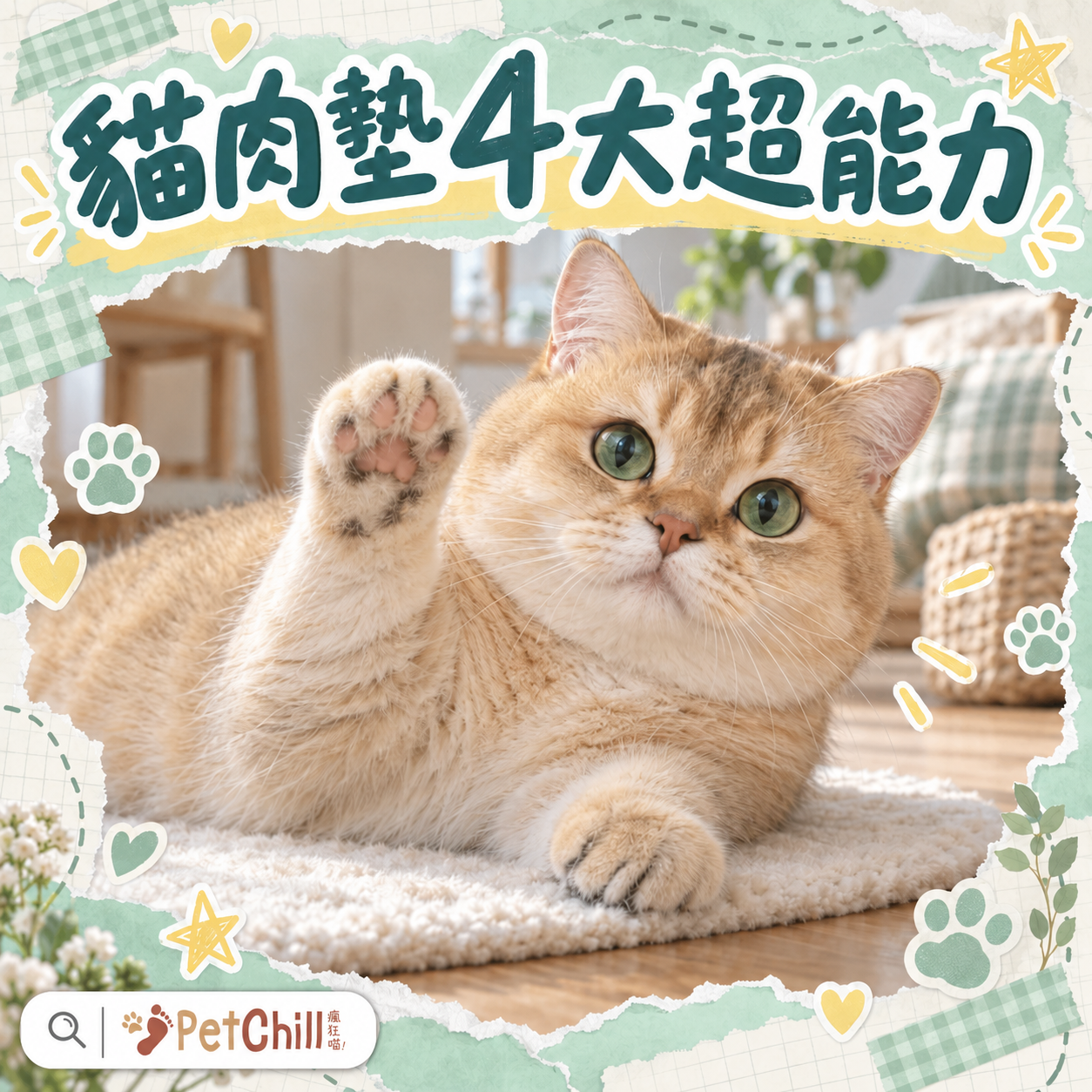
Quick answer: Cat paw pads are not just a "cute feature" — they are precision organs with four major functions: shock absorption and sound dampening (fatty pads absorb landing impact), sweat-based cooling (one of the few places on a cat's body with sweat glands), vibration sensing (containing lamellar corpuscles that detect tiny vibrations), and non-slip landing (front paw pads touch down at the moment of landing to prevent slips). Wet paw prints on the consultation table are paw pad sweat and are normal; check the pads weekly for dryness, cracks or foreign objects, trim the fur around the paws regularly, and households with glossy floors should pay special attention to slip prevention.
Have you noticed that no matter how high your cat jumps from the cat tree, it lands almost silently? The secret lies in those soft pink paw pads. Paw pads are not just a "cute feature" — they are precision organs combining shock absorption, sweating, sensing and slip prevention. PetChill takes you through these "meow paw superpowers" again.
1. Built-in shock absorbers: a pair of "silent running shoes"
Cats are digitigrade animals — their claws do not touch the ground when walking; they rely on their toes and paw pads. To protect bones and joints, the underside of a cat's paw is wrapped in a thick fatty pad that works like an athlete's cushioned running shoe: absorbing impact when jumping from height and almost silencing their steps when stalking prey. Textbook research notes that felines (except cheetahs) have flat paw pad structures — a "silent configuration" evolved over millions of years for hunting in the wild.
2. Those pink pads are actually "sweat glands"
You may have noticed: on the veterinarian's consultation table, or when travelling in a carrier, your cat leaves wet little paw prints on the surface — not urine, but paw pad sweat! Apart from the nasal cavity, the fatty paw pads are almost the only hairless area on a cat's body that sweats. So seeing wet paw prints after your cat walks by in summer or when nervous is a normal physiological phenomenon; but if there is persistent heavy sweating when it is not hot and the cat is not stressed, it is worth consulting a veterinarian.
3. A "vibration alarm" on the paws
Cat paw pads contain many sensory cells called "lamellar corpuscles" (Pacinian corpuscles), which are vibration receptors that can detect extremely subtle vibrations underfoot — including human footsteps, and even earthquake precursors that humans can barely perceive. This pressure-sensing system also lets cats precisely judge the ground and adjust muscles and balance at the moment of pouncing or landing.
4. Non-slip landing pads
Research observations have found that a cat's paw pads barely touch the ground when walking, but at the moment of landing from a jump the front paw pads do touch down — likely to prevent slipping on landing. For cats living in small Hong Kong flats with glossy tiles or wooden floors, this is especially important: floors that are too slippery increase the burden on landing and may affect joints in the long run.
Cat paw pads: 4 functions × human-world comparison table
| Paw pad function | Scientific principle | Similar human gear | What owners should watch for |
|---|---|---|---|
| Shock absorption and sound dampening | Fatty soft pads absorb impact | Cushioned running shoes | Any limping after a fall from height |
| Sweat-based cooling | Paw pads are a rare hairless sweat gland site | Sweat-absorbing sports gloves | Persistent wet paw prints in a cool environment → see a veterinarian |
| Vibration sensing | Lamellar corpuscles detect micro-vibrations | Sensors | Hiding during thunderstorms or fireworks is normal |
| Non-slip landing | Paw pads touch down at landing to increase friction | Non-slip yoga mat | Use non-slip mats on glossy floors |
Daily paw pad care: 3 things to watch
- Check: every week, look for dryness, cracks, burns or embedded foreign objects on the pads, and whether claws have grown into the pad.
- Trim: regularly trim overlong fur around the paws, especially after applying skincare products in winter when dirt sticks more easily.
- Environment: use non-slip mats on glossy floors and provide a stable landing area for your cat's cat tree.
Want to trim your cat's paw fur and nails but your cat resists as soon as you touch its paws? The key is daily "touch training" desensitisation — while your cat is relaxed, stroke each area one by one and reward with treats. Once accustomed, nail trimming and paw pad checks are no longer a battle. See our full guide to cat touch training: 9 sensitive areas desensitisation methods.
Hong Kong climate special notes: prevent burns in summer, cracks in winter
- Summer: Outdoor asphalt and balcony tiles can exceed 50°C after sun exposure. Before taking your cat out, test the ground with the back of your hand for 7 seconds; burned paw pads appear red and swollen, and the cat may hesitate to walk.
- Winter: Dry cold plus indoor air-conditioning can make paw pads dry and cracked; apply a thin layer of pet-specific, lick-safe paw balm.
- All year: Litter particles and carpet fibres easily get stuck between paw pads; long-haired cats and senior cats (with reduced self-grooming) need especially frequent checks.
Also, paw pads are the last line of defence when a cat jumps from height — if you have a cat tree or live in a high-rise, window screens and landing buffer zones are equally important. Do not let "silent landing" become a long-term joint burden. For anti-fall measures, see our guide to preventing cats from falling from height in Hong Kong: 5 major tips for window screening and balcony protection in high-rise homes.
Why do cats "look" at the ground before landing?
The vibration sensing and non-slip functions of paw pads are actually tied to hunting instinct: before pouncing, a cat uses its paw pads to test the stability of the ground, and adjusts its centre of gravity quickly at the moment of landing. When you see your cat look down before jumping, or take a couple of steps before accelerating, the same sensing system is at work. This instinct also explains why cats sometimes "miss" when catching toys — not clumsiness, but a floor that is too slippery affecting paw pad judgement. To learn more about how cats' hunting behaviour can be recreated and explored at home, see our article: Cat brings "prey" back as a gift = love? Unpacking the hunting instinct behind gift-giving.
PetChill's paw balm and non-slip mat products can help you care for your cat's paws in one place; search for "paw pad" and "non-slip" products on our website.
Key takeaways
- ✅ Paw pads combine four functions — shock absorption, sweating, vibration sensing and slip prevention — and are not just "cute"
- ✅ Wet paw prints on the consultation table or in the carrier = paw pad sweat, normal when hot or stressed
- ✅ Check paw pads weekly for dryness, cracks, burns, embedded objects and claws growing into the pad
- ✅ Long-haired cats need regular trimming of fur around the paws to reduce slipping on glossy floors
- ✅ Hong Kong homes: prevent ground burns in summer, cracks in winter, and use non-slip mats throughout to protect joints
- ❌ Do not apply human hand cream or skincare products to paw pads — risk if licked
- ❌ Persistent heavy wet paw prints in a cool environment, or with lethargy — do not dismiss as "normal sweating"; see a veterinarian
- ❌ Do not let cats jump from height just because "cats always land fine" — joint damage accumulates slowly
PetChill's Reminder
Next time you see your cat land silently, take a look at those pink paw pads — they really are the top-spec "cushioned running shoes" of the cat world. Check the pads regularly and keep the environment non-slip so your cat can jump high and land steady.
For more cat trivia and practical care tips, keep following PetChill's latest articles!
(References: Cat Care Encyclopedia sections OCR — "all-in-one running shoes with shock absorbers", "What do the paw pads on a cat's front paws do?", "Vibration alarm", "Animals that walk on their toes", etc.)