
📌 Key Takeaways
- ✅ Ingredients are listed in descending order by weight; the first ingredient has the highest content
- ✅ The first three should be clearly named animal proteins; avoid meat by-products
- ✅ A high protein number does not necessarily mean better; read it together with the ingredients list
- ✅ Only food labelled complete can be fed as the sole diet long-term; complementary foods cannot be fed alone
- ✅ Transition foods over 7 days; extend to 10 to 14 days for sensitive stomachs
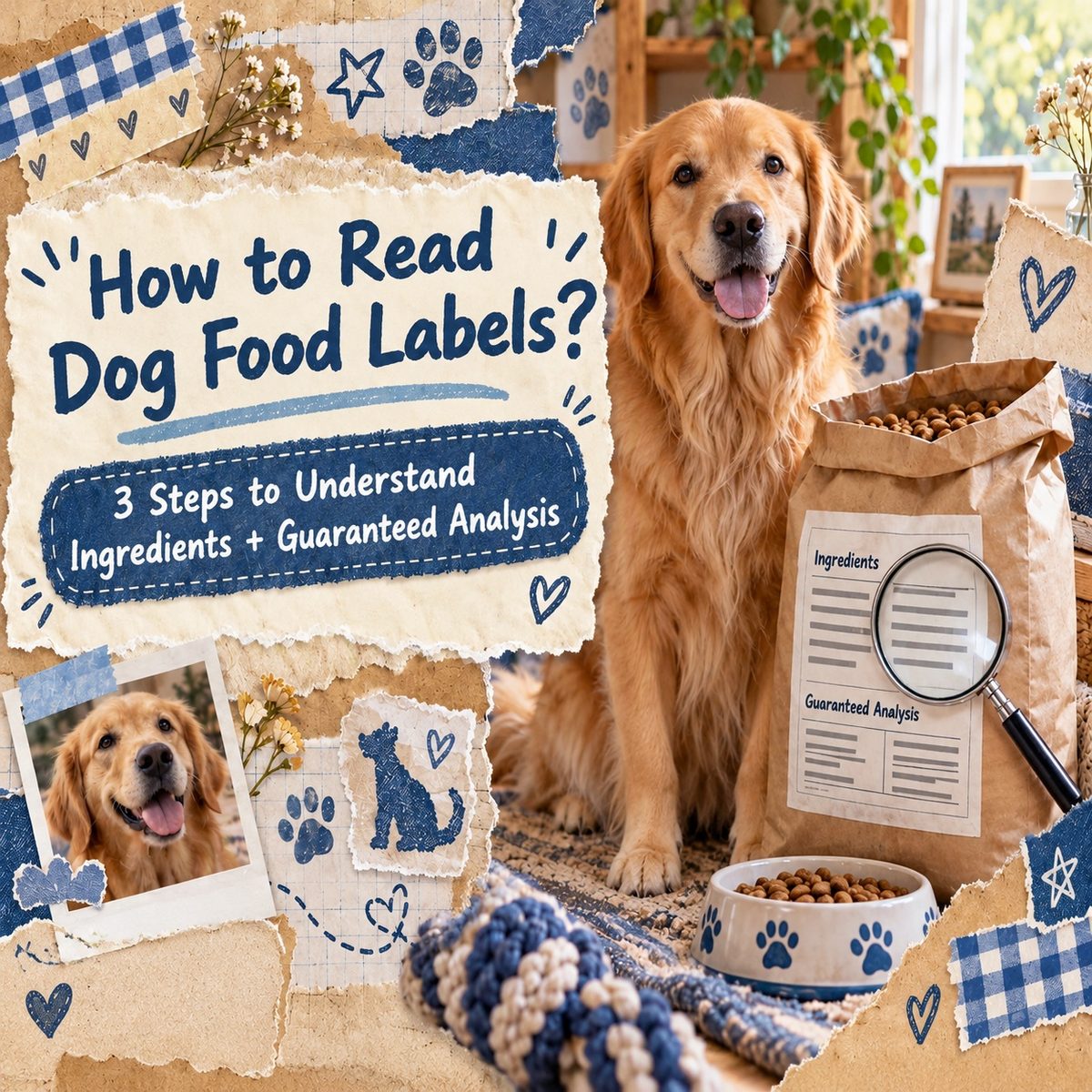
Standing in front of the pet shop shelf, faced with dozens of dog foods and packaging covered with words like "natural", "high meat", and "grain-free", have you ever made a decision based on price and packaging design? The real answer is printed on the small label on the back of the bag. Knowing how to read a dog food label not only helps you choose food with better value for money, but also prevents skin and digestive problems caused by food allergies or nutritional imbalance. Here are 3 steps to turn you from a novice into an owner who knows how to choose food.
Why read dog food labels?
The dog food label is the only source of information regulated by law that must be declared truthfully. Advertisements can say "full of fresh meat", but the ingredients list must be arranged by weight from high to low. In other words, as long as you know how to read the label, you will no longer be led by marketing buzzwords on the packaging, and you can directly compare the real differences between brands without relying on a salesperson's introduction.
Step 1: Look at the ingredients list first; order = content level
The ingredients list is the most important part of the entire label because ingredients must be listed in descending order by weight; the first ingredient has the highest content.
Three key points:
-
Top 3 ingredients: Ideally clearly named animal proteins, such as "chicken", "dehydrated chicken", "chicken meal". If it only says "meat by-products" or "poultry meal", the source is hard to trace.
-
Number of protein sources: Multiple meats (chicken, fish, beef) appearing in the first few ingredients means a more diverse protein source, which is usually gentler on dogs with sensitive stomachs.
-
Fats and carbohydrates: Named fats like "chicken fat" or "fish oil" are better than just "animal fat"; brown rice, oats, sweet potato are easier-to-digest carbohydrate choices.
Also check whether the packaging states "complete dog food" or a main food status. Labelled "Complete" means the nutritional ratio meets daily requirements and can be fed long-term as the sole diet; products labelled "complementary" or "mixer" cannot be fed alone.
Step 2: Then look at the expected analysis; don't focus on a single number
The expected Analysis usually lists four items: crude protein, crude fat, crude fibre, and moisture.
- Crude protein: Generally adult dog food is about 22% to 26%; puppies and highly active dogs usually need 26% or more.
- Crude fat: About 10% to 15%; too high easily leads to weight gain, too low may affect coat shine.
- Crude fibre: About 3% to 5%; moderate fibre helps intestinal motility.
- Moisture: Dry food is usually below 10%; lower moisture means longer shelf life, but remember to provide enough drinking water for your dog.
Note that a high protein number does not necessarily mean better. If a high-protein formula also uses a lot of hard-to-digest ingredients, the dog may still have soft stool. So the numbers in step 2 must be read together with the ingredients list in step 1 to be meaningful.
Step 3: Look at age and size suitability to match your dog's real needs
The same brand usually offers puppy, adult, and senior formulas, differing in protein, fat, calcium-phosphorus ratio, and kibble size. Small breeds have smaller kibble, medium and large breeds have larger kibble, making it easier to chew and slowing eating speed. If your dog has special conditions, such as being overweight or having joint problems, discuss with your veterinarian whether a prescription diet is needed.
5 Key Selection Principles
-
Transparent ingredients list: The clearer the first few ingredients, the better.
-
Balanced nutritional values: Don't chase extremely high numbers in a single item.
-
Match age and size: Puppies, adults, and seniors have different needs.
-
Try a small bag first: Buy a small package and trial for 2 to 3 weeks, observing stool, coat, and energy.
-
Price does not equal quality: The most expensive food is not necessarily the best for your dog; the most suitable food is the best.
Transition gradually: the 7-day switching method
Even if you choose an ideal new food, you cannot switch all at once. Sudden switching is the most common cause of diarrhoea in dogs. It is recommended to transition over 7 days:
- Days 1 to 2: 75% old food + 25% new food
- Days 3 to 4: 50% old food + 50% new food
- Days 5 to 6: 25% old food + 75% new food
- After day 7: 100% new food
During the transition, closely observe stool and appetite, and watch for vomiting, diarrhoea, or scratching. If your dog has a sensitive stomach, is a picky eater, or has just been vaccinated or moved to a new environment, slow down and extend the transition period to 10 to 14 days.
PetChill's Reminder
Choosing dog food does not require superstition about price or marketing buzzwords. By knowing how to read the ingredients list and expected analysis, you already understand your dog's needs better than most owners. Remember that any food transition should be gradual, giving the digestive system enough time to adapt.
To learn more about dog diet and daily care knowledge, please keep following PetChill HK's latest article updates!