

🤖 AI Summary
When choosing a second cat for a multi-cat home, breed compatibility is important: Ragdolls, British Shorthairs and American Shorthairs are gentle and easy to mix; Siamese and Abyssinians are active and need a match; Persians and Exotics are quiet and dislike noise. An age gap of 1 to 3 years is easiest to integrate, and after neutering they get along more harmoniously. A new cat should be introduced using the "isolation and gradual introduction method" for 7 to 14 days, which greatly increases success rates.
• Gentle group: Ragdoll, British Shorthair, American Shorthair—almost universally compatible
• Active group: Siamese, Abyssinian, Bengal—need a match of the same type
• Quiet group: Persian, Exotic Shorthair, Chinchilla—dislike noise and chasing
• Age gap of 1 to 3 years is easiest to integrate
Quick answer: When choosing a cat for a multi-cat home, the most important thing is "matching energy levels"—active with active, quiet with quiet. Ragdolls, British Shorthairs and American Shorthairs are gentle and almost universally compatible; Siamese and Abyssinians are active and lively and need a match of the same type; Persians and Exotic Shorthairs are quiet and dislike noise, so they are not suitable to live with active breeds. A new cat should be introduced using the isolation and gradual introduction method, not put together immediately.
Table of Contents
-
Why is breed compatibility so important?
-
Which of the three personality types is most compatible?
-
Breed compatibility comparison table
-
The influence of age, sex and neutering
-
Correct process for bringing a new cat home
-
Common questions FAQ
Why is breed compatibility so important?
Many Hong Kong cat owners, after getting their first cat, think "should I get another one to keep it company?" But not all cats get along—combinations with too great a difference in energy levels easily lead to one being harassed and the other ignored:
- Active cats chase quiet cats to play, causing the other long-term stress
- Quiet cats ignore active cats, and active cats get bored and become destructive
- Breeds with strong territorial instincts find it hard to accept a new cat invading
Breed is not the only factor (personality and socialisation are also important), but it is a good starting point. With the correct introduction process, a multi-cat home can be harmonious long-term. If you are preparing to introduce a second cat, we recommend reading our complete new cat introduction SOP and second cat introduction guide.
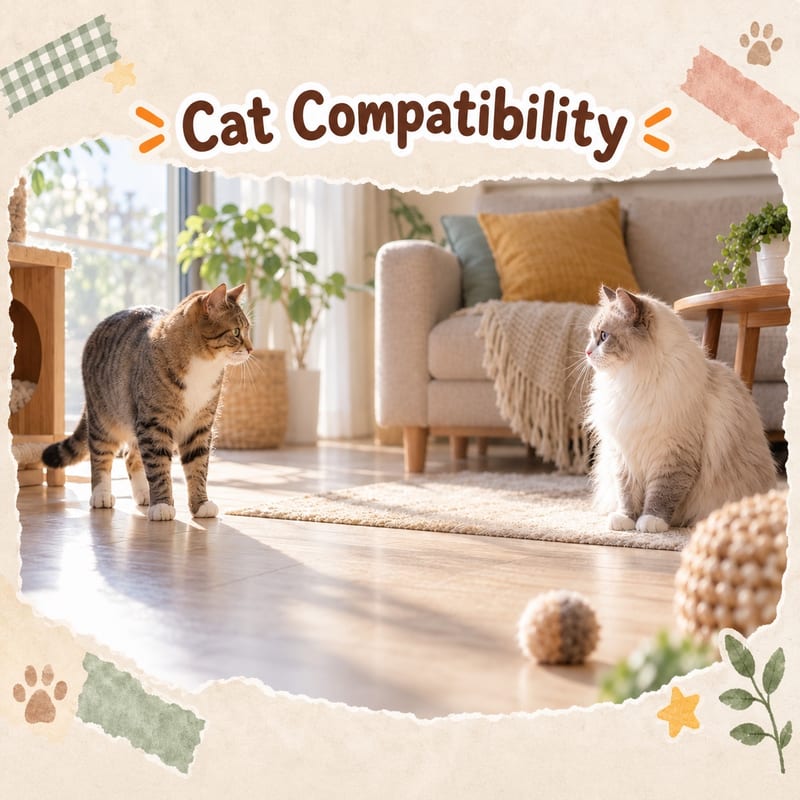
Which of the three personality types is most compatible?
1. Gentle and easy-going type
These cats are adaptable, have low territorial instincts, and are easiest to accept new companions:
- Ragdoll—famous for being as easy-going as a dog, first choice for multi-cat homes
- British Shorthair—calm and generous, not fussy
- American Shorthair—friendly and patient, good with cats and people
- Maine Coon—giant and gentle, very tolerant
2. Active and playful type
Full of energy, likes interaction, needs a same-type companion to burn off energy:
- Siamese—lively and active, clingy, needs company to avoid boredom
- Abyssinian—the athlete among cats, loves chasing
- Bengal—off the charts energy, best with a same-level playmate
- Oriental Shorthair—smart and active, needs lots of stimulation
3. Quiet and noise-sensitive type
Likes peace, slow to warm up, gets very stressed when chased:
- Persian / Exotic Shorthair—quiet and sedentary, dislike noise and chasing
- Chinchilla—elegant and slow to warm up, needs time to build trust
- Russian Blue—shy and slow to warm up, sensitive to environmental changes
- Chartreux—quiet and independent, dislikes being disturbed
Breed compatibility comparison table
| Resident cat | Best new cat match | Possible | Not recommended | Why this rating |
|---|---|---|---|---|
| Ragdoll | Ragdoll, Maine Coon, British Shorthair | American Shorthair, domestic shorthair | Bengal | Ragdoll is gentle but fears being overly harassed |
| Siamese | Siamese, Abyssinian, Oriental Shorthair | Domestic shorthair, American Shorthair | Persian | Siamese energy is too high; quiet cats will break down |
| Persian / Exotic | Persian, Chinchilla | British Shorthair, Russian Blue | Bengal, Abyssinian | Quiet cats need same-type slow living |
| Domestic shorthair (mixed) | Domestic shorthair, American Shorthair | British Shorthair, Ragdoll | Depends on personality | Domestic shorthairs are adaptable but vary individually |
| Bengal | Bengal, Abyssinian | Siamese | Persian, Chinchilla | Energy levels too far apart |
Transparent rating criteria: The above is based on a comprehensive assessment of typical energy levels, territorial instincts, socialisation levels of each breed and veterinary behaviour literature; actual compatibility still depends on the individual cat's personality.
The influence of age, sex and neutering
- Age gap: A gap of 1 to 3 years is easiest to integrate; be especially careful with an older cat and a kitten—the kitten will disturb the older cat's rest
- Sex: If both are neutered, a male-female pair is usually the most harmonious; two unneutered males are most likely to fight
- Neutering: After neutering, hormone-driven aggression is greatly reduced; for multi-cat homes, neutering all cats is strongly recommended
Correct process for bringing a new cat home
-
Isolation period (days 1 to 7): The new cat stays in a separate room with water, food and cat litter; the resident cat only smells the scent
-
Scent exchange (days 4 to 7): Swap blankets and toys so both become familiar with each other's scent
-
Meeting through the door (days 7 to 10): Use a baby gate or glass door for them to see each other, observe reactions
-
Supervised contact (days 10 to 14): Short daily sessions together with treat rewards
-
Formal cohabitation: Only when there is no hissing or chasing for several days can you fully let go
Double the resources: Number of litter trays = number of cats + 1; food and water bowls placed separately; enough high resting spots so the weaker cat has an escape route.
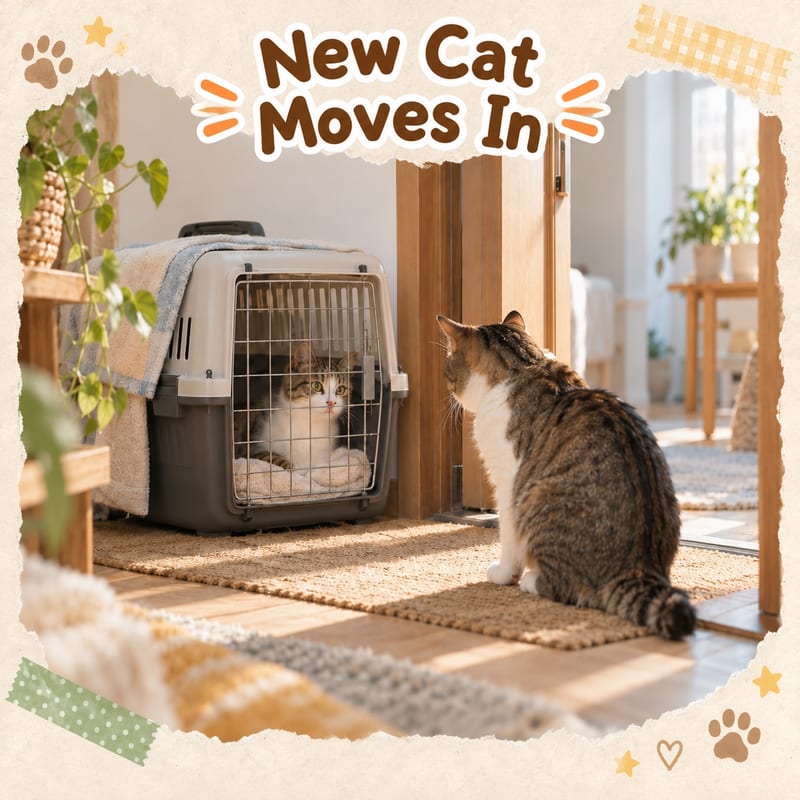
Hong Kong small flat practical: 7-day isolation and gradual introduction checklist for small units
Hong Kong property is expensive, and many cat owners live in open-plan or one-bedroom units of just over 300 square feet, so isolating a new cat seems like Mission Impossible. Actually, by making good use of space and a schedule, you can get it done in seven days.
Day 1–2: Zoning
- Use the bathroom as a temporary room for the new cat: place a litter tray, water bowl, cardboard box bed, and add a pet gate at the door (available on Taobao for $80).
- The resident cat continues to use the living room, but swap spaces at least once a day so both cats smell each other's scent.
Day 3–4: Scent exchange
- Swap towels or toys used by the two cats and place them around so the scents gradually permeate.
- Hong Kong weather is humid, so towels must be dried daily before reuse to avoid mould.
Day 5: Meeting through the door
- Open the bathroom door, use a baby gate to separate them, and let the two cats meet through the bars.
- If hissing or puffing up occurs, stop immediately and try again the next day; if no reaction, extend to 10 minutes.
Day 6: Short time together
- Choose the resident cat's most relaxed time (usually before eating and sleeping), put the new cat in the living room for 5 minutes, with humans present throughout.
- Prepare small treats; reward both cats when calm to build positive associations.
Day 7: Assess cohabitation
- If two consecutive short sessions together show no hostility, gradually increase the time; if chasing still occurs, go back to Day 5 and practise again.
- For small units, remember vertical space: add shelves or cat trees so the weaker cat has an escape route.
Hong Kong-specific tips
- Keep air-conditioning on for ventilation to reduce irritability caused by stuffiness.
- If living in a village house with a balcony, you can place the new cat's cage on the balcony for temporary isolation, but ensure safety netting and shade.
- For public or subsidised housing, remember the management office may not like pets; during isolation, avoid neighbour complaints and keep noise down.
Hong Kong small unit 7-day isolation practical checklist
Day 1–2: Zoning
- Use the bathroom as a temporary room for the new cat: place a litter tray, water bowl, cardboard box bed, and add a pet gate at the door (available on Taobao for $80).
- The resident cat continues to use the living room, but swap spaces at least once a day so both cats smell each other's scent.
Day 3–4: Scent exchange
- Swap towels or toys used by the two cats and place them around so the scents gradually permeate.
- Hong Kong weather is humid, so towels must be dried daily before reuse to avoid mould.
Day 5: Meeting through the door
- Open the bathroom door, use a baby gate to separate them, and let the two cats meet through the bars.
- If hissing or puffing up occurs, stop immediately and try again the next day; if no reaction, extend to 10 minutes.
Day 6: Short time together
- Choose the resident cat's most relaxed time (usually before eating and sleeping), put the new cat in the living room for 5 minutes, with humans present throughout.
- Prepare small treats; reward both cats when calm to build positive associations.
Day 7: Assess cohabitation
- If two consecutive short sessions together show no hostility, gradually increase the time; if chasing still occurs, go back to Day 5 and practise again.
- For small units, remember vertical space: add shelves or cat trees so the weaker cat has an escape route.
Hong Kong-specific tips
- Keep air-conditioning on for ventilation to reduce irritability caused by stuffiness.
- If living in a village house with a balcony, you can place the new cat's cage on the balcony for temporary isolation, but ensure safety netting and shade.
- For public or subsidised housing, remember the management office may not like pets; during isolation, avoid neighbour complaints and keep noise down.
📌 Key summary
- ✅ Matching energy levels is the most reliable
- ✅ Ragdoll, British Shorthair, American Shorthair are almost universally compatible
- ❌ Active cats paired with quiet cats easily cause long-term stress
- ❌ Two unneutered males easily fight
- ✅ Isolation and gradual introduction for 7 to 14 days greatly increases success rate



