
🤖 AI Summary
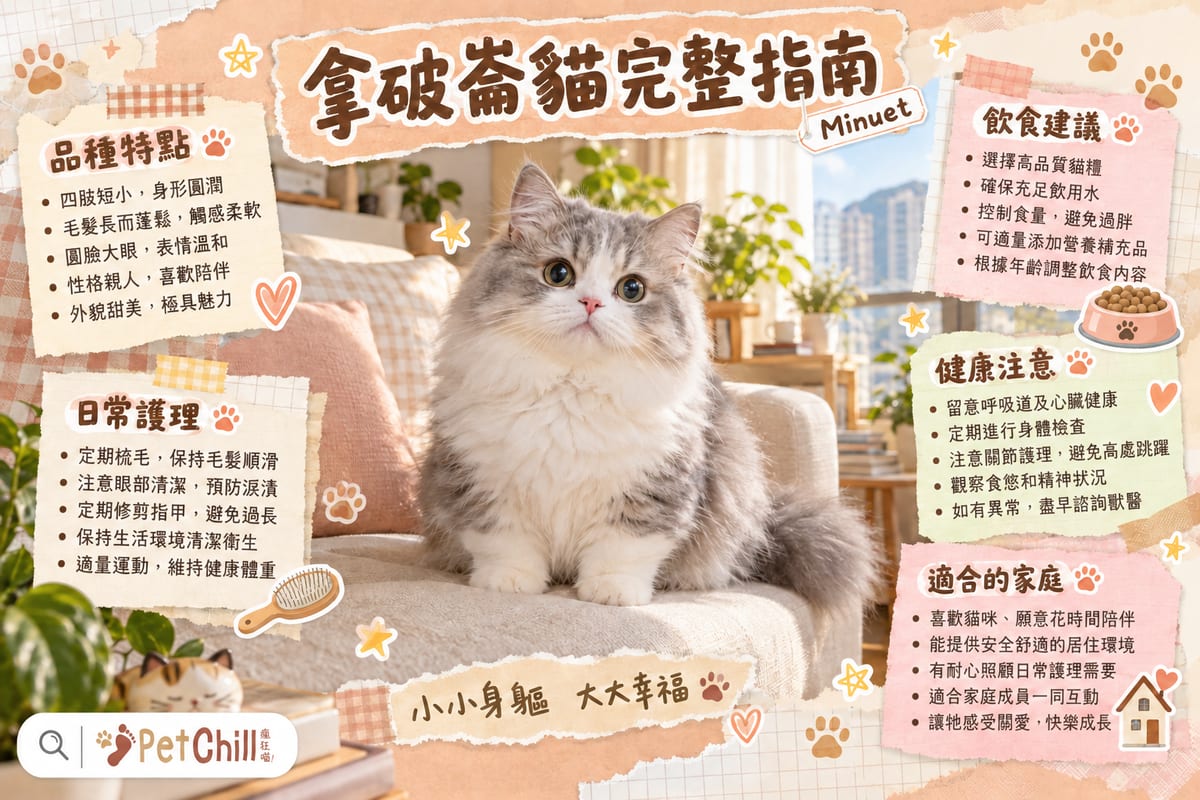
The Napoleon cat (English name Minuet, formerly Napoleon) is a man-made cross between the Munchkin and the Persian family, first bred in the USA in 1996, officially renamed by TICA in 2015, and adopting a new breed standard from May 2026.
• The same litter can have short-legged and long-legged kittens; MNT/MNL/MTT/MTL are all the same breed
• Health risks come from both parent lines: PKD, HCM, tear ducts, plus the spinal and joint burden of short legs
• The key to buying is not the price, but the parents' PKD ultrasound and heart examination records
Quick answer: The Napoleon cat (Minuet) is a cross between the Munchkin (short legs) and the Persian family (round face, long coat), characterised by short legs with a baby face, a gentle, clingy personality and moderate activity. It has no independent new-breed diseases; all risks are inherited from both parent lines: polycystic kidney disease, hypertrophic cardiomyopathy, blocked tear ducts, and the spinal and joint burden brought by the short-leg gene. In Hong Kong, 2026 pet-grade reference prices are around HKD 10,000 to 20,000, pedigree grade HKD 20,000 to 35,000, but price does not equal health.
Contents
-
What breed is the Napoleon cat? Origin and basic facts
-
The short-leg gene and the four types
-
Personality and key points for living together
-
Health risks and when to see a veterinarian
-
The reality of keeping one in Hong Kong
-
Price, adoption and verification checklist
-
Six self-check questions before buying
-
FAQ
What breed is the Napoleon cat? Origin and basic facts
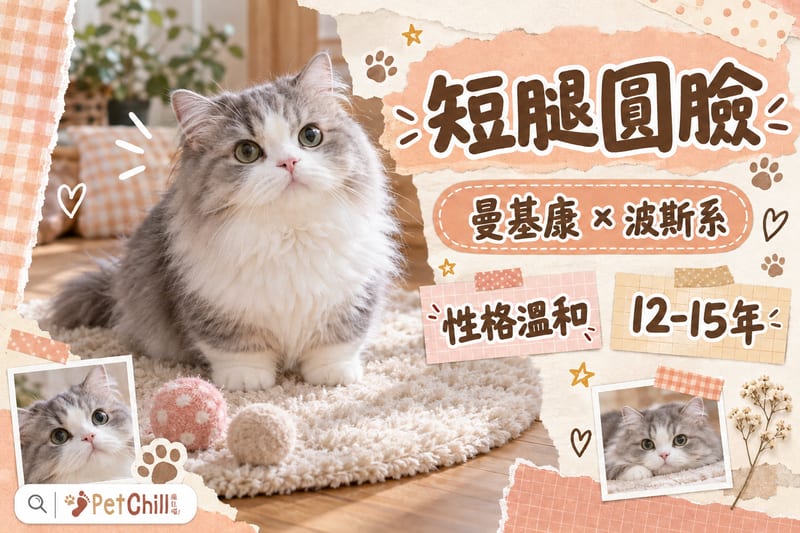
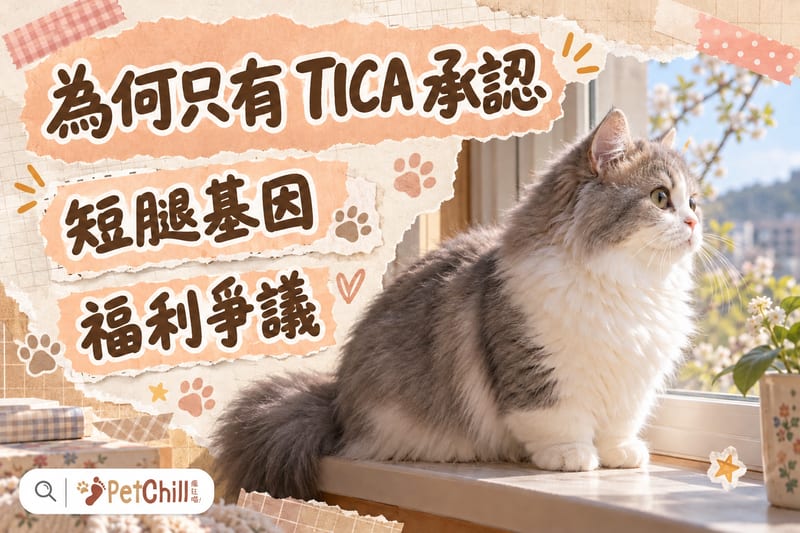
The Napoleon cat's English name is Minuet, formerly Napoleon. In 1996, American breeder Joe Smith crossed the Munchkin with the Persian family, aiming for "short legs but not looking like a Munchkin, round face but not looking like an extreme flat-faced Persian" — using the Persian family's roundness to soften the Munchkin's angles while keeping a longer muzzle to avoid the breathing difficulties of an extreme flat face. TICA classifies it as a domestic cat cross; it entered the experimental breed group in 2001 and gained full championship status in 2016; in 2015 TICA voted to change the name from Napoleon to Minuet because the original name had always been controversial. Currently only TICA recognises the breed; major registries such as CFA do not accept registration, partly due to animal welfare concerns about the short-leg gene. In August 2025 TICA passed a new standard, effective 1 May 2026, dividing the Minuet into short-legged and long-legged groups.
| Item | Details |
|---|---|
| English name | Minuet (formerly Napoleon) |
| Parent breeds | Munchkin × Persian family (Persian, Himalayan, Exotic Shorthair) |
| Origin | 1996, USA |
| Registry | TICA (the only major registry that recognises it) |
| Body type | Medium, semi-cobby, sturdy bone |
| Weight | About 2.5–4.5 kg; long-legged individuals can exceed 5 kg |
| Lifespan | Generally 12–15 years |
| Coat | Shorthair (MNT/MTT) and longhair (MNL/MTL) both exist |
| Personality keywords | Gentle, clingy, curious, moderate activity |
Weight and lifespan are general breed ranges; actual values depend on the individual and how it is kept. Short-legged individuals carry more skeletal load, so weight control matters more than chasing a higher weight.
The short-leg gene and the four types
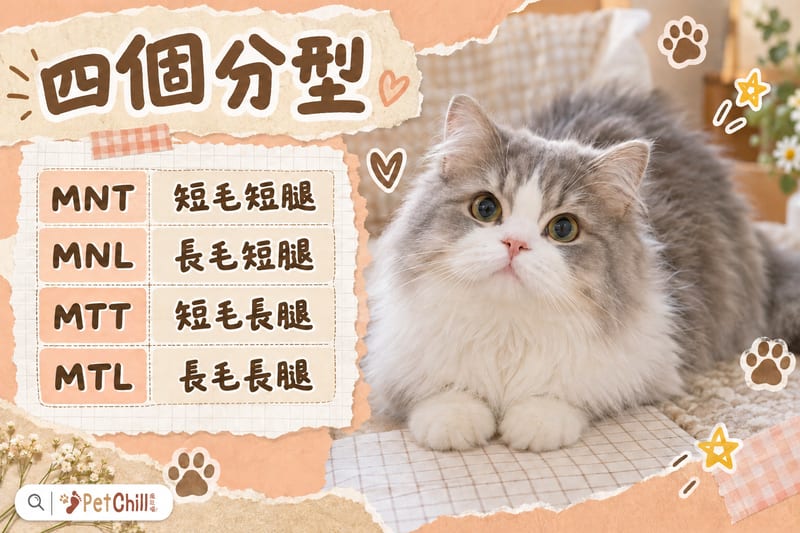
The short-leg trait comes from the Munchkin's chondrodysplasia gene and is inherited as dominant. This gene has a key feature: embryos with a pair of the alleles together (homozygous) cannot develop, so every mating produces both short-legged and long-legged kittens in the same litter. Long-legged kittens are not "impure"; they are still Napoleon cats, and TICA gives them separate codes. In practice, long-legged individuals jump almost like ordinary domestic cats and have less joint burden; short-legged individuals need environmental modification to compensate.
| Code | Coat | Leg length | Commonness in Hong Kong |
|---|---|---|---|
| MNT | Shorthair | Short legs | Rare |
| MNL | Longhair | Short legs | Most common |
| MTT | Shorthair | Long legs | Rare |
| MTL | Longhair | Long legs | Rare |
The Hong Kong market is dominated by longhaired short-legged (MNL) cats because sellers mostly use longhaired Persian-family parents, giving the look closest to the market image of a "baby-faced short-legged cat". If you only want short legs, you must accept that littermates may be long-legged; conversely, if you don't mind long legs, the shorthaired long-legged (MTT) is actually much easier to care for in Hong Kong summers.
Personality and key points for living together
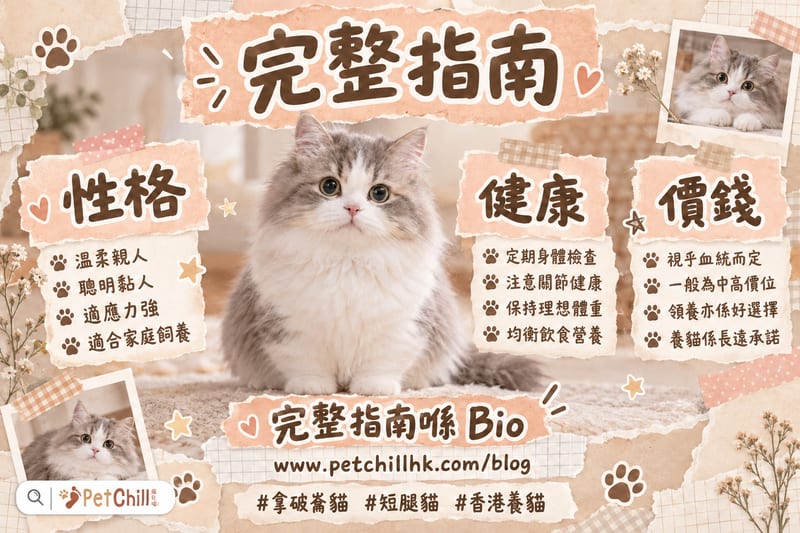
The Napoleon cat's personality is roughly midway between its two parent lines: the Persian family's calmness, dislike of conflict and preference for a stable environment, plus the Munchkin's curiosity and playfulness. Most individuals are the "clingy but not annoying" type, following you from living room to bedroom and liking to sit beside you, but not like a Siamese demanding interaction all the time. With strangers they usually observe first and approach later; they are not the type to roll over on first meeting.
Two things you must accept in advance. First, short legs mean it cannot jump high, but that does not mean it won't try — it will jump onto the sofa, bed edge and windowsill, just with poorer landing control and a loud landing, so use steps and non-slip mats. Second, the Persian-family blood makes some individuals more sensitive to environmental change; when moving house, renovating or adding a new family member, they need a fixed hiding spot and a maintained routine, otherwise stress responses such as not eating or inappropriate urination may appear. If there are children at home, the key is to teach "sit down to pet, don't lift high" — a short-legged cat has nothing to brace against when picked up, and forced holding easily leads to scratches and falls.
Health risks and when to see a veterinarian
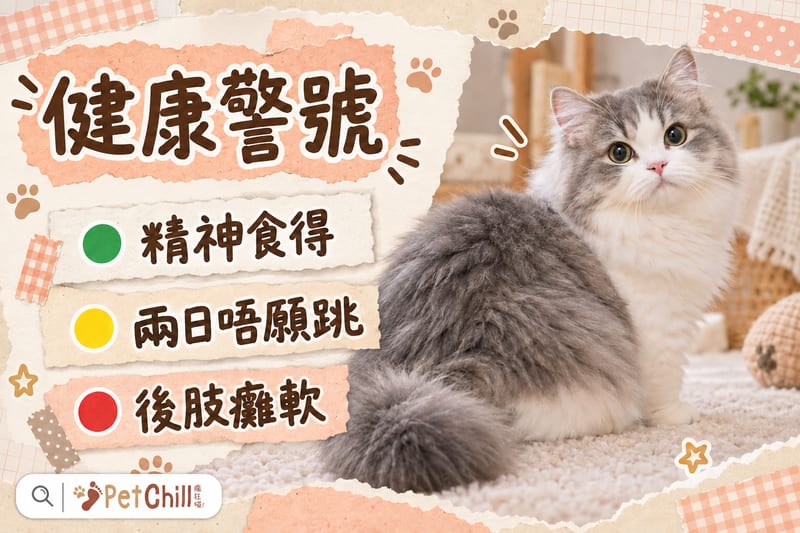
The health problems are not a single new-breed disease but the stacking of risks from both parent lines. The Persian family's classic issue is polycystic kidney disease (PKD); affected cats' kidneys gradually develop cysts, and there may be no symptoms at all early on. On the heart side there is hypertrophic cardiomyopathy (HCM); the facial structure makes blocked tear ducts more likely. On the short-leg gene side, common issues are abnormal spinal curvature, intervertebral disc problems and joint degeneration, which aggravate each other with excess weight. Anaesthesia and hypothermia risks also need more attention than with an ordinary cat.
| Risk | Cause | What to watch day to day | When to see a veterinarian |
|---|---|---|---|
| Polycystic kidney disease (PKD) | Persian-family inheritance | Water intake, urine volume, weight changes | Confirmed carriers: blood test + ultrasound every six months |
| Hypertrophic cardiomyopathy (HCM) | Familial inheritance | Panting after exercise, sudden hind-limb weakness | Open-mouth breathing or hind-limb paralysis is an emergency |
| Blocked tear ducts | Facial structure | Tear staining, colour of eye discharge | If discharge turns yellow-green or the cat squints, check immediately |
| Spinal/joint degeneration | Short-leg gene + weight | Reluctance to jump, stiff walking | Not willing to move for more than two days |
| Obesity | Low activity + indoor living | Can't feel ribs, waistline gone | Adjust the diet as soon as weight exceeds by 10% |
Frankly, PKD and HCM are both "you only know after testing" diseases; you cannot tell from appearance. So the useful approach is: before buying, ask for the parents' PKD ultrasound reports and heart ultrasound records, and confirm the reports are issued by a registered veterinarian with dates and microchip numbers that match. Without reports, no matter how cheap, the risk is being transferred to you.
The reality of keeping one in Hong Kong
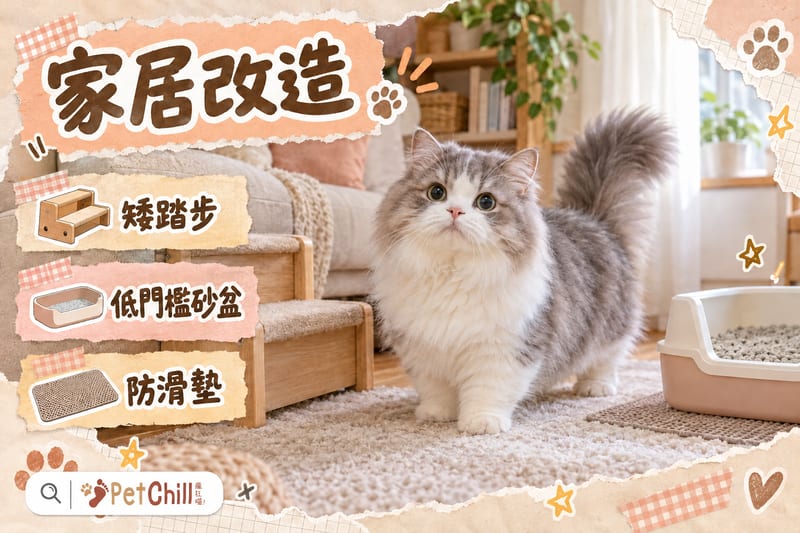
Hong Kong's small flats are actually not a bad thing for the Napoleon cat: its activity is moderate, and a 200–300 sq ft living room plus windowsill is enough; the key is "use low steps for vertical space". A short-legged cat already struggles to jump from the floor onto a platform 40 cm or higher, and forcing a jump will hurt its joints, so it is recommended to build a staircase-style route with two to three steps (15–20 cm each) and lay non-slip mats or short-pile carpet at landing spots. Choose a litter box with a low threshold or a front opening; high-sided boxes make short-legged cats likely to give up using them and then urinate inappropriately.
Hot and humid weather is the second key point. Longhaired types need air-conditioning or dehumidifying on for long periods in Hong Kong summers, aiming for indoor humidity of 50–60%, otherwise skin mould and follicle problems are more likely; daily brushing is not just for looks but for early detection of mats and red skin spots. A short-legged cat's belly is close to the floor, so watch the floor temperature in summer too.
| Item | Monthly estimate (HKD) | Notes |
|---|---|---|
| Staple food (dry + wet) | 400–800 | Medium longhaired cat; a high wet-food ratio raises costs |
| Cat litter | 120–250 | Low-threshold boxes use slightly more than ordinary boxes |
| Brushing/grooming supplies | 80–200 | Longhaired type needs a slicker brush and comb |
| Air-conditioning/dehumidifier electricity (shared) | 200–500 | Long operation in summer |
| Medical reserve | 300–600 | Recommend annual blood test + heart check |
| Insurance (optional) | 150–400 | Depends on breed restrictions and coverage |
These are general market estimates as of October 2026; actual expenses depend on brands and the cat's health.
Price, adoption and verification checklist
2026 Hong Kong prices roughly fall into three tiers: pet grade (no pedigree paper, basic vaccines) around HKD 10,000 to 20,000; pedigree grade with TICA registration and parents' health reports around HKD 20,000 to 35,000; show grade or imported lines can be higher. The Napoleon cat is a niche breed in Hong Kong with unstable supply, and prices within the same litter can vary greatly due to leg length, coat colour and face shape, so the concept of a "standard price" does not really hold. Those clearly below market price usually cut corners on health checks and source costs; those clearly overpriced without a clear explanation of the premium should be questioned about what exactly you are paying extra for.
| Grade | Reference price (HKD) | Should include |
|---|---|---|
| Pet grade | 10,000–20,000 | Basic vaccines, deworming, microchip |
| Pedigree grade | 20,000–35,000 | TICA registration, parents' PKD/HCM reports |
| Show/imported | 35,000 and above | Complete pedigree documents, import quarantine records |
For adoption, be prepared: the chance of a Napoleon cat appearing on Hong Kong adoption platforms is low, mostly adult rehoming or special cases. If what you really want is "a short-legged, round-faced companion cat", you can also watch for mixed short-legged cases at local organisations; you don't have to lock onto the breed name.
Six self-check questions before buying
- Do I want the short-legged look, or a gentle-natured cat?
- Can I accept that littermates may be long-legged, and that prices will differ accordingly?
- Do I have space at home for low steps and non-slip mats?
- Do I have 15–20 minutes a day to brush a long coat?
- Have I budgeted for annual blood tests and heart checks?
- If the cat develops kidney or heart problems at age five, can I afford long-term medical care?
If you answer "no" or "not sure" to three or more of the six, it is better to look at other breeds or consider adoption.
This article is for reference only and cannot replace veterinary diagnosis; for any health concerns please consult a registered veterinarian, and in emergencies seek medical help immediately.
Sources
- TICA — Minuet breed introduction and standard
- TICA — The Minuet Breed (August 2025 standard revision notes)
- Agriculture, Fisheries and Conservation Department — Animal Trading and Breeding (Cap. 139B regulations)
- Veterinary Surgeons Board of Hong Kong — Register of Registered Veterinary Surgeons
Key takeaways
- ✅ Napoleon cat = Munchkin × Persian family, renamed from Napoleon to Minuet in 2015, using the new standard from May 2026.
- ✅ The same litter has short-legged and long-legged kittens; MNT/MNL/MTT/MTL are all the same breed.
- ✅ Risks are inherited from both parent lines: PKD, HCM, blocked tear ducts, spinal and joint degeneration, obesity.
- ✅ Hong Kong keeping focuses on low steps, low-threshold litter boxes, non-slip mats, plus long hours of air-conditioning and dehumidifying.
- ✅ Before buying, always check the parents' PKD ultrasound and HCM heart reports.
Related reading
- Cat breed encyclopedia overview (this series)
- Munchkin cat complete guide
- Persian cat complete guide
- Hong Kong cat buying guide: 6 steps to verify licences and vaccination cards
- Cat breed lifespan ranking
PetChill's Reminder: A short-legged cat's joints and weight are on the same line — every extra 100 grams doubles the load on landing. Rather than buying the most expensive cat tree, first modify your home with carpets, steps and a low-threshold litter box, and add ten minutes of interactive play daily; that is already the most practical investment.



