
🤖 AI Summary
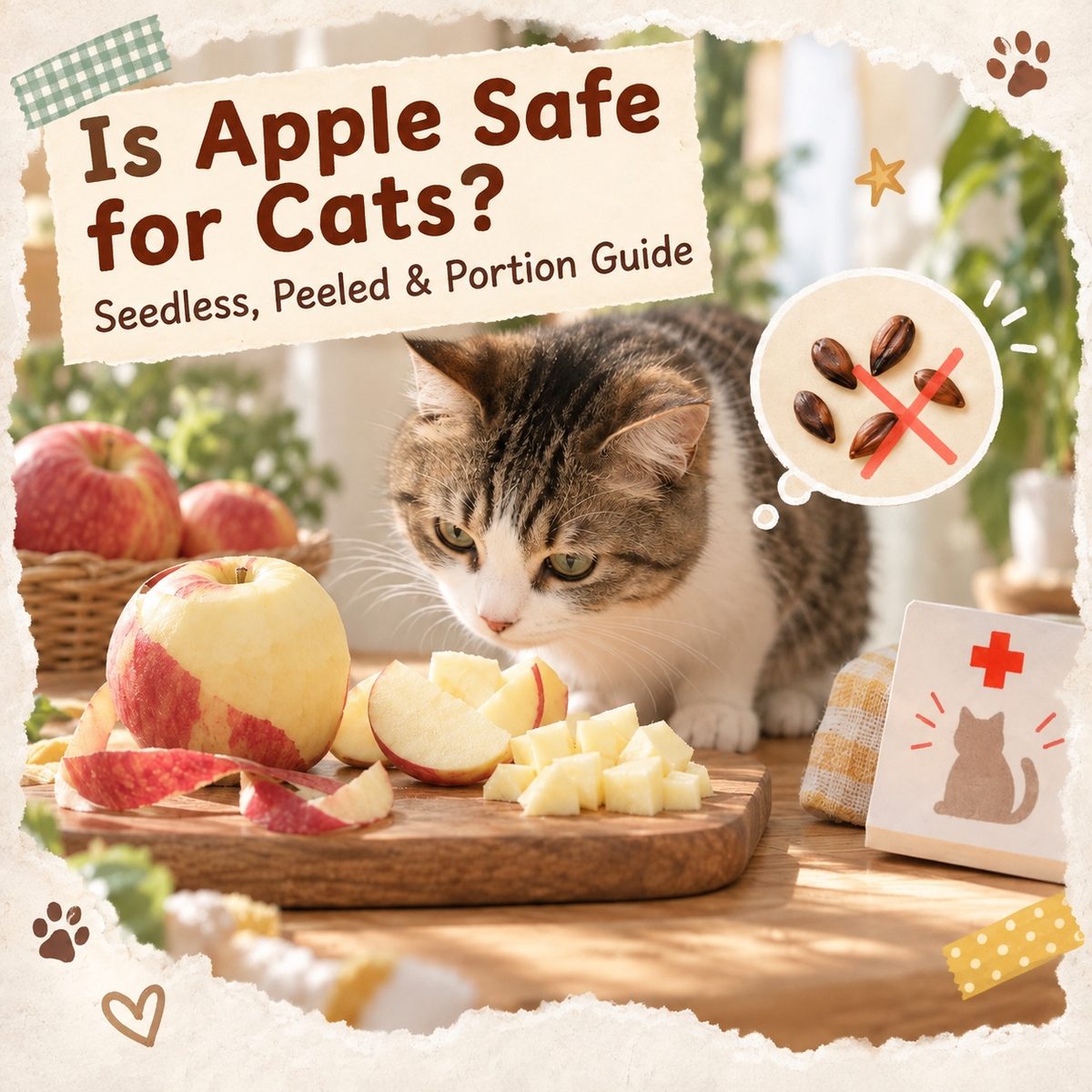
Apples are one of the safe fruits for cats — after deseeding, peeling and slicing thin, they can be given occasionally as a treat. Apples are rich in vitamin C, fibre and water. But note: apple seeds are not edible (they contain cyanogenic glycosides, which release hydrogen cyanide when crushed); apple skin can be eaten but is best peeled off (pesticide residue + coarse fibre); apple core is not edible (seeds concentrated). The portion limit is ≤10% of daily total calories.
• Apple flesh = safe, just deseed, peel and slice thin
• Apple seeds = not edible (contain cyanogenic glycosides)
• Apple core = not edible (seeds concentrated)
Quick answer: Apples are a safe fruit for cats — deseed, peel, cut into 1 to 2mm thin slices, and keep to ≤10% of daily total calories. Nutritional highlights: vitamin C (antioxidant), fibre (aids digestion), high water content (84%). Avoid: apple seeds (contain cyanogenic glycosides, which release hydrogen cyanide when crushed), apple core (seeds concentrated), high sugar (caution or avoid for diabetic/obese cats). Available year-round in Hong Kong supermarkets, about HKD 3 to 8 each.
Contents
-
✅ Safe to eat! But watch which parts
-
Nutritional benefits
-
⚠️ Risky parts table
-
Safe feeding SOP
-
Portion quick-reference table
-
Common misconceptions about cats eating apples
-
Accidental ingestion first aid card
-
FAQ
✅ Safe to eat! But watch which parts
Apple is an ASPCA-certified safe fruit for cats. But "safe" comes with conditions — only the flesh, and it must be prepared correctly:
- Flesh ✅: deseed, peel and slice thin — safe, nutritious, and some cats will enjoy it
- Apple seeds ❌: contain cyanogenic glycosides — release hydrogen cyanide when crushed
- Apple core ❌: seeds concentrated — same risk as apple seeds
- Apple skin ⚠️: can be eaten but best peeled off — pesticide residue + coarse fibre hard to digest
Remember in one sentence: Flesh is fine, seeds and core are not.
Nutritional benefits
| Nutrient | Content per 100g apple | Benefit for cats |
|---|---|---|
| Water | About 84% | Natural hydration |
| Vitamin C | About 4.6 mg | Antioxidant |
| Dietary fibre | About 2.4 g | Aids digestion (small amount) |
| Potassium | About 107 mg | Muscle function |
| Calories | About 52 kcal | Low-calorie treat (but watch the high sugar) |
Highlights: Apple is a low-calorie + high-water combination — as a treat it is not too heavy, and it can help cats hydrate. Fibre content is moderate, which helps digestion.
But note: Nutritional benefits do not mean you should feed a lot — apples are a high-sugar fruit (about 10g sugar per 100g), so portion control is essential.
⚠️ Risky parts table
| Part | Risk | Reason | Consequence |
|---|---|---|---|
| Apple seeds | ❌ Not edible | Contain cyanogenic glycosides — release hydrogen cyanide when crushed | Cyanide poisoning |
| Apple core | ❌ Not edible | Seeds concentrated | Cyanide poisoning |
| Apple skin | ⚠️ Best peeled off | Pesticide residue + coarse fibre | Gastrointestinal irritation (low risk) |
| Flesh (excess) | ⚠️ Control portion | High sugar | Obesity, diarrhoea, blood sugar fluctuations |
| Processed products (apple sauce, apple juice) | ❌ Not edible | Soaked in syrup = high sugar | Obesity, gastrointestinal upset |
High-risk cat groups (caution or avoid):
- Diabetic cats — high sugar can cause blood sugar to spike
- Obese cats — extra sugar worsens weight problems
- Cats with sensitive stomachs — new food may cause diarrhoea
Apple seed toxicity:
Apple seeds contain cyanogenic glycosides — but the content is relatively low (compared to cherry stones). 1 to 2 apple seeds pose a very low cyanide risk to cats, but not edible is not edible — do not take the risk.
Safe feeding SOP
Five-step safety method:
-
Selection: Choose a fresh but not overripe apple — smooth skin, no damage
-
Washing: Rub and wash the skin under running water for at least 30 seconds (wash before cutting — the knife can carry bacteria from the skin into the flesh)
-
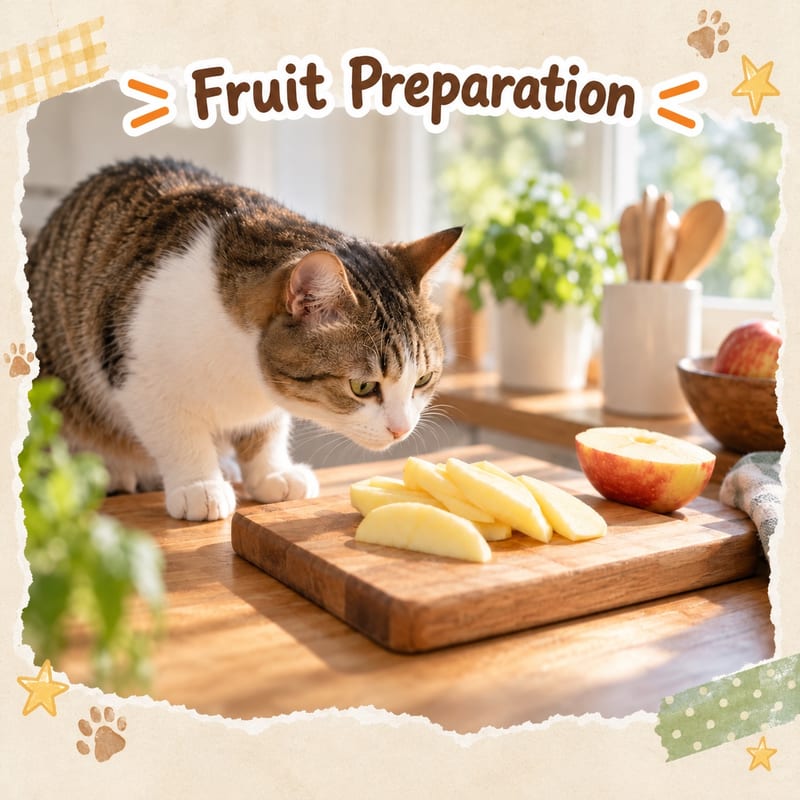
Preparation: Cut open → completely remove all seeds and core → peel off all skin (peeling recommended, pesticide residue + coarse fibre)
-
Slice thin: Cut into 1 to 2mm thin slices — cats have small mouths, thin slices prevent choking
-
Feeding: Put in a bowl to feed → first time give only a fingertip amount → observe for 24 hours for any gastrointestinal reaction
Forbidden processed products: Apple sauce (high sugar), apple juice (sugar concentrated, no fibre), apple pie (sugar + butter), caramel apple (caramel = high sugar).
Portion quick-reference table
| Cat weight | Daily apple limit | Thin-sliced portion | Frequency |
|---|---|---|---|
| 3kg | ≤3 kcal | 1 small slice | 1 to 2 times per week |
| 4kg | ≤4 kcal | 1 to 2 small slices | 1 to 2 times per week |
| 5kg | ≤5 kcal | 2 small slices | 1 to 2 times per week |
| 6kg+ | ≤6 kcal | 2 to 3 small slices | 1 to 2 times per week |
Calculation logic: A cat's daily calorie requirement is about 200 to 300 kcal (depending on weight/neutering/activity level), and fruit treats should make up ≤10%. Apple is about 52 kcal per 100g.
The portion limit is ≤10% of daily total calories: It does not need to be eaten daily; 1 to 2 times per week is already a good treat frequency.
Common misconceptions about cats eating apples
Misconception 1: "Apple seeds are tiny, eating them should be fine"
→ Apple seeds contain cyanogenic glycosides — although the content is far lower than cherry stones, they are still not edible. 1 to 2 seeds pose a very low risk, but do not take the risk.
Misconception 2: "Apple skin is nutritious, no need to peel"
→ Apple skin can be eaten, but it is best peeled off — pesticide residue is mainly on the skin, and the coarse fibre is a burden on a cat's stomach. If you insist on keeping the skin, wash it thoroughly and only consider organic apples.
Misconception 3: "Apples are natural and safe, so eating more is fine"
→ Apples are a high-sugar fruit — excess can cause obesity, diarrhoea and blood sugar fluctuations. Portion control is key.
Misconception 4: "Apple core is as safe as the flesh"
→ The apple core is the part where seeds are concentrated — the seeds contain cyanogenic glycosides and are not edible. When cutting an apple, always completely remove the core.
Accidental ingestion first aid card
🚨 Cat accidental ingestion of apple seeds/core first aid card
Symptoms (hours to 24 hours after eating):
- Repeated vomiting (may see seed/core remnants)
- Diarrhoea
- Sharp drop in appetite
- Abdominal pain (arched back, will not let you touch the belly)
- Difficulty defecating or no defecation (sign of intestinal obstruction)
Immediate action:
-
Record the time of ingestion + estimate the amount (how many seeds/how much core)
-
If only a small amount of flesh was eaten → observe for 24 hours, mostly harmless
-
If seeds or core were eaten → take to the veterinarian for assessment (especially kittens/small cats)
-
If repeated vomiting/no defecation occurs → take to emergency immediately (intestinal obstruction can be very serious)
-
Do not induce vomiting yourself — incorrect methods can cause aspiration
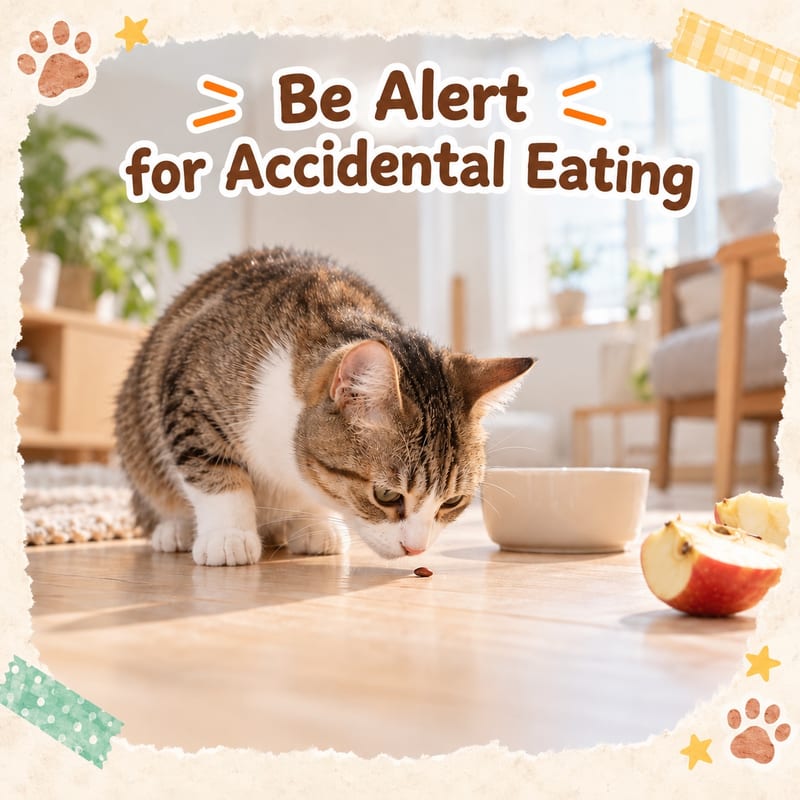
Prevention: When cutting an apple, immediately throw the seeds and core into a lidded bin — do not leave them where the cat can find them.
This article is for reference only and cannot replace veterinary diagnosis. If you suspect accidental ingestion, consult a registered veterinarian immediately.
Hong Kong small-unit practical guide: 3 steps in the kitchen, zero mistakes
Hong Kong kitchens are small, but you can still safely prepare apples for cats without a big setup.
1. Choose the fruit
ParknShop, Wellcome and Market Place have fresh New Zealand or US Fuji apples daily; choose a small one (about 150 g) which is enough for several servings. Look for smooth skin and no bruises; you do not need the most expensive, but it must be fresh.
2. Minimal tools
- Use a small separate chopping board dedicated to cat treats, not shared with raw meat.
- Use an ordinary peeler to remove the skin, then cut in half, scoop out the whole core with a teaspoon, and cut into 1–2 mm thin slices.
- Put the sliced apple immediately into an airtight box; it keeps in the fridge for 48 hours. Take out and leave at room temperature for 10 minutes before feeding to avoid the cold irritating the stomach.
3. Feeding scenario
- Bowl: use the ceramic bowl your cat normally eats wet food from; avoid plastic to prevent staining.
- First time give only a fingertip amount, observe for 24 hours; if no problems, increase to the recommended limit in the table.
- Throw away leftover flesh immediately; do not leave it by the bowl overnight to prevent fruit flies and bacteria.
When to see a doctor?
- If seeds or core were eaten, immediately pack the remnants and take the cat to a 24-hour emergency (CityU Veterinary, North Point PAW or Kowloon AMV are all open overnight).
- If only too much flesh was eaten and there is diarrhoea, you can withhold food for 12 hours and provide only water; if diarrhoea or vomiting persists within 24 hours, book a daytime clinic immediately.
Remember: Hong Kong's humid weather means cut apples must be thrown away if not eaten within 2 hours — do not be soft-hearted.
Further reading

📌 Key points
- ✅ Flesh is only safe after deseeding, peeling and slicing thin
- ✅ 1–2 times per week, calories ≤10%
- ❌ Seeds and core contain cyanogenic glycosides, release toxin when crushed
- ❌ High sugar easily causes obesity, diabetic cats should avoid
- ❌ Processed products like apple sauce and juice are not edible
 K9 Natural full guide →
 Feline Natural full guide →
 Fuji One full guide →

