
🤖 AI Summary
Chronic kidney disease (CKD) is the number one chronic illness in senior cats: incidence rises sharply from age 7, and "nine out of ten cats have kidney issues" isn't just a scare tactic. Kidneys don't regenerate, and by the time symptoms appear, most function is often already lost — so the key is test early, stage early, manage early.
• The international IRIS staging runs from Stage 1 to 4, determined by creatinine + SDMA + urine specific gravity — you can't rely on symptoms alone
• The five pillars of management: prescription renal diet, hydration, phosphorus control, blood pressure monitoring, regular rechecks
• Red lines: complete refusal to eat for 24 to 48 hours (fatty liver risk), vomiting + extreme weakness, seizures
Quick answer: Feline chronic kidney disease (CKD) is an irreversible condition in which kidney function gradually declines over more than 3 months, with incidence rising sharply in cats over 7. Diagnosis relies on blood tests (creatinine, SDMA) + urinalysis (urine specific gravity, proteinuria), staged 1 to 4 according to international IRIS standards. CKD cannot be cured, but staged management (renal prescription diet + hydration + phosphorus control + blood pressure monitoring) can effectively slow progression and maintain quality of life for years.
Contents
-
Why "nine out of ten cats have kidney issues"?
-
What do kidneys do? What happens when they fail?
-
Early signs: easily mistaken for "old age"
-
Diagnosis: SDMA catches the early stage
-
IRIS staging table: Stage 1 to 4, stage by stage
-
When to see a vet + emergency red lines
-
The five pillars of care + Hong Kong recheck rhythm
-
FAQ
Why "nine out of ten cats have kidney issues"?
"Nine out of ten cats have kidney issues" is a popular saying in the veterinary world describing how common feline kidney disease is — it may not literally be nine out of ten, but the data is indeed striking: cats are among the pets with the highest incidence of chronic kidney disease, rising noticeably from age 7, with cats over 15 hit especially hard.
Why cats in particular? Several innate factors: cat ancestors came from the desert and naturally have a low thirst drive, so long-term mild dehydration keeps the kidneys working overtime year-round; nephrons (the kidney's working units) have less innate reserve; and modern indoor cats get little exercise, with obesity and dental problems common — all of which chronically burden kidney function.
The trickiest part: the kidney is a "silent organ" — kidney function must be lost to a considerable degree before obvious symptoms appear, and by the time owners notice, it's often no longer early. So the core of this article isn't "what to do once they're sick" but "how to catch it before symptoms appear".
What do kidneys do? What happens when they fail?
The kidney isn't just a "filter" — it's the body's master coordinator of water and electrolytes:
- Waste removal — filters metabolic waste (urea etc.); kidney failure → toxin buildup → vomiting, bad breath, weight loss
- Water regulation — concentrates urine; kidney failure → dilute urine → increased drinking and urination
- Electrolytes and acid-base balance — potassium, phosphorus, calcium balance; kidney failure → high phosphorus → hyperparathyroidism → bone loss
- Blood production signals — secretes erythropoietin; kidney failure → anemia → weakness, pale gums
- Blood pressure regulation — kidney failure and high blood pressure are mutually causal, and can damage eyes and brain
Understanding this makes it clear why kidney cat symptoms are so "scattered": from drinking and urination, appetite and weight, to energy and coat — all are kidney-related. It also makes clear why management must be "multi-pronged", not solved by a single pill.
Early signs: easily mistaken for "old age"
Five early warning signs — if any apply, test the kidneys:
-
Increased drinking and urination — water bowl empties fast, litter clumps large and numerous
-
Slow weight loss — not sudden anorexia, but "eating yet losing weight"
-
Fluctuating appetite — picky eating, walks away after a few bites
-
Intermittent vomiting — not daily, but every few days
-
Dull coat, stronger breath — greasy, lackluster fur; urine/ammonia smell on the breath
All these signs can be masked by the words "he's just old" — which is exactly the main cause of delay. If a cat over 7 shows any one of these, it's worth doing a kidney function check.
How to tell kidney disease from normal aging? Aging is slow and steady; kidney disease is decline with signals — increased drinking and urination plus weight loss are the two most critical dividing lines.
Diagnosis: SDMA catches the early stage
- Creatinine — the traditional main marker, but its drawback is that it only rises after considerable kidney function loss
- SDMA — symmetric dimethylarginine, reflects declining kidney function earlier, an important recent breakthrough in CKD diagnosis, available at major Hong Kong laboratories
- Urine specific gravity (USG) — the kidney's ability to concentrate urine; early CKD typically shows "dilute urine"
- Urine protein (UPC) — proteinuria is an accelerator of progression, affecting staging and medication
- Blood pressure — CKD and high blood pressure are twins; it should be measured at every recheck
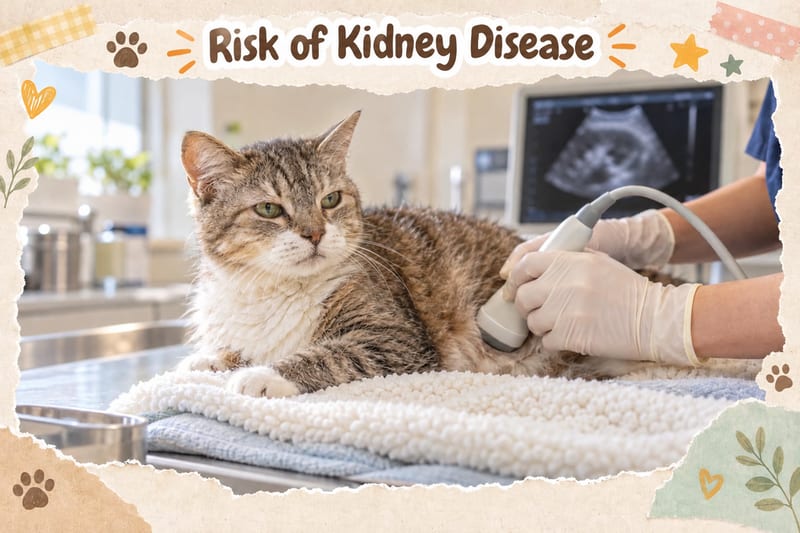
- Imaging — ultrasound to view kidney structure (atrophy, polycystic kidney etc.)
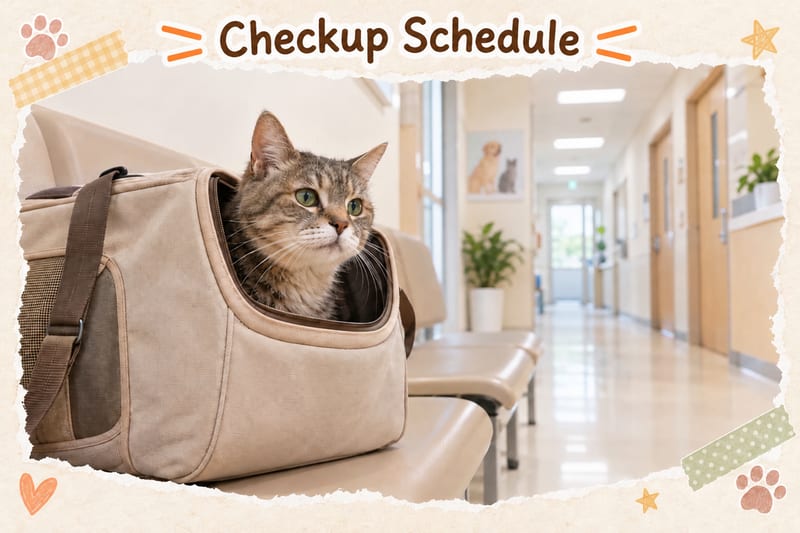
Hong Kong recommendation: From age 7, cats should have annual blood tests including SDMA + urinalysis + blood pressure once a year; for cats over 10 or already showing signs, every six months. The cost of health checks is far lower than late-stage treatment.
IRIS staging table: Stage 1 to 4, stage by stage
IRIS (International Renal Interest Society) is an international kidney research organization whose CKD staging is a globally used management map for veterinarians — staging relies on creatinine values (adjusted with SDMA, urine protein, blood pressure), and cannot be judged by symptoms alone.
| Stage | Creatinine (mg/dL) | Meaning | Typical presentation | Management focus |
|---|---|---|---|---|
| Stage 1 | <1.6 | Kidney abnormality but blood values not elevated | Dilute urine, proteinuria or structural abnormality | Find the cause, stabilize blood pressure, recheck every 6–12 months |
| Stage 2 | 1.6 to 2.8 | Mild renal insufficiency | Increased drinking and urination begins, most still bright | Renal prescription diet + phosphorus control + hydration, recheck every 6 months |
| Stage 3 | 2.9 to 5.0 | Moderate insufficiency, toxins evident | Weight loss, intermittent vomiting, fluctuating appetite | Add phosphate binders, subcutaneous fluids, anti-nausea, recheck every 3 months |
| Stage 4 | >5.0 | Severe failure | Marked weight loss, anemia, poor energy | Intensive management + nutritional support, consider palliative care, more frequent rechecks |
Two more subdivisions: Each stage is further subdivided by proteinuria (UPC <0.2 non-proteinuric / 0.2 to 0.4 borderline / >0.4 proteinuric) and blood pressure — both proteinuria and high blood pressure are "accelerators" that need additional medication to control.
Important concept: Staging is not a death sentence — the same Stage 3 can remain stable for years with good management; poor management can drop to Stage 4 within months. Staging determines strategy, rechecks determine success.
When to see a vet + emergency red lines
Red/green triage table:
| Situation | Verdict | Action |
|---|---|---|
| Over 7, no symptoms | 🟢 Prevention | Annual health check including SDMA + urinalysis + blood pressure |
| Increased drinking/urination or slow weight loss | 🟡 See vet | Kidney function test and staging as soon as possible |
| Diagnosed CKD, stable rechecks | 🟢 Management | Recheck according to stage rhythm |
| Complete refusal to eat over 24 hours | 🔴 Emergency | Kidney cat not eating → accelerated breakdown + fatty liver risk, treat immediately |
| Frequent vomiting + extreme weakness | 🔴 Emergency | Possible acute deterioration (acute-on-chronic) |
| Seizures, falling over, rapid breathing | 🔴 Critical | Hypertensive crisis / severe anemia / uremic encephalopathy, see vet immediately |
| Sudden complete inability to urinate | 🔴 Critical | Rule out obstruction (see urinary emergency article) |
The five pillars of care + Hong Kong recheck rhythm
1. Renal prescription diet — the single most evidence-backed measure to slow progression: low phosphorus, moderate high-quality protein. Transition gradually over 1 to 2 weeks; a kidney cat must not be starved — eating regular food is better than not eating at all, so transition flexibly.
2. Hydration — the lifeline for kidney cats: flowing water fountains, multiple water stations, wet food as the main diet; learn subcutaneous fluids in the mid-to-late stages (can be done at home, your vet will teach you), a common support for Stage 3 and above.
3. Phosphorus control — high phosphorus accelerates kidney deterioration: if prescription food isn't enough, add phosphate binders to meals; adjust based on regular phosphorus testing.
4. Blood pressure and proteinuria management — high blood pressure can trigger strokes and retinal detachment: antihypertensives (e.g. amlodipine) + proteinuria medication as needed.
5. Symptom support — anti-nausea injections/meds (maropitant, mirtazapine) to stimulate appetite and stop vomiting; erythropoietin for anemia; potassium supplementation if low — all adjusted according to blood test results.
Suggested recheck rhythm: Stage 1–2 every six months (blood test + urinalysis + blood pressure + weight); Stage 3 every 3 months; Stage 4 individualized and more frequent — every recheck is a chance to fine-tune treatment.
This article is for reference only and cannot replace veterinary diagnosis. If you have health concerns, please consult a registered veterinarian.

Further reading
📌 Key points
- ✅ From age 7, annual blood test + urinalysis + blood pressure to catch CKD early
- ✅ IRIS staging determines strategy, recheck frequency determines success
- ✅ Prescription renal diet + hydration + phosphorus control = the three big ways to slow progression
- ❌ Relying on symptoms alone misses the golden window for early treatment
- ❌ Forcing a cat to switch food; not eating leads to fatty liver
- ❌ Complete inability to urinate / seizures / 24 hours without eating — don't delay seeing a vet
 Feline Natural full guide →