
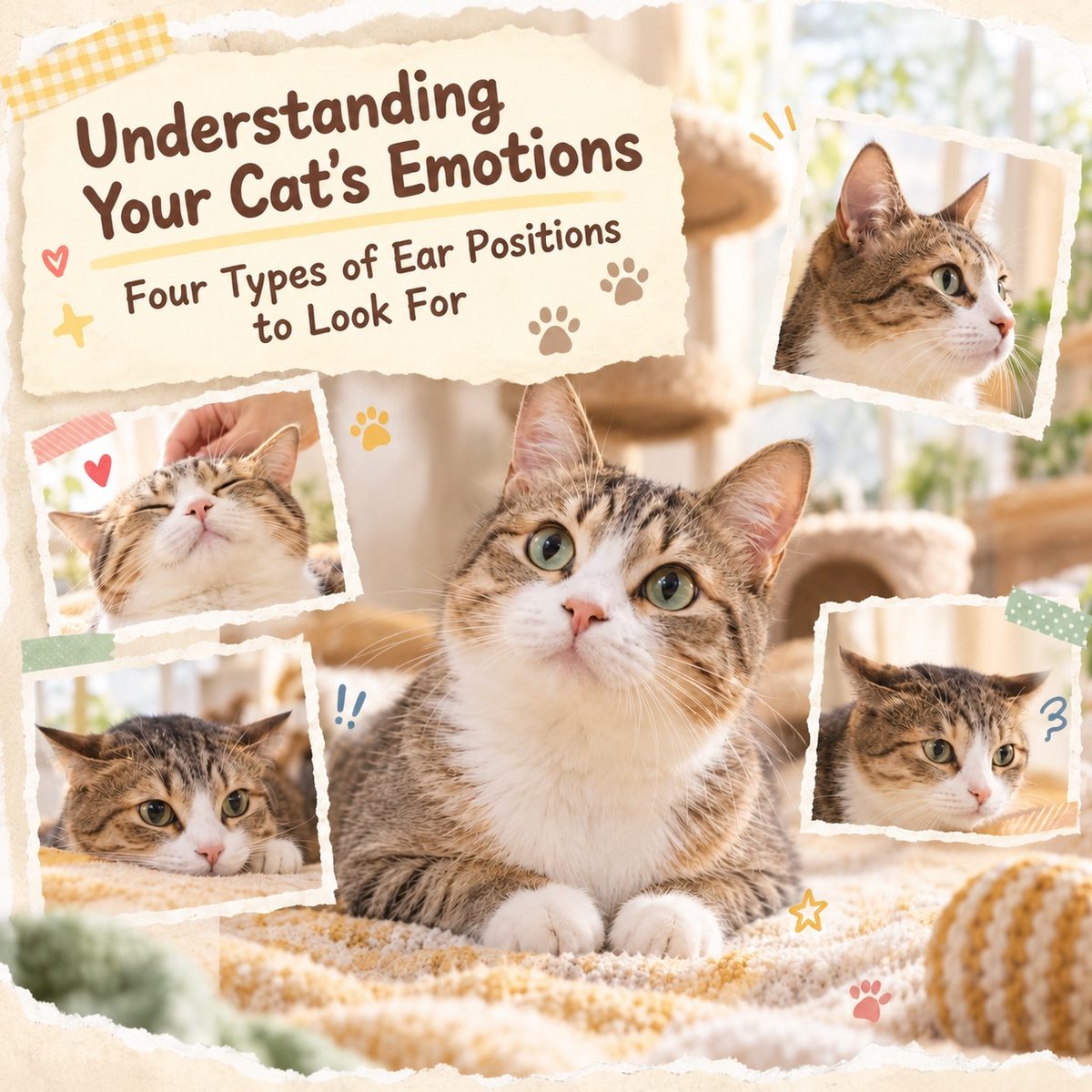
Quick answer: A cat's ears have over 30 muscles and can display four main positions—drooping means fear, flattened back means anger, facing forward and slightly outward means calm, and standing straight up means curiosity. By observing ear direction along with pupil size and whisker movement, you can instantly read your cat's mood and avoid misunderstandings that annoy your feline boss.
The Secret of Cat Ears: The Superpower of Over 30 Muscles
A cat's ears aren't just for hearing—they're also an important tool for expressing emotions. Compared to human ears, which have degenerated to only 6 muscles, cat ears have over 30 muscles and can flexibly turn in all directions. This design serves two purposes:
- Receiving sounds: Helps cats precisely locate the source of sounds around them
- Expressing emotions: Changes ear direction with mood, becoming the most intuitive emotional indicator
Besides ears, a cat's pupils and whiskers are also important observation points. Pupil size is not only affected by light but also changes with emotions; whiskers move forward or backward depending on interest and fear. By observing these three areas together, you can more accurately understand your cat's mood.

Learn the 4 Ear Positions at Once: From Fear to Curiosity
A cat's ears can display four main states, each representing a different emotion:
| Ear position | Emotion | Description | Typical scenario |
|---|---|---|---|
| Drooping | Fear | Ears droop and press close to the head | When encountering danger or fear |
| Flattened back | Anger/Alert | Ears turn sideways and point backward | When annoyed or preparing to attack |
| Facing forward, slightly outward | Calm | Ears face forward, back slightly visible | Relaxed, safe state |
| Standing straight up | Curiosity | Ears upright and facing forward | When interested in something |
🔴 Drooping: Fear signal
When a cat's ears droop, it means it is in a state of fear. This posture serves two purposes: protecting the important ears from harm and signaling to the other party, "I am small and weak, please don't hurt me." When you see this, it's best to give the cat space to calm down.
🟠 Flattened back: Anger and alertness
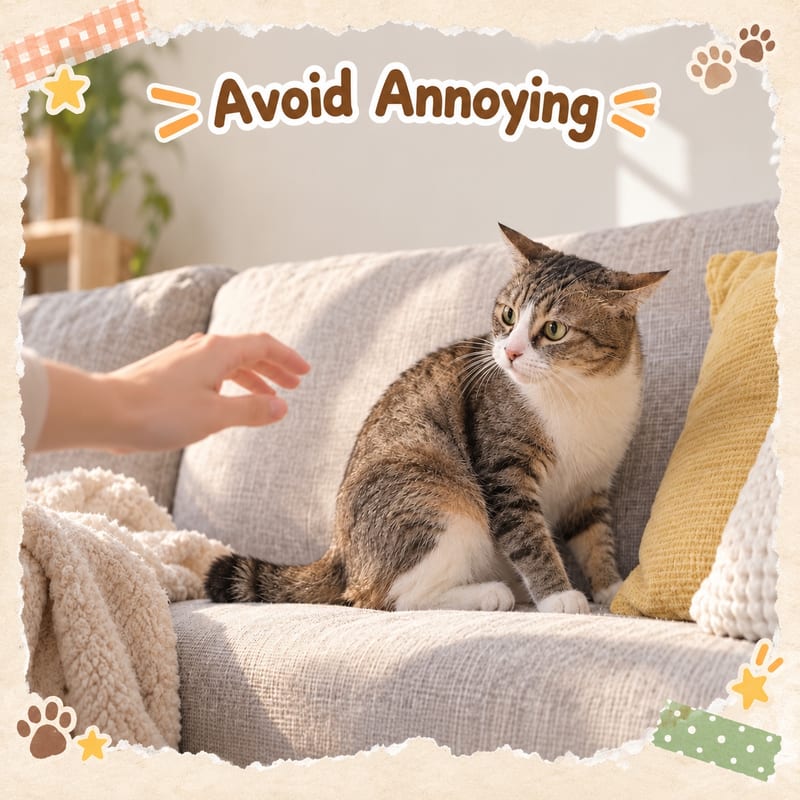
Ears turned sideways and pointing backward indicate anger or alertness. The cat may have seen something it dislikes, is feeling irritable, or even preparing to attack. At this time, never reach out to pet it, or you may get scratched.
🟢 Facing forward, slightly outward: Calm and relaxed
The most relaxed state: ears facing forward, slightly outward, with the back of the ears slightly visible. This is proof that the cat feels safe and comfortable—the best time to interact.
🔵 Standing straight up: Full of curiosity
Ears standing straight up and facing forward mean the cat has a strong interest in something. It is focused on observing, so don't disturb it—let it satisfy its curiosity.
Pupils + Whiskers: More Accurate When Observed Together
Judging a cat's mood by ears alone may not be comprehensive enough; observing pupils and whiskers together gives a more accurate picture:
The secret of pupil size
Pupil size is not only affected by light but also changes with emotions:
- Constricted pupils: May be a prelude to attack, or disgust at something
- Dilated pupils: Surprise, curiosity, excitement
- Medium pupils: Safe and content state
Try looking into your cat's eyes and calling its name, then observe the instant change in pupils to see its reaction to you. For a deeper look into your cat's visual world, see What does it mean when cats watch TV? Uncovering the truth behind staring at screens.
Whisker movement
Whiskers are a cat's most sensitive sensors:
- Forward: Gathering information about something interesting
- Naturally drooping: Calm state, no need for special sensing
- Pulled back: Feeling fear or threat
Practical Scenarios: How to Avoid Annoying Your Cat
Once you learn to read cat language, you can avoid many misunderstandings in daily life:
| Scenario | Cat's state | Correct action | Wrong action |
|---|---|---|---|
| Cat's ears droop | Fear | Wait quietly for it to calm down | Force-pick it up |
| Cat's ears flattened back | Anger | Immediately stop interacting | Continue petting |
| Cat's ears standing up | Curiosity | Observe but don't disturb | Interrupt its attention |
| Cat's ears calm | Relaxed | Gentle interaction is okay | Sudden movements that startle it |
Remember, a cat's emotional expression is based on two switches: "safe" and "dangerous." When it feels safe, it relaxes and is happy; when it feels danger, it wants to flee or fight. Understanding this will help you get along better with your cat.
To further understand the meaning of cat vocalizations, see Complete guide to cat sounds: The true meaning behind 6 meows. Combined with ear observation, the effect is even better.
Reading Ears in Hong Kong's Small Flats: 5 Steps from Observation to Action
Living in Hong Kong, space is small and noise is constant, so cats' emotions can fluctuate easily. Here are 5 steps to help you quickly judge and respond to your cat's mood using ear positions in limited space.
1. Set up an "observation spot"
Place a low stool in the living room and bedroom, at a height level with the cat tree. At a fixed time each day (e.g., 5 minutes after work), sit quietly and watch your cat. First record the three indicators—ear position, pupils, whiskers—to build an "emotion diary."
2. Sound management
Hong Kong has constant upstairs renovations and street noise. If your cat's ears suddenly droop, immediately close the windows, turn on the air-conditioning, or play a white noise app. Keep the volume just enough to mask outside sounds—not too loud, or it becomes a second scare.
3. Space zoning
Use an IKEA short bookcase or a pet tunnel to create a "safe corner" in a 200 sq ft flat. When your cat's ears flatten back, let it walk into the safe corner on its own; you stay put and don't chase. Remember to place a soft mat and pheromone spray in the corner to help it calm down faster.
4. Interaction timing
When you see ears facing forward and slightly outward, softly call your cat's name. If the pupils are not dilated and whiskers are naturally drooping, you can interact with a wand toy for 3–5 minutes. If the ears remain upright, it means the cat is still curious—switch to a puzzle toy, but keep your voice gentle throughout to avoid neighborhood renovation noise drowning out your voice.
5. When to see a vet
If your cat refuses food for two consecutive meals, ears remain droopy, and pupils are dilated, it means the issue has shifted from emotional to physical discomfort. Hong Kong has 24-hour veterinary clinics across Hong Kong Island, Kowloon, and the New Territories. You can first WhatsApp photos or short videos to the vet for a preliminary judgment, then decide whether a late-night trip is necessary, reducing travel stress for your cat.
Remember, in Hong Kong's cramped environment, your cat's ear positions change more frequently. As long as you observe daily at fixed times and respond quickly, even a small flat can give your feline boss a great sense of security.
Further Reading
Hong Kong 24-Hour Vet Map: Where to Go When Ear Positions Are Abnormal
Hong Kong is small, but there are quite a few 24-hour vets. Below is a breakdown by Hong Kong Island, Kowloon, and the New Territories so you can find the nearest support in the shortest time when your cat's ears remain droopy and pupils dilated.
Hong Kong Island
- North Point: Victoria Veterinary Hospital (3-minute walk from Fortress Hill Station Exit B)
- Wan Chai: Hong Kong Veterinary Emergency Centre (5 minutes from Wan Chai Station Exit A3)
Kowloon
- Mong Kok: CityU Veterinary Medical Centre (4 minutes from Mong Kok East Station Exit D)
- Tsim Sha Tsui: Kowloon Animal Hospital (6 minutes from Tsim Sha Tsui Station Exit L3)
New Territories
- Sha Tin: Sha Tin Veterinary Emergency Centre (2 minutes from City One Station Exit B)
- Tsuen Wan: Yan Oi Animal Hospital (5 minutes from Tsuen Wan West Station Exit C2)
3 steps before leaving home
- First use your phone to take pictures of your cat's ear position, pupils, and whiskers, and WhatsApp them to the clinic for the vet's preliminary judgment.
- Prepare a breathable cat carrier and a towel. If your cat's ears are flattened back, you can gently wrap it in the towel to reduce struggling.
- Use an app to book a "pet-friendly fleet" to avoid being unable to hail a taxi late at night.
Tips
- If the vet replies that you can observe first, stay home and continue monitoring ear position changes, and report back after 2 hours.
- If you really need to go out, remember to bring your cat's favorite small blanket; a familiar scent helps reduce stress.
- After returning home, upgrade the "safe corner": add another soft mat and a plug-in pheromone diffuser to help your cat fully relax.

 K9 Natural full guide →
 Feline Natural full guide →
 Fuji One full guide →

