
🤖 AI Summary
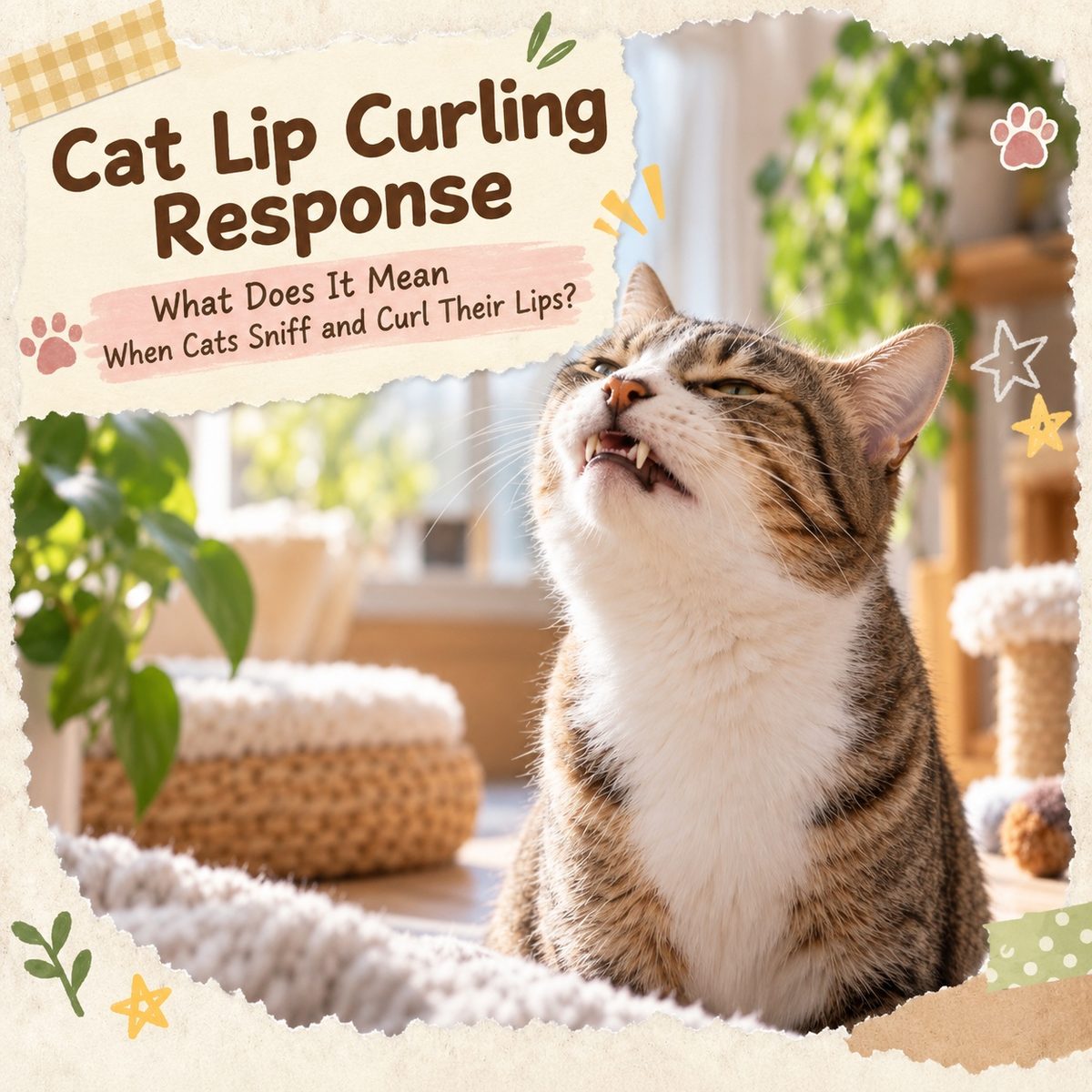
After sniffing certain scents, a cat lifts its head, opens its mouth, curls its upper lip, and stares blankly—as if something stinks. Actually, this is the Flehmen response (lip curl): curling the upper lip allows scent to enter the vomeronasal organ in the roof of the mouth, which analyzes complex information such as pheromones.
• It's not disgust! Your cat is in 'second gear,' seriously reading scent.
• Common triggers: urine marks from other cats, new smells, you just touched another animal.
• This is normal physiological behavior, different from vomiting or breathing difficulty.
Quick answer: The Flehmen response (lip curl) is when a cat, after sniffing a specific scent, curls its upper lip, half-opens its mouth, and pauses motionless. The purpose is to direct scent into the vomeronasal organ (Jacobson's organ) to analyze pheromones—especially social and reproductive messages from other cats. It's normal behavior; ignore it, and don't mistake it for your cat disliking you.
Contents
-
What is the Flehmen response?
-
Why does it happen? The secret of the vomeronasal organ
-
Common triggers
-
Flehmen vs discomfort: how to tell
-
FAQ
What is the Flehmen response?
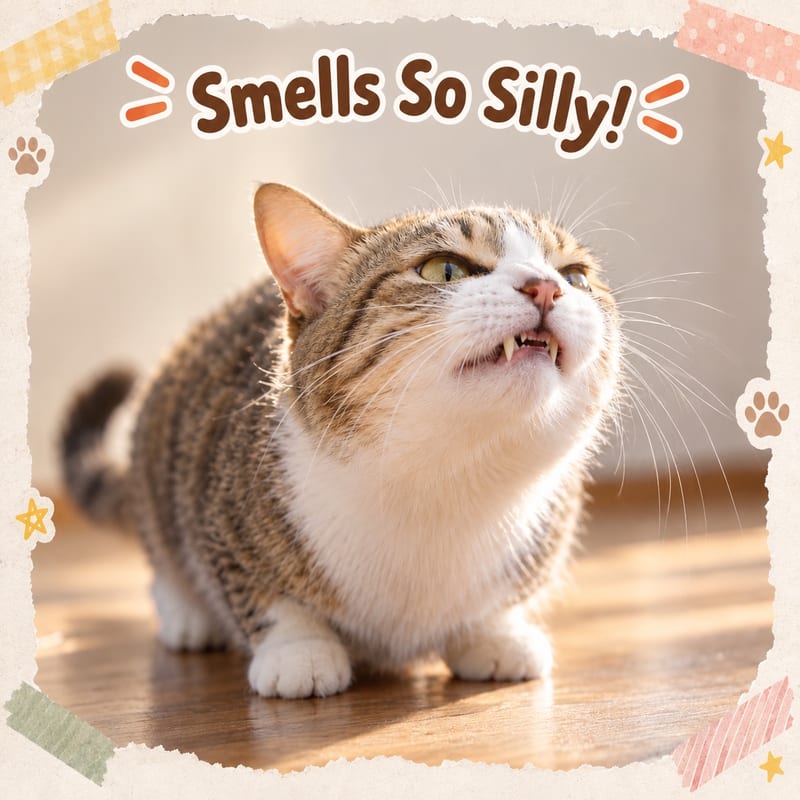
The Flehmen response, also called lip curl or Flehmen reaction, is a behavior found in many mammals—cats (from domestic cats to tigers), horses, and pandas all do it. The action is dramatic: after sniffing certain scents, the cat lifts its head, curls its upper lip, half-opens its mouth, squints, and freezes for a few seconds, looking as if it's been overwhelmed by a stench or suddenly contemplating life.
But the truth is: it doesn't think it stinks—it's intently smelling—using another olfactory system in its mouth to seriously analyze the scent it just encountered.
Why does it happen? The secret of the vomeronasal organ
Cats have a special organ on the roof of the mouth (behind the incisors) called the vomeronasal organ (also called Jacobson's organ), which specifically receives pheromones—chemical messages left by other cats, containing rich data such as identity, sexual status, and emotions.
Normally this organ doesn't directly contact the main airflow in the nasal cavity. When a cat encounters a scent worth investigating, it performs the Flehmen response: the lip-curl and mouth-open action creates a channel in the mouth that pumps scent molecules into the vomeronasal organ—like switching from 'smelling with the nose' to 'scanning with the vomeronasal organ' in second gear.
Simple analogy: ordinary sniffing is 'taking a glance'; the Flehmen response is 'reading every word with a magnifying glass.'
Common triggers
| Scenario | Why it triggers |
|---|---|
| Smelling another cat's urine mark | Urine is a cat's 'scent business card,' containing identity and sexual status data |
| You come home after touching another animal | You bring back 'third-party' scent information |
| New shoes, new objects, foreign smells | Unfamiliar scents are worth analyzing in second gear |
| Damp/chemical smells (cleaners, etc.) | Strong scent molecules trigger investigation |
| Scent of a female in heat | Unneutered males are especially sensitive, using it to assess mate status |
Fun fact: Some cats do Flehmen after smelling their owner's sweat after exercise, or certain strong smells (like durian or wind oil)—not a complaint, but serious analysis.
Flehmen vs discomfort: how to tell
Flehmen is normal behavior, but you need to distinguish it from real health problems:
| Feature | Flehmen response 🟢 | Discomfort signal 🔴 |
|---|---|---|
| Trigger | Right after sniffing a specific scent | No obvious trigger, continuous |
| Posture | Head up, lip curl, returns to normal after a few seconds | Head down, drooling, continuous open-mouth breathing |
| Duration | A few seconds to a dozen seconds | Continuous or repeated |
| Accompaniment | Preceded by sniffing | Vomiting, no appetite, lethargy |
| Afterwards | Continues activities as if nothing happened | Hiding, refusing food |
When to see a vet immediately: Continuous open-mouth breathing (cats normally don't pant like dogs), heavy drooling, bad breath, pawing at the face, refusing food—may be oral disease, foreign body in the throat, or poisoning.
This article is for reference only and cannot replace veterinary diagnosis. If you have health concerns, please consult a registered veterinarian.
Hong Kong small-unit practical tips: how to let your cat safely 'sniff in second gear'
Hong Kong living spaces are small and scents are concentrated, making cats more prone to triggering Flehmen. Here are three steps to give your cat a safe 'scent experience' even in a tiny flat.
1. Scent zoning management
- Shoe cabinet dust isolation: The street scents brought back from work or school are the strongest. Place a covered shoe cabinet at the entrance, take off shoes and hang coats first, then enter the living room to interact with your cat, reducing sudden Flehmen.
- Air new items on the balcony first: Put newly bought bags or cardboard boxes on the balcony or near a window overnight to let plastic or warehouse smells dissipate. Give them to your cat the next morning to avoid overwhelming stimulation at once.
2. Observation timing
- First ten minutes after work: You've just taken the MTR and eaten at a cha chaan teng, so you carry the most 'foreign intelligence.' Your cat will usually rush over to sniff your trouser leg and then do Flehmen. Just stand still and let it sniff; don't pick it up immediately—let it finish reading the data.
- Right after scooping the litter: In multi-cat households, after you scoop the litter, other cats will sniff the new litter surface and may do Flehmen in succession. Use this chance to note which cat reacts most, helping you understand their social hierarchy.
3. When to see a vet
- Lasting more than 30 seconds: Normal Flehmen finishes in seconds. If open-mouth breathing or lip curl lasts over half a minute, especially with drooling, take your cat to the nearest 24-hour vet clinic immediately (e.g., in Prince Edward, Wan Chai, Tsuen Wan).
- Night emergency strategy: Night consultations in Hong Kong are more expensive. Call ahead to ask if the emergency vet requires an appointment, and bring your cat's recent diet and bowel movement records to save time and money.
Remember: Flehmen is your cat's social media; letting it sniff is like letting it scroll Instagram. As long as the environment is safe, don't interrupt their 'gossip time.'
Further reading
Hong Kong cat care in practice: Flehmen observation log in a small flat
1. Keep a 'scent diary'
Every night after work, note down the following three things on your phone for seven consecutive days:
- Time of your cat's first Flehmen (usually 1–3 minutes after you enter)
- Trigger source (your trouser leg? A newly delivered box?)
- Reaction length (time with your phone; normal is 2–8 seconds)
After seven days you'll notice:
- If it's triggered by your trouser leg every day, it means the street scents you bring back are most attractive; consider changing into indoor trousers right after entering to reduce overstimulation.
- If the delivery box triggers the longest reaction, next time air it on the balcony overnight before bringing it in for your cat to sniff, which can shorten Flehmen time.
2. 'Scent buffer zone' in a small flat
No space in an open kitchen-living room in Hong Kong? DIY with an IKEA transparent storage box:
- Cut a cat hole in the side, put an old towel inside as bedding, making it your cat's exclusive 'sniffing booth.'
- Place new objects on top of the box overnight so the scent slowly seeps through the holes. The next morning, let your cat enter the box to sniff, avoiding overwhelming concentration at once.
3. When to take your cat to the vet?
- Night clinic routes: On Hong Kong Island, go to the 24-hour emergency in Wan Chai; in Kowloon, Prince Edward and Mong Kok have overnight vets. Before leaving, WhatsApp the clinic a photo or short video to confirm if it's an emergency, avoiding a wasted trip.
- Money-saving tip: Call during the day to ask about night surcharges. Some clinics only charge extra after 11 pm; arriving half an hour earlier can save you a bit.
Remember: Flehmen is your cat's social app; help it organize its 'messages' and it will live comfortably.
📌 Key points
- ✅ Flehmen is your cat 'shifting into second gear' to read scent
- ✅ Common triggers: urine marks from other cats, new smells, you touched another animal
- ❌ Don't mistake it for your cat disliking your smell
- ❌ Continuous open-mouth breathing and drooling are the real symptoms
- ✅ Normal reaction finishes in seconds, then the cat continues as usual