
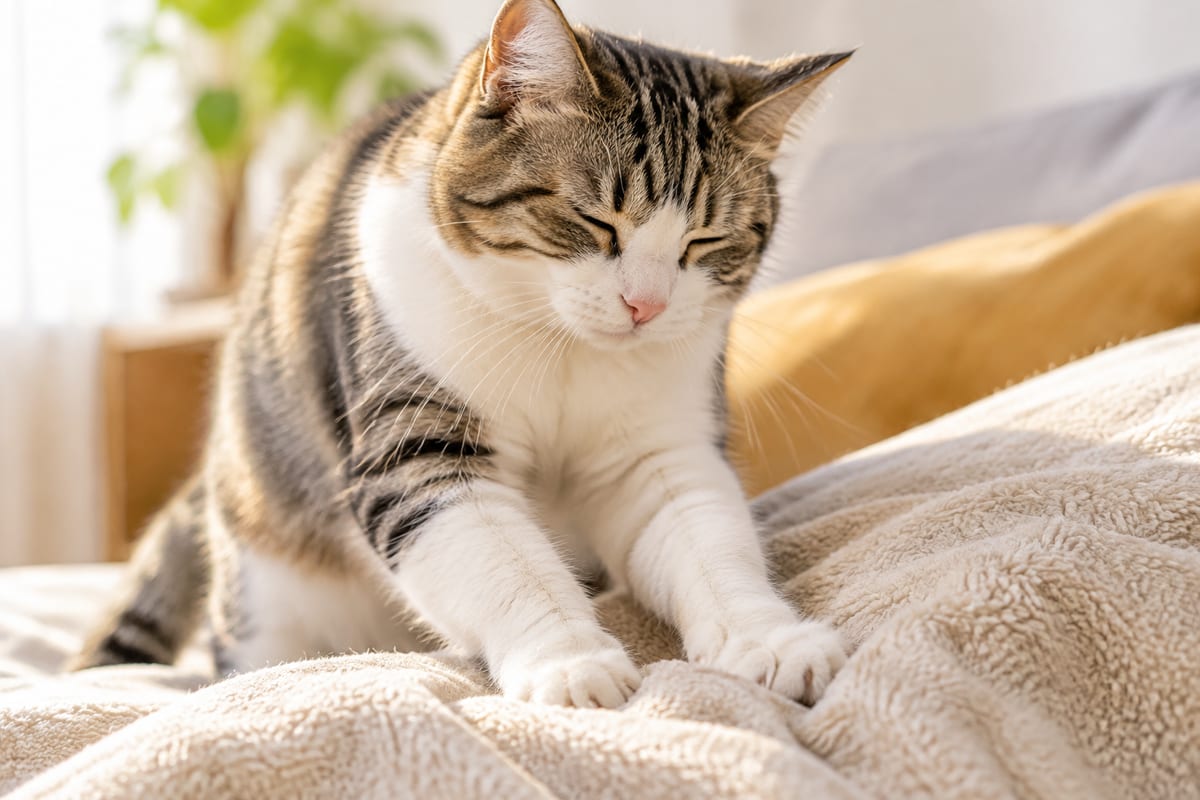
Quick answer: Cat kneading is an instinctive behaviour carried over from kittenhood, originally to stimulate the mother cat's milk flow. When adult cats knead, it means they feel safe, content and trusting — the highest form of affection towards their owner. According to animal behaviour research, the purring frequency during kneading ranges from 25-150 Hz, a range proven to aid bone repair and reduce stress.
Does your cat often jump onto your lap, alternately pressing its front paws up and down, with eyes half-closed and purring? This is "kneading" — one of the most heart-melting cat behaviours. But have you ever wondered why adult cats still do this kitten behaviour? Behind it lies deep trust in you and an evolutionary story.
What Is Kneading? Decoding Your Cat's "Happy Dance"
Kneading (also called "making biscuits") refers to a cat alternately and rhythmically pressing its front paws on a soft surface — your lap, a blanket, a cushion, or even the air. The action usually repeats every 1-2 seconds, with the cat's eyes half-closed, clearly in a very pleasurable state.
3 Typical Features of Kneading
- Rhythmic pressing: Front paws alternately press down, once every 1-2 seconds, sometimes with claws extended
- Accompanied by purring: Most cats purr while kneading, showing extreme contentment
- Half-closed eyes: Relaxed gaze, slightly closed, completely immersed in comfort
Interestingly, some cats also drool while kneading. Animal behaviourists believe this is linked to memories of suckling mother's milk as a kitten — the cat may associate the pleasure of kneading with the image of its mother producing milk, and drool unconsciously.
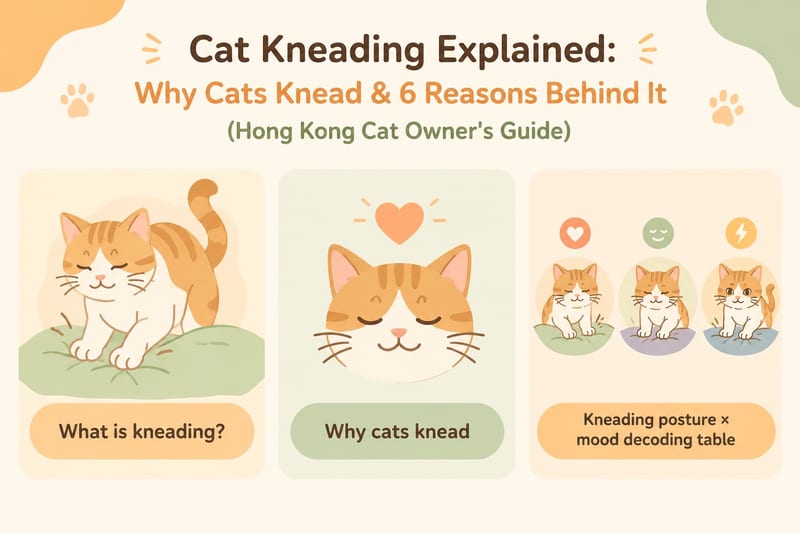
The Science of Kneading: 5 Reasons You Must Know
1. A Continuation of Kitten Instinct
The most fundamental reason for kneading can be traced back to kittenhood. Newborn kittens press their front paws on the mother cat's belly to stimulate milk flow. This action is closely linked to the fullness and security brought by suckling. Even after weaning, kittens still remember this comforting feeling.
2. Trust and Love for the Owner
Adult cats transfer this kitten-to-mother communication behaviour to their owner. When your cat kneads your lap, it is actually treating you as a mother figure and expressing similar feelings. This can be described as the highest level of trust a cat can show a human.
3. The Instinct to Mark Territory
Cats have sweat glands in their paw pads, and they secrete pheromones when kneading. This behaviour is like "stamping" you, telling other animals: "This person is mine!" So if your cat often kneads you, to some extent it has already claimed you as its exclusive territory.
4. Evolutionary Throwback: Nesting Instinct
Another theory is that kneading originates from wild cats' nesting behaviour. Wild cats use their paws to flatten grass and leaves to build a temporary nest. This explains why cats often lie down after kneading — they are actually "making the bed".
5. Stress Relief and Self-Healing
The purring frequency during kneading ranges from 25-150 Hz. This frequency range is not random — research from North Carolina State University College of Veterinary Medicine indicates that a vibration frequency of 25 Hz aids bone tissue repair, while 50-150 Hz reduces soft tissue swelling and promotes wound healing. In other words, every time a cat kneads and purrs, its body is undergoing a session of "self-physiotherapy". This mechanism explains why cats recover relatively quickly from fractures — they have a built-in vibration healing system.
Purring Frequencies During Kneading and Their Therapeutic Effects
| Frequency Range | Physiological Effect | Research Source |
|---|---|---|
| 25 Hz | Promotes bone tissue repair | North Carolina State University College of Veterinary Medicine |
| 50-100 Hz | Reduces soft tissue swelling | Journal of the Acoustical Society |
| 100-150 Hz | Relieves muscle tension, reduces stress | Multiple animal behaviour studies |
These research data show that kneading is not just emotional expression but also an evolutionary survival mechanism — promoting physical recovery through vibration frequencies while releasing endorphins for pleasure.
What If Your Cat's Kneading Hurts?
Although kneading is a cute behaviour, cats extending their claws while kneading can indeed hurt. Here are the correct ways to handle it:
Correct Approaches
- Regular nail trimming: Keeping your cat's nails neat is the most effective method. Trim every 2-3 weeks
- Place a thick blanket: Put a thick blanket or cushion on your lap to protect your skin while giving your cat a soft surface to knead
- Gentle guidance: If your cat presses too hard, gently lift its front paws onto the blanket instead of pushing it away
- Enjoy the moment: Kneading is how cats express trust — let it finish if possible
Wrong Approaches
- Shouting: Makes the cat feel rejected and damages trust
- Suddenly pushing away: The cat may be startled and associate kneading with negative experiences
- Punishment: Any form of punishment harms the human-cat relationship
- Trimming nails while kneading: Cats are most relaxed when kneading — do not startle them by trimming nails then
If your cat kneads too enthusiastically and its claws really dig into your skin, the gentlest approach is to stand up and slowly walk away. After a few interruptions to its lazy enjoyment, the cat will learn to hold back its claws.
Which Cats Especially Love to Knead?
| Cat Type | Kneading Frequency | Possible Reason |
|---|---|---|
| Kittens | Very high | Strongest instinctive behaviour, not yet weaned |
| Bottle-fed/rescue cats | Medium to high | May see new owner as a substitute mother |
| Cats raised from young | Medium | See owner as a mother figure |
| Senior cats | Medium | May show kitten behaviour due to cognitive decline |
| Multi-cat households | Depends on individual | May knead other cats rather than humans |
Research found that kittens separated from their mother early (adopted before 8 weeks of age) knead more frequently as adults, because subconsciously they are still seeking that missing maternal love.
Common Myths About Kneading
Myth 1: Kneading means the cat wants food
Many people immediately bring out treats when they see their cat knead, thinking it is hungry. In fact, kneading has no direct relationship with appetite. Although kittens kneading does stimulate the mother's milk flow, adult cats knead purely for emotional expression and stress relief — nothing to do with hunger. Feeding every time your cat kneads may actually lead to overeating.
Myth 2: Only certain breeds knead
Kneading is a common behaviour in all felines, regardless of breed. Whether it is a British Shorthair, Ragdoll, Siamese or mixed breed, as long as it had a normal kittenhood, it may knead. Breed differences only affect the frequency and style of kneading, not the existence of this instinctive behaviour.
Myth 3: Cats only knead people
Cats knead a wide variety of things — soft blankets, cushions, pillows, even other cats. Some cats even knead the air because they are so immersed in comfort that they do not even need a surface. They knead people simply because the owner's lap is the closest, most trusted "soft surface".
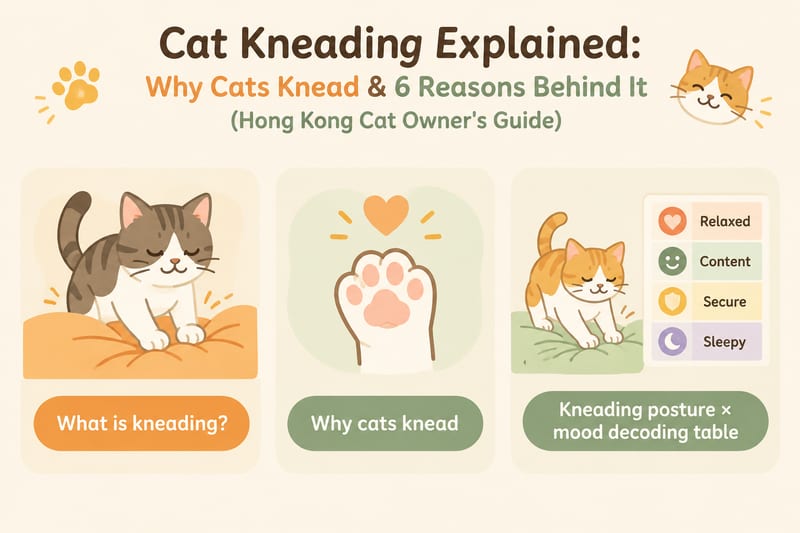
Further Reading
PetChill's Reminder
Cat kneading is the most sincere expression of love your cat can give you — every press tells you: "I trust you, I feel safe by your side." Next time your cat jumps onto your lap and starts its "happy dance", put down your phone and enjoy this warm moment.
To learn more about cat behaviour, keep following PetChill's latest articles!
 Instinct full guide →