

🤖 AI Summary
A cat with all four feet tucked under its body, looking like a loaf of bread—that's the 'loaf' position (bread squat). Most of the time it's a sign of relaxation, warmth, and trust; but if it stays squatting + poor appetite + low energy, it could be a pain signal from abdominal discomfort.
• This article includes a 'comfortable vs abdominal pain' traffic-light checklist
• Key to judgment: look at expression, tail, appetite, and energy together
• Loafing for over a day + no appetite = see a vet as soon as possible
Quick answer: Loafing is mostly a good thing—relaxation and trust, warmth and energy saving, preparing to sleep. But if the cat squats stiffly, has dilated pupils, poor appetite, hides, or is lethargic, it could be a sign of abdominal pain or other pain. The traffic-light checklist in this article helps you tell a 'comfortable loaf' from a 'pain warning' in 10 seconds.
Table of Contents
-
What is the loaf position?
-
4 main reasons cats loaf
-
Traffic-light checklist: comfortable or abdominal pain?
-
When to see a vet immediately
-
FAQ
What is the loaf position? 30-second summary (posture elements table)
The loaf position (English: Loaf, commonly called bread squat) is not a single movement but a static posture with 'four elements all present'. Check the four points below to know if what you're seeing is a standard loaf—if any element is missing, it doesn't count.
| # | Element | Standard loaf appearance | What it means if not met |
|---|---|---|---|
| 1 | Front paws | Both front paws completely tucked under the chest, paws not visible from the side | Front paws extended and propped = ready to get up at any time, a 'half-squat' |
| 2 | Hind legs | Hind legs folded into the sides of the abdomen, close to the body | Hind legs exposed or half-squat = preparing to jump, or joint discomfort |
| 3 | Tail | Wrapped close around the body, tail tip naturally loose | Tail tucked tight, stiff, or tapping the floor = tension or pain |
| 4 | Back | Slightly arched but soft lines, like a freshly baked loaf | Back arched high like a 'bridge', muscles tense = abdominal pain signal |
30-second summary:
- Loaf = all four elements present: front paws tucked, hind legs folded, tail close, back relaxed.
- All four present = normal; all four present but face tense, not eating, not moving = needs follow-up.
- Never judge by posture alone; always look at expression, tail, appetite, activity level together.
Remember one line: Posture is a noun, state is an adjective. 'Loaf' only tells you the cat has assumed a posture; whether it's comfortable or in pain depends on how it loafs.
Loaf mood comparison table: how relaxation, tension, and pain each appear
The same squatting posture, with different expressions and body details, can mean completely opposite things. The table below compares three columns; just check each item.
| Observation | 🟢 Relaxed (comfortable loaf) | 🟡 Tense (stressed/alert) | 🔴 Pain (painful loaf) |
|---|---|---|---|
| Eyes | Squinting, slow blinking, pupils small and steady | Pupils slightly large, eyes scanning around | Pupils noticeably dilated, staring fixedly |
| Ears | Relaxed forward or naturally to the side | Pressed back, frequently turning | Flat back, motionless for a long time |
| Face | Muscles soft, whiskers naturally drooping | Face somewhat tense, whiskers forward | Tense, fine lines on the nose bridge |
| Breathing | Steady and slow, about 20–30 per minute | Slightly fast, may pause when startled | Shallow and fast, abdominal movement obvious |
| Posture | Whole body close to the ground, back soft, can stretch at any time | Squatting close but head raised, keeping watch | Stiff, back arched high, flinches when belly touched |
| Tail | Close to body but tip loose, occasionally swaying | Wrapped tightly around the body | Tucked under the abdomen, invisible |
| Appetite | Gets up immediately when a can is opened | Willing to eat but leaves after a couple of bites | Not eating at all, or sniffs and walks away |
| Interaction | Responds to name, willing to play | Doesn't want interaction now, moves to a dark corner | Ignores you completely, may even hide |
Three scenario examples:
- Winter afternoon, the cat squats in the sunny spot by the window, slow blinking, stays put when you walk by → green light, warmth + trust.
- Guests at home, the cat squats under the sofa but head raised, pupils dilated, ears pressed to the side → yellow light, stressed and watching, don't force it out.
- 3 a.m., the cat squats motionless by the litter box, flinches when belly touched, won't even eat canned food → red light, see a vet within 24 hours.
One more mantra: Green light—you can take photos; yellow light—record it; red light—don't wait. If the three columns are unclear, take three photos (front, side, tail) and send them to your vet for a preliminary opinion.
When does loafing require a vet visit? Red-flag list (any one means go)
Loafing alone is not a disease; but with any of the following, you shouldn't wait any longer:
| # | Red-flag combination | Possible indication | Timeframe |
|---|---|---|---|
| 1 | Loafing + frequent litter box visits but no urine/only a few drops | Urethral obstruction in male cats | Immediate emergency, can be fatal within hours |
| 2 | Loafing + not eating at all for over 24 hours | Risk of fatty liver, general malaise | Within 24 hours |
| 3 | Loafing + persistent vomiting, bloated belly, flinches when belly touched | Acute abdominal pain, pancreatitis | Same day |
| 4 | Loafing + open-mouth breathing, rapid breathing | Heart/lung problems | Immediate |
| 5 | Loafing + cold ears and paws, low body temperature | Poor circulation, pre-shock | Immediate |
| 6 | Loafing + sudden hind leg weakness, dragging | Hind limb thromboembolism | Immediate emergency |
| 7 | Senior cat suddenly loafing frequently, difficulty getting up | Arthritis pain | Arrange check-up within a week |
Vet observation: Cats are masters at hiding pain; by the time they 'clearly don't seem themselves', they've actually been enduring it for a while. This list isn't meant to scare you but to help you decide 'go tonight or tomorrow morning'. If any item is ticked, the answer is tonight.
5-minute preparation before leaving (so you're not flustered in an emergency):
- Use your phone to take a 10-second video of the squatting posture and breathing movements; the vet can understand quickly.
- Note down the food intake, water intake, and urination frequency in the last 24 hours.
- Bring the most recent blood test/vaccination records; photos are fine.
- Use a hard-shell carrier, not a soft bag—a cat in pain may struggle and escape.
- Call ahead to confirm the clinic has night service and ultrasound equipment.
Loaf vs other postures: a table to distinguish seven common squatting/sitting positions
The most confusing for cat owners are 'loaf, sphinx, arched back, side-lying, half-squat ready to jump'. Seeing them together will clear up the confusion:
| Posture | Appearance | Common meaning | Need to worry? |
|---|---|---|---|
| Loaf | All four feet tucked, back rounded, like a loaf | Relaxation, warmth, preparing to sleep | Check accompanying expression and behaviour |
| Sphinx | Front paws extended and propped, hind legs tucked, chest on the ground | Staying to observe, ready to get up | Usually not |
| Arched back, neck tucked | Back arched high like a bridge, head low, feet tucked tight | Abdominal pain, discomfort | High alert, check ASAP |
| Side-lying | Whole body lying on its side, belly exposed | Extreme trust, deep sleep | Not needed |
| Half-squat ready to jump | Hind feet planted, weight forward, bottom slightly raised | Ready to pounce on a toy | Not needed |
| Head-low, close-to-ground squat | Loaf but nose touching the ground, neck completely relaxed | Deep rest | Pay attention if it occurs for several days in a row |
| Stiff sitting posture | Sitting but four feet spread, muscles tense | Pain, neurological problems | Needs vet visit |
The key to telling them apart is one line: See if it's willing to relax. Willing to relax, stretch, get up to eat = normal; tense, unwilling to move, unwilling to eat = treat as illness.
Four most common misconceptions about loafing
| Misconception | Reality |
|---|---|
| Loafing always means abdominal pain | Most loafing is relaxation, warmth, preparing to sleep. Painful loafing is only a minority, and always comes with accompanying signals like 'not eating, not moving, tense face' |
| The longer the loaf, the worse | A cat can loaf for three or four hours sleeping; duration is not an indicator; change (suddenly loafing more) and accompanying behaviour are |
| Loafing is a precursor to FIP | Loafing is not a specific signal of FIP. FIP comes with persistent fever, weight loss, bloated belly, jaundice; it won't just be one posture |
| Male cats loafing are especially prone to urinary disease | Urethral obstruction is indeed high-risk in male cats, but unrelated to the squatting posture; what to look at is 'litter box frequency + urine volume', not the posture itself |
A practical approach: from today, every time you see a loaf, jot down three numbers—how long it loafed, how much it ate, whether it got up to play. Record for seven days and you'll have your own cat's 'normal values'; any deviation will be obvious at a glance.
What is the loaf position?
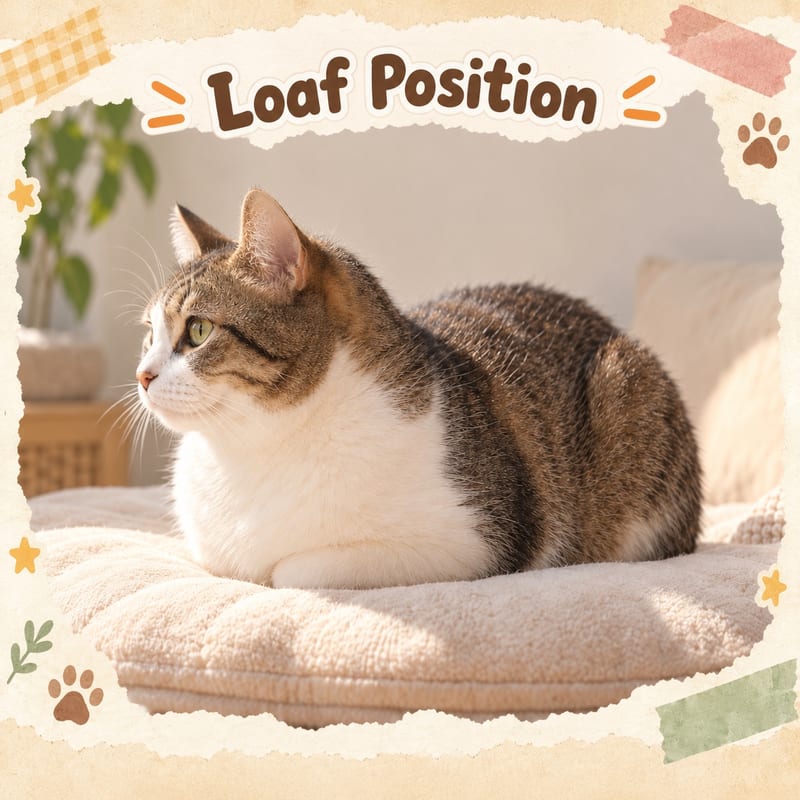
The 'loaf' (English: Loaf, bread squat) is a sitting posture where the cat tucks all four feet completely under its body and the back arches slightly, looking from the side like a squatting hen or a freshly baked loaf of bread. Almost all cats do this; it's one of the most classic cat postures.
This posture is essentially 'hiding weapons': a cat's escape tools are its four legs; tucking all paws in means 'I'm not preparing to run—it's safe here'. So loafing has always been seen as a sign of security, especially when it loafs near you—it's actually a vote of trust in the environment and in you.
4 main reasons cats loaf
| # | Reason | Explanation |
|---|---|---|
| 1 | Relaxation and trust | Four feet tucked = no need to escape at any time, completely at ease with the environment |
| 2 | Warmth and energy saving | Paw pads are heat-loss areas; when it's cold or the floor is chilly, tucking feet under the belly reduces heat loss |
| 3 | Preparing to sleep | Half-loaf is a prelude to sleep—tucking away the scent-emitting paw pads, entering do-not-disturb mode |
| 4 | Pain signal ⚠️ | For pain such as abdominal pain or urinary discomfort, cats use the loaf posture to press on the uncomfortable area |
The first 3 reasons are completely normal; the 4th is what all vets remind cat owners to watch for—cats are pain-hiding masters, and loafing is sometimes their 'enduring' posture.
Traffic-light checklist: comfortable or abdominal pain?
You can't tell by posture alone; you need 'posture + expression + behaviour' together:
| Light | Observation combination | Judgment | What you should do |
|---|---|---|---|
| 🟢 Green | Relaxed face, squinting or closed eyes, purring, tail tip naturally swaying | Comfortable loaf, normal | Take photos, no need to worry |
| 🟢 Green | Loafing when cold, squatting on a heat pad/sunny spot | Warming mode | Let it loaf, can add a blanket |
| 🟡 Yellow | Loafing for a long time but gets up to eat, play, litter box normal | Normal but worth noting | Keep observing, don't panic |
| 🟡 Yellow | Loafing noticeably more than before, slightly low energy | May be starting to feel unwell | Record food intake and loafing frequency |
| 🔴 Red | Stiff loafing + dilated pupils + not grooming + no appetite | Pain warning | See a vet within 24 hours |
| 🔴 Red | Loafing + vomiting/frequent litter box visits/not eating at all | Possible emergency (urethral obstruction, peritonitis, etc.) | See a vet immediately |
One mantra: Relaxed face and soft body means a loaf; tense face and not eating is a warning.
When to see a vet immediately
If loafing is accompanied by any of the following, don't observe any longer—book a vet appointment directly:
- ⚠️ No appetite at all for over 24 hours—cats not eating can trigger fatty liver
- ⚠️ Frequent litter box visits but no urine/only a few drops—urethral obstruction in male cats is an emergency that can be fatal within hours
- ⚠️ Persistent vomiting, bloated belly, flinches when belly touched—acute abdominal pain
- ⚠️ Lethargy + hiding + not grooming—combined signals of general malaise
- ⚠️ Rapid breathing, open-mouth breathing—heart/lung problems
Cats in the wild need to hide weaknesses, so pain signals are very subtle; when they clearly 'don't seem themselves', they've actually been enduring it for a while. Better to make a wasted trip than to delay.
This article is for reference only and cannot replace veterinary diagnosis. If you have health concerns, please consult a registered veterinarian.

How to write a loafing observation log? (7-day record table)
Traffic-light judgment by impression is prone to error; use a seven-day table for quantitative recording, and any change will automatically show up. Find a notebook or phone notes app and fill in four fields daily:
| Date | Loafing frequency/total duration | Food intake (percentage of normal) | Litter box (urine/poop frequency) | Judgment |
|---|---|---|---|---|
| Day 1 | 🟢/🟡/🔴 | |||
| Day 2 | ||||
| Day 3 | ||||
| Day 4 | ||||
| Day 5 | ||||
| Day 6 | ||||
| Day 7 |
Three principles for filling the table:
- Fill at the same time. It's recommended to fix it before the evening feeding, reviewing the whole day at once; don't fill in randomly.
- Fill in numbers, not adjectives. 'Loafed a lot' is useless; '8 times, total 3 hours' can be compared with the next week.
- Litter box in a separate column. Urine volume and poop frequency are the first indicators to change, usually 1–2 days earlier than posture changes.
How to interpret after seven days:
| Situation | Interpretation | Action |
|---|---|---|
| Frequency stable, food intake over 80%, litter box normal | Normal values established | Record once a week afterwards |
| Frequency increased by over 50% but food intake normal | Possibly colder weather, or starting to feel unwell | Add a heat pad, continue daily recording |
| Frequency increased + food intake dropped below 50% | Needs veterinary assessment | Book within one to two days |
| Any day with obviously abnormal litter box numbers | Urinary or gastrointestinal warning | Contact vet same day |
This table has another side effect: once posted, the whole family judges by the same standard, and there will no longer be disagreements like 'someone thinks it's fine, someone thinks it needs to go to the hospital immediately'.
Hong Kong small-flat practical guide: how to observe loafing warnings in a 300 sq ft unit
Hong Kong homes are small, cats have limited activity range, but it's actually easier to observe behaviour changes. Below is a practical checklist for small Hong Kong units, helping you see the traffic lights even without a big house.
1. Fixed 'observation spots'
- Place a low stool in the living room and bedroom each, at eye level with the cat's loafing spot; sit down for 10 seconds every day at breakfast/after work and scan the cat's expression and tail.
- Set two daily alarms on your phone (before leaving in the morning, before evening feeding) to remind yourself to record 'how long it loafed today'.
2. Use 'phone photos' instead of naked-eye estimation
- Take three consecutive photos from the same angle, comparing ear, pupil, and tail positions; if abnormal for three consecutive days, yellow light; five days, red light.
- Don't use flash when taking photos to avoid startling the cat.
3. Small-unit-specific alarm lines
- The cat usually loves to loaf on top of the TV cabinet/beside the shoe cabinet; if it doesn't appear in the usual spot for two consecutive meals, immediately check the food bowl and water level.
- The bathroom is small, the litter box is behind the bathroom door; before each shower, glance to see if there's squatting in the litter box but no urine marks; if so, call the vet immediately.
4. Nearby vet list
- Hong Kong Island: Happy Valley, Sai Wan Ho 24-hour emergency
- Kowloon: Prince Edward, Mong Kok night service until 12
- New Territories: Sha Tin, Tsuen Wan have overnight stays Set the phone as a shortcut, send photos via WhatsApp for a preliminary opinion, saving time and taxi fare.
Remember: Hong Kong transport is convenient; better to take a taxi to the vet than wait until the next day. Cats have a high pain tolerance; by morning it may have worsened.
Further reading
📌 Key summary
- ✅ Loafing is mostly a normal posture of trust and warmth
- ✅ Traffic-light table: relaxed face and soft body = comfortable; tense face and not eating = warning
- ❌ Don't conclude the cat has abdominal pain based on posture alone
- ❌ Cat not eating for over 24 hours + loafing = don't delay, see a vet immediately
 Fuji One full guide →


 Almo Nature full guide →