
🤖 AI Summary
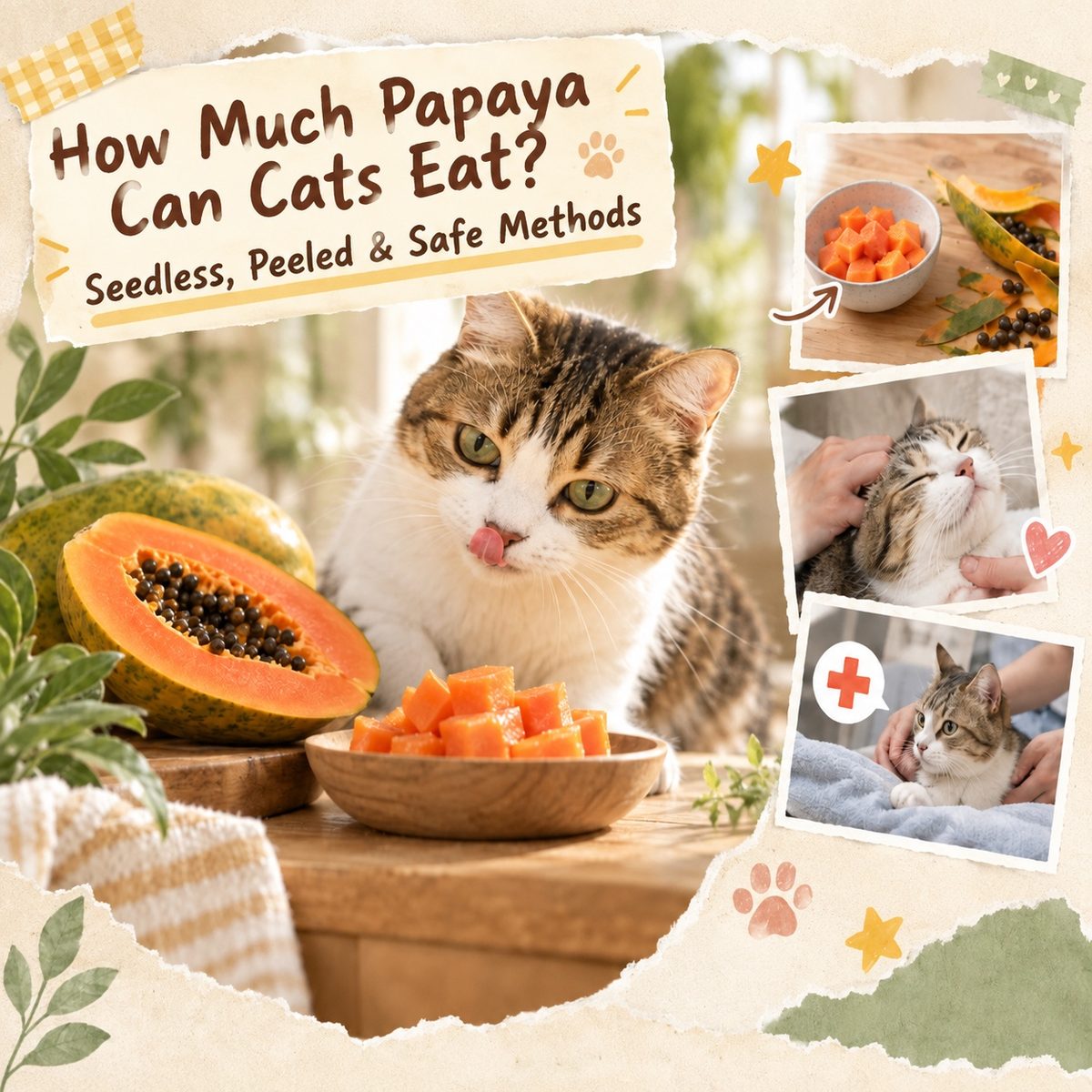
Papaya is one of the safe fruits for cats — once deseeded, peeled and finely diced, it can be given occasionally as a treat. Papaya is rich in vitamins A and C, and enzymes (papain), which aid digestion. But note: papaya seeds are not edible (trace cyanide + intestinal blockage); papaya skin is not edible (coarse fibre irritates the gut); it is a high-sugar fruit — portion control is essential. The upper limit is ≤10% of daily total calories.
• Papaya flesh = safe, just deseed, peel and dice
• Papaya seeds + skin = not edible
• High sugar — control the portion
Quick answer: Papaya is a safe fruit for cats — deseed, peel, cut into 1 to 2cm pieces, and keep to ≤10% of daily total calories. Nutritional highlights: vitamin A (eye health), vitamin C (antioxidant), papain (aids digestion), high water content. Avoid: papaya seeds (trace cyanide + intestinal blockage), papaya skin (coarse fibre irritates the gut), high sugar (diabetic/overweight cats should eat with caution or avoid). Available year-round in Hong Kong supermarkets, about HKD 15 to 30 each.
Contents
-
✅ Edible! But watch which parts
-
Nutritional benefits
-
⚠️ Risky parts table
-
Safe feeding SOP
-
Quick portion table
-
Common misconceptions about cats eating papaya
-
First-aid card for accidental ingestion
-
FAQ
✅ Edible! But watch which parts
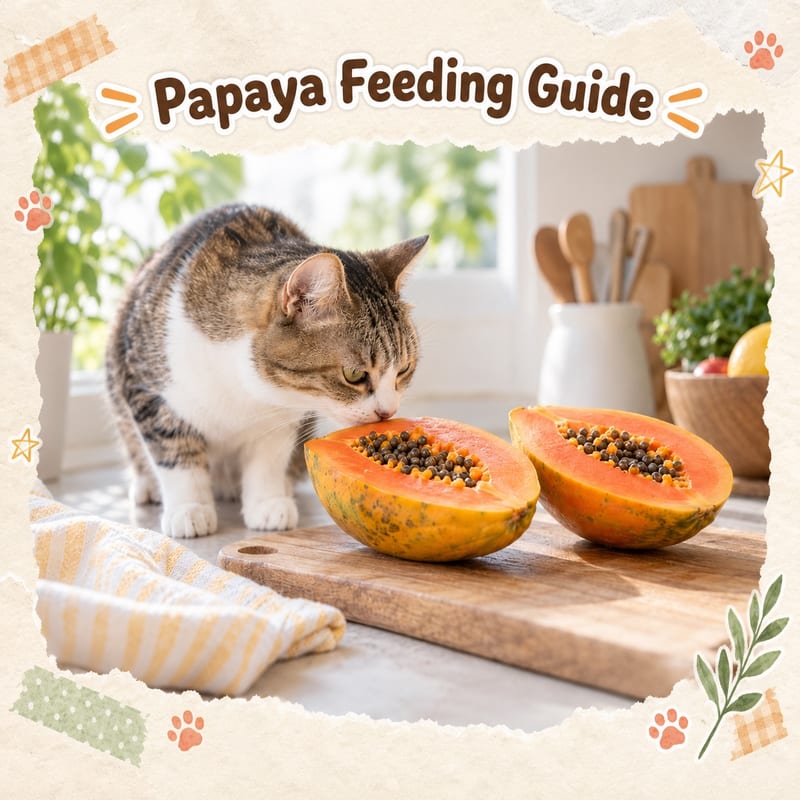
Papaya is an ASPCA-certified safe fruit for cats. But "safe" comes with conditions — only the flesh, and it must be prepared correctly:
- Flesh ✅: deseed, peel and finely dice — safe, nutritious, and some cats enjoy it
- Papaya seeds ❌: contain trace cyanide + can block the intestines
- Papaya skin ❌: coarse fibre hard to digest + pesticide residue
Remember in one sentence: Flesh is edible, seeds and skin are not.
Nutritional benefits
| Nutrient | Per 100g papaya | Benefit for cats |
|---|---|---|
| Water | About 88% | Natural hydration |
| Vitamin A | About 47 μg RAE | Eye and skin health |
| Vitamin C | About 60.9 mg | Antioxidant, immune support |
| Papain | Enzyme | Helps digest protein |
| Dietary fibre | About 1.7 g | Aids digestion (small amount) |
| Calories | About 43 kcal | Low-calorie treat (but watch the high sugar) |
Highlight: Papain is a protein-digesting enzyme — theoretically it can aid digestion. But 99% of a cat's nutritional needs come from their main meals; papaya is just an occasional taste.
But note: Nutritional benefits do not mean you should feed more — papaya is a high-sugar fruit (about 8g sugar per 100g), so portion control is essential.
⚠️ Risky parts table
| Part | Risk | Reason | Consequence |
|---|---|---|---|
| Papaya seeds | ❌ Not edible | Contain trace cyanide + block intestines | Cyanide poisoning (very low risk) + intestinal blockage |
| Papaya skin | ❌ Not edible | Coarse fibre hard to digest + pesticide residue | Vomiting, diarrhoea, gastrointestinal irritation |
| Flesh (excess) | ⚠️ Control portion | High sugar | Obesity, diarrhoea, blood sugar fluctuations |
| Processed products (dried papaya, papaya jam) | ❌ Not edible | Soaked in syrup = high sugar | Obesity, gastrointestinal upset |
High-risk cat groups (feed with caution or avoid):
- Diabetic cats — high sugar can spike blood glucose
- Overweight cats — extra sugar worsens weight problems
- Cats with sensitive stomachs — new foods may cause diarrhoea
- CKD (chronic kidney disease) cats — need to control potassium intake; papaya has moderate potassium
Safe feeding SOP
Five-step safety method:
-
Choose: Pick a ripe but not overripe papaya — yellow skin with a little green, slightly springy when pressed
-
Wash: Rub the skin under running water for at least 30 seconds (wash before cutting — the knife can carry bacteria from the skin into the flesh)
-
Prepare: Cut open → remove all seeds completely → peel off all skin (at least 5mm thick)
-
Dice: Cut into 1 to 2cm pieces — cats have small mouths, so small pieces prevent choking
-
Feed: Serve in a bowl → the first time give only a fingertip amount → observe for 24 hours for any gastrointestinal reaction
Forbidden processed products: Dried papaya (high sugar), papaya jam (syrup), papaya juice (concentrated sugar without fibre), papaya ice cream (lactose + sugar).
Quick portion table
| Cat weight | Daily papaya limit | Diced portion | Frequency |
|---|---|---|---|
| 3kg | ≤3 kcal | 1 tablespoon | 1 to 2 times per week |
| 4kg | ≤4 kcal | 1 tablespoon | 1 to 2 times per week |
| 5kg | ≤5 kcal | 1 tablespoon | 1 to 2 times per week |
| 6kg+ | ≤6 kcal | 1.5 tablespoons | 1 to 2 times per week |
Calculation logic: A cat's daily calorie requirement is about 200 to 300 kcal (depending on weight/neutering/activity level), and fruit treats should make up ≤10%. Papaya is about 43 kcal per 100g.
The portion is capped at ≤10% of daily total calories: It does not need to be fed daily; 1 to 2 times per week is a good treat frequency.
Common misconceptions about cats eating papaya
Misconception 1: "Papaya enzymes help cats digest, so feed it every day"
→ Papain theoretically aids digestion, but a cat's digestive system is already very efficient — no extra enzymes are needed. Feeding papaya daily = excess sugar, more harm than good.
Misconception 2: "Papaya seeds are small, eating them should be fine"
→ Papaya seeds contain trace cyanide — although the amount is far lower than in cherry pits, they are still not edible. And small seeds can block the intestines (especially in kittens/small cats).
Misconception 3: "Papaya skin is nutritious, no need to peel"
→ Papaya skin is coarse fibre that is hard to digest and can cause gastrointestinal irritation. Pesticide residue is mainly on the skin. Always peel off all the skin.
Misconception 4: "Papaya is natural and safe, so eating more is fine"
→ Papaya is a high-sugar fruit — excess can cause obesity, diarrhoea and blood sugar fluctuations. Portion control is key.
First-aid card for accidental ingestion
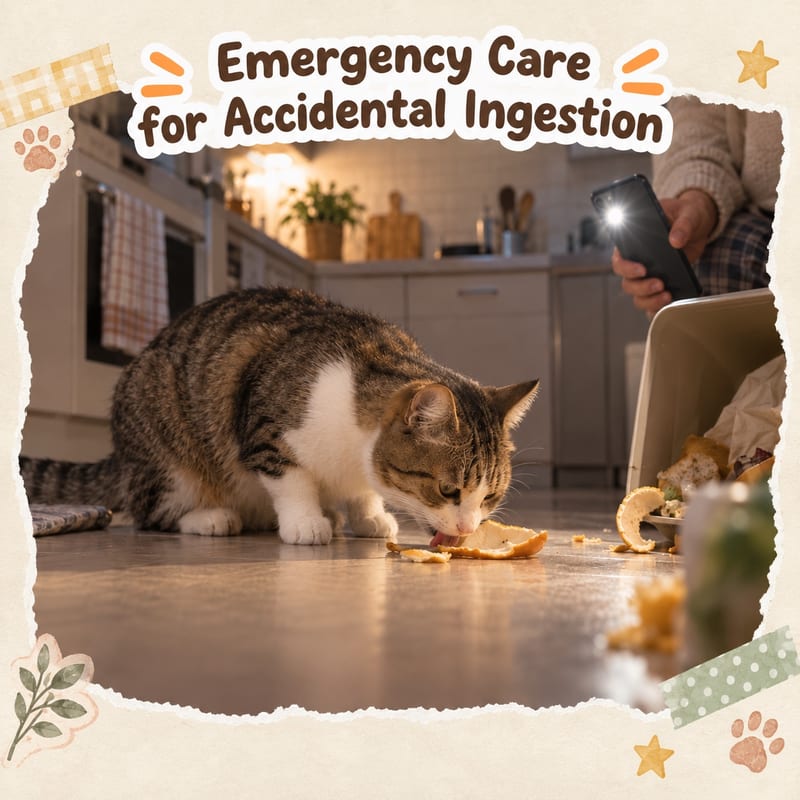
🚨 First-aid card for cats eating papaya seeds/skin
Symptoms (hours to 24 hours after eating):
- Repeated vomiting (may see seed/skin remnants)
- Diarrhoea
- Sharp drop in appetite
- Abdominal pain (arched back, won't let you touch the belly)
- Difficulty defecating or no bowel movement (sign of intestinal blockage)
Immediate action:
-
Record the time of ingestion + estimate the amount (how many seeds/how much skin)
-
If only a small amount of flesh was eaten → observe for 24 hours, usually harmless
-
If seeds or skin were eaten → take to the vet for assessment (especially kittens/small cats)
-
If repeated vomiting/no bowel movement → take to emergency immediately (intestinal blockage can be serious)
-
Do not induce vomiting yourself — incorrect methods can cause aspiration
Prevention: When cutting papaya, throw the seeds and skin immediately into a lidded bin — do not leave them where the cat can find them.
This article is for reference only and cannot replace veterinary diagnosis. If you suspect accidental ingestion, consult a registered veterinarian immediately.
Hong Kong small-flat practical guide: 30-second papaya cat treat routine
Hong Kong kitchens are small and time is tight. To safely give papaya to your cat, follow this "small-flat lazy pack":
1. Buy: On your way home from work, drop by ParknShop/Wellcome and pick a palm-sized papaya with yellow-green skin, about HKD 15–20; no need to buy a big one since the cat won't finish it.
2. Wash + cut: Back home, rub the skin under running water in the sink for 30 seconds, then dry immediately with kitchen paper. Put the chopping board on top of the fridge (where the cat can't reach), cut off a quarter with one knife, wrap the rest in cling film and put it back in the fridge. Peel the cut piece (use a peeler horizontally, removing at least 5 mm), then cut straight and remove all black seeds.
3. Dice: Cut the flesh into 1 cm cubes, cut 1 tablespoon portion at a time, put the remaining flesh immediately into a ziplock bag and refrigerate, consume within two days.
4. Feed: Put 1 tablespoon of papaya cubes into the cat bowl; the first time give only a fingertip amount and observe for 24 hours for diarrhoea. If no problem, then give the full portion.
5. Dispose: Throw the seeds and skin immediately into the toilet and flush, do not put in the bin — Hong Kong summers are hot, flies come quickly, and cats can easily steal food.
When to see a doctor? If within 6 hours after eating the cat vomits more than 2 times in a row, has completely no appetite, or has no bowel movement within 24 hours with a bloated abdomen, immediately take them to a familiar veterinary clinic (such as Kowloon Animal Hospital, CityU Veterinary Medical Centre) for walk-in or emergency appointment. Remember to bring the remaining papaya cubes to help the vet estimate the intake.
Further reading
📌 Key summary
- ✅ Flesh can be an occasional treat after peeling and deseding
- ✅ Vitamin A for eye health, papain aids digestion
- ❌ Seeds contain trace cyanide + can cause intestinal blockage
- ❌ Skin is coarse fibre hard to digest + pesticide residue
- ❌ High sugar — diabetic/overweight cats should eat with caution
 K9 Natural full guide →
 Feline Natural full guide →