
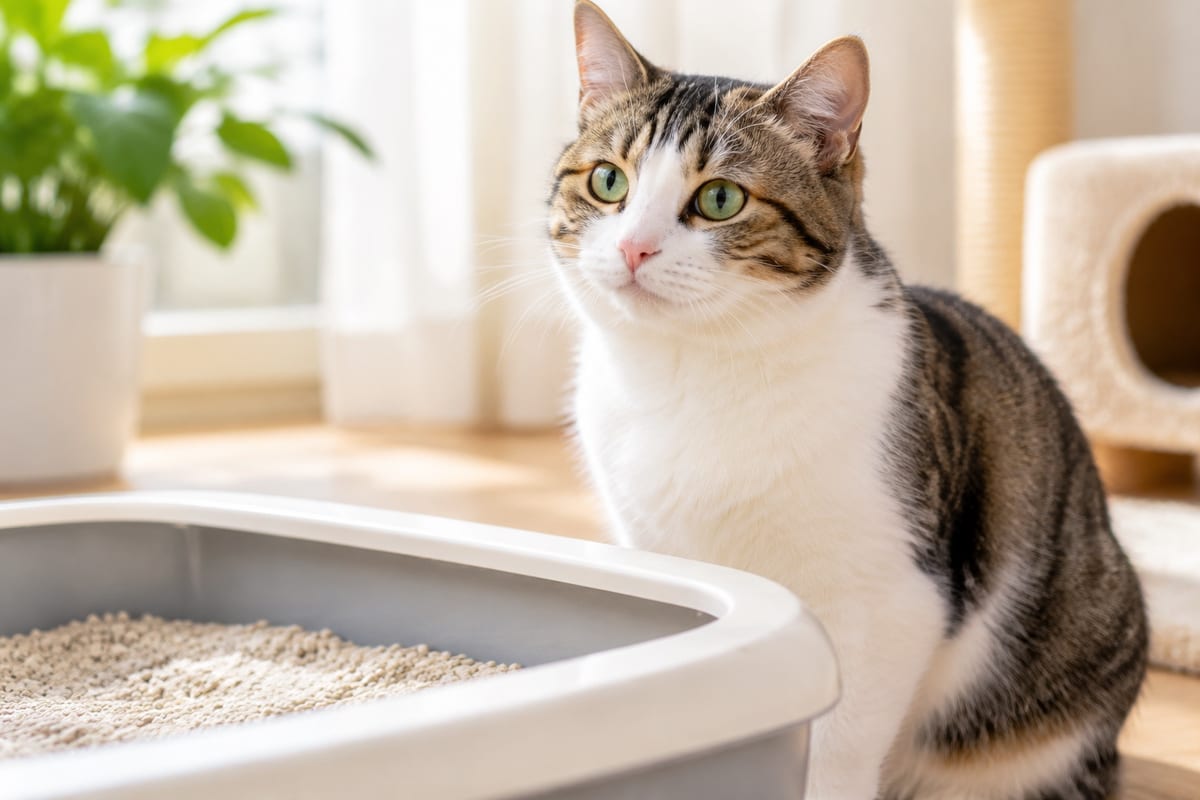
Quick answer: Observe your cat's poop across 7 shapes (banana-shaped, firm segments, sheep droppings, log-shaped, soft stool, mushy stool, watery stool) and use the 4-step record method: pick up, look, smell, record. A few minutes a day builds a systematic health monitoring habit. Normal poop should be banana-shaped or firm segments; tracking changes over time is more useful than a single observation.
Cats won't directly tell you their tummy hurts, but their poop, appetite, water intake, and energy levels can all leave signals worth noticing. As the end product of digestion and metabolism, poop reflects information on many fronts and is one important clue for observing your cat's digestive system and day-to-day health.
Note, however, that poop is only one part of health observation; you cannot judge that a cat has a particular disease from a single stool. What is truly useful is continuous observation and recording of changes.
Why observe your cat's poop?
When your cat's poop suddenly changes, don't look at the poop alone; consider it together with your cat's recent life situation. Poop condition can be affected by:
- Diet composition: type of food, brand changes, changes in eating habits
- Water intake: directly affects the moisture and hardness of poop
- Intestinal state: the gut's own motility and digestive function
- Living environment: moving house, a new family member, a change in litter box location
- Emotions and stress: cats are sensitive to environmental changes
- Bowel movements: frequency and whether there is difficulty
- Overall condition: appetite, water intake, energy
So poop observation is not a standalone act but part of overall health monitoring.
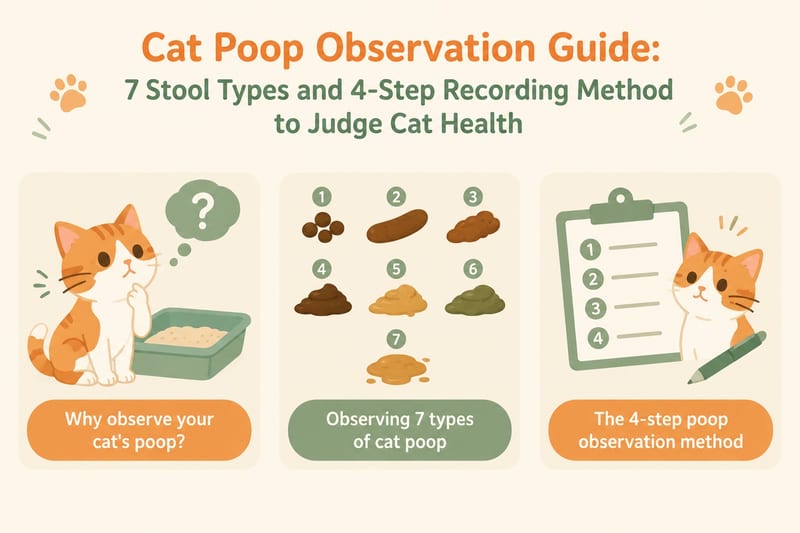
7 cat poop shapes to observe
Here are 7 common poop shapes, from more ideal to states that need attention, to help you build basic observational awareness.
| Poop shape | Description | Health meaning | Suggested action |
|---|---|---|---|
| Banana-shaped | Complete log, even shape, moderately soft | A more ideal everyday state | Maintain current diet and lifestyle |
| Firm segments | Formed but firmer, in segments | Normal range, slightly hard | Can monitor water intake |
| Sheep droppings | Small round pellets, fairly dry and hard | Possibly insufficient water | Increase water intake, keep observing |
| Log-shaped | Log-like but firmer texture, slightly wet | Normal range, slightly wet | Observe dietary changes |
| Soft stool | Has shape but soft, easily breaks apart | Needs attention to intestinal state | Observe for 1-2 days; if persistent, consult a veterinarian |
| Mushy stool | Paste-like or clumped, high moisture | Intestines may be uncomfortable | Keep observing, record frequency |
| Watery stool | Liquid, no complete shape | Needs attention | Consult a veterinarian |
1. Banana-shaped poop
This is a reference for a more ideal, fully formed everyday poop shape. Overall it is a complete log, even in shape, formed, with some softness, not overly dry or hard, and does not break apart.
2. Firm segment poop
Still formed, but firmer and more solid than banana-shaped. It keeps a complete shape, in segments or logs, firmer in texture than banana-shaped, not loose soft stool, and still clearly recognisable as poop. Changes in this shape and texture can serve as a reference for daily observation.
3. Sheep dropping poop
Small round pellets, fairly dry and hard, not easily forming a complete log. Sheep dropping poop can be one observation signal to check water intake, but you cannot directly conclude it is definitely dehydration, because poop shape can also be affected by diet, intestinal motility, living environment, and other factors.
4. Log-shaped poop
Overall it still keeps a clear log, wood-like shape with some completeness. It is not as soft as banana-shaped, nor as loose as soft or mushy stool, and its shape is still clearly recognisable. Log-shaped poop is generally classified as slightly on the wet side and can be one category in daily poop shape observation.
5. Soft stool
It may still have some shape, but is clearly softer than normal formed poop, easily deformed, and may break apart or stick during cleaning. If it occurs occasionally, keep observing; if it persists, also watch appetite, water intake, energy, and other body changes.
6. Mushy stool
It can no longer hold a complete log shape, is paste-like or clumped, has more moisture, breaks apart easily, and is less formed than ordinary soft stool. This poop shape deserves more continuous observation than ordinary soft stool; record the frequency and duration.
7. Watery stool
Almost no complete shape, markedly increased moisture, liquid or near-liquid, no longer able to hold the structure of normal formed poop. If it persists, or is accompanied by lethargy, decreased appetite, vomiting, or obvious dehydration, consider seeking professional veterinary assessment.
The 4-step poop observation method: pick up, look, smell, record
A simple, practical daily observation routine:
Step 1: Pick up
When cleaning up poop, note its completeness and try to keep the original shape; do not break the sample apart during cleaning.
Step 2: Look
Observe the poop's colour, shape, size, texture, and completeness. Use a magnifying tool if necessary.
Step 3: Smell
Note the poop's odour, but odour is only one item in daily observation; you cannot diagnose disease by smell alone.
Step 4: Record
Write down your observations, including date, time, poop shape, colour, hardness, bowel movement, appetite, water intake, and energy. Continuous records make it easier to spot changes in your cat's poop.
Set up a poop observation record sheet
It is recommended to keep the following simple record for your cat, filling it in for a few minutes each day:
- Date and time
- Poop shape (refer to the 7 categories above)
- Poop colour
- Poop texture
- Poop size
- Any difficulty passing stool
- Today's appetite
- Today's water intake
- Today's energy
- Any recent food changes
- Any recent environmental changes
- Duration of abnormal signs
Single observation vs continuous recording
A very important idea: don't jump to conclusions because of one abnormal poop. For example, if you find soft stool for the first time today, record it first, keep observing the next day to see if it continues, and also watch appetite, water intake, and energy, then decide whether further action is needed.
"Trends" are usually more useful than "single observations." If poop condition keeps changing or recurs, it deserves more attention.
The relationship between gut health and poop
Gut health should not be judged by poop alone. Diet, intestinal state, gut microbiota, metabolism, environment, emotions, and stress all affect a cat's digestive system. Poop is only one observation window; a truly comprehensive health assessment needs information from many aspects.
Regular health check-ups for your cat, together with daily poop observation, appetite records, water intake monitoring, and energy observation, are the most effective way to manage health.
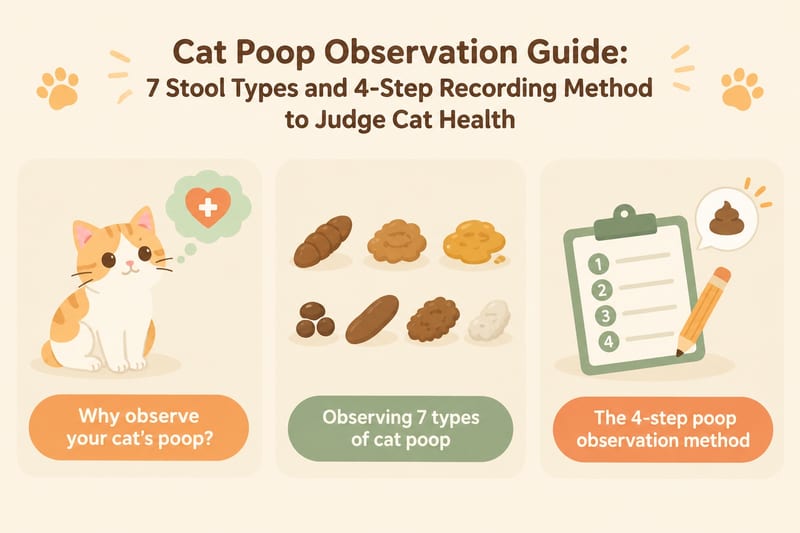
Further reading
Key takeaways
- ✅ Observing poop shape (7 categories) helps you understand your cat's digestive system
- ✅ The 4-step method "pick up, look, smell, record" is simple and practical, taking just a few minutes a day
- ✅ Continuous recording is more useful than a single observation
- ✅ Poop observation is part of overall health monitoring; you cannot judge disease from poop alone
- ❌ Don't jump to conclusions because of one abnormal poop
- ❌ Don't ignore other observations such as appetite, water intake, and energy
- ❌ If watery stool persists, consult a veterinarian; don't delay
 Almo Nature full guide →