
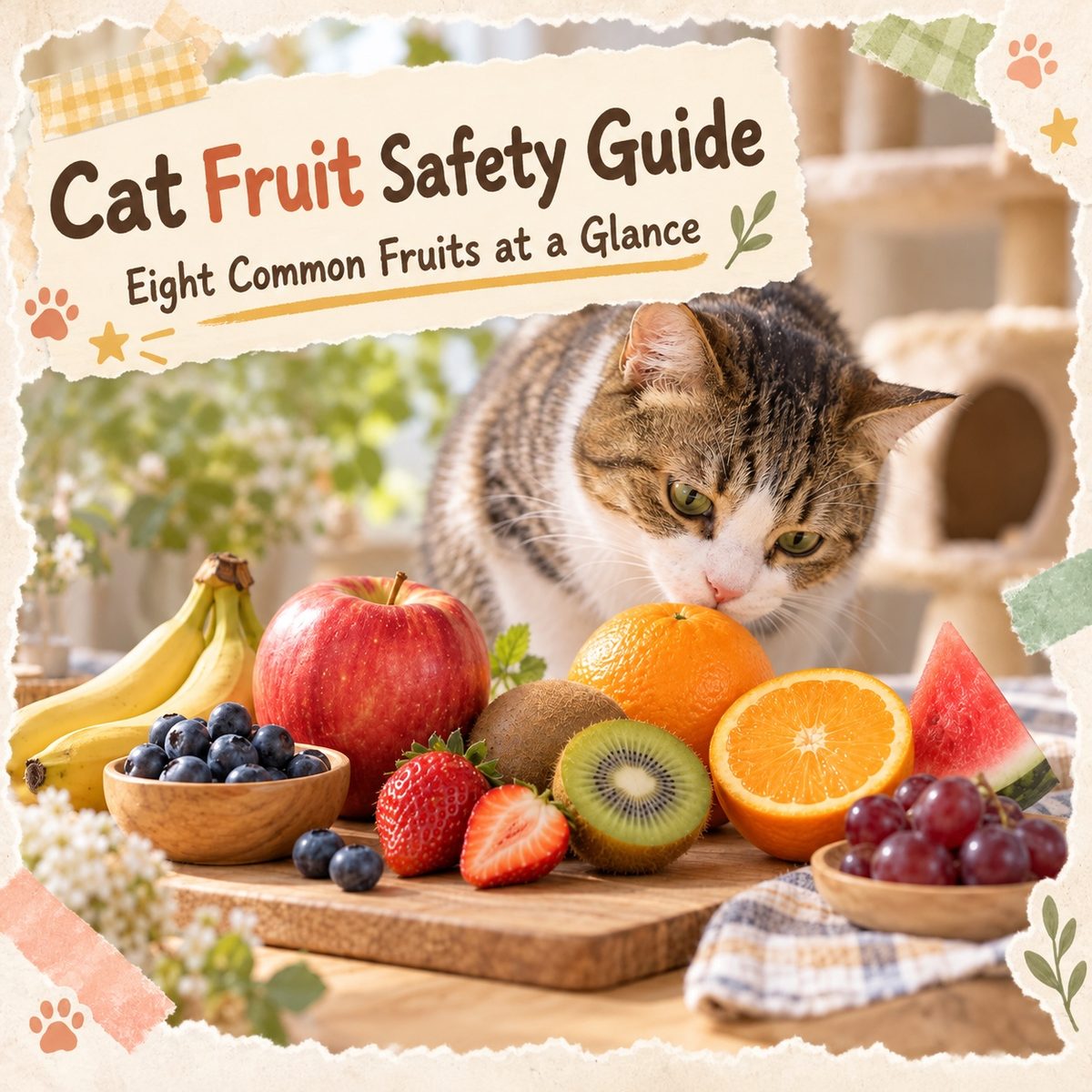
🤖 AI Summary
Cats are carnivores — fruit is always just an occasional small taste, never a nutritional necessity. Here's the safety verdict on 8 common fruits in Hong Kong: blueberries ✅ safe in small amounts, watermelon (seeded and peeled) ✅ very small amounts, cantaloupe (seeded and peeled) ✅ small amounts, apple (seeded and peeled) ✅ very small amounts, papaya (seeded and peeled) ✅ small amounts, banana ✅ very small amounts — all must be cut into small pieces, no added sugar, and not used as a meal replacement. Red-line fruits: grapes/raisins = absolutely off-limits (acute kidney failure), cherries (pits contain cyanogenic glycosides) = do not feed. Any fruit should not exceed 10% of a cat's daily total calories; if grapes/raisins are ingested, see an emergency vet immediately.
• Grapes/raisins = zero tolerance: a few can be fatal
• All fruit must be cut into small pieces, seeds and pits removed, peeled
• Fruit is not a nutritional requirement for cats — just an occasional taste
Quick answer: Cats are obligate carnivores — fruit is not part of their nutritional needs, but small amounts of safe fruit can be an occasional treat. Safe group: blueberries ✅, watermelon (seeded and peeled) ✅, cantaloupe (seeded and peeled) ✅, apple (seeded and peeled) ✅, papaya (seeded and peeled) ✅, banana ✅ — all cut into small pieces, ≤10% of daily calories. Red-line group: grapes/raisins = acute kidney failure = zero tolerance, cherry pits contain cyanogenic glycosides = do not feed. Ingestion of grapes/raisins = emergency vet immediately.
Table of Contents
-
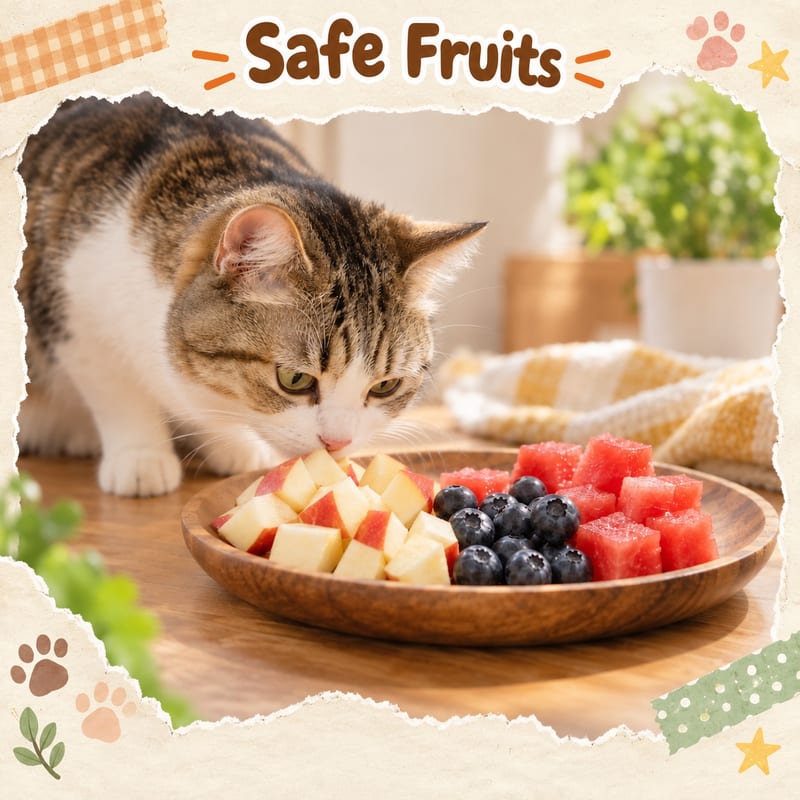
✅ Overview of 6 safe fruits
-
❌ Red-line fruits: grapes/raisins + cherries
-
Quick portion calculator
-
Safe feeding SOP
-
Common misconceptions about cats eating fruit
-
Poisoning first-aid card
-
FAQ
✅ Overview of 6 safe fruits
| Fruit | Safety | Key nutrients | Safety conditions | Maximum portion (4kg cat) |
|---|---|---|---|---|
| Blueberries | ✅ Most recommended | Anthocyanins, vitamin C | Wash, cut in half (prevent choking) | 2 to 3 berries per serving |
| Watermelon | ✅ Safe | Water, potassium | Seeded and peeled, cut into small pieces | 1 tablespoon per serving |
| Cantaloupe | ✅ Safe | Vitamin A, potassium | Seeded and peeled, cut into small pieces | 1 tablespoon per serving |
| Apple | ⚠️ Conditional | Fibre, vitamin C | Seeded (cyanogenic glycosides), peeled, cored, thinly sliced | 1 to 2 small slices per serving |
| Papaya | ⚠️ Conditional | Vitamin A, enzymes | Seeded and peeled, cut into small pieces | 1 tablespoon per serving |
| Banana | ⚠️ Small amounts | Potassium, fibre | Peeled, thinly sliced | 1 to 2 small slices per serving |
Common rules: All fruit must be washed → seeds and pits removed, peeled → cut into small pieces (under 1cm) → small amounts → no added sugar/condensed milk/chocolate sauce.
❌ Red-line fruits: grapes/raisins + cherries
Grapes/raisins (any variety, any colour) — absolutely off-limits!
- Toxic mechanism: The specific toxin has not yet been identified, but the clinical evidence is clear — just a few grapes/raisins can cause acute kidney failure in cats (and dogs).
- Dose: No safe dose — cases have been reported with 1 to 2 grapes; there is no "a little should be fine".
- Symptoms: Vomiting, diarrhoea within hours of ingestion → rapid decline in kidney function within 24 to 48 hours → oliguria/anuria.
- Processed products are equally dangerous: Raisins, sultanas, raisin bread, red wine vinegar — all contain the toxin.
- Emergency action: Suspected ingestion → do not wait for symptoms → take the cat to an emergency vet immediately.
Cherries — do not feed!
- Toxic parts: The pit, stem, and leaves contain cyanogenic glycosides — chewing releases hydrogen cyanide.
- Risk: The flesh itself is very low in toxicity, but cherry pits are small and difficult for cats to separate completely; feeding whole cherries = cat chews the pit = risk of cyanide poisoning.
- Symptoms: Rapid breathing, dilated pupils, brick-red gums, shock (in severe cases).
- Conclusion: The risks far outweigh the benefits — cats don't need cherries, so don't feed them.
Quick portion calculator
| Cat weight | Daily fruit limit | Number of blueberries | Watermelon/cantaloupe/papaya | Apple slices |
|---|---|---|---|---|
| 3kg | ≤3 kcal | 1 to 2 berries | Half a tablespoon | 1 small slice |
| 4kg | ≤4 kcal | 2 to 3 berries | 1 tablespoon | 1 to 2 small slices |
| 5kg | ≤5 kcal | 3 to 4 berries | 1 tablespoon | 2 small slices |
| 6kg+ | ≤6 kcal | 4 to 5 berries | 1.5 tablespoons | 2 to 3 small slices |
Calculation logic: A cat's daily calorie requirement is about 200 to 300 kcal (depending on weight/neutering/activity level), and fruit should be ≤10% = about 20 to 30 kcal. For a 4kg neutered cat at about 200 kcal/day, the fruit limit is about 20 kcal ≈ 3 blueberries. This is the upper limit — it doesn't need to be fed daily; once or twice a week is enough.
Safe feeding SOP
Five-step safety method:
-
Selection: Choose only from the ✅ safe list above; for a new fruit, give only a fingertip-sized amount the first time and observe for 24 hours.
-
Washing: Rinse under running water for at least 30 seconds (to remove pesticide residues).
-
Preparation: Remove seeds, pits, peel, and stems — seeds/pits contain cyanogenic glycosides or can cause intestinal blockage.
-
Cutting: Cut into pieces smaller than 1cm — prevents choking and makes portion control easier.
-
Feeding: Put it in a bowl or hand-feed — do not give a whole fruit for the cat to bite.
Forbidden processed products: Candied fruit, jam, canned fruit (high sugar), fruit juice (concentrated sugar), chocolate-dipped fruit (theobromine toxicity), alcohol-soaked fruit.
Common misconceptions about cats eating fruit
Misconception 1: "Cats won't be healthy if they don't eat fruit"
→ Cats are obligate carnivores — their nutritional needs can be 100% met by high-quality cat food. Fruit is a treat, not a source of nutrition.
Misconception 2: "A little grape should be fine"
→ Grapes/raisins have no safe dose — cases of kidney failure have been reported with 1 to 2 grapes. Don't take the risk.
Misconception 3: "Fruit is rich in vitamin C, so they should eat more"
→ Cats can synthesise vitamin C themselves — they don't need to supplement it from fruit. Excessive vitamin C can also cause diarrhoea.
Misconception 4: "Natural fruit is safe; only chemicals are toxic"
→ Grapes, cherry pits — natural foods can also be fatally toxic. "Natural = safe" is a logical fallacy.
Poisoning first-aid card
🚨 First-aid card for cats that have eaten grapes/raisins/sultanas
Symptoms (6 to 24 hours after ingestion):
- Repeated vomiting (may see grape/raisin remnants)
- Sharp drop in appetite, lethargy
- Diarrhoea
- Abnormally increased water intake → then decreased
- Discomfort when abdomen is touched
Immediate action (do not wait for symptoms):
-
Record the time of ingestion + estimate the amount ingested
-
Take the cat to the nearest emergency vet immediately — do not wait for symptoms to appear
-
Upon arrival, tell the vet: what was ingested, how much, and when
-
The vet may take these steps: induce vomiting (within 2 hours of ingestion) + activated charcoal + fluid therapy to monitor kidney function
-
Do not induce vomiting yourself — incorrect vomiting methods can cause aspiration
Hong Kong 24-hour veterinary emergency:
- SPCA (Society for the Prevention of Cruelty to Animals) emergency service
- Night emergency services at veterinary clinics in various districts (it is advisable to check the phone number of the nearest emergency vet in advance and save it in your phone)
🚨 First-aid card for cats that have eaten cherries
Risk: Pits/stems/leaves contain cyanogenic glycosides — chewing releases hydrogen cyanide
Immediate action:
-
If you see the cat chewing a cherry pit → take it to an emergency vet immediately
-
If only a small amount of flesh was eaten (no pit chewed) → observe for 24 hours; if rapid breathing/dilated pupils appear, seek veterinary care immediately
-
Keep the cherry remnants and take them to the vet — this helps determine the amount ingested
This article is for reference only and cannot replace veterinary diagnosis. If you suspect ingestion, consult a registered veterinarian immediately.

Practical tips for small Hong Kong flats: how to feed fruit safely in a 300 sq ft home
Hong Kong homes are small and cats love to jump around, so feeding fruit requires extra vigilance. Here are five practical steps designed for Hong Kong's cramped living spaces, ensuring you don't mess up the home and your cat doesn't get into dangerous spots.
1. Set up a fixed "fruit corner" Place a small plastic mat (A4 size is enough) in the kitchen or by the dining table, and prepare fruit only in this spot. Rinse the mat immediately after use so no sweet smell lingers to attract the cat. Remember to store red-line fruits like grapes and cherries on a high shelf in the fridge or in a sealed container, to prevent the cat from jumping on top of the fridge and stealing them.
2. Mini tool kit Prepare a set of "cat-only" small tools: a ceramic knife (less likely to retain metallic taste), a mini cutting board, and a 1cm measuring sticker (so you can see the size at a glance when cutting). Store everything in a clear airtight box and wash immediately after use; do not mix with regular cooking tools to reduce cross-contamination.
3. Feeding timing Choose the time when your cat is most quiet — usually after a nap or half an hour after you get home at night. Close the bedroom door first, leaving the cat only in the living room, to prevent it from jumping onto the kitchen counter. Clean up immediately after feeding; do not leave the fruit plate on the table "just for a while" — Hong Kong cats are amazing jumpers and can snatch a slice of apple in seconds.
4. Dispose of waste immediately Hong Kong summers are hot and humid, and fruit peels and pits ferment quickly and attract fruit flies. Throw them away immediately after cutting; do not leave them in the bin until the next morning. Use a small rubbish bag and tie it up right away, or flush down the toilet (make sure there are no large pits).
5. Observation spot After feeding, keep the cat within your sight for at least 30 minutes, watching for vomiting, sneezing, or abnormal behaviour. Most Hong Kong veterinary clinics close after 8pm, so if anything seems wrong, you can go to SPCA emergency or pre-Google the address of the nearest 24-hour vet and save it in your phone map, so you're not caught unprepared.
Remember: Hong Kong spaces are small and temptations are many; the safest approach is "if you can't watch it, don't leave it out". Put fruit away immediately after preparation — that's the long-term solution for cat ownership in small flats.
Further reading
📌 Key takeaways
- ✅ Blueberries are the safest, 2–3 berries is enough
- ✅ Seed and peel watermelon and cantaloupe before feeding
- ❌ A few grapes/raisins can cause kidney failure
- ❌ Cherry pits contain cyanogenic glycosides, do not feed
- ✅ Fruit is only a treat, not a meal replacement
- ✅ If grapes are ingested, go to the emergency vet immediately
 K9 Natural full guide →
 Feline Natural full guide →