
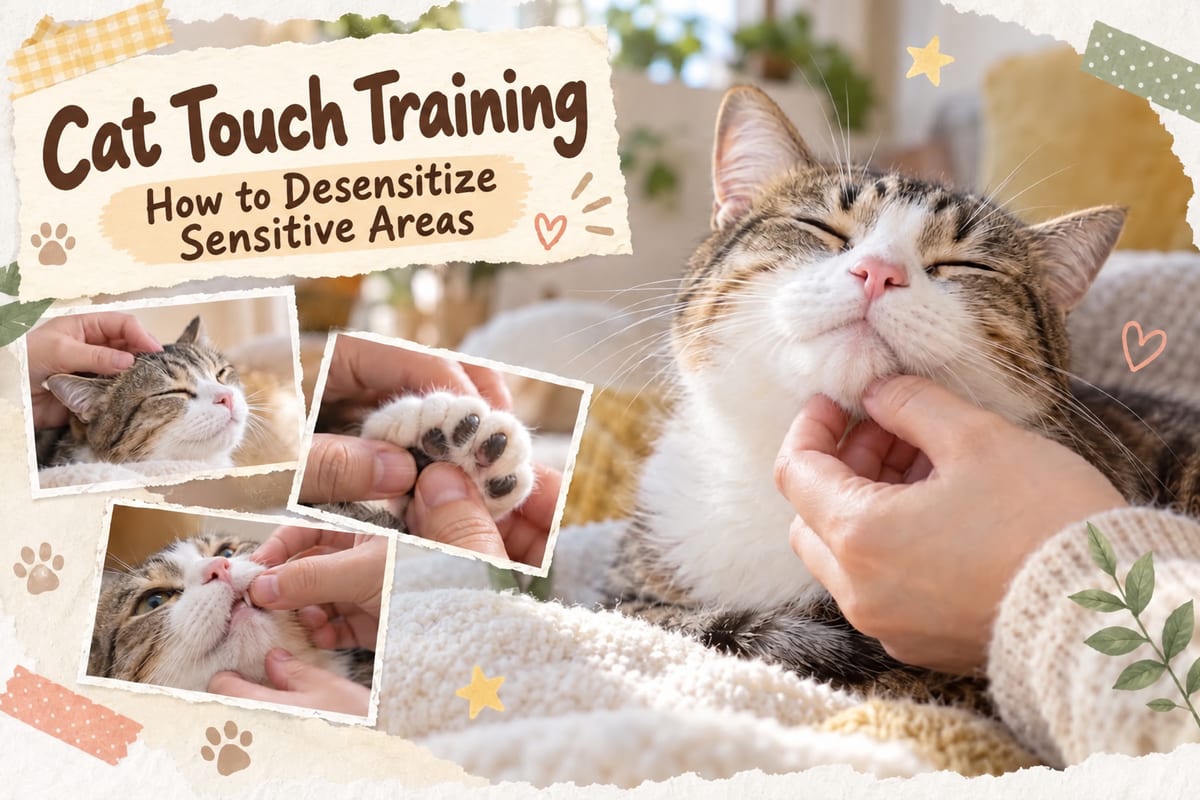
Quick answer: With 3-5 minutes of daily, gradual touching starting from the head and neck across 9 sensitive areas, paired with treat rewards, cats build a positive association that "being touched = something good", so vet visits and nail trimming no longer become a struggle.
Have you ever been scratched until you bled while trimming your cat's nails? Or taken your cat to the vet only to have it turn into a "lion out of the cage" the moment the carrier opens? The root of these problems is often that the cat is not used to having its sensitive body areas touched.
"Touch Training" is a gradual approach that gets cats accustomed to being touched all over their bodies. This training not only makes daily care easier but also greatly improves cooperation during vet visits, medication and bathing. According to Japanese feline behaviour research, starting touch training during the "golden socialisation period" from 3 weeks to 3 months of age gives the best results, but adult cats can also gradually adapt with patient training.
What is touch training and why is it so important?
The core concept of touch training is "desensitisation"—through repeated, gentle, positive physical contact, cats gradually get used to being touched in areas they originally resist. The benefits include:
- Smoother daily care: brushing, nail trimming and tooth brushing are no longer a "battle"
- Better cooperation at the vet: no struggling when the vet examines ears, mouth or abdomen
- Easier medication: once used to having the mouth and teeth touched, giving medication becomes much less difficult
- Closer human-cat bond: increased trust and warmer interaction
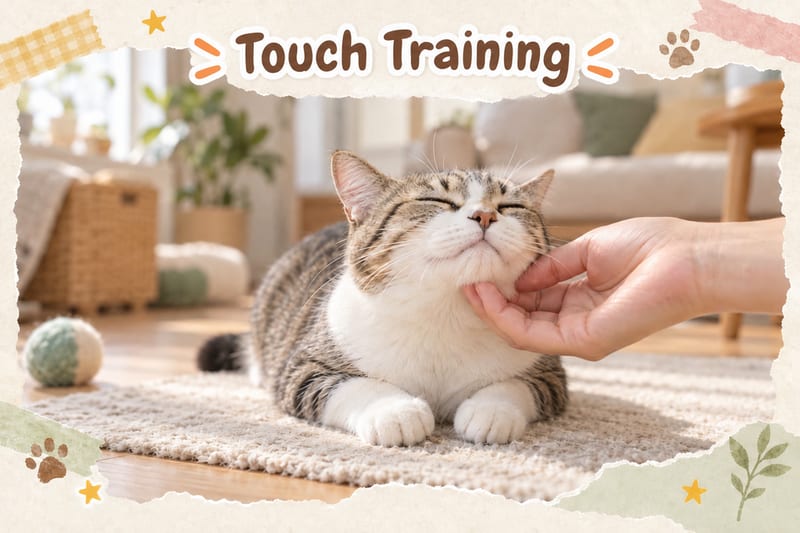
The golden socialisation period: the earlier the better
A cat's golden socialisation period is from 3 weeks to 3 months after birth. During this time, cats are most receptive to new things. If you start touch training at this stage, your cat will be much less resistant to physical contact later on.
However, don't be discouraged if your cat is already an adult! Touch training for adult cats requires more patience and time, but with the right method it can still succeed. The key is: keep each session short (3-5 minutes) and pair with treat rewards so the cat associates "being touched" with "something good happening".
9 sensitive areas touch training steps
Below are the 9 training areas arranged from easiest to hardest; start with the easy ones and progress gradually:
1. Head and neck
This is the area most cats accept. Use your fingertips to gently stroke the top of the head, chin and sides of the neck. These areas have scent glands and cats find it comfortable. Practise 2-3 times daily for 1-2 minutes each time.
2. Ears
Gently hold the tip of the ear between thumb and forefinger and softly stroke the back of the ear and the inner edge. This training is very important for future ear cleaning and ear drops. If the cat struggles, let go immediately and try again next time.
3. Nose tip
Gently stroke the tip of the nose with a fingertip. This helps the cat get used to being touched in the central facial area, which helps with vet examinations of the nasal cavity later.
4. Mouth and teeth
Gently stroke around the mouth, then try to gently lift the upper lip with your finger to touch the teeth. This training is the foundation for tooth brushing and medication. Once the cat is used to it, using a toothbrush and toothpaste becomes much easier.
5. Front legs and paw pads
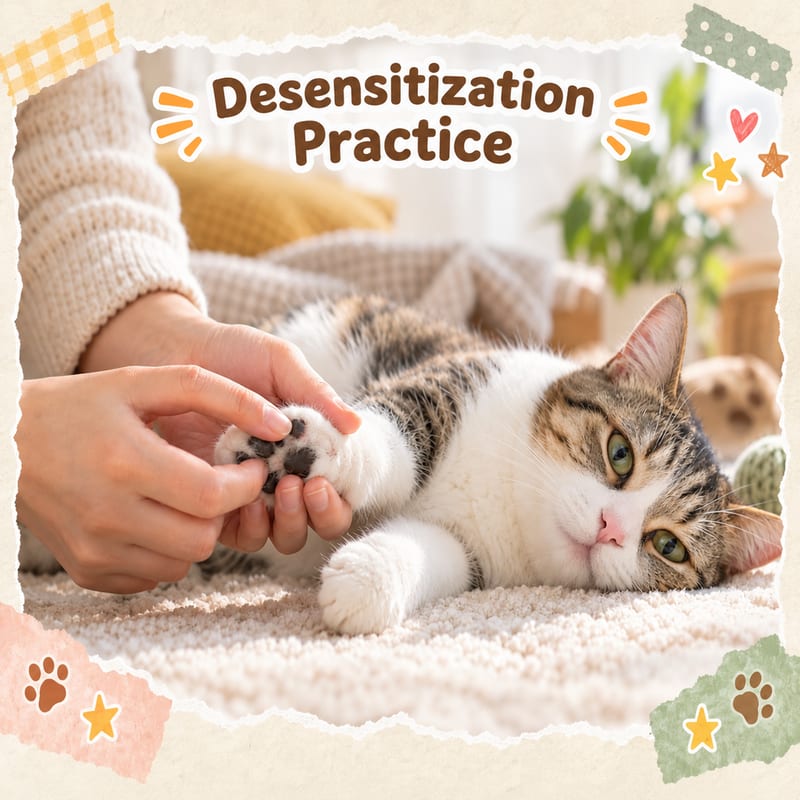
Gently squeeze and stroke from the base of the leg towards the toes, touching each toe and every paw pad. This training directly affects how easy nail trimming will be. Gently press each paw pad for 30 seconds daily and the cat will get used to having its toes held.
6. Back
Hold the cat steady with one hand and gently stroke the back along the direction of the fur with the other. Most cats accept this area, but the focus is getting the cat used to the feeling of being "held still".
7. Chest and belly
Gently support the cat's body from behind with one hand and stroke the chest and belly with the other. The belly is the cat's most vulnerable area, so this training takes longer to build trust.
8. Tail
Hold the tail with your hand and gently stroke from base to tip. Many cats dislike having their tail touched, but this training is very important for vet examinations of the tail and anal area.
9. Hind legs and paws
Same as front leg training, but hind legs are usually more sensitive. Gently hold the hind leg and press each paw pad. Once this training is complete, nail trimming and paw checks on the hind legs will be no problem at all.
| Area | Suggested order | Training focus | Daily application |
|---|---|---|---|
| Head and neck | 1 | Gently stroke chin and sides of neck | Daily affection, putting on a collar |
| Ears | 2 | Gently hold ear tip between thumb and forefinger | Ear drops, cleaning earwax |
| Mouth and teeth | 4 | Stroke mouth first, then lift lip | Tooth brushing, medication |
| Front legs and paw pads | 5 | Press each toe and paw pad | Nail trimming, paw checks |
| Back | 6 | Stroke along fur and hold body still | Brushing, applying skin medication |
| Chest and belly | 7 | One hand supports back, one strokes belly | Vet palpation, ultrasound |
| Tail | 8 | Gently hold and stroke from base to tip | Anal gland check, cleaning |
| Hind legs and paws | 9 | Same as front legs but gentler | Trimming hind nails, checks |
The 4 principles of training
To do touch training well, remember these principles:
- Gradual progression: start with areas the cat accepts and slowly move to sensitive areas
- Short and frequent: 3-5 minutes per session, 2-3 times a day, is more effective than one 30-minute session
- Treat rewards: give treats after each session to build a positive association
- Watch reactions: if the cat shows signs such as flattened ears, tail swishing or dilated pupils, stop immediately
Touch training tips for adult cats
If your cat is already an adult, the training steps need to be even slower:
-
Week 1: only stroke the head and neck, with treats each time
-
Week 2: add ears and mouth
-
Week 3: add front legs and paw pads
-
From week 4: gradually add the remaining areas
Adult cats may need 2-3 months to fully adapt to being touched in all areas, but with persistence you will definitely see progress.
PetChill's Reminder
Touch training is the foundation of cat care; do this step well and future brushing, nail trimming, tooth brushing and vet visits will all be much smoother. Remember, patience and positive rewards are the keys to success!
To learn more about cat training and care, keep following PetChill's latest articles!
Hong Kong small-flat practicalities: how to do touch training in a tiny unit?
Hong Kong homes are small, but limited space actually makes it easier to control the environment. First, choose a corner where your cat usually relaxes most—beside the sofa, on the windowsill or at the foot of the bed—and lay down its favourite towel or soft mat so it knows "this is the safe zone".
Before training, prepare the "three essentials": high-value treats (freeze-dried chicken cubes or cat sticks are recommended, with a strong smell), a timer (a phone is fine, to ensure each session does not exceed 5 minutes), and a small towel for backup—if the cat suddenly bolts, you can gently wrap its body in the towel to avoid injury.
You can follow this "Hong Kong-style timetable":
- Before leaving for work in the morning: 1 minute of head and neck stroking, give two freeze-dried treats and stop immediately, so the cat associates "owner leaving = reward".
- When you get home from work: don't rush to pick up the cat; put down your bags, wash your hands, then do 2 minutes of ear and mouth touching, then open a can for dinner to reinforce "owner coming home = good things happen".
- Sofa time before bed: when sitting down to watch a show, put the cat on your lap and use 3 minutes to gradually stroke back → belly → tail, giving a small treat every 15 seconds, and naturally stop when the episode ends.
If you have a domestic helper or family member helping, remember to unify the commands: who is responsible for which area and when to give treats, to avoid confusing the cat. Most importantly, Hong Kong people are fast-paced, but cats can't read clocks; only by slowing down can we give our cats a lifetime of security.
Further reading
📌 Key summary
- ✅ Short, frequent daily training is far more effective than one long session
- ✅ Easy first, then hard: head and neck → ears → mouth → limbs → belly → tail
- ✅ Treat rewards are key to building positive associations
- ❌ Continuing to touch when you see flattened ears or dilated pupils will make the cat more resistant
- ❌ Trying to do everything at once with an adult cat usually backfires
 Fuji One full guide →

