
Quick answer: Cats have about 300 million neurons, and their intelligence far exceeds what most people imagine. They have 3 learning methods: observational learning (learn by watching once), trial-and-error learning (fall down and get back up), and conditioned reflex learning (reward-driven). Most interestingly, cats will 'train' their owners—by observing to find your habits and weaknesses, then exploiting them for their own benefit.
Has your cat ever opened a cupboard door by itself, learned to wait for you to feed it at a specific time and place, or even made you comply with just one look? If you think cats are just 'aloof' animals, you may be underestimating their intelligence. Research shows that cats' learning ability and memory far exceed what most people imagine. Today PetChill unveils the high-IQ secrets of felines.
Cats' Memory: Short-Term and Long-Term Dual Tracking
Cats' memory system is similar to humans', divided into short-term and long-term memory. Long-term memory lets them remember the fixed locations of the litter box and food bowl, even after several months. Short-term memory helps them cope with sudden changes—for example, when you move the food bowl to another room, cats can find the new location very quickly.
Scientific research indicates that cats' short-term memory can last from minutes to hours, while long-term memory can last for years. This explains why cats are especially nervous every time they pass by the veterinarian's clinic after one visit—they remember the last experience!

3 Unique Learning Methods of Cats
| Learning Method | How It Works | Real Example | Cognitive Level |
|---|---|---|---|
| Observational learning | Watch → imitate | Observe owner opening door → learn to open door handle | Higher cognition |
| Trial and error | Try → fail → try again | Kitten learning to jump → master distance and force | Basic learning |
| Conditioned reflex | Reward-driven association | 'Sit → get treat' → follow command | Rational judgement |
1. Observational Learning: Learn by Watching Once
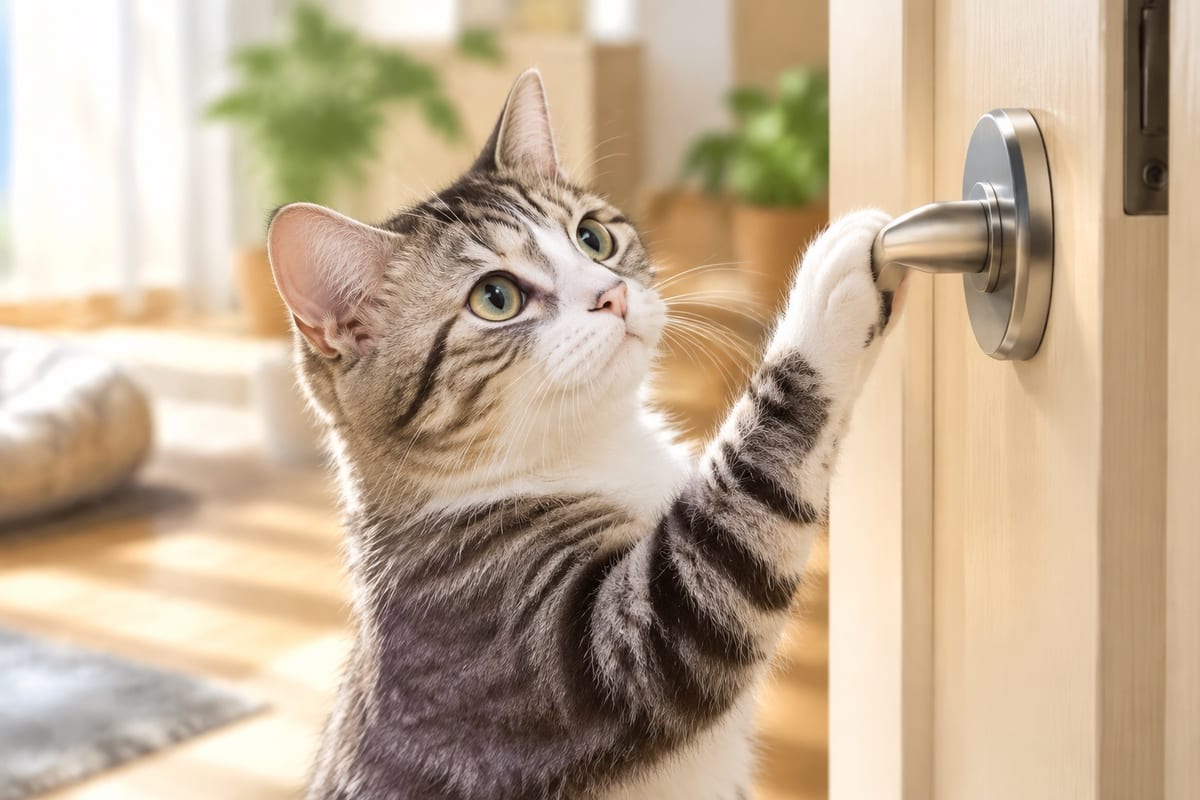
Cats are excellent observers. Research has recorded cats watching their owners open doors and then trying to imitate them. Some clever cats have even learned to use their paws to pull down door handles! This 'observe → imitate' learning method is considered higher-level cognitive ability in the animal kingdom.
If your cat stares at you while you work, don't think it's just curious—it might be 'learning the tricks'!
2. Trial-and-Error Learning: Fall Down and Get Back Up
Like humans, cats learn new skills through 'try → fail → try again'. For example, when a kitten learns to jump, it may miss and fall at first, but after a few attempts it will master the correct distance and force calculation. This learning method allows cats to adapt to various new environments and challenges.
3. Conditioned Reflex Learning: Reward-Driven
Cats follow the philosophy of 'what's in it for me'. Unlike dogs, cats don't cooperate to please their owner; they decide whether it's worth acting after rational judgement. If you use treats as rewards, cats will quickly learn the association 'sit → get treat' and cooperate with your commands.
High-IQ Behaviours of Cats: They're Training You!
This is the most interesting part—many cat owners may not realise they've already been 'trained' by their cats!
Cats are masters at directing humans. Through keen observation, they find household routines and their owner's weaknesses, then exploit them. For example:
- Whenever you sit down to eat, the cat jumps on the table and looks at you with pitiful eyes—because it knows this works
- The cat makes a specific meow at a fixed time and place, because it has found this combination makes you get up and feed it
- Some cats even learn to press a specific switch or pull open a specific drawer, because they know what they want is inside
These behaviours are not 'instinct' but 'skills' acquired through observation and learning. In other words, your cat may understand you better than you think!
Cat vs Dog Intelligence: Each Has Its Strengths
Many people compare cat and dog intelligence. In fact, the two show intelligence in different ways:
| Comparison Item | Dog | Cat |
|---|---|---|
| Number of neurons | About 500 million | About 300 million |
| Brain cortex density | Lower | Higher |
| Social learning | Good, actively follows commands | Weaker, independent judgement |
| Problem solving | Relies on human guidance | Autonomous judgement and decision-making |
| Learning motivation | Please owner | Reward-driven (act only if there's benefit) |
| Training cooperation | High | Selective cooperation |
Research shows cats have about 300 million neurons. Although fewer than dogs' 500 million, cats have a higher density of neurons in the brain cortex, making them perform better in some cognitive tasks. Simply put, cats aren't unintelligent—they just selectively display their intelligence. As one cat owner said: 'Dogs ask "What do you want me to do?", cats ask "What's in it for me?"'
3 Small Games to Boost Your Cat's Intelligence
Want to stimulate your cat's brain development? These 3 simple games can help:
- Hide-and-seek food: Hide treats in different containers or locations and let your cat use smell and observation to find them
- Puzzle toys: Use toys that require thinking to get treats out, exercising your cat's problem-solving ability
- Interactive play: Spend 10-15 minutes daily using a wand toy for simulated hunting games to stimulate your cat's thinking and reaction abilities

Further Reading
PetChill's Reminder
Cats' intelligence far exceeds our imagination—they not only learn and remember, but also 'train' their owners for their own benefit. Next time you find your feline master making you comply with just one look, smile knowingly: these are all signs of their high intelligence!
To learn more about cat behaviour, keep following PetChill's latest articles!