
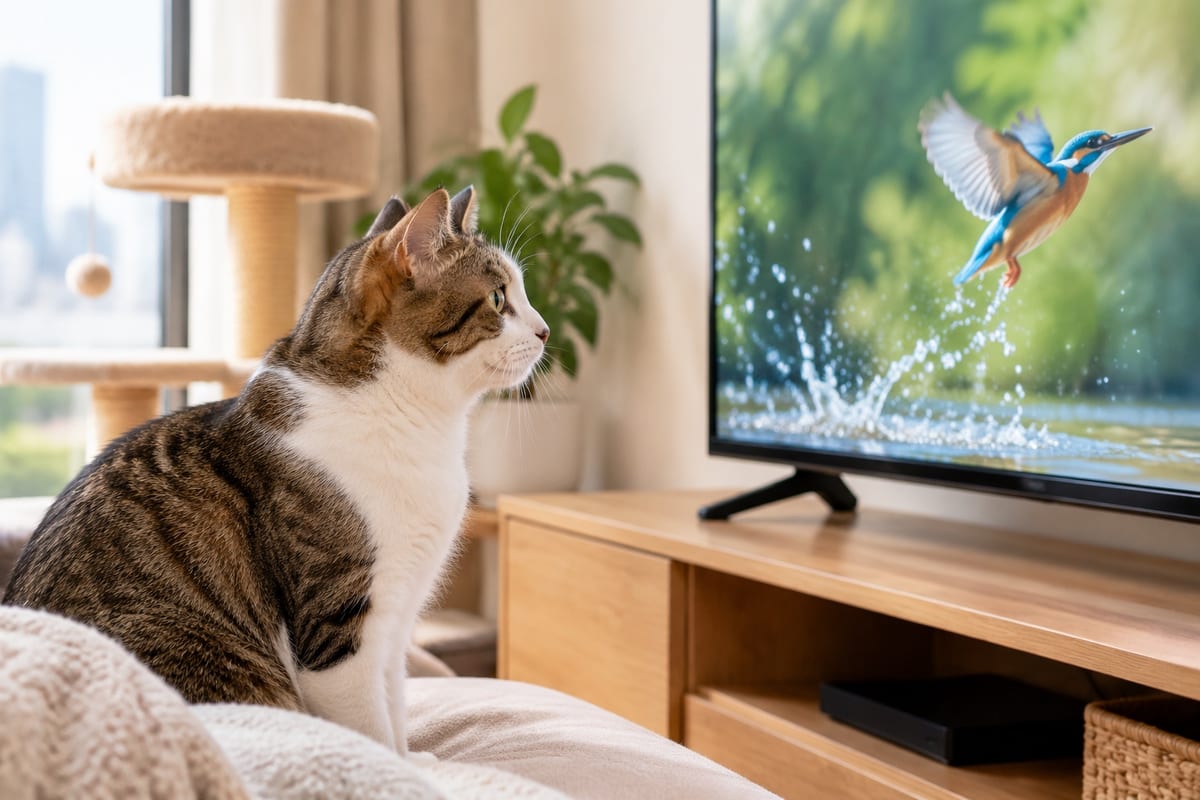
Quick answer: Cats staring at the TV aren't really "binge-watching" — fast-moving images on screen (birds, fish, small animals) trigger their innate hunting-tracking instinct. Short TV sessions (ideally 15–20 minutes each) are safe mental stimulation for cats, but you should control the volume (cats have sensitive hearing) and screen brightness. TV must never replace real interactive playtime.
You get home, turn on the TV — does your cat immediately jump over and stare fixedly at the screen? Sometimes they even reach out a paw to swipe at the birds and fish on screen? Many cat owners think their cats "like watching TV", but the truth is more interesting than you imagine! PetChill has put together a complete analysis of cats watching TV, from hunting instinct and vision science to safety tips and Cat TV recommendations, all in one place.
Why do cats stare at the TV?
Cats have an innate hunting instinct for moving objects, a gene left over from thousands of years of evolution. Fast-moving images on a TV screen — such as birds flying, fish swimming, or even a football match — trigger their "tracking mode".
So cats aren't really "watching a show"; they're just tracking moving targets on the screen. It's the same behaviour as watching birds from a window!
Some cats even try to "catch" the animals on screen, reaching out to swipe at the screen, or even going behind the TV to look for prey. These are all normal hunting reactions — no need to worry.
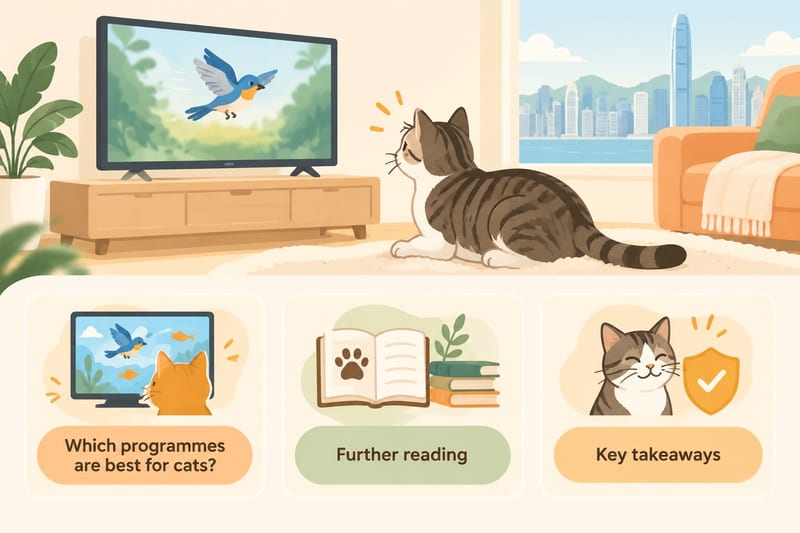
Can cats actually see the TV picture?
Many cat owners wonder: do cats see the same picture as we do? The answer is "not exactly the same". According to feline vision research:
| Visual ability | Cats vs humans |
|---|---|
| Motion detection | Cats are better, reacting extremely quickly to fast-moving objects |
| Night vision | Cats far outperform humans (about 6–8 times more light-sensitive) |
| Colour perception | Cats are weaker, mainly distinguishing blue-green tones |
| Close focus | Cats are weaker; near objects appear blurry |
There's also a fun fact: older CRT (big-back) TVs have a low refresh rate, so cats actually see a flickering, frame-by-frame image; modern LED/OLED TVs have a high refresh rate, so cats can see smooth motion. That's why some long-time cat owners find their cats had no interest in the old TV but suddenly became interested after getting a new one — this may be the reason!
Is it a problem for cats to watch TV? 3 key points
Short TV sessions are generally fine and can even provide some mental stimulation for indoor cats. But note the following:
| Point to note | Recommendation |
|---|---|
| Viewing time | No more than 15–20 minutes each time, then redirect the cat's attention to avoid eye strain |
| Volume control | Cats' hearing is many times more sensitive than humans'; lower the volume to avoid stress |
| Escape space | Ensure the cat has a quiet corner to leave and rest at any time |
Don't let them watch for long periods
Like humans, staring at a screen for a long time can cause eye strain. It's best not to exceed 15–20 minutes each time, then redirect their attention.
Watch the volume
Cats' hearing is many times more sensitive than humans'; what we consider normal volume may be too loud for them. Loud TV programmes or music can make cats stressed and anxious. Remember to lower the volume so your cat can comfortably "enjoy" the programme.
Provide an escape space
Even while your cat is watching TV, make sure they have somewhere to leave and hide at any time. If the cat feels bored or overstimulated, they need a quiet corner to rest.
Which programmes are best for cats?
If you want to choose suitable "entertainment" for your cat, the following types of programmes are usually most popular:
- Nature documentaries: images of birds, fish, and small mammals attract their attention best
- Videos designed for cats (Cat TV): YouTube has many "Cat TV" videos showing birds, mice, and other moving images; just search "Cat TV for cats"
- Slow-moving objects: images that move too fast may confuse cats; medium-speed movement is ideal
Tip: When showing Cat TV to your cat for the first time, sit nearby and observe their reaction. If your cat gets excited and lunges at the screen, make sure the TV is stable!
What to do if your cat bites the TV or scratches the screen?
Some cats don't just watch — they bite TV cables and scratch the screen. These behaviours carry safety risks and need to be addressed seriously:
- Tidy cables: Use cable trunking or cable ties to secure and hide the TV power cord and HDMI cables to prevent your cat from biting them and getting an electric shock
- Secure the TV: Wall-mount it or use anti-tip straps to prevent the TV from falling if your cat lunges at the screen
- Provide alternatives: Scratching and swiping is natural; provide cat scratchers, teaser wands, and other legitimate targets to satisfy their scratching needs
- Redirect attention: As soon as your cat lunges at the screen, distract them with a toy; don't shout loudly (which may make them more anxious)
Using TV as a substitute for interaction? Absolutely not!
Although TV can provide brief stimulation, it must never replace real interaction and playtime. Cats need physical hunting games — such as teaser wands and small balls — to satisfy their nature.
Schedule at least 15–20 minutes of interactive playtime every day; it's more effective than any "Cat TV" for keeping your cat happy and healthy.
Further reading
Key takeaways
- ✅ Cats staring at the TV is hunting instinct triggered by moving images, not really binge-watching
- ✅ Cats have strong motion detection and good night vision, but weaker colour perception and close focus
- ✅ Limit each viewing session to 15–20 minutes, lower the volume, and keep brightness moderate
- ✅ Cat TV (bird and fish videos) is a good entertainment choice for indoor cats
- ✅ Tidy cables and secure the TV to prevent biting and scratching accidents
- ❌ TV cannot replace interactive play; 15–20 minutes of daily playtime is essential
- ❌ Not recommended to leave the TV on all day to "entertain" your cat
 Almo Nature full guide →