

Getting a second cat is a wish for many cat owners—one more furry kid at home means double the happiness. But if you think you can just bring the new cat home and let it meet the resident cat 'face to face,' you might be in for days of hissing, fighting, or even urine marking! Why do cats need to meet slowly? How can you help the new and resident cats coexist peacefully? This complete guide will take you from the isolation period and scent swapping to the actual meeting, step by step, so your two cats can go from strangers to roommates.
Quick answer: Never let the new cat meet the resident cat immediately after coming home. The correct approach is to first place the new cat in a separate room for isolation for about two weeks. During this time, swap scents with towels, then allow visual contact through a door crack or gate, and finally arrange short face-to-face meetings. The whole process generally takes 2 to 8 weeks, depending on the personalities of both cats. The American Society for the Prevention of Cruelty to Animals (ASPCA) points out that gradual introductions are key to reducing cat conflicts and building long-term harmonious relationships.
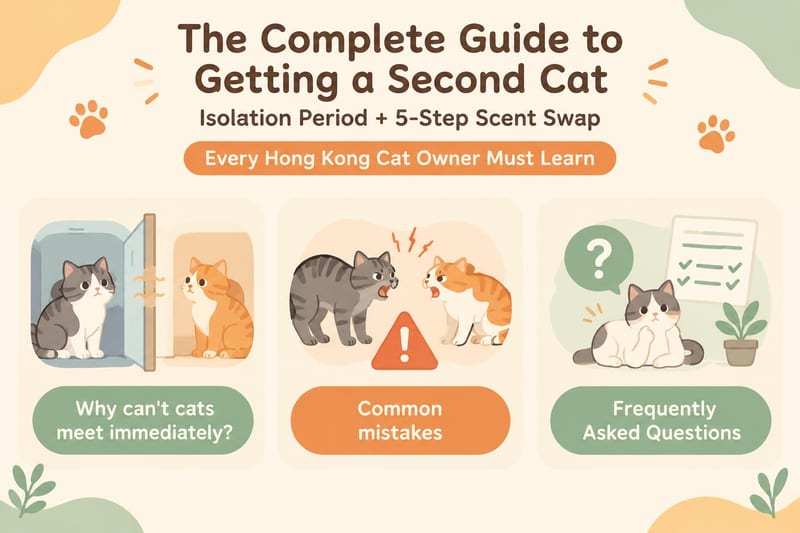
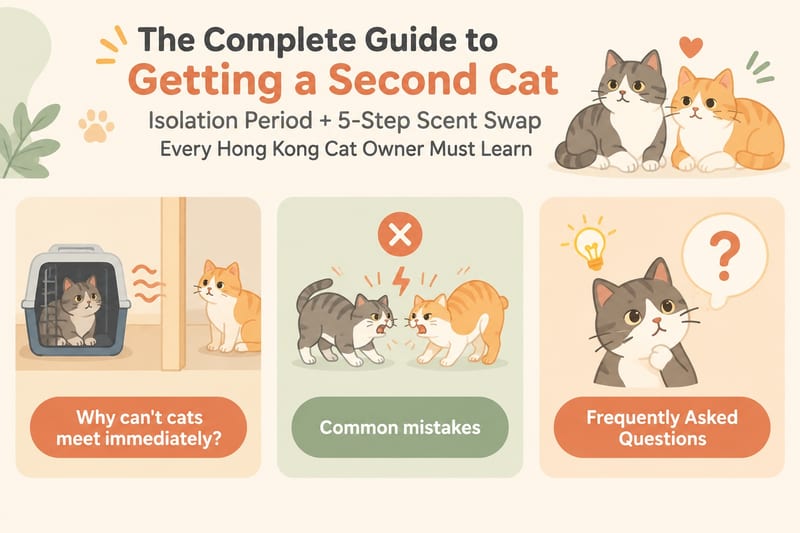
Why can't cats meet immediately?
Cats are highly territorial animals. To a resident cat that has lived there for a long time, the whole home is its territory. A strange cat suddenly appearing is like 'an intruder at the door,' so it will naturally be on guard, hiss, or even attack. And the new cat, in a new environment, is already stressed; being forced to face a strange big cat will only make it more frightened.
According to pet behavior research, social relationships between cats are mainly built on scent recognition, not sight. They need time to confirm through scent that the other is 'not a threat' before they gradually let their guard down. So the core principle of introducing a new cat is just one sentence: swap scents first, then swap glances, and meet last.
Preparation checklist before getting a second cat
Before bringing the new cat home, it's recommended to prepare the following items, all as separate sets to avoid resource competition:
| Item | Recommended quantity | Purpose |
|---|---|---|
| Litter box | 1 per cat + 1 spare | Avoid litter box guarding and urine marking |
| Water stations | At least 2 places in the home | Separate drinking spots to reduce conflict |
| Food bowls | 1 separate set per cat | Separate feeding to avoid food guarding |
| Separate room or large pen | For the new cat only | For isolation in the first two weeks |
| Cat pheromone product | 1 set | Soothe tension in both cats |
| Towels 2-3 | For scent swapping | Wipe and swap scents |
Tip: The 'N+1' rule for litter boxes (i.e., number of cats plus one) is the gold standard for avoiding litter box conflicts in multi-cat households—remember to follow it.
5 steps for introducing new and resident cats
Step 1: Isolation in a separate space (weeks 1-2)
After the new cat comes home, place it directly in a separate room that the resident cat doesn't often enter, with a litter box, water, food, bed, and toys. During this time, the two cats only 'smell and hear each other' but never meet.
During isolation, continue to play with and feed treats to the resident cat as usual, so it understands that 'the new cat is here, but my life hasn't lost anything,' avoiding jealousy. Also spend time with the new cat in its room every day to help it adjust.
Step 2: Scent swapping (weeks 1-2, in parallel)
Gently wipe a towel on the new cat's cheeks and body, then let the resident cat smell it, and reward with a treat after sniffing; do the reverse with another towel—wipe the resident cat and let the new cat smell it. When neither hisses or puffs up at the other's scent, you can move to the next step.
Advanced approach: swap the cats' sleeping mats, or alternately let the new cat explore the living room while the resident cat inspects the new cat's room, so both get used to each other's lingering scent.
Step 3: Visual contact (weeks 2-3)
After scent swapping is successful, open the door a crack, or use a baby gate/glass door to separate them, so the cats can see each other but not touch. This is the best time to feed or give treats on both sides of the door—creating a positive association that 'seeing each other = good food.'
If either cat hisses or growls, immediately increase the distance and don't force it.
Step 4: Short meetings (from weeks 3-4)
When both cats can look calmly at each other through the gate, or even sleep on opposite sides of the door, you can arrange a formal meeting. The first meeting should be 5-10 minutes, with toys or treats to distract them, and someone watching the whole time. If it goes well, gradually extend the time; if there's chasing, ears back, or puffing up, separate immediately and go back to the previous step.
Step 5: Long-term coexistence observation (weeks 4-8)
Once the two cats can be in the same room without interfering with each other, you can let the new cat move freely. But continue to watch for resource competition: litter box guarding, food guarding, blocking paths, etc. The most common problem in multi-cat households isn't fighting, but one cat being suppressed long-term and hiding—this 'cold violence' also needs to be addressed.
Common mistakes: right vs. wrong
| ✅ Correct approach | ❌ Wrong approach |
|---|---|
| Isolate the new cat in a separate room for two weeks | Let the two cats interact freely on the first day |
| Swap scents with towels and adapt gradually | Hold the two cats face to face to 'meet' |
| Use treats to build positive associations during meetings | Shout or punish when cats hiss |
| Separate litter boxes and food bowls per cat | Share one set of resources between the two cats |
| Separate immediately at conflict and go back a step | Force the cats together, thinking 'they'll get used to it' |
How long does the introduction period take?
Each pair of cats progresses differently; here's a general reference:
| Cat combination | Estimated time |
|---|---|
| Kitten + gentle adult cat | About 1-2 weeks |
| Adult + adult (compatible personalities) | About 2-4 weeks |
| Adult + adult (more sensitive personalities) | About 4-8 weeks |
| Cats with stray history or strong wariness | 8 weeks or more |
Remember: slow is better than fast. Rushing through steps is the number one cause of broken relationships between new and resident cats. If reactions are still intense after more than a month, consult a veterinarian or cat behavior consultant, and consider using cat pheromone products to help soothe emotions.
Further reading
Key takeaways
- ✅ The new cat must be isolated in a separate room for about two weeks; scent first, meeting later
- ✅ Swap scents with towels and use treats to build positive associations
- ✅ Follow the N+1 rule for litter boxes; separate food bowls and water stations
- ✅ Start meetings with 5-10 minutes; at any conflict, go back a step
- ❌ Never let the two cats interact directly on the first day, and never punish a hissing cat
- ❌ Don't force coexistence; each pair progresses differently—slow is better than fast
PetChill's Reminder
Getting a second cat is an endurance race. With thorough preparation and a step-by-step approach, the vast majority of cats can go from strangers to good friends. From litter boxes and gates to pheromone products, PetChill has everything you need to help you and your two furry bosses transition smoothly! To learn more about multi-cat households, keep following PetChill's latest articles!