

🤖 AI summary
Heartworm spreads through mosquito bites: a mosquito carrying larvae bites → larvae enter the body → they take up residence in the heart and lung vessels and grow into 30cm adults. Dogs are ideal hosts: many worms, gradually increasing heart-lung burden — coughing, exercise intolerance, ascites; cats are not ideal hosts but are more at risk: just a few worms can trigger asthma-like attacks or even sudden death, and there is no approved helps manage — for feline heartworm, prevention is everything. Hong Kong mosquito season is roughly April to November (it never quite reaches zero year-round), and monthly prevention is the only reliable line of defence.
• Dogs can be treated but it's expensive and gruelling: worm-killing course + strict exercise restriction
• Cat preventives differ from dog ones: doses/ingredients vary, do not share
• Starting prevention before 7 months of age can skip blood screening
Quick answer: Heartworm (Dirofilaria immitis) spreads through mosquito bites and lives in the heart-lung arteries. Dog symptoms: coughing, exercise intolerance, weight loss, ascites (staged treatment: adult-worm injection + exercise restriction, high cost and high risk). Cat symptoms: asthma-like coughing/vomiting/sudden death, no approved adult-worm treatment — only supportive care; prevention is the only script. Hong Kong mosquito season is roughly April to November: monthly prevention (chew/spot-on/injection) all year without a break; dogs should have a blood test before starting.
Contents
-
What is heartworm? How the transmission chain works
-
Dog vs cat: two completely different scripts
-
Symptom self-check + staging
-
Diagnosis: what tests confirm it
-
Dog treatment options (why prevention is much cheaper)
-
When to see a vet + red lines
-
Prevention types compared + Hong Kong mosquito season
-
FAQ
What is heartworm? How the transmission chain works
Heartworm (Dirofilaria immitis) is a thread-like parasite spread by mosquitoes — the adult looks like a thin noodle (up to 25 to 30cm in dogs) and lives in the pulmonary artery and right heart.
The transmission chain in four steps:
-
A mosquito bites an infected animal — taking in microfilariae (first-stage larvae) in the blood
-
Development inside the mosquito — larvae develop in the mosquito over 1 to 2 weeks into infective larvae (L3)
-
Bite transmission — a mosquito carrying L3 bites a cat or dog, and the larvae enter through the bite wound
-
Migration and maturation in the body — larvae migrate and develop for about 6 months into adults, take up residence in the heart-lung arteries, and start the next cycle
Two key facts:
- One mosquito is enough — a single infective bite can cause infection
- 6-month incubation — it takes about half a year from infection to adult maturity: preventives work by killing the larval stage during those six months; once adult worms are established it's a completely different story
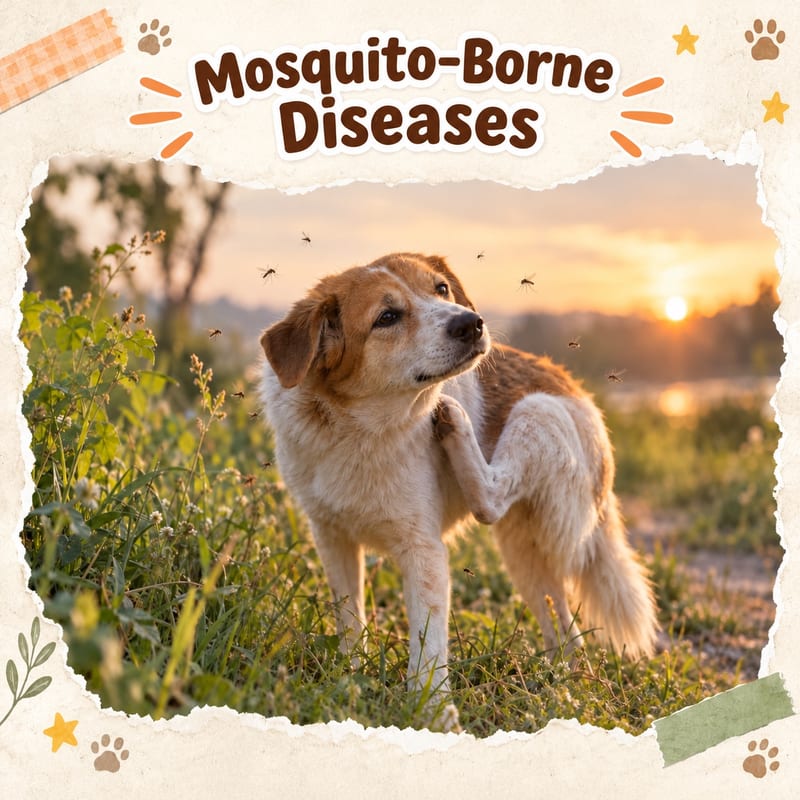
Dog vs cat: two completely different scripts
| Dog | Cat | |
|---|---|---|
| Host suitability | Ideal host: worms can multiply heavily (dozens common) | Non-ideal host: few worms (mostly 1 to 6) |
| Disease course | Chronic heart-lung failure script: progressive over months to years | Acute storm script: can die suddenly without warning |
| Main symptoms | Coughing, exercise intolerance, ascites | Asthma-like attacks, vomiting, sudden breathing difficulty |
| Treatment | Approved adult-worm treatment (Melarsomine injection) | No approved helps manage: supportive care while waiting for worms to die naturally (2 to 3 years) |
| Prevention | The foundation of everything | Prevention = everything |
Key cat warning: Feline heartworm disease is most often misdiagnosed as feline asthma/allergic bronchitis — the symptoms are very similar. Cats in Hong Kong that never go out can still be bitten by mosquitoes (mosquitoes coming indoors is normal), and prevention is not just for dogs.
Symptom self-check + staging
Dogs (progressive):
- Stage 1-2: coughing (noticeable after exercise), easily tired, exercise intolerance
- Stage 3: weight loss, coughing blood, ascites (signs of heart-lung failure), fainting
- Caval syndrome (severe): too many worms causing blockage — haemolysis, shock, emergency
Cats (sudden):
- Asthma-like: coughing, open-mouth breathing, rapid breathing
- Gastrointestinal type: intermittent vomiting (with no gastrointestinal explanation)
- Sudden death: for some cats the first 'symptom' is sudden collapse
Timeline reminder: In dogs it can take 1 to 2 years from infection to symptoms — 'fine right now' does not mean no infection; testing only when symptoms appear often means stage 3 already.
Diagnosis: what tests confirm it
Dogs:
- Antigen test (rapid test) — detects female adult worm antigen: the standard for annual routine screening (note: it only turns positive about 6 to 7 months after infection — it can't detect the larval stage)
- Microfilaria smear — directly see blood larvae: supportive
- Confirming a positive: X-ray (heart-lung appearance) + antibody/recheck + biochemistry — full assessment before treatment
Cats:
- Antibody test — cats have low infection rates but antibody tests are sensitive: evidence of exposure
- Antigen test — only positive for female worms: cats have few worms, so antigen false negatives are common
- X-ray + ultrasound — changes in pulmonary artery imaging: the main diagnostic tool
Before starting prevention: dogs over 6 months old should have a blood test (antigen) before starting; puppies started on prevention before 7 months of age can skip screening and go straight ahead — that's the practical value of 'early prevention saves screening'.
Dog treatment options (why prevention is much cheaper)
The three-stage protocol after confirming infection (American Heartworm Society AHS standard script):
-
Stabilisation — first kill larvae (preventive dose) + start doxycycline (kills the symbiotic bacteria Wolbachia, reducing reaction to worm killing) + anti-inflammatories: about 1 to 2 months
-
Adult-worm kill — Melarsomine deep intramuscular injection (two- or three-injection protocol, spaced): the injection itself is gruelling + expensive (in Hong Kong the full course commonly exceeds HK$10,000, for reference only)
-
Strict rest — for 4 to 6 weeks after worm killing, extremely restrict exercise (cage rest mainly): dead worms blocking the pulmonary artery is the most dangerous complication, and excited running and jumping can trigger it
Cats: no Melarsomine protocol — supportive care (steroids to control lung inflammation etc.) + waiting for worms to die naturally (about 2 to 3 years), with risk of recurrent attacks during that time.
Cost comparison (for reference only): prevention costs tens to just over a hundred dollars a month vs dog treatment over ten thousand + rest risk + cats cannot be treated — heartworm is 'the king of preventive value'.
When to see a vet + red lines
| Situation | Assessment | Action |
|---|---|---|
| Monthly prevention kept up | 🟢 Prevention | Annual blood screening to confirm |
| Persistent cough (especially after exercise) | 🟡 See vet | Blood test + auscultation + imaging |
| Obvious exercise intolerance | 🟡 See vet | Heartworm screening |
| Open-mouth breathing/rapid breathing (cat) | 🔴 Emergency | Risk of hypoxia, emergency vet that night |
| Ascites/fainting/coughing blood | 🔴 Emergency | Signs of heart-lung failure |
| Fever/lethargy during treatment | 🔴 Recheck | Assess reaction to dying worms |
Prevention types compared + Hong Kong mosquito season
| Type | Representative ingredient concept | Frequency | Features |
|---|---|---|---|
| Oral chew | Moxidectin/Milbemycin class | Monthly | Easy to give, taken as a treat; generally well accepted by dogs |
| Spot-on (back of neck) | Selamectin/Moxidectin + Imidacloprid | Monthly | One drop also protects against fleas and ear mites (some); suits difficult-to-medicate cases |
| Long-acting injection | Moxidectin long-acting injection | Dog: one injection every 6 to 12 months | No need to remember monthly; injection must be done at a clinic |
| Cat-specific | Cat-formula spot-on/chew | Monthly | Cat and dog doses and ingredients differ, strictly do not share |
How to choose: ① cat and dog each use their own specific product ② choose the format based on how easy it is to medicate ③ in Hong Kong's humid environment, a 'heartworm + flea' coverage combination is recommended (see PetChill's cat flea/tick fever article) ④ if a month is missed → contact the clinic for a recheck before restarting.
Hong Kong mosquito season:
| Period | Mosquito activity | Protection focus |
|---|---|---|
| April to June | Warming + plum rain outbreak | Prevention must already be in place |
| July to September | Annual peak | Zero tolerance: on time every month |
| October to November | Still active | Don't underestimate autumn mosquitoes |
| December to March | Lower but not zero | Keep it up — mosquitoes still seen in warm winters |
Principle: Hong Kong mosquito season is roughly April to November, but urban warm winters + indoor constant temperatures mean mosquitoes are present all year — prevention 12 months a year without a break is the Hong Kong script.
This article is for reference only and cannot replace veterinary diagnosis. If you have health concerns, please consult a registered veterinarian.

Further reading
📌 Key points
- ✅ Hong Kong mosquito season is April to November, but mosquitoes are present all year, so prevention doesn't stop
- ✅ Dog treatment costs over ten thousand + strict rest; prevention is much cheaper than treatment
- ✅ A few worms can kill a cat suddenly; prevention is the only script
- ❌ Cat and dog medications cannot be shared; doses and ingredients are completely different
- ❌ If you miss a month, contact your vet immediately; don't just double up on your own
- ❌ Waiting for symptoms before seeing a vet is usually too late
 Fuji One full guide →


 Feline Natural full guide →