
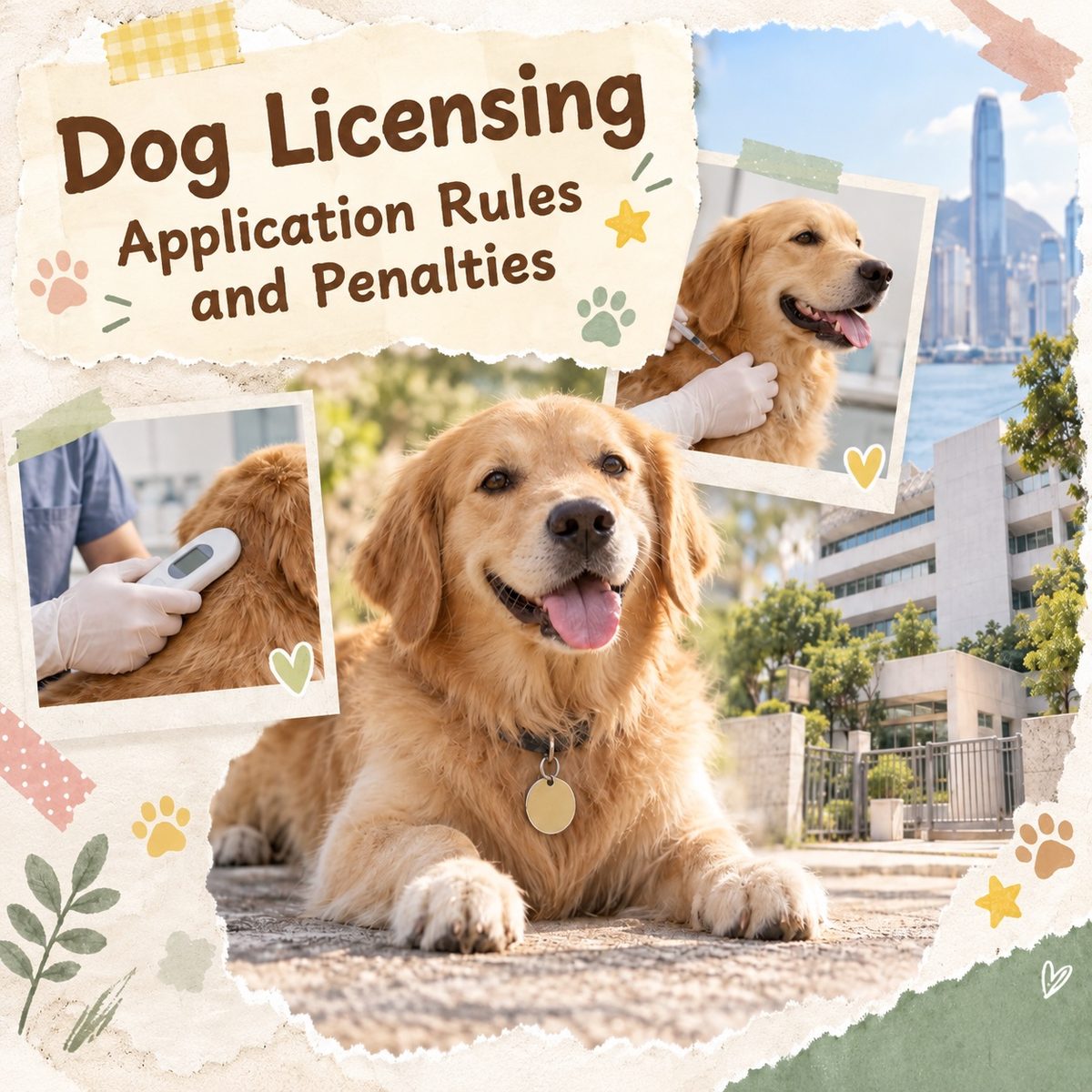
Quick answer: Cap 421 is Hong Kong's Rabies Ordinance: dogs must be microchipped, vaccinated against rabies and licensed with a 3-year dog licence by 5 months old at the AFCD or an approved veterinary clinic. Failure to do so can result in a fine. Remember to renew before expiry; if the vaccine has expired, it must be given at renewal. This article breaks down the licensing booking process, fee differences, lost licence handling and rules for taking your dog out.
🤖 AI summary
Dog ownership in Hong Kong is governed by the Rabies Ordinance (Cap 421): dogs must be licensed, microchipped and vaccinated against rabies by 5 months old. The dog licence is valid for 3 years and must be renewed. Violations can result in fines. This article explains the licensing process, costs, rules for taking dogs out and common questions.
Keeping a dog is not just about love—it is a legal responsibility. Hong Kong has clear legal requirements for dog ownership, and many new dog owners are unsure about 'how to get a dog licence', 'when to vaccinate' and 'what happens if I don't license'. The PetChill editorial team has put together the key points of Hong Kong's dog ownership laws so you can be a law-abiding and responsible owner.
What laws govern dog ownership in Hong Kong?
The main legislation regulating dogs in Hong Kong is the Rabies Ordinance (Cap 421) and its subsidiary legislation, enforced by the Agriculture, Fisheries and Conservation Department (AFCD). Key requirements include:
- Dog licence: All dogs over 5 months old must have a valid dog licence
- Microchip implantation: Dogs must be implanted with a microchip for identification when licensing
- Rabies vaccination: Dogs must be vaccinated against rabies and receive boosters on time
- Control in public places: Dogs must be properly controlled in public places (e.g., on a leash)
In addition, the Public Health (Animals and Birds) Ordinance and the Prevention of Cruelty to Animals Ordinance (Cap 169) also cover areas such as dog fouling and animal cruelty. Violations can result in fines and, in serious cases, prosecution.

Dog licensing process: must be done by 5 months old
Many new owners think 'it's not too late to license the dog when it's older', but the law requires dogs to be licensed by 5 months old. The process is as follows:
-
Prepare documents: Bring your identity document (e.g., Hong Kong identity card)
-
Go to the processing location: AFCD Animal Management Centre or an AFCD-approved private veterinary clinic
-
Microchip implantation: The vet will implant a microchip (quick process, the dog will only feel a slight prick)
-
Rabies vaccination: If the dog has not been vaccinated or the vaccination has expired, it must be vaccinated on the spot
-
Collect the dog licence: After completion, a dog licence will be issued, generally valid for 3 years, and must be renewed before expiry
| Item | Requirement | Remarks |
|---|---|---|
| Licensing age | 5 months old | Fine for overdue licensing |
| Microchip | Implanted at licensing | Used to identify the owner |
| Rabies vaccine | Must be vaccinated | Keep the vaccination card safe |
| Licence period | 3 years | Must renew before expiry |
| Processing location | AFCD / approved veterinary clinic | Private clinics may charge a consultation fee |
Legal basis: The above are statutory requirements under the Rabies Ordinance—not 'recommendations' but 'mandatory'. Specific fees are subject to the latest AFCD announcement. If you have questions about the process, you can contact the AFCD directly.
Rabies vaccine: almost eradicated in Hong Kong but must be maintained
Hong Kong has had no local rabies cases since the 1980s and is a 'rabies-free area', relying on a strict vaccination system to maintain this status. The law requires:
- Dogs must present valid rabies vaccination proof or be vaccinated on the spot when licensing
- Vaccine protection generally lasts 3 years and must be boosted on expiry (along with licence renewal)
- If a dog bites someone, the vaccination record is an important legal document
Remember: not vaccinating is not only illegal but also puts your dog and the community at risk.
Rules for taking dogs out: leash, dog fouling, fighting dogs
Besides licensing and vaccination, there are rules to follow when taking your dog out:
- Leash: Dogs must be led on a leash or otherwise properly controlled in public places. Letting dogs roam freely can result in a fine
- Dog fouling: Not cleaning up dog faeces is illegal and can result in a fixed penalty. Remember to bring plastic bags
- Fighting dogs: Fighting dogs such as Pit Bull Terriers are strictly controlled in Hong Kong. Import and breeding are restricted, and there are additional conditions for keeping them
- Large dogs: Some larger dogs may need to wear a muzzle in public places, depending on specific regulations
If you also have a cat, you may want to read our other article Hong Kong Cat Ownership Laws Guide; the legal requirements for cats and dogs differ slightly.
Do adopted dogs also need a licence?
Yes. Whether a dog is adopted or purchased, as long as it is over 5 months old, the new owner is responsible for licensing it. Adoption organisations (e.g., SPCA) usually help with microchipping and vaccination, but the licence holder responsibility transfers to the new owner. Before adopting, you may want to read Adopt or Buy? Must-Read Before Getting a Pet in Hong Kong to understand the responsibilities and processes of both.

Practical checklist for dog owners in small Hong Kong flats: from licensing to daily rules
Living in a small Hong Kong flat means limited space but unlimited responsibility. The following checklist helps you integrate legal requirements into daily life without running around.
1. Book a veterinary clinic
- Call first to ask if the clinic is 'AFCD-approved'. When booking, state 'licensing + microchip + vaccination all-in-one' to avoid discovering on arrival that they don't do implantation.
- Confirm fees: some clinics charge consultation, microchip and vaccine fees separately. Get a full quote before deciding.
2. Pack your bag before going out
- Identity card + old vaccination card (if any)
- Your dog's favourite treats: reward immediately after vaccination to reduce fear
- Portable water bottle and towel: there may be a little blood after vaccination; wipe it clean immediately
3. Three essentials at home
- Two leashes: one for daily use, one spare by the door so you don't have to search when going out.
- Bag and dispenser: buy small bag dispensers that clip to the leash so you can pick up dog faeces immediately and avoid fines.
- Vaccination card holder: keep the dog licence, vaccination card and microchip paper together so you don't have to search at renewal.
4. Renewal alarm
- Set a phone reminder 3 months before the dog licence expires and book the vet early to avoid peak season.
- If you move house or change phone number, remember to update the microchip company's records so you can be found if your dog goes missing.
5. Public/private housing notes
- Public housing residents: remember to declare your dog to the Housing Department. Some estates have additional rules, such as muzzling large dogs.
- Private housing residents: check the deed of mutual covenant for breed restrictions to avoid discovering after signing that you cannot keep a dog.
By following the above steps, even in a 200 sq ft flat, you can be a law-abiding and worry-free owner.
Related articles
- Hong Kong Cat Laws Guide | AFCD Licensing + Rabies Ordinance + Import Quarantine at a Glance
- Cat Microchip Implantation Guide | Hong Kong Costs, Process, Real Lost-and-Found Cases
- Adopt Instead of Buy Hong Kong | List of Government-Recognised Animal Adoption Organisations
📌 Key points
- ✅ License, vaccinate and microchip by 5 months old
- ✅ Dog licence valid for 3 years; renew before expiry
- ✅ Must leash and clean up dog faeces in public; fines apply for violations
- ❌ Not licensing or vaccinating is illegal and can lead to prosecution
- ❌ No vaccination record if a dog bites someone can lead to legal trouble