
🤖 AI Summary
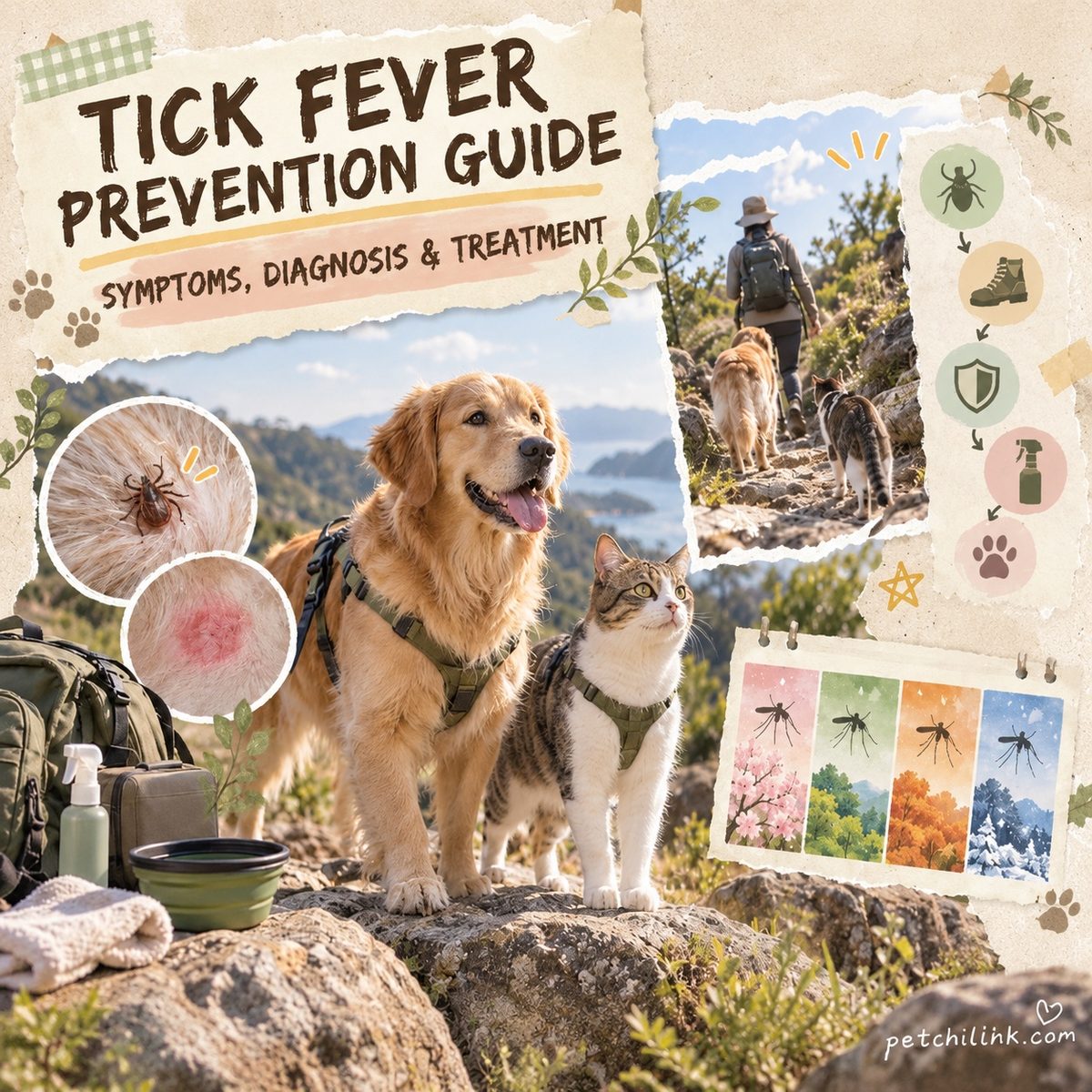
Tick fever is not one disease—it is an umbrella term for a group of blood-borne pathogen diseases transmitted by tick bites: Ehrlichia, Babesia, Anaplasma, etc., which attack red blood cells/platelets/white blood cells. Ticks are present in Hong Kong country parks all year round, and hiking dogs are the highest-risk combination: fever, weakness, pale gums, and dark urine appearing 1 to 2 weeks after an acute hike—blood tests are needed immediately. The prevention triad: monthly topical/oral tick-killing medication + full-body check after hiking + choosing hiking routes that avoid dense vegetation.
• Tick bites must be removed by pulling straight out—twisting/squeezing can break the mouthparts off in the skin
• The chronic phase can silently damage the bone marrow—annual blood tests are the safest bet
• Ticks need to be attached for 24 to 48 hours before fully transmitting disease: checking the same evening after hiking is very effective
Quick answer: Tick fever = an umbrella term for blood parasite diseases transmitted through tick bites. The most common in Hong Kong: Ehrlichia (attacks platelets → bleeding tendency), Babesia (destroys red blood cells → haemolytic anaemia), Anaplasma. Symptoms: fever, weakness, poor appetite, pale gums, dark urine, bruising. The 1 to 2 weeks after hiking is the acute onset window. Diagnosis relies on blood PCR + blood smear. Treatment: targeted antibiotics (Ehrlichia: doxycycline) or anti-Babesia drugs, blood transfusion for severe cases. Prevention: monthly tick-killing preventive medication (topical/oral) + immediate check after hiking + route planning.
Table of Contents
-
What is tick fever? Why Hong Kong's terrain is high-risk
-
Comparison table of the three major pathogens
-
Symptom self-check + acute/chronic timeline
-
Diagnosis: what tests confirm it
-
Treatment plan
-
When to see a doctor + red lines
-
Hiking protection SOP + pest calendar
-
FAQ
What is tick fever? Why Hong Kong's terrain is high-risk
Ticks are arachnid blood-sucking parasites—they lurk on grass tips/shrubs, and when they sense the body heat and CO2 of passing animals they climb on, find a spot to bite and suck blood. Tick fever is the umbrella term for the pathogen diseases they transmit when biting—one tick can carry several pathogens at once (mixed infection is not uncommon).
Why Hong Kong is particularly high-risk:
- Well-developed country park network—Tai Mo Shan, Lion Rock, Shing Mun, Ma On Shan, Sai Kung… hiking trails cut through grass and shrubs, exactly tick habitat
- Warm all year round—Hong Kong has no winter that truly kills ticks: prevention is needed all year
- Humid—ideal environment for tick eggs/larvae to develop
- Stray cattle/stray dogs/wildlife as carriers—rural mammals are pathogen reservoirs + tick hosts
Hiking dogs are the highest-risk combination—but urban park lawns and downstairs flower beds also pose a risk: dogs that don't hike still need basic protection.
Comparison table of the three major pathogens
| Pathogen | Target | Typical signs | Special note |
|---|---|---|---|
| Ehrlichia canis | White blood cells/platelets | Fever, bruising and bleeding spots, nosebleeds, platelet crash | Chronic phase silently damages bone marrow |
| Babesia gibsoni/canis | Red blood cells | Haemolytic anaemia, pale gums, dark/tea-coloured urine, jaundice | Can be transmitted through bites/vertically |
| Anaplasma spp. | White blood cells/platelets | Fever, joint pain, lameness, lethargy | Often co-infects with Ehrlichia |
Common ground: All three follow the "insect bite → blood system damage → anaemia/bleeding/fever" script—so annual routine blood tests (complete blood count + platelets) are the core of early detection.
Symptom self-check + acute/chronic timeline
Acute phase (onset window 1 to 2 weeks after bite):
- Fever (noticeably hot inside ears/underarms)
- Sudden weakness, collapses after two steps
- Appetite crashes
- Pale gums (anaemia) or bruising spots (bleeding tendency)
- Urine turns dark (tea-coloured—a sign of haemolysis)
- Tell-tale sign: doesn't even want to go on its usual favourite walk
Chronic/subclinical phase (the most insidious):
- Some dogs show no obvious acute symptoms after infection—the pathogen lurks chronically
- Gradual weight loss, intermittent low fever, recurring minor ailments
- The chronic phase of Ehrlichia can cause bone marrow haematopoietic failure: persistently low platelets/white blood cells
- Many cases are "only discovered through blood tests at the annual check-up"
Timeline summary: Hiking day → 1 to 2 week acute window (watch for fever and weakness) → passing the acute phase doesn't mean safe (chronic latency possible) → annual blood tests as a safety net.
Diagnosis: what tests confirm it
- Blood PCR panel—detects Ehrlichia/Babesia/Anaplasma DNA all at once: the gold standard, most sensitive in the acute phase
- Blood smear microscopy—sees the organisms inside red blood cells in acute Babesia: a cheap adjunct, a negative result doesn't rule it out
- Complete blood count + platelet count—degree of anaemia + clues of platelet crash: essential baseline
- Serum antibody test—4Dx-type rapid test: shows exposure history, active infection judgement must combine with PCR
- Biochemistry + urinalysis—assess haemolysis/organ impact
Mixed infection note: In Hong Kong clinical practice, Ehrlichia + Anaplasma co-infection is commonly seen—when symptoms are mixed, a full panel PCR is the most reliable.
Treatment plan
| Pathogen | First-line drug | Course concept |
|---|---|---|
| Ehrlichia/Anaplasma | Doxycycline | 3 to 4 weeks (give with water to prevent oesophagitis) |
| Babesia | Imidocarb (injection)/ combination oral regimen | Two injections or a long oral course; monitor side effects |
Adjunctive support:
- Severe anaemia: blood transfusion (with blood typing)
- Extremely low platelets: strictly restrict strenuous activity + avoid trauma
- Dehydration/refusing food: fluid therapy + nutritional support
- Chronic bone marrow suppression cases: long-term complete blood count monitoring
helps manage ≠ immunity: After recovering from tick fever, reinfection is possible—prevention must be lifelong, not "once infected you have antibodies".
When to see a doctor + red lines
| Situation | Assessment | Action |
|---|---|---|
| Tick found after hiking, dog normal | 🟢 Handle + observe | Pull straight out + watch daily for two weeks |
| Fever/weakness 1 to 2 weeks after tick removal | 🟡 See a vet the same day | Complete blood count + PCR window |
| Pale gums + dark urine | 🔴 Emergency | Acute haemolysis: same-night emergency |
| Skin bruising/nosebleeds | 🔴 Emergency | Platelet crisis: see a vet immediately |
| Sharp drop in urine output/jaundice | 🔴 Urgent handling | Haemolysis + kidney load, see a vet immediately |
| Low platelets on annual blood test | 🟡 Follow-up | Chronic infection assessment + PCR |
Hiking protection SOP + pest calendar
Before hiking:
- Follow the calendar for monthly tick-killing preventive medication (topical/oral chew)—confirm no missed month before hiking
- Long-haired dogs can be combed and checked first
- Route planning: walk as close to the centre of the trail as possible, avoid the grass-sweeping spots on both sides
During hiking:
- Don't let the dog charge into tall grass/shrub hollows
- During rest breaks, quickly feel over the body (around ears/underarms/between toes)
- Bring water—avoid the dog drinking puddle water (also prevents leptospirosis)
After hiking (the critical 24 hours):
- Same-evening full-body "comb-and-check": feel + visually inspect from head to tail—focus on: inside and outside ears/collar area/underarms/groin/between toes/eyelid edges
- Sweep away unattached ticks; pull attached ones straight out (see FAQ)
- Within two weeks: observe energy/appetite/urine colour daily—the acute window period
Hong Kong pest calendar (protection calendar):
| Month | Tick activity | Mosquito (heartworm) activity | Protection focus |
|---|---|---|---|
| Mar to May | High (warming spring, they start crawling) | Rising | Tick-killing + start heartworm mosquito prevention |
| Jun to Aug | High + humid outbreak | Peak | Full protection: ticks/mosquitoes/fleas |
| Sep to Nov | High (autumn hiking peak season) | Sustained | Tick-killing is most important in hiking season |
| Dec to Feb | Medium-low but present all year | Lower, not zero | Don't stop medication—Hong Kong has no truce period |
Conclusion: Tick and mosquito prevention and control all year round, stepped-up checks during hiking season (autumn and spring)—"no need to protect in winter" is temperate thinking, not applicable to Hong Kong.
This article is for reference only and cannot replace veterinary diagnosis. If you have health concerns, please consult a registered veterinarian.
Further reading
📌 Key takeaways
- ✅ A full-body comb-and-check within 24 hours after hiking can cut off transmission
- ✅ Monthly topical/oral tick-killing medication is a must all year round
- ✅ Within 1–2 weeks of acute symptoms appearing is the golden treatment period
- ❌ Stopping medication in winter = the whole year's defence line falls
- ❌ Twisting and squeezing when removing ticks breaks the mouthparts, raising infection risk