
🤖 AI Summary
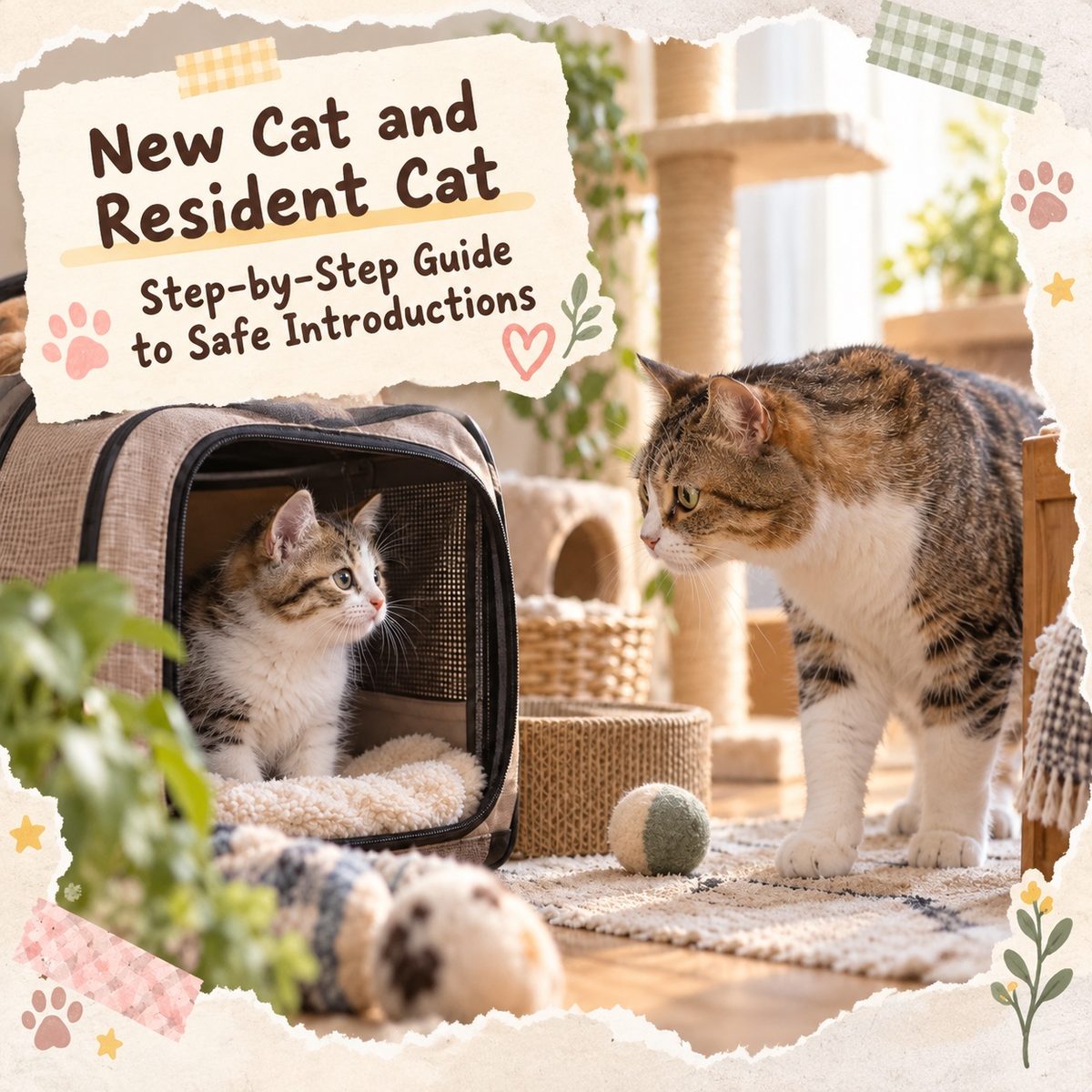
The first 14 days after a new cat arrives are the golden adaptation window for their whole life. This SOP has four stages: Day 1-3 safe room isolation, Day 4-7 exploration expansion, Day 8-11 barrier recognition with existing pets, Day 12-14 limited freedom. Supporting tools: pre-arrival checklist, daily traffic light observation chart, and the "3 No's" principle (no chasing, no noise, no forced touching).
• Suitable for: single new cat + households with existing cats/dogs
• 14 days is a baseline, not a deadline; slow cats can take longer
• Not eating on Day 3, still hiding on Day 5 = escalate handling
Quick answer: Keep the new cat in a safe room (small room/large cage) with only food, water and litter box for Day 1-3; Day 4-7 open the whole home for exploration (existing pets separated); Day 8-11 do scent and visual exchange through a door/barrier; Day 12-14 short periods of limited freedom + supervised contact. Throughout, remember no chasing, no noise, no forced touching—progress is determined by the cat's behaviour.
Contents
-
Why a 14-day SOP?
-
Pre-arrival checklist
-
Four-stage timeline (Day 1-14)
-
Daily traffic light observation chart
-
The "3 No's" principle
-
FAQ
Why a 14-day SOP?
Cats are highly territorial animals; a new environment means their whole world is reset—all scents unfamiliar, all sounds unfamiliar, no safe roadmap. For the first few days, not eating or drinking, hiding, meowing at night are all normal stress responses—not illness, not dislike of you.
The problem is beginners easily make two mistakes: one is letting go too fast—opening the cage the first night and letting them run all over the house, resulting in them being so scared they hide under the sofa for three days and it becomes harder to build trust; the other is rushing intimacy—grabbing them out to pet every day, making them associate you with "scary events". The 14-day SOP gives a clear path: what to do at each stage, when to advance, when to stop—follow it and you won't go wrong.
Pre-arrival checklist
Prepare the following the day before the new cat arrives:
- ✅ Safe room: a small room (bathroom/study), or a large three-tier cage—the key is small and enclosed; don't give the whole living room at first
- ✅ Litter box (one), cat litter (ideally the same type used at the rescue/shelter)
- ✅ Food and water bowls (placed separately), keep the original cat food for at least a week before slowly transitioning
- ✅ Hiding spots: a cardboard box on its side, a half-covered cat bed—must have a "can hide" option
- ✅ Scratching post, small toys (wand toy put aside; may not be needed the first few days)
- ✅ Window screen check: in Hong Kong high-rises, window grilles must be secured (high-rise syndrome is a real risk)
- ✅ Cables tidied, small items put away, toxic plants removed
For households with existing cats/dogs, also: check existing pets' vaccination records, reserve a separate room as the new cat's safe room, prepare an extra set of bowls and litter box.
Four-stage timeline (Day 1-14)
📍 Day 1-3: Safe room isolation period
- Bring the cat home and place the carrier directly into the safe room; open the carrier door but don't pull them out
- Set up food, water and litter box, then leave them to adjust
- Enter the room 2-3 times a day: change water, scoop the litter, put out food—move slowly, keep voice low, no forced interaction
- Don't panic if they don't eat—cats can go 24-48 hours; but over 48 hours with no food at all requires a veterinarian
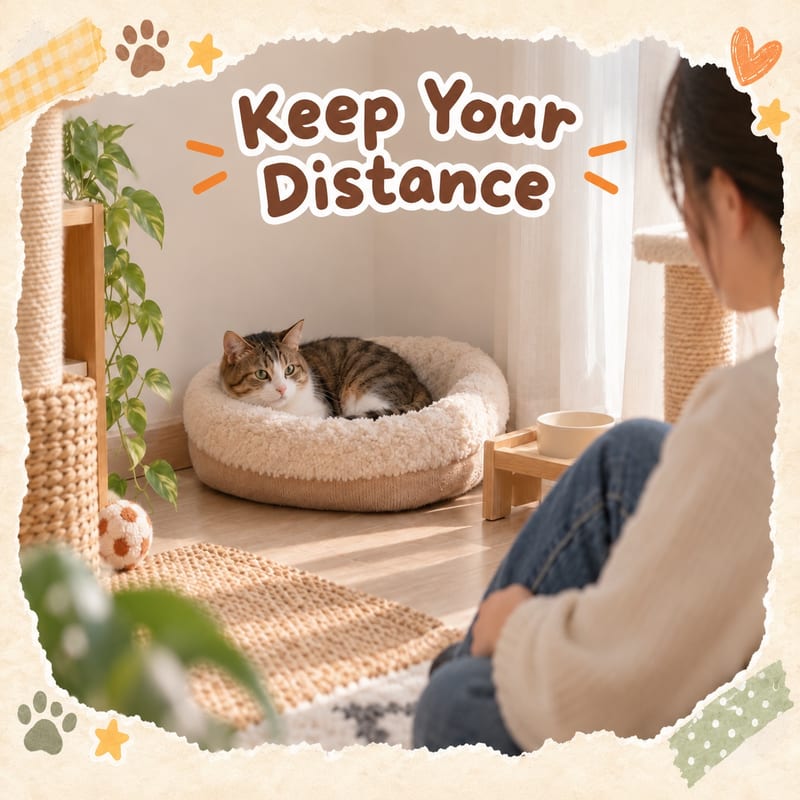
- Hiding and not coming out? Normal. Sit in the room quietly reading/on your phone, let them get used to your presence
Success indicators for this stage: They eat and use the litter box while you are present.
📍 Day 4-7: Exploration expansion period
- Open the safe room door (room door), let them decide when to come out and explore—don't carry them out
- For the first whole-home exploration, choose night time or when few people are home; quiet helps exploration
- They will slowly sniff the whole house, rub against furniture (scent marking)—these are good signs
- For households with existing pets: isolate existing pets in another area during exploration, take turns letting them out
- Start short interactions: toss freeze-dried treats/snacks near them, don't reach your hand towards them
Success indicators for this stage: They come out of the room on their own, know where food and litter box are, dare to sleep near you.
📍 Day 8-11: Scent/visual exchange period (households with existing pets)
- Scent swapping: use a clean towel to wipe the new cat's cheeks, place in the existing pet's area; then wipe the existing pet's cheeks, place in the new cat's area; continue only if no abnormal reaction after sniffing
- Feeding through the door: place food bowls on both sides of the door, start with the door far apart, gradually move closer—associate "the other's scent" with "good things like meals"
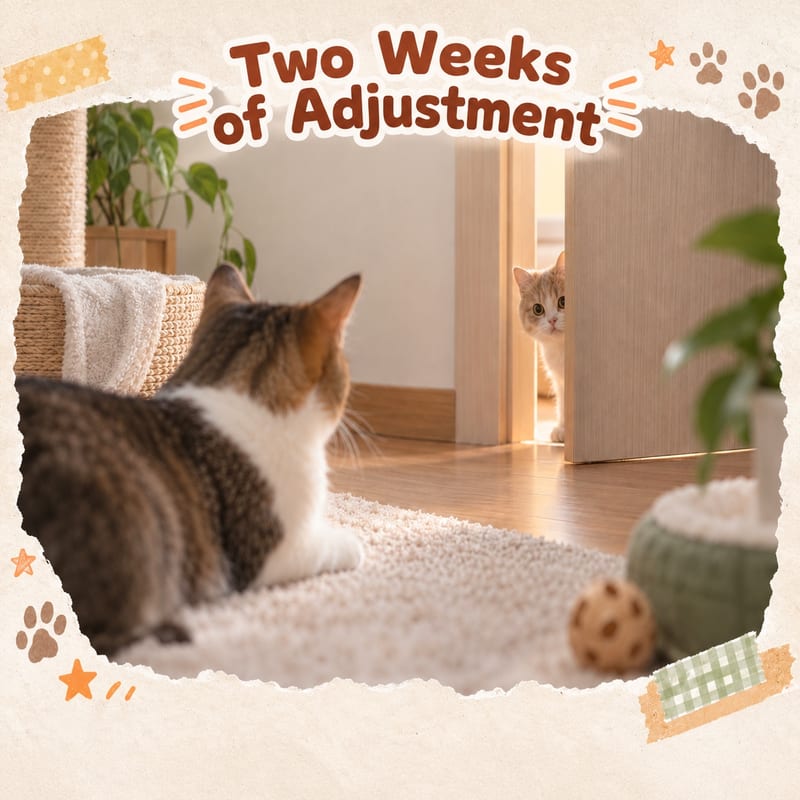
- Visual contact: through a door gap/baby gate/playpen, first open only 1-2 minutes, observe reaction: curious sniffing = good; hissing/growling = close immediately, go back to previous stage the next day
- Single-cat households: this stage can proceed directly—strengthen interaction (wand toy twice daily, 10 minutes each)
Success indicators for this stage: Both sides can eat calmly through the door/barrier, no persistent hissing.
📍 Day 12-14: Limited freedom + supervised contact
- Existing pet households: hold one formal meeting—fully open but supervised throughout, lasting 5-15 minutes; if fur flies or chasing starts, separate immediately and go back to the barrier stage the next day
- Don't create "resource competition" situations: number of litter boxes = number of cats + 1, bowls placed separately, more than one high resting spot
- Single-cat households: full-house freedom officially begins, consolidate routine—regular feeding, daily playtime
- Continue to monitor: appetite, litter box use, energy levels
Success indicators for this stage: The two cats can coexist in the same room (no need to cuddle, mutual non-interference is a pass); single cat has a stable daily routine.
Daily traffic light observation chart
| Light | Behaviour | Assessment | Action |
|---|---|---|---|
| 🟢 Green | Eating and drinking normally, using litter box, exploring, willing to be near you | Adapting smoothly | Proceed with SOP |
| 🟡 Yellow | Eating less, hiding more, meowing at night, avoiding you | Mild stress, normal range | Slow down, go back to previous stage for two more days |
| 🔴 Red | Over 48 hours with no food at all, persistent diarrhoea/vomiting, no urine in litter box for 2 days, rapid breathing | Possible health issue | Book a veterinarian as soon as possible |
Recording suggestion: Take a photo/write two sentences daily (how much eaten, whether litter box used)—very useful when seeing the vet.
The "3 No's" principle
Throughout the 14 days, remember these three iron rules:
- No chasing—if they hide, don't pull them out; forcing them out only confirms "this place is not safe"
- No noise—keep the home quiet for the first two weeks, pause parties, renovations, stranger visits
- No forced touching—interaction initiated by them: pet only when they come to you, start from the chin; if they walk away, let them go
Hong Kong small flat practicalities: a 14-day setup that works even in 200 sq ft
Hong Kong is short on space; many families live in open-plan or 200 sq ft subdivided flats, yet can still run the full 14-day SOP—just master "space zoning + time staggering".
Safe room transformation
- No room? Use a large three-tier cage (90cm+) in the corner of the living room, litter box on the bottom tier, bed on the middle tier, food and water on the top tier. Cover the cage with a large towel, leave a 5cm gap as a door—instantly becomes a small room.
- Families with a enclosed kitchen can set up the new cat's safe room in the kitchen, close the kitchen door at night and let them explore the living area; during the day when you go to work, they return to the safe room to rest.
Existing pet isolation schedule
- Existing cat usually sleeps in the master bedroom? For the first three days after the new cat arrives, the existing cat moves to the living room cat tree, and the master bedroom becomes the new cat's safe room. After 11pm, let the new cat out to explore the living room for 1 hour, temporarily isolate the existing cat in the bathroom—staggered outings.
- Households with existing dogs are simpler: dogs need morning and evening walks anyway; during the 30-minute walk, let the new cat out to inspect the whole house, then return them to the safe room before the dog comes back.
Essential hardware list (available same day in Sham Shui Po/Taobao)
- Metal window screen with velcro: $40-60/ft, DIY window grille sealing, leave a 2-inch safety distance to prevent high-rise syndrome.
- Baby gate (180cm wide): $120-150, place at the room door as a barrier, essential for visual contact on Day 8-11.
- Collapsible cat tunnel: $50-80, place in the middle of the living room as a "neutral zone", a place to hide during the first meeting.
Air-conditioning/humidity notes
- Don't let the safe room face the air-conditioner directly; place a damp towel or old T-shirt as a shield, maintain 24-26°C.
- Hong Kong humidity above 80%, scoop the litter twice daily to avoid the new cat holding urine due to wet litter.
When to see the vet + transport
- Book immediately when red light appears. Hong Kong Island 24-hour emergency: CityU North Point, Eastern Hospital Sai Wan Ho; Kowloon: VEC Prince Edward, PetDB Mong Kok; New Territories: CityU Tai Wai, CityU Tsuen Wan.
- New cats are scared of cars; cover the carrier with a dark towel, sit in the front passenger footwell in a taxi for stability; for journeys over 20 minutes, bring a small amount of catnip biscuits to distract.
With the above setup, even 200 sq ft can run the full 14-day integration—the key is "small space means longer time"; slow cats can meet on Day 20 and it's still not too late.
Related product recommendations
For beginners starting to keep pets, basic equipment and staple food should be prepared all at once. Here are related products available at PetChill:
- Fuji One Natural Minimalist Daily 3.0 Tofu Cat Litter Lavender 6L - Original Import (Fuji One) — tofu litter flushable, low dust
- Fujihime no Awayuki 3.0 Natural Whitening Soy Milk Tofu Cat Litter Original 18L - Original Import (random old/new packaging) (Fujihime no Awayuki) — tofu litter flushable, low dust
Want to see more: Fuji One Brand Guide
Product prices and latest offers are subject to the product page; this article is for reference only.
Further reading
📌 Key takeaways
- ✅ Keep them in the safe room for the first three days, let the cat decide when to come out
- ✅ Record daily with the traffic light chart, only advance on green
- ✅ For existing pet households, scent swap first then visual contact
- ❌ No food at all for 48 hours = see a vet immediately
- ❌ Don't force-pull the cat out to pet, it destroys trust
 Fuji One full guide →


 Fuji Cat full guide →


 K9 Natural full guide →



