
🤖 AI Summary
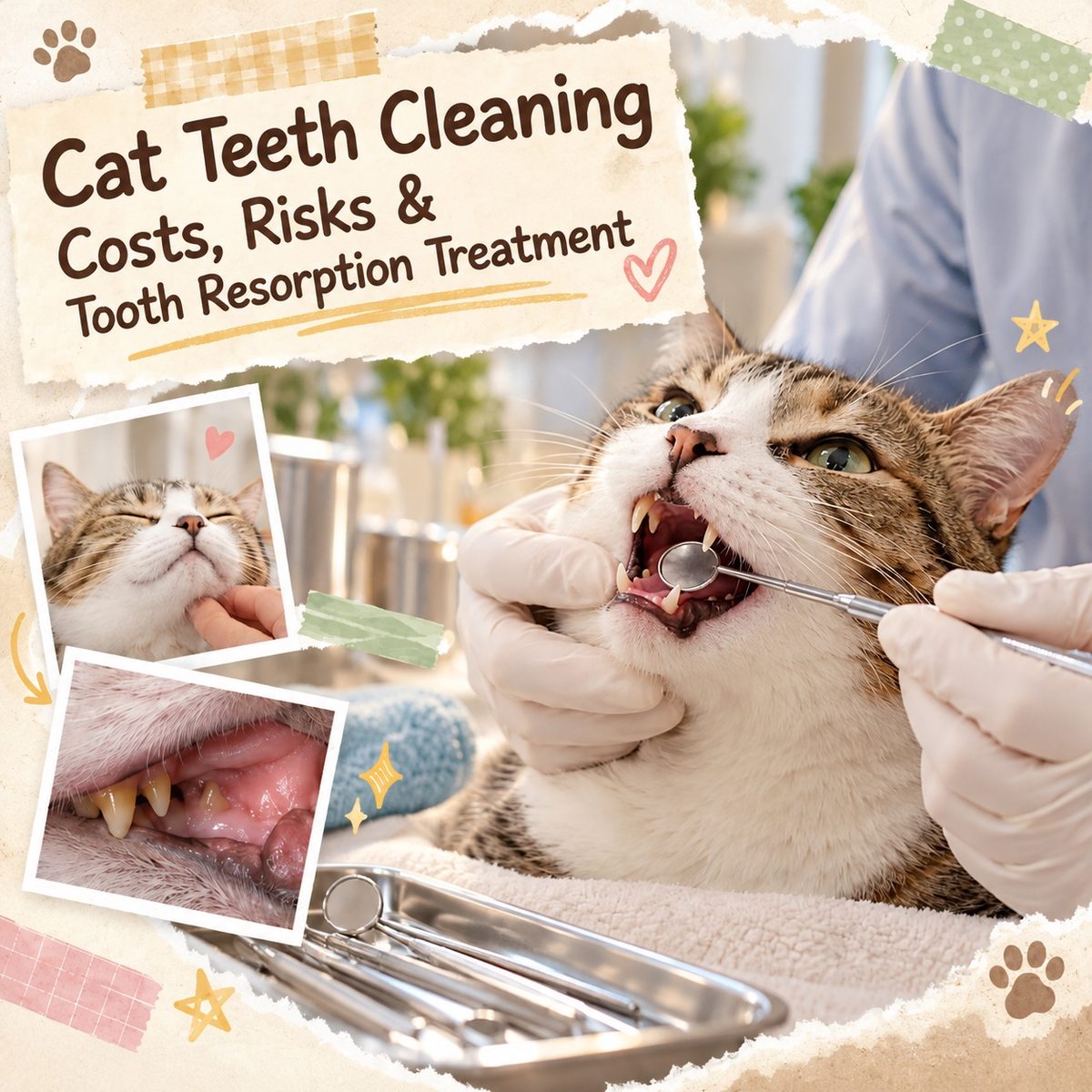
Cat teeth cleaning is not cosmetic; it is a medical procedure under anaesthesia: ultrasonic scaling + subgingival debridement + dental X-rays + polishing are all part of a complete treatment. In Hong Kong, cat teeth cleaning with anaesthesia starts at around HK$2,000 to 6,000, with extractions charged separately. Cats also have a hidden killer—tooth resorption (TR): the outside can look normal while the inside rots, and it's impossible to see without dental X-rays.
• Warning signs: bad breath, tartar, red/swollen gums, eating slowly or chewing on one side
• Anaesthesia is not a monster: with pre-op blood tests and modern monitoring, risks are manageable
• Anaesthesia-free cleaning treats the symptom, not the cause; it can't clean below the gumline
Quick answer: Cat teeth cleaning in Hong Kong costs around HK$2,000 to 6,000+, including anaesthesia, ultrasonic scaling and polishing; blood tests, X-rays and extractions are usually extra, so ask for an all-inclusive price.
Teeth cleaning (COHAT) is a complete dental treatment performed under one anaesthetic: pre-op blood tests → anaesthesia → oral examination + dental X-rays → ultrasonic scaling + subgingival debridement → polishing → (if needed) extractions. Tooth resorption (TR) is a common problem specific to cats; diagnosis relies on dental X-rays. Daily brushing and dental products can only extend the interval between cleanings; no product can replace professional cleaning.
Contents
-
Quick reference: cleaning process × cost factors
-
What does cat teeth cleaning actually involve? It's more than 'whitening'
-
When to clean? Six major signals
-
How does tartar form? And how is it related to tooth resorption?
-
The truth about anaesthesia risk: at what age can you clean?
-
Complete process breakdown (COHAT six steps)
-
Tooth resorption: the invisible killer of cat teeth
-
Hong Kong price table + how to choose a clinic + when to see a vet
-
Daily care, cleaning frequency and FAQ
Quick reference: cleaning process × cost factors
Cleaning process quick reference (COHAT six steps):
| Step | What happens | Key points |
|---|---|---|
| 1. Pre-op assessment | History + initial oral exam + blood tests (extra for senior cats) | Fasting before cleaning is generally 8 to 12 hours, follow clinic instructions |
| 2. Anaesthetic induction + intubation | Induction then endotracheal intubation | Prevents water and debris from entering the lungs; a safety key |
| 3. Oral examination + dental X-rays | Under anaesthesia, examine each tooth + X-ray the roots | Cats have 30 teeth; many problems are invisible from the outside |
| 4. Ultrasonic scaling + subgingival debridement | Shatter crown tartar + clean infection sources inside gum pockets | If you don't clean below the gumline, it's as if you never cleaned |
| 5. Polishing + rinsing | Smooth out micro-scratches on the tooth surface | Slows down plaque re-attachment |
| 6. Treatment decision | Based on X-rays and probing, decide to keep or extract | Extractions done immediately + pain relief |
| Post-op | Observe appetite and wound at home | Most recover same day or next day; cats with extractions eat soft food for a few days to a week. Individual recovery arrangements should be confirmed with your veterinarian |
Cost factors quick reference (actual prices must be confirmed with the clinic):
| Factor | How it affects cost |
|---|---|
| Body weight | Anaesthetic dose calculated by weight |
| Dental condition | Whether extractions are needed and how many—the biggest variable |
| Dental X-rays | X-rays are charged per item, but not recommended to skip |
| Clinic tier | General clinic vs 24-hour hospital charges differ |
| What the package includes | Big difference between 'cleaning package price' and 'all-inclusive with X-rays'; ask clearly what's included |
What does cat teeth cleaning actually involve? It's more than 'whitening'
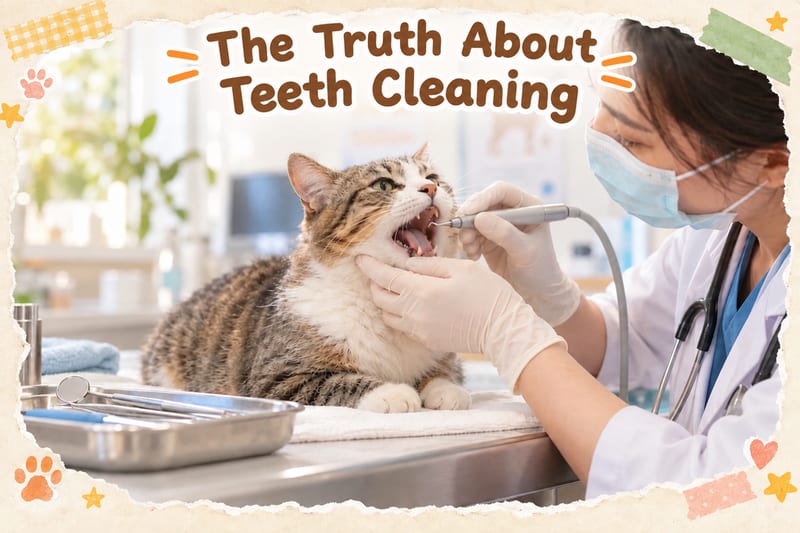
The formal name for cat teeth cleaning is COHAT (Complete Oral Health Assessment and Treatment)—a complete oral health assessment and treatment. It is not a 'bath-style' clean, but a systematic dental treatment performed under one anaesthetic:
- Remove calculus—plaque mineralises into tartar (brownish-yellow hard deposits); a toothbrush can't remove it, it needs ultrasonic scaling
- Subgingival debridement—the real damage hides below the gumline: tartar and infected tissue inside periodontal pockets cannot be cleaned without anaesthesia
- Periodontal assessment—probe pocket depth and mobility of each tooth to decide keep or extract
- Dental X-rays—check root condition: the outside may look fine, but the root may already be rotting (especially common in cats)
- Polishing—smooth micro-scratches on the tooth surface after scaling to slow plaque re-attachment
Why anaesthesia-free cleaning doesn't work? Surface tartar can be scraped away, but the subgingival area (the real battleground of periodontal disease) cannot be reached; and a cat won't lie there with its mouth open for you to scrape for two hours—anaesthesia-free cleaning treats the symptom, not the cause, and may even scratch the tooth surface and speed up re-accumulation.
When to clean? Six major signals
-
Bad breath—not 'cats naturally have strong breath'; obvious odour = bacteria + infection signal
-
Tartar—brownish-yellow hard deposits on tooth surface (especially outer side of molars)
-
Red/swollen or bleeding gums—healthy gums are pink and tight against the tooth; red, swollen and easily bleeding = gingivitis
-
Changes in eating—eating slowly, taking a couple of bites and walking away, chewing on one side, refusing dry food and preferring wet food
-
Drooling/pawing at mouth—indirect signs of oral pain
-
Loose teeth/exposed roots—already advanced periodontal disease
Time reference: Most cats develop obvious tartar from 3 to 5 years of age; individual variation is large (diet, genetics, oral structure). Your vet's annual health check will also assess dental staging—plan a cleaning if needed; don't wait until the cat can't eat.
How does tartar form? And how is it related to tooth resorption?
Tartar is not innate; it is the result of plaque mineralisation: after eating, plaque remains on the tooth surface, minerals deposit and harden into brownish-yellow hard deposits (especially on the outer side of molars). These hard deposits cannot be brushed away; they need ultrasonic scaling—that's why 'cat tartar' and 'cat teeth cleaning' are always discussed together.
A clear line:
-
Plaque accumulation → inflammation starts at the gum margin (red, swollen gums, easy bleeding when brushing)
-
Plaque mineralises into tartar → rough tartar surface makes it easier for new plaque to stick, creating a vicious cycle
-
Tartar extends below the gumline → periodontal pockets form; the real infection and destruction happen below the gumline
-
Periodontal disease deepens → teeth become mobile, roots exposed, worsening to the point of extraction
-
Tooth resorption (TR) may occur concurrently → not necessarily directly related to tartar, but also only visible on dental X-rays, so both must be assessed together for a complete picture
So 'how much tartar is visible on the surface' does not equal severity: the tooth with the most tartar may not be the most painful; the most painful is often the part below the gumline that you can't see. Regular check-ups + dental X-rays are meant to catch these blind spots.
The truth about anaesthesia risk: at what age can you clean?
'Anaesthesia is dangerous' is the biggest worry for owners. Let's break it down:
- Modern veterinary anaesthesia risk has been greatly reduced—pre-op assessment + tailored anaesthetic protocol + full monitoring (heart rate, oxygen saturation, blood pressure, temperature); anaesthetic risk for healthy cats is quite low
- Pre-op blood tests are essential—screen for kidney, liver, blood sugar problems; for senior cats add thyroid testing + heart auscultation, and cardiac ultrasound if needed
- Age is not an absolute barrier—the key is 'pre-anaesthetic assessment', not 'how old': older cats with well-controlled chronic diseases (e.g., stable CKD, hyperthyroidism) can still be safely anaesthetised; waiting until the mouth is rotten and teeth are loose means the cat is already in pain and infection, and the anaesthetic risk is actually higher
- High-risk cases have strategies—cats with kidney/heart disease can have gentler drug combinations, shorter anaesthesia time, or staged procedures
Real risk ranking: Properly anaesthetised and monitored cleaning << untreated periodontal disease (chronic pain + infection + bacteria entering the bloodstream damaging heart and kidneys). Not treating dental disease is the long-term risk.
Complete process breakdown (COHAT six steps)
-
Pre-op assessment—history + initial oral exam + blood tests (extra for senior cats); fasting before cleaning (generally 8 to 12 hours, follow clinic instructions)
-
Anaesthetic induction + intubation—induction then endotracheal intubation (prevents water/debris from entering the lungs; a safety key)
-
Complete oral examination + dental X-rays—under anaesthesia, examine each tooth + X-ray roots (cats have 30 teeth; many problems are invisible from the outside)
-
Ultrasonic scaling + subgingival debridement—shatter crown tartar + clean infection sources inside gum pockets
-
Polishing + rinsing—smooth tooth surface to delay re-accumulation
-
Treatment decision—based on X-rays + probing results: keep / fill (rare) / extract (mobile, resorption, severe periodontal); extractions done immediately + pain relief
Post-op: Most cats recover their spirits same day or next day; cats with extractions eat soft food for a few days to a week; give pain medication as prescribed for the full course. Dental X-rays + treatment records will be given to you for future comparison.
Tooth resorption: the invisible killer of cat teeth
Tooth resorption (TR) is a dental disease specific to cats and extremely common—studies show 30-60% of cats over 3 years old have signs, and many cats will have at least one affected tooth in their lifetime:
- What is it?—the tooth structure is 'eroded and dissolved' by the cat's own cells starting from the root, as if the tooth is rotting inside the bone
- How to detect?—advanced cases visible: gum 'creeping up' the tooth surface, pink defects, chipped crown; but early stages exist only in the root—the outside can look completely normal, and it's invisible without X-rays
- What does it feel like?—very painful: cats eat slowly, chew on one side, resist having their mouth touched, but cats are experts at hiding pain, and many owners think nothing is wrong
- How to treat?—cannot be repaired or saved: the standard treatment for confirmed TR (especially with defects) is extraction (sometimes crown amputation surgical extraction)
- Link to stomatitis—some cats with stomatitis have TR/periodontal infection involvement (see PetChill's stomatitis article)
This is exactly why 'teeth cleaning must include dental X-rays': just scraping off surface tartar leaves the rotten root still hurting.
Hong Kong price table + how to choose a clinic
Overview of cat teeth cleaning costs in Hong Kong (for reference only; actual prices subject to clinic quote):
| Item | Approximate range (HKD) |
|---|---|
| Basic cleaning package (anaesthesia + ultrasonic scaling + polishing) | 2,000 to 6,000 |
| Pre-op blood tests | 500 to 1,500 |
| Dental X-rays (full mouth/regional) | 800 to 2,000 |
| Extraction (per tooth, simple) | 200 to 600 |
| Extraction (complex/surgical, e.g., resorption) | 600 to 2,000+ per tooth |
| Total cost for multiple extractions in one mouth | 8,000 to 20,000+ |
What affects cost: body weight (anaesthetic dose), dental condition (whether extractions are needed), whether dental X-rays are taken, clinic tier (clinic vs 24-hour hospital). When requesting a quote, ask clearly whether it includes anaesthesia + blood tests + X-rays + extractions—'basic cleaning $2,xxx' and 'all-inclusive with X-rays' are two different worlds; you only discover extra charges after falling into a low-price trap.
Three questions when choosing a clinic:
-
Do they have a dental X-ray machine? (No X-ray = blind spots for subgingival disease and tooth resorption)
-
Does anaesthesia include pre-op blood tests + full monitoring?
-
How are extractions charged? Is pain relief included?
When to see a vet + red lines
Red/green decision table:
| Situation | Assessment | Action |
|---|---|---|
| Mild bad breath, clean tooth surface | 🟢 Prevention | Start brushing habit + annual check-up |
| Tartar accumulation + obvious bad breath | 🟡 See vet | Assess cleaning plan |
| Red/swollen bleeding gums / eating changes | 🟡 See vet | Periodontal assessment, don't delay |
| Not eating at all / holding food without swallowing / drooling | 🔴 See vet urgently | Acute oral pain, examine ASAP |
| Facial swelling (possible jaw abscess in cats) | 🔴 See vet urgently | Infection management |
| Persistent not eating / bleeding / fever after cleaning or extraction | 🔴 See vet urgently | Check for post-op complications |
One principle: Cats won't tell you they have toothache—'eating a bit slower' is already a sign they are at their pain tolerance limit. Don't ignore the two signals: bad breath + changes in eating.
Daily care + cleaning frequency
Brushing is the only gold standard:
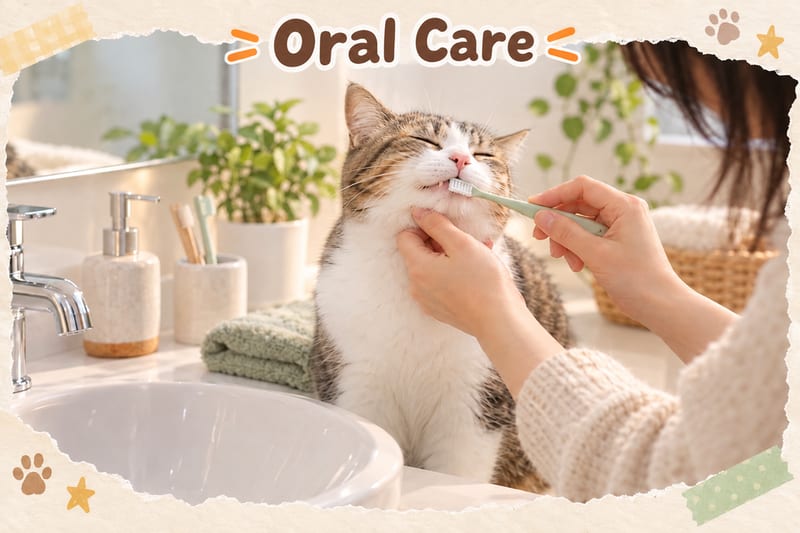
- Toothbrush + pet toothpaste (human toothpaste contains fluoride/xylitol, toxic to cats)—at least 2 to 3 times a week, daily is best
- Gradual approach: touch mouth → taste toothpaste → brush front canines → gradually move to back teeth
- Easiest to train from kittenhood; take it slowly with adult cats, don't force (if the cat has oral pain, treat the pain first before brushing)
Adjunctive products (helpful but cannot replace brushing):
- Dental chews/dental food—choose VOHC-certified products
- Water additives/oral sprays—adjunctive bacteria reduction
- Chews/toys—cats have limited interest, effect is average
Cleaning frequency: Large individual variation—cats with good teeth and daily brushing may need cleaning every few years; cats prone to tartar every 1 to 2 years. Base it on veterinary oral assessment, not fixed numbers.
This article is for reference only and cannot replace veterinary diagnosis. If you have health concerns, please consult a registered veterinarian.
Further reading
Related articles
- Cat oral care | Brushing, tartar, bad breath, periodontal disease guide →
- Senior cat dental care | Anaesthesia risks, periodontal disease, loose teeth →
- Complete oral care guide for cats and dogs | Causes of bad breath, tartar, gingivitis + brushing methods →
📌 Key takeaways
- ✅ Cleaning = COHAT under anaesthesia, not just surface cleaning
- ✅ Bad breath + eating slowly are already warning signs of dental pain
- ✅ Pre-op blood tests + monitoring reduce anaesthetic risk
- ❌ Anaesthesia-free cleaning cannot clean subgingival tartar
- ❌ Waiting until teeth fall out increases infection risk
 Fuji One full guide →

