

Quick answer: A cat's purr is not just about being 'happy'. They also purr when injured, stressed, hungry, or even near death. It's actually a multi-signal for self-healing, self-soothing, and communicating with you.
"Purr... purr..." When you stroke your cat curled up on your lap and hear that soothing purr, doesn't the whole world feel gentler? But did you know that a cat's purr is far more complex than we imagine? Today PetChill takes you deep into this fascinating feline mystery.
How is the purring sound produced?
A cat's purr is produced when the brain sends signals that cause the laryngeal muscles to contract rapidly (about 25-150 times per second), vibrating the vocal cords. This mechanism allows cats to purr continuously while both inhaling and exhaling, so the purr you hear is continuous and unbroken.
Interestingly, scientists still cannot be 100% certain of all the details of this mechanism. A 2023 study even proposed a new theory of 'fake sounds from the true vocal cords', suggesting that purring may involve pads of tissue within the vocal cords.
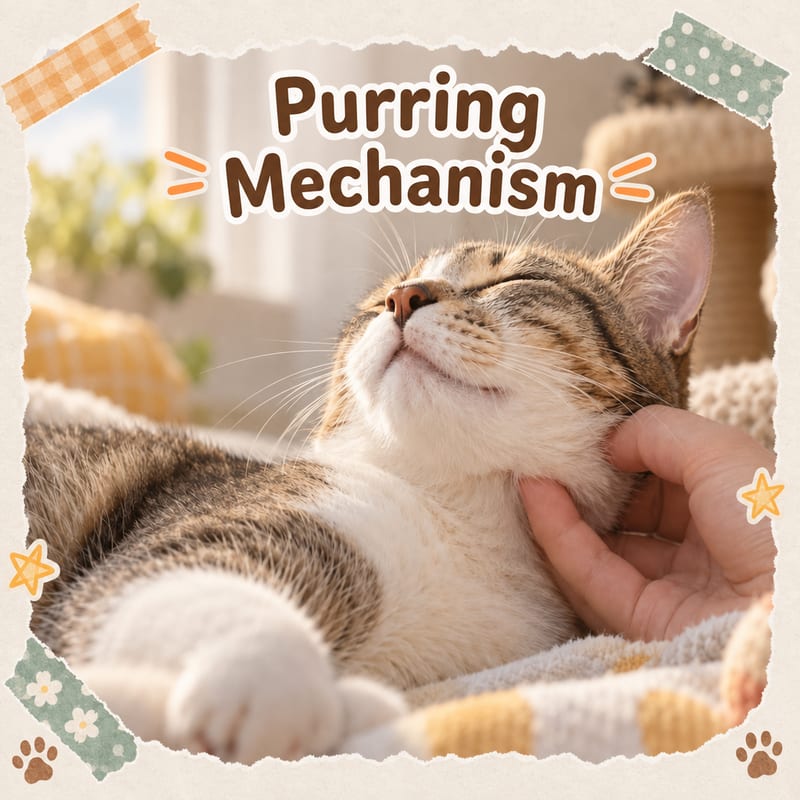
6 reasons why cats purr
1. Expressing contentment and relaxation
This is the most widely known reason. When a cat purrs on your lap, on a warm balcony, or under the covers, it usually means they feel safe and comfortable.
2. Self-healing mechanism
Research has found that the frequency of a cat's purr (25-50 Hz) falls exactly within the range of vibrations that promote bone healing and soft tissue repair. This explains why cats also purr when injured or ill—they are carrying out 'self-repair'.
3. Relieving stress and anxiety
You might not have thought of this, but cats also purr when nervous or scared. At the veterinary clinic, many seemingly relaxed cats are actually soothing themselves through purring. It's a self-comforting mechanism.
4. Demanding food or attention
Some cats have learned to 'manipulate' humans with their purr. Research has found that when cats want food, they produce a special frequency that combines a purr with a cry, similar to the frequency of a human baby's cry, which triggers our caregiving instinct.
5. Social interaction
Mother cats purr while nursing, making kittens feel secure. Kittens start responding to purring within days of birth; it's one of the earliest forms of mother-child communication.
6. Facing pain or nearing death
This is the more heartbreaking side. Some cats also purr when unwell or even near death. Research suggests this may be their final way of self-soothing.
How to interpret your cat's purr?
| Situation | Possible reason | What to observe |
|---|---|---|
| Purring when stroked | Happy, relaxed | Eyes half-closed, body soft |
| Purring before meals | Anticipating food | Walking to food bowl, tail up |
| Purring at the vet | Nervous, self-soothing | Ears flattened back, body tense |
| Purring after injury | Self-healing | Limping, loss of appetite |
| Purring while sleeping | Deep relaxation | Fully asleep |
Fun trivia
- Not all felines purr. Large cats like lions and tigers cannot purr continuously due to differences in laryngeal structure, but they can roar. This is an evolutionary trade-off.
- A domestic cat's purr can be as low as 25 Hz, very close to the frequency used in ultrasound therapy devices.
- Cats adjust their purring frequency according to their owner's mood; when you're feeling down, their purr may become more intense.

PetChill's observations
Every purr is a way for your cat to communicate with you. Next time you hear that gentle sound, take a moment to observe the situation—you'll understand your cat better and discover how precious this furry friendship is.
Want to hear more interesting stories about cats? PetChill continues to dig up the most soothing cat knowledge for you!
Hong Kong small-flat practical guide: how to distinguish and respond to your cat's purr
Space is tight in Hong Kong, so a cat's purr is especially noticeable, but small spaces actually make it easier for owners to observe their little gestures. Here are some practical tips to help you see through your cat's mind even in a 300 sq ft flat.
1. The 'open the can' purr before meals At 7 am and 7 pm, does your cat purr and meow in symphony at the kitchen door? This purr mixed with a high-frequency cry is the 'feed me' signal. You can place a phone recorder by the bowl and compare it with the relaxed purr; you'll hear a noticeably higher frequency. Remember not to give in immediately—wait for it to calm down for two minutes before opening the can, to avoid reinforcing the vicious cycle of 'waking you up means food'.
2. The 'carrier' purr on the way to the vet Taking a taxi to a clinic in Prince Edward or North Point, and your cat purrs so loudly in the carrier that the whole car can hear? This is not enjoyment but extreme stress. You can place an old T-shirt with your scent in the carrier and gently cover the carrier with a small towel to reduce visual stimulation from the street. At the clinic lobby, choose a corner seat and avoid direct stares from other dogs. If the purr is accompanied by flattened ears and dilated pupils, it's really scared; don't force it out to 'comfort' it—let it observe the environment from inside the carrier first.
3. The 'pain-bearing' purr after injury The most common accident for Hong Kong cats is falling from a height (so-called 'high-rise syndrome'). If your cat limps after falling off a bed or cabinet but is still purring, don't mistakenly think it's 'fine'. This kind of purr is usually rapid and softer, and is accompanied by loss of appetite and hiding under the bed. Take it to a 24-hour emergency clinic immediately (e.g., in Kowloon City or Sai Wan Ho); don't wait to 'see how it goes'.
4. The late-night 'sleep companion' purr Hong Kong people sleep late, and cats often jump onto the bed in the middle of the night to purr and accompany you. If the purr is too loud and affects your sleep, you can place a soft mat beside the bed and train it to sleep in its own spot. Reward it with treats for relaxing and purring on the mat, and it will gradually learn that 'sleeping with you doesn't mean lying on your face'.
Remember, in Hong Kong's dense environment, cats have many sources of stress: renovation noise, upstairs leaks, even the smell of roast meat from downstairs. Observing the context behind the purr more often is the real 'advanced cat owner class'.
Further reading
Hong Kong small-flat practical checklist: see through your cat's mind even in 300 sq ft
Living in Hong Kong, small spaces actually make observation easier. Here is a 'small-flat' checklist to help you quickly judge the true signal behind your cat's purr within 300 sq ft.
Step 1: The 'can' purr before meals
- Time: most punctual at 7 am and 7 pm.
- Sound characteristics: mixed with a high-pitched 'meow', higher frequency than usual.
- Action: record with your phone and compare; you'll know instantly whether it's 'feed me' or 'truly relaxed'.
- Response: wait two minutes before opening the can to avoid reinforcing the bad habit of 'waking you up means food'.
Step 2: The 'carrier' purr at the vet
- Location: taxi back seat, clinic lobby.
- Sound characteristics: loud but irregular purr, accompanied by panting.
- Action: put an old T-shirt in the carrier, cover the carrier with a towel, choose a corner seat.
- Response: don't force it out; let it observe the environment from inside the carrier first.
Step 3: The 'pain-bearing' purr after injury
- Common scenarios: falling off a cabinet, high-rise syndrome.
- Sound characteristics: soft and rapid purr, irregular rhythm.
- Action: immediately check for limping, hiding under the bed, loss of appetite.
- Response: take it to a 24-hour emergency clinic, either Kowloon City or Sai Wan Ho, don't wait.
Step 4: The late-night 'sleep companion' purr
- Time: 1-3 am, when Hong Kong people are latest.
- Sound characteristics: steady rhythm, occasionally mixed with gurgling throat sounds.
- Action: place a soft mat beside the bed, reward it with treats for sleeping in its own spot.
- Response: persist for a week, and the cat will learn that 'sleeping with you doesn't mean lying on your face'.
When to see a vet?
- The purr suddenly becomes high-frequency + appetite loss for over 24 hours.
- The purr is accompanied by limping, vomiting, hiding for more than a day.
- The late-night purr suddenly becomes intermittent, more like panting than purring.
Remember, Hong Kong's dense environment—renovation noise, upstairs leaks, market smells—can all stress your cat out. Use the checklist above more often, and you can be a caring cat owner even in a small flat.
📌 Key takeaways
- ✅ Purring at 25–50 Hz helps bone and soft tissue repair
- ✅ Purring when nervous or at the vet is self-soothing
- ✅ A special-frequency purr before meals = telling you to open a can
- ❌ Don't assume all purrs mean happiness; look at body language too
- ❌ Continuous purring after injury may be pain-bearing; don't ignore it
This article is compiled from breed consensus and clinical care guidelines; individual cats and dogs vary greatly. For health issues, please consult a registered veterinarian first.