
Quick answer: An occasional hairball (once every 1-2 months) is a normal physiological phenomenon, but if you see "retching without bringing anything up", loss of appetite, constipation, or lethargy, these are warning signs of hairball disease and you should see a veterinarian as soon as possible. The key to prevention is daily brushing + appropriate use of hairball gel + a high-fibre diet.
Did you know? Cats spend about 30% of their day grooming themselves, and the amount of hair they swallow in a year could knit a small scarf! Most hair passes out in the faeces, but sometimes it forms a hairball that is brought up. An occasional hairball is normal, but if the frequency increases or your cat retches without bringing anything up, beware of hairball disease. This article explains the reasons cats bring up hairballs, how to tell normal from abnormal, and 5 key prevention strategies. Combined with regular brushing and grooming and daily health observation, you can effectively protect your cat's digestive health.
Why do cats bring up hairballs?
A cat's tongue is covered with hook-like papillae that catch loose hair when grooming and swallow it into the stomach. Most hair passes through the digestive tract and out in the faeces, but when hair accumulates in the stomach to a certain amount, it forms a hairball that is brought up. This is a natural defence mechanism, and an occasional occurrence is nothing to worry about.
Some cats never bring up hairballs at all—their digestive systems are more efficient and can pass all hair normally. So not bringing up hairballs is also normal and doesn't mean there's a problem.
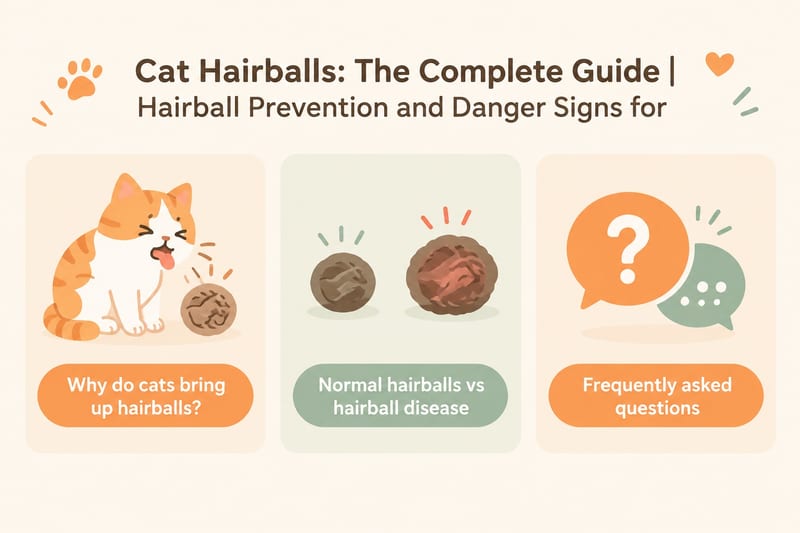
Normal hairballs vs hairball disease: how to tell?
| Comparison | Normal hairball ✅ | Hairball disease danger signs ❌ |
|---|---|---|
| Frequency | Once every 1-2 months or less | Multiple times a week or continuous retching |
| What comes up | Cylindrical or clumped hairball | Nothing comes up, repeated dry heaving |
| State after | Acts as if nothing happened, eats, sleeps and plays as usual | Lethargic, reluctant to move |
| Appetite | Eats normally | Noticeable loss of appetite |
| Bowel movements | Normal faeces | Constipation or dry hard faeces containing hair |
| Abdomen | Soft and normal | Swollen and hard, hard lump on touch |
| What to do | No special treatment needed | Take to veterinarian as soon as possible |
Detailed danger signs of hairball disease
- Retching without bringing anything up: Repeated retching but nothing comes out—this is the most typical warning sign
- Noticeable loss of appetite: No interest even in favourite foods
- Constipation or dry hard faeces: Fewer bowel movements, hair visible in faeces
- Swollen hard abdomen: A hard lump can be felt when touching the abdomen
- Lethargy: Reluctant to move or play, sleeps all day
- Suddenly stops bringing up hairballs: A cat that used to bring up hairballs occasionally suddenly stops—possibly a hairball too large and stuck
If any of the above symptoms appear, take your cat to the veterinarian as soon as possible. Severe impaction may require surgery, and delay can be life-threatening. It's also advisable to watch for early signs of illness in cats to catch problems early.
Which cats are more prone to hairball problems?
Long-haired cats
Long-haired breeds such as Persians, Maine Coons and Ragdolls are at high risk of hairball disease. Their hair is longer and more abundant, and they swallow 2 to 3 times as much hair as short-haired cats when grooming. Long-haired cat owners need to brush more diligently—at least once a day is recommended.
Senior cats
Older cats have reduced gastrointestinal motility, making it harder for hair to pass normally. In addition, older cats prefer sedentary activities, so grooming time relatively increases, and hairball problems naturally become more serious.
Shedding season
During the spring and autumn shedding periods, cats lose a lot more hair, and the amount swallowed increases accordingly. Pay special attention to hairball problems during this time, and increase brushing frequency.
5 key strategies to prevent hairball disease
1. Regular brushing (most important!)
Short-haired cats should be brushed at least 2 to 3 times a week, while long-haired cats need daily brushing. Use a comb or slicker brush to thoroughly remove loose hair and undercoat, which can greatly reduce the amount of hair swallowed during grooming. Brushing is also a great time to bond with your cat. For more detailed brushing techniques and tool choices, see the complete cat grooming guide.
2. Use hairball gel appropriately
Hairball gel lubricates the intestines and helps hairballs pass smoothly. Generally use 2 to 3 times a week, and during shedding season you can increase to every other day. Squeeze out a small amount for your cat to lick directly or mix into food. Be careful to use in moderation—overuse may cause diarrhoea.
3. Provide cat grass
Cat grass can stimulate gastrointestinal motility and help hairballs be brought up or passed in the faeces. You can grow wheatgrass or oat grass at home and let your cat eat freely. Not all cats like cat grass, but if your cat is willing to eat it, it's a natural and good prevention method.
4. High-fibre diet
Cat food containing appropriate fibre can promote gastrointestinal motility and help hair pass in the faeces. Some cat food brands offer formulas specifically for hairball problems; consult your veterinarian for advice. Adequate water intake is also important for gastrointestinal motility; for more information see the cat hydration guide.
5. Increase exercise
Moderate exercise can promote gastrointestinal motility and help digestion and hair passage. Spend 15 to 20 minutes a day playing with your cat using toys like a wand toy or laser pointer—this greatly helps prevent hairball disease.
Frequently asked questions
Q: Does my cat need to see a veterinarian for hairballs? A: Occasional hairballs (once every 1 to 2 months) are normal and don't require a vet visit. But if you see retching without producing anything, loss of appetite, constipation, or lethargy, take your cat to the veterinarian promptly. Severe impaction may need surgery; costs vary with severity, but a typical gastrointestinal check-up plus medication is around HK$500-1500.
Q: Can hairball gel be used every day? A: Daily use is not recommended. Generally 2 to 3 times a week is enough, and during shedding season you can increase to every other day. Overuse may cause diarrhoea or affect absorption of fat-soluble vitamins. It's best to consult your veterinarian before use.
Q: Is it normal for a cat not to bring up hairballs? A: Yes, it's normal! Not bringing up hairballs means your cat's digestive system is efficient and can pass all swallowed hair normally. However, if your cat used to bring up hairballs occasionally and suddenly stops completely, especially with constipation or loss of appetite, watch out for a possible blockage.
Q: Is cat grass harmful to cats? A: Cat grass is safe for most cats, but not all cats like it. If your cat won't eat cat grass, you can use hairball gel or a high-fibre diet instead. Make sure your cat doesn't come into contact with toxic houseplants such as lilies or ivy.
Q: What is the most effective way to prevent hairball disease? A: Regular brushing is the most effective prevention, as it reduces the amount of hair your cat swallows at the source. Combined with appropriate use of hairball gel and a balanced diet, you can effectively prevent hairball disease.
Key summary
- ✅ Occasional hairballs (once every 1-2 months) are a normal physiological phenomenon—no need to worry
- ✅ Daily brushing is the most effective way to prevent hairball disease, especially for long-haired cats
- ✅ Use hairball gel 2-3 times a week; increase frequency during shedding season
- ✅ High-fibre diet + adequate water + moderate exercise for all-round hairball prevention
- ❌ "Retching without bringing anything up" is the most typical warning sign—take to the vet immediately
- ❌ Loss of appetite, constipation, swollen hard abdomen, and lethargy are all danger signs
- ❌ Don't delay seeing the vet—severe impaction may require surgery
Although hairball disease is common, most cases can be effectively controlled with good daily prevention. Regular brushing is the simplest and most effective method; combined with appropriate hairball gel, a balanced diet and moderate exercise, you can help your cat stay free from hairball trouble. If you notice persistent vomiting, constipation, or loss of appetite, don't delay—take your cat to the veterinarian as soon as possible.