

Quick answer: A cat's night vision is 6 times stronger than a human's, each ear has 30 muscles and can rotate 180 degrees independently, and whiskers are a highly precise touch radar — when they "stare at thin air", they are actually using super senses to detect tiny stimuli you cannot see.
Have you ever seen your cat suddenly fix its gaze on an empty wall corner, pupils dilated, ears twitching rapidly, as if it has "seen something"? Don't worry — your cat is not seeing spirits. It is simply using super senses to perceive a world humans cannot detect at all. Today we take you deep into 5 super senses of cats and reveal the science behind these mysterious behaviours!
Cat vs Human Senses Comparison
| Sense | Cat | Human | Difference |
|---|---|---|---|
| Night vision | Extremely strong in dim light (tapetum lucidum reflection) | Almost cannot see in the dark | Cat about 6 times stronger |
| Hearing range | Up to 70,000 Hz | Up to 18,000 Hz | Cat nearly 4 times higher |
| Field of view | 220°–280° | About 180° | Cat 40°–100° wider |
| Ear movement | 30 muscles per ear, independent 180° rotation | 3 muscles, barely move | Cat far more mobile |
| Touch (whiskers) | Multiple groups of vibrissae all over body, detect airflow | No vibrissae system | Unique to cats |
| Colour vision | Blue + green (dichromatic) | Red, green, blue (trichromatic) | Humans see more colours |
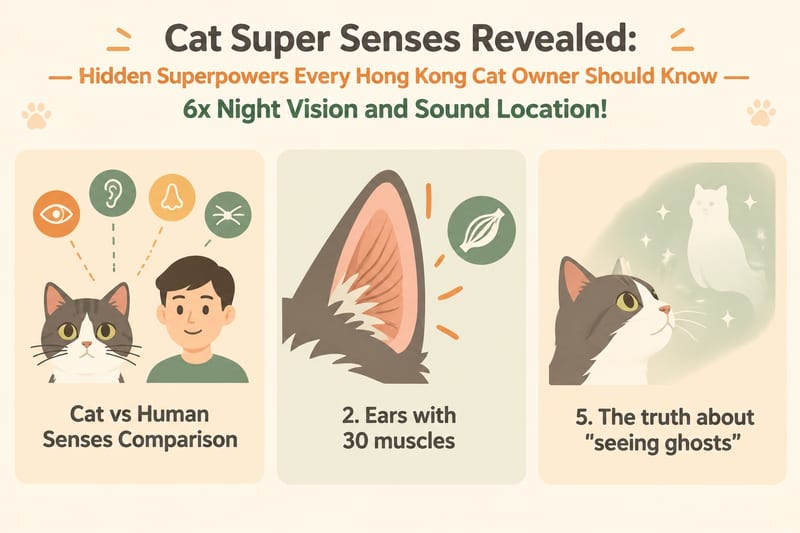
1. Night vision 6 times stronger than humans: the secret weapon for hunting in the dark
Cats are natural crepuscular hunters, and their eyes are built for darkness. Behind the cat's eye is a reflective layer called the tapetum lucidum, which reflects light back onto the retina and greatly increases sensitivity. Because of this, a cat's vision in dim light is 6 times that of humans!
In addition, a cat's field of view is 220 to 280 degrees, much wider than a human's 180 degrees. Of this, 130 degrees is binocular vision, allowing them to judge prey distance precisely. Interestingly, cats are very sensitive to fast-moving objects, but if a mouse stays still and plays dead, the cat may not see it at all — because the cat eye's static clarity is actually average. For more on cat eye care, see our cat eye care guide.
2. Ears with 30 muscles: faster sound location than dogs
Each cat ear is controlled by about 30 muscles and can rotate 180 degrees independently, like two precise sound receivers. The shape of the outer ear is like an asymmetrical funnel, collecting sound and sending it precisely to the eardrum. For a detailed look at cat ear language, we have a dedicated article.
Even more impressive, cat ears can sense sounds up to 70,000 Hz, while humans can only hear up to 18,000 Hz. This ability lets cats easily catch the faint footsteps of a mouse. Cats also have "selective deafness" — their auditory system only sends important sound signals to the brain, filtering out irrelevant noise automatically, so cats can sleep soundly even in noisy environments!
3. Whiskers are a highly precise radar: much more than decoration
A cat's whiskers are formally called vibrissae, highly sensitive touch organs far more developed than ordinary fur. They are not only on both sides of the mouth but also above the eyes, on the cheeks and on the inside of the front legs. These vibrissae can detect the tiniest air movements, helping cats judge whether a space ahead is wide enough to pass through and whether there are prey burrows nearby. For more on the secrets of cat whiskers, you can explore the amazing functions of vibrissae.
When a cat catches a mouse, it uses its whiskers to touch the prey and track its position, so it can react quickly at the slightest movement. The vibrissae above the eyes can also sense stimuli, making the cat close its eyes in time to protect itself. So trimming a cat's whiskers is like taking away its most important navigation system — absolutely never do it!
4. A colourful world they cannot see red in
For a long time people thought cats were colour-blind, but scientific research has found that cats can actually distinguish colours — just not the same rainbow as humans. A cat's eye has only two types of cone cells (humans have three), so they can only recognise blue and green; red simply does not exist in their eyes.
Interestingly, kittens are born with more cone cells and can see more colours, but this ability disappears as they grow. As nocturnal animals, colour vision is not key to a cat's survival — in the dark of night, all cats are grey.
5. The truth about "seeing ghosts": super perception
Many cat owners have seen this scene: the cat suddenly fixes its gaze on an empty corner, ears twitching rapidly, pupils dilated, body frozen. The scientific explanation is that a cat's hearing and vision far exceed humans', and they may perceive insects crawling behind the wall, ultrasound, or even faint air movements.
Scientists believe this behaviour is a "settling response" — the cat pauses all movement and focuses all sensory resources in one direction to concentrate on external stimuli. So next time you see your cat "staring at thin air", don't panic — it is just using its superpowers to detect a world you cannot see!
Cat emotions can be seen in the pupils
Besides super senses, a cat's pupils are also a "barometer" of emotion. Medium-sized pupils mean a relaxed, normal state; narrow slit pupils mean assertiveness or alertness; almost round pupils mean unease; fully dilated pupils mean extreme fear. Combined with ear and whisker movements, you can become an expert at reading cat emotions.

Keeping Cats in Hong Kong's Small Flats: 5 Practical Tips to Make the Most of Their Super Senses
Hong Kong property prices are high, and open-plan or one-bedroom flats are common. Space may be small, but a cat's sensory needs do not shrink. Here are tips to give your cat a "super-sensory experience" even within 300 sq ft.
1. Night vision: keep a "dim-light corridor" Cats have strong night vision, but that does not mean total darkness. Put a warm night light in the corridor (5–10 lux) — not harsh on the eyes and not disturbing your sleep. Avoid shining white spotlights directly at the litter tray, or your cat will avoid it.
2. Hearing: reduce "unnecessary noise" Renovation upstairs and garbage truck noise are loud in Hong Kong, and cats have sensitive ears; long-term stress can cause anxiety. Add soundproofing stickers by the window or thick curtains. When using air-conditioning or a fan at night, use low fan speed to reduce continuous high-frequency sound.
3. Whiskers: switch to "wide bowls" Narrow, tall bowls are common in small flats, and a cat's whiskers easily touch the sides, causing long-term "whisker stress". Switch to shallow dishes or wide ceramic bowls, diameter ≥12 cm, height ≤4 cm, for comfortable eating without hurting the vibrissae.
4. Field of view: set up a "high observation deck" Cats have a wide field of view and love to look down from above. Add a non-slip mat on the windowsill or top of a wardrobe so they can watch the street. Make sure window grille gaps are no wider than 10 cm, to prevent cats falling out while chasing insects.
5. Detecting abnormalities: when to see a vet? If your cat shows a sudden increase in "staring at thin air" for more than two days, persistently dilated pupils, or ears constantly flattened back, it may be a sign of stress or a health warning. First check whether there are new insects, dripping sounds or neighbour renovations at home; if it continues after ruling out external factors, book a veterinarian appointment the same day to check hearing or the nervous system.
Remember: Hong Kong spaces are small, but sensory stimulation must not be lacking. By making good use of lighting, sound and furniture height, even 300 sq ft can give your cat a five-star super-sensory experience.
 Almo Nature full guide →