Corn Snake
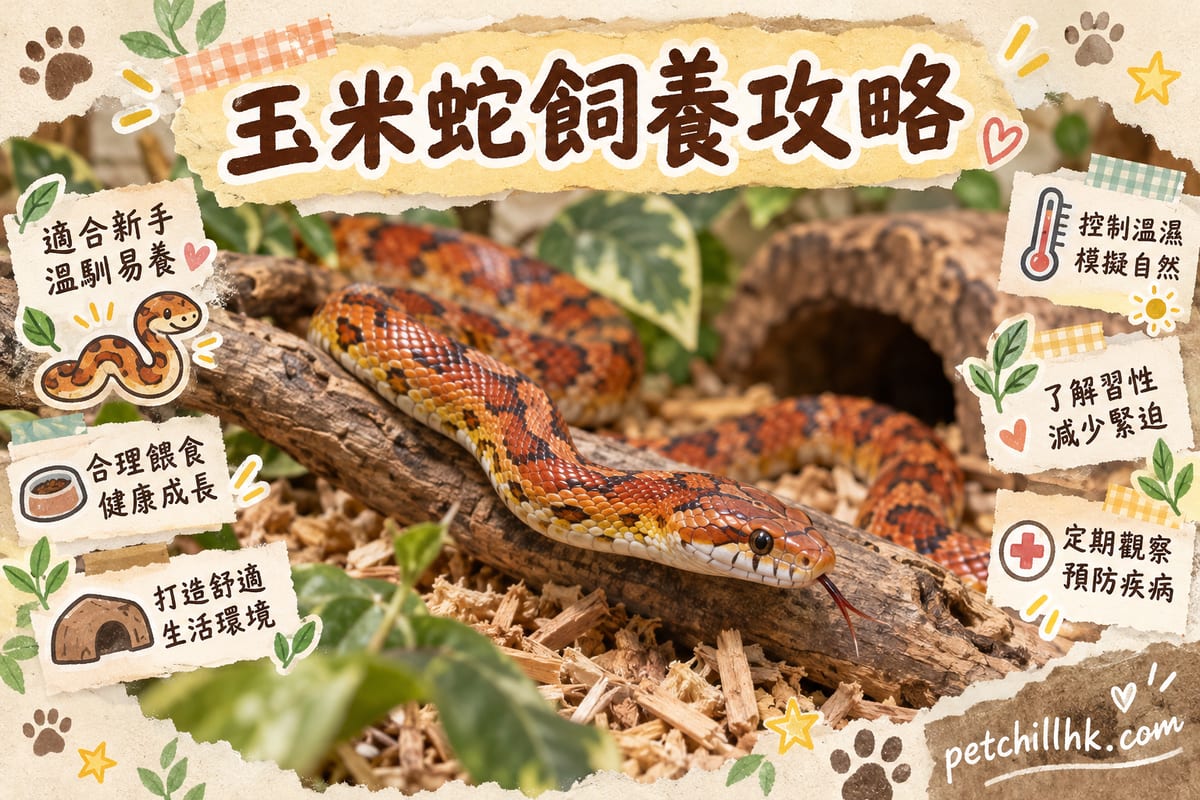
Corn snakes are ectothermic, so their condition is almost entirely determined by the environment inside the enclosure: the wrong temperature means poor digestion, the wrong humidity means a failed shed, and a loose lid means an escape. Adults typically reach 1.2 to 1.5 metres in length, and most sources say they live more than a dozen years, so be prepared for a commitment of more than ten years before you get one. They are active at dusk and at night, hide during the day, and are also decent climbers; they are non-venomous, gentle in temperament and feed mainly on frozen-thawed mice, making them a relatively easy introductory snake species. As long as you provide the correct temperature gradient and escape-proof design, they can be kept for more than ten years. The enclosure must always have both a warm and a cool end, the lid must be escape-proof, and the substrate must stay dry; adjust humidity during shedding and periods of food refusal. Indoor temperatures in Hong Kong winters are on the low side, so heating equipment and a power-outage backup are not things you can skip, because digestion stalls at low temperatures and food is easily regurgitated; once water quality or enclosure temperature deteriorates, a reptile can go downhill within a day or two. The power-outage backup should include an insulated box.
Size
Medium
Weight
Adults reach roughly 1.2-1.5 m in total length
Key facts
Origin
South-eastern North America
Size
Medium
Weight
Adults reach roughly 1.2-1.5 m in total length
Coat
Scales, in many colour morphs
Personality
Daily life & habits
Corn snakes hide during the day and are active at dusk and at night, so the enclosure needs enough hiding places; the minimum setup is two hides, one at the hot end and one at the cool end, plus a water bowl and climbing branches. A hide only needs to be big enough to enclose the snake's body; too large and it actually feels insecure. Daily care means changing the water, removing waste and glancing at the thermometer and hygrometer every day; replace the substrate regularly, do a full enclosure change if there is any odour, and keep ventilation good. Clean equipment with a reptile-safe disinfectant, rinse it and let it dry completely before putting the snake back. In humid seasons, dehumidify: substrate that stays soaked will cause skin problems and mites. In summer, when indoor temperatures are high, avoid direct sunlight on the enclosure and a stuffy build-up. Over-handling is one of the environmental causes of food refusal, so keep the frequency of handling in check. Ventilation in small flats is the third point: an enclosure will let humidity and ammonia accumulate, and an extractor fan plus a dehumidifier is a workable combination. Snakes climb, so the enclosure also needs vertical space and climbing branches. The water bowl should be changed daily.
Care essentials
Grooming
Before shedding the eye caps turn blue, body colour dulls, hiding increases and some individuals refuse food; during this time raise the humidity, pause feeding and handle less. A healthy shed should come off as one complete layer of old skin, eye caps included. Incomplete shedding is usually related to low humidity or dehydration: add a humid hide and provide a shallow water bowl so the snake can soak itself, using lukewarm water no deeper than its body. Most importantly, never peel off leftover skin by hand, and never pull off the eye caps, because both injure the new skin, which has not yet hardened, and the eyes. If leftover skin is still stuck after several days, an eye cap remains, or the tail tip becomes dry and black, hand it to a vet. Keep enclosure humidity at 40 to 60 percent, raising it to 60 to 70 percent during shedding by adding a humid hide with damp sphagnum moss. On damp: store substrate and bedding sealed, monitor enclosure humidity with a hygrometer; the humid hide should stay damp but not waterlogged, since being too wet also causes mould and skin problems.
Exercise
The enclosure needs a temperature gradient, warm at one end and cool at the other, so the snake can choose its position. The hot-spot surface is generally recommended at about 28 to 30 degrees and the cool end at about 22 to 25 degrees, with a slight drop at night. Heat mats, ceramic heat emitters and deep heat projectors are all used, but the key is connecting them to a thermostat; heat rocks are not recommended. Check the hot spot and the cool end with a thermometer, and do not judge warmth by feel, because once a point far hotter than needed appears in the enclosure, the snake has nowhere to escape. The standard is not a room temperature that feels comfortable to a person, but the thermometers and hygrometers inside the enclosure. An adult enclosure also needs height, because it climbs, and climbing branches add vertical range. Moving to a bigger enclosure without adding more decor and hides will make a juvenile hide constantly and refuse food. The biggest problem in air-conditioned rooms is temperature fluctuation: air blowing straight from a vent chills a reptile repeatedly, enclosure temperature becomes unstable, and the snake will refuse food and digest poorly. A thermometer is essential equipment.
Training
Corn snakes do not need training; the priorities are a stable environment and safe handling habits. Clip the lid down firmly and narrow the cable routing holes, because a healthy snake can get out in a single night. Do not handle the snake or move the enclosure immediately after feeding, as it easily causes bites and regurgitation; live prey is also not recommended, because a mouse will bite back. With a heat rock or an unthermostatted heat mat, a point far hotter than needed will appear in the enclosure. Pulling off leftover skin or eye caps during shedding injures the new skin and the eyes. Causes of food refusal fall into three groups: physiological, environmental and pathological; the order of handling is to check temperature and humidity first, then record body weight. If body weight is clearly falling, or there is pus around the mouth or audible breathing, find a vet who treats reptiles. Most refusals are environment-related and usually resolve once conditions are corrected. Not heating in winter, or having no warming backup during a power cut, are the most common mistakes; do not feed during a power cut, as digestion stalls at low temperatures. A stable environment matters more than any handling technique.
Diet
The staple is frozen-thawed mice; live prey is not recommended, because a mouse will bite back. Thaw in lukewarm water or at room temperature, and do not use a microwave or hot water, because prey that is hot outside and cold inside causes digestive problems. A prey item roughly as thick as the thickest part of the snake's body is the right size. On frequency: juveniles generally once every five to seven days, sub-adults every seven to ten days, adults every ten days to two weeks; sources differ, so adjust to body size and digestion, and err on the side of less rather than more, as overfeeding increases metabolic load. If it regurgitates, stop feeding for seven to ten days, then switch to a prey item one size smaller and check the enclosure temperature. Pause feeding during shedding. Most introductory sources consider a UVB lamp non-essential, and nocturnal species can go without, but you then need whole-prey feeding plus a calcium powder containing D3, and that cannot replace a temperature gradient. A drop in appetite in winter is physiological and not necessarily illness; if it refuses food several times in a row, check the enclosure temperature and humidity first. For juveniles, choose prey by body size.
Living environment
For an adult, the enclosure should be at least one metre long, and there should be height too, because it climbs. The core of reptile keeping is using equipment to replicate the natural environment: as long as the enclosure provides the correct temperature gradient and humidity zones, the same room can house a desert-type gecko or a tropical horned frog. Glass tanks hold heat well but ventilate poorly; mesh-top tanks ventilate well but lose heat quickly, and the usual approach in Hong Kong is a glass tank with a mesh top plus supplementary heat. The lid is the first line of defence: a snake will push a loose lid up with its nose and climb out along cables through the routing holes, so clip the lid down firmly and narrow the cable holes; do not use tape to fix things inside the enclosure, because tape sticks to snake skin and tears the scales when pulled off. The minimum setup is two hides, a water bowl and climbing branches. Aspen shavings are commonly used as substrate, as they absorb moisture and are easy to clean; paper towel suits a quarantine period. Cedar shavings are generally considered unsuitable for snakes, and pine shavings are also debated, so it is best to avoid both. Monitor enclosure humidity with a hygrometer.
Corn Snake everyday food & supplies
Chosen by species (cat) from products PetChill stocks — not a breed-specific formula. Actual suitability depends on age, weight and health.
 Special offer
Nutriplan Cat Food Complete Health Nutritional Formula 5kg (64352)
HK$123HK$128About HK$24.6 per kg
Price checked 2026-10-21; the store page shows the live price, stock and offers.

Bella & Molly's Dutch Berry Royal Selected Cat Food AAFCO Anti-Aging Grain-Free Single Protein Salmon Formula 50g (Limited Time Experience)
HK$10About HK$200 per kg
Price checked 2026-10-21; the store page shows the live price, stock and offers.

Hills Cat Food Life Stage Series Adult Formula Chicken 490g (609885)
HK$55About HK$112.24 per kg
Price checked 2026-10-21; the store page shows the live price, stock and offers.
History & origin
The corn snake (Pantherophis guttatus) is native to south-eastern North America and is a non-venomous, ground-dwelling snake. Morphs commonly seen in Hong Kong include Okeetee, characterised by an orange ground colour with thick black-bordered saddle markings, as well as albino, grey and snow. Morphs affect appearance only and do not change husbandry requirements, so a snake's difficulty should never be judged by its morph. In the wild it is active at dusk and at night, hides during the day, and is also a decent climber. Captive-bred individuals are consistently available, which is why it has become one of the most common introductory snake species: as long as you provide the correct temperature gradient and escape-proof design, it can be kept for more than ten years. Before choosing, beginners should work out three things: how much time they can put in each day for interaction and cleaning, how much stable space there is at home for an enclosure, and whether Hong Kong's humidity and air-conditioned environment suit the species. Reptiles are one of six main pet categories, and requirements differ greatly between them, so no single setup works for all; the dryness and temperature swings of air-conditioned rooms in winter are especially pronounced for reptiles.
Who it suits
Is the Corn Snake right for you?
Beginners can keep one, because of the gentle temperament and the reliable feeding response to frozen prey; the prerequisites are a home with a long-term reliable power supply and family members who accept feeding mice. On housing, public housing, tenancy agreements and building deeds all have rules about pets, so check them before getting one; some reptiles are controlled under the Protection of Endangered Species of Animals and Plants Ordinance, so confirm the source with the seller before buying, and ask the Agriculture, Fisheries and Conservation Department if unsure. Few vets in Hong Kong treat reptiles, and they may not offer night emergencies, so find one in advance and call to confirm. Indoor temperatures can drop into the teens in winter, so heating equipment must be ready all year; a power cut is the most easily overlooked risk, so prepare an insulated box with disposable hand warmers, wrap the warmers in a layer of cloth so they never touch the snake directly, leave ventilation holes in the box, and never rely on an open flame for heat. Do not feed during a power cut, because digestion stalls at low temperatures. For aquariums and reptiles, watch for rising room temperature and power cuts. Heating equipment must be connected to a thermostat.
Health & care
Common health issues and care advice for the Corn Snake
Reptile conditions can deteriorate very quickly. If any of the following appear, improve the environment first and book a vet at the same time. Open-mouth breathing, audible breathing or bubbles at the nostrils may be a respiratory infection: raise the enclosure temperature immediately, keep it dry and see a vet. Pus around the mouth, reddened oral tissue and food refusal may be stomatitis (mouth rot); do not attempt to clean it yourself, leave it to the vet. Retained shed or a retained eye cap is usually related to low humidity or dehydration: add a humid hide, and see a vet if it has not cleared within a few days. Small moving black specks between the scales are mites: isolate the snake, disinfect the enclosure and switch to paper-towel substrate. A red, soft, foul-smelling belly is scale rot, usually caused by substrate that stays wet for long periods. Tissue protruding from the tail or vent is a prolapse: keep it moist and see a vet immediately. Medication and dosage must be decided by a vet; and not every clinic treats reptiles, so a stable environment and early detection matter. A clear drop in body weight is a signal that needs immediate attention, so do not wait for obvious symptoms before seeking help.
Want to see more small animal breeds?
Besides the Corn Snake, you can also compare Budgerigar, Rabbit and Hedgehog — breed guides that compare personality, size and care difficulty.
Frequently asked questions
The questions people ask most about the Corn Snake
The corn snake is a non-venomous, ground-dwelling snake. It is gentle in temperament and feeds mainly on frozen-thawed mice, making it a relatively easy introductory snake species.
Adults typically reach 1.2 to 1.5 metres in length, and most sources say they live more than a dozen years, so be prepared for a commitment of more than ten years before you get one.
The enclosure must have both a warm and a cool end, the lid must be escape-proof, and the substrate must stay dry; adjust humidity during shedding and periods of food refusal.
First check the temperature and humidity, then consider whether it was recently moved to a new enclosure, handled too often, or is in shed. Most refusals are environment-related and usually resolve once conditions are corrected; if body weight is falling or there is pus around the mouth, see a vet as soon as possible.
Winter room temperatures can drop into the teens. Use a heat mat or heat lamp with a thermostat to maintain the warm and cool ends, and prepare an insulated box with hand warmers as a power-outage backup.
The enclosure needs a cold-to-hot gradient: a hot spot of about 28 to 30 degrees and a cool end of about 22 to 25 degrees. Digestion stalls at low temperatures.
Aspen shavings are commonly used, as they absorb moisture and are easy to clean; paper towel suits a quarantine period, and cedar shavings are generally considered unsuitable.
Juveniles about once every five to seven days; adults can be stretched to every seven to ten days. Use frozen-thawed mice, not live prey.
Clip the lid down firmly and narrow the cable routing holes; if it does escape, seal the door gaps first and concentrate the search on warm, dark corners.
You may also like
Other dog breeds like the Corn Snake