Rabbit
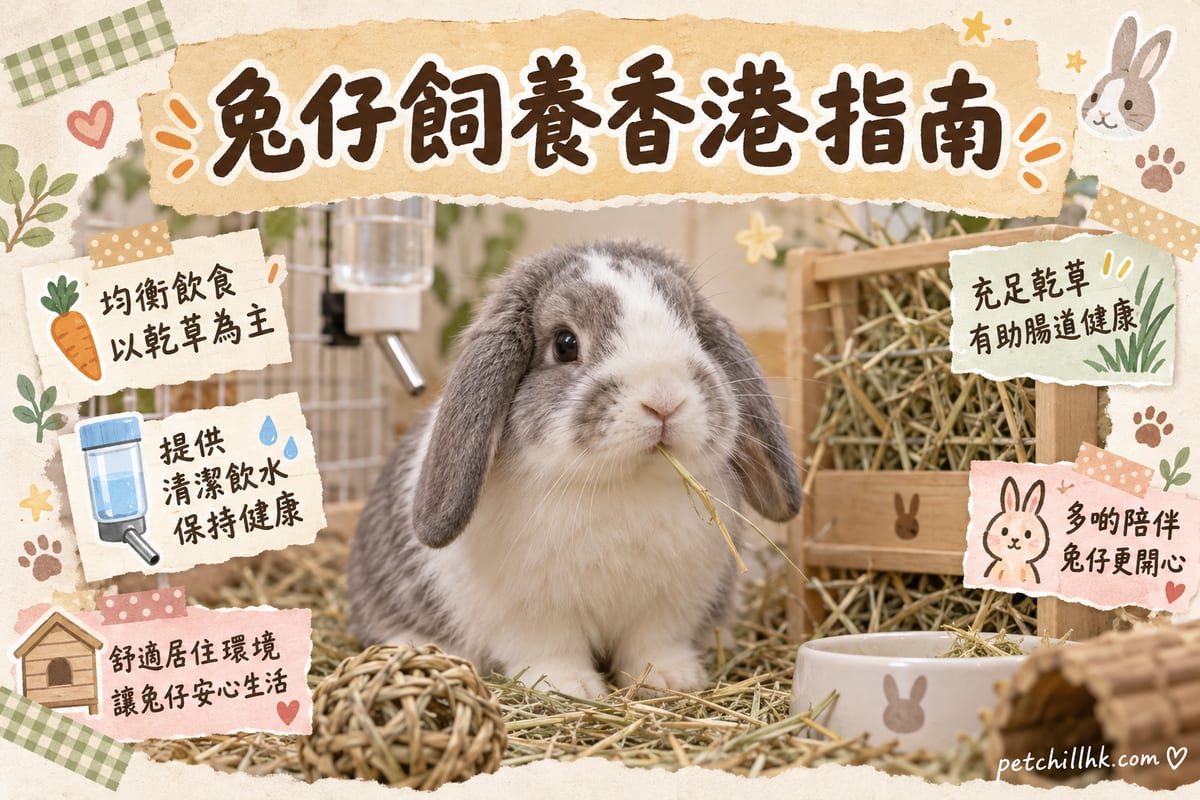
A rabbit is not a 'bigger hamster'. The domestic rabbit is a burrowing herbivore and a prey animal, especially sensitive to sudden noises and to hands coming down from above; common pet rabbits include the Netherland Dwarf, the Holland Lop, the Lionhead and the New Zealand White. Three points need to be clear first: rabbits are hindgut fermenters, with a digestive tract built to process large amounts of fibre; rabbits cannot vomit, so once the gut fills with gas or becomes blocked there is no vomiting route out; and rabbit teeth grow continuously and must be worn down by chewing fibre. On weight, dwarf rabbits are about 1 to 1.5 kg and medium breeds about 2 to 2.5 kg; average lifespan is about 8 to 12 years, depending on breed and care; the daily staple is unlimited hay or grass. These three structural facts directly determine everything that follows: hay must be unlimited, the environment must be cool and ventilated, and a gut that stops moving is an emergency. So housing, diet and summer arrangements cannot simply copy what works for other small animals.
Size
Small to medium
Lifespan
8-12 years
Weight
Dwarf rabbits around 1-1.5 kg, medium breeds around 2-2.5 kg
Key facts
Lifespan
8-12 years
Size
Small to medium
Weight
Dwarf rabbits around 1-1.5 kg, medium breeds around 2-2.5 kg
Coat
Short or long coat, many colour varieties
Personality
Daily life & habits
Rabbits are active at night - the most active part of their day is the night - so the daily routine should follow that rhythm. Every day: change the fresh water, top up the hay, and clear wet bedding and leftover vegetables; leftover vegetables should not be left overnight, because damp, spoiled vegetables directly affect the gut. At dusk let the rabbit out into the pen to move freely, and watch whether it jumps and eats grass normally; a change in jumping posture or a refusal to jump are signals to watch. Before bed, check how much was eaten and how many droppings there are - the two most practical daily indicators, since changes in the shape and number of droppings often flag a problem earlier than appetite. Weigh once a week, because rabbits hide pain well and weight loss can be the first sign of a dental or gut problem. Change the drinking water daily; a lack of water slows gut motility, so rinse the water bowl as you go. In summer, check daily that the frozen water bottle and the tiles are still cool and that the air conditioning is running, and place the pen away from air-conditioner draughts and direct sunlight.
Care essentials
Grooming
Brushing is the core grooming job for a rabbit: two or three times a week for short-haired rabbits, daily during a moult; long-haired rabbits need layer-by-layer brushing down to the skin to prevent matting underneath. During a moult, fur intake rises, and daily brushing reduces the risk of gut stasis - so brushing is not just about looks, it is part of gut management. While brushing, run your hands over the skin and check for redness, hair loss or dandruff. Check the toenails every four to six weeks; overlong nails affect how the rabbit stands, and if you are not confident, leave it to a vet or a pet groomer. Don't bathe often, because rabbits clean themselves and a full-body wash easily chills and stresses them; for spot cleaning, a slightly damp cloth is enough. Clean cages and pens with pet-safe products, rinse thoroughly and let them dry before putting the rabbit back. Also keep untreated wood chews on hand to help wear the teeth down alongside hay. In daily life, watch how fast it eats hay and whether it drools - these are the earliest dental clues, earlier than waiting for weight loss.
Exercise
Rabbits are horizontal movers: they need a length they can hop along continuously, not levels, which is why a pen is generally better than a cage. UK rabbit welfare organisations recommend an activity area of about 3 m by 2 m; small Hong Kong flats may not manage that, so the practical approach is a pen as a base plus daily free-roaming time, rather than long confinement in a cage only big enough to turn around in. The floor must be non-slip: standing long term on wire mesh presses the soles, causing hair loss and even ulcers, so use a solid non-slip surface with paper pellets or unscented wood shavings; aromatic softwood shavings are also not ideal. The pen needs a hiding house, ideally with two entrances, because a rabbit is a prey animal and needs a retreat that doesn't involve crossing open space. Don't put the pen by a window with direct sun or in front of an air-conditioner outlet - localised heat is harder to notice than the overall room temperature. Rabbits are active at night, and the sound of jumping and cage-biting carries to the flat below; a thick mat reduces complaints. The most common beginner mistake is buying a small cage with shelves, when what a rabbit needs is floor space, not a shelved cage.
Training
Training a rabbit starts with the environment and how you pick it up. Litter training is the easiest success: rabbits usually urinate in a fixed corner, so put a square litter tray with paper or wood-pellet litter there - no scolding needed; if it already uses a particular corner, move the tray to that spot rather than forcing a change of habit. Getting handling wrong frightens and injures a rabbit: neither picking it up from above nor by the ears is acceptable; the correct way is one hand under the chest and one supporting the hindquarters, held close to your body. This follows from its prey instincts - a hand coming from above looks like a predator to a rabbit. Fruit may only be given in tiny amounts, occasionally, as a reward; don't use treats to buy cooperation, and don't relax the hay and vegetable proportions because the rabbit has been 'good'. Environmental noise is part of training too: site the pen away from sources of vibration and use thick mats to reduce sound transmission, and your rabbit's stress will naturally be lower. Also, don't shout after a one-off accident - rabbits are especially sensitive to sudden sounds.
Diet
Hay is a rabbit's staple, without exception. The general recommendation is that hay makes up most of the daily food volume; for adults, grass hays such as timothy are the mainstay, and young rabbits can have alfalfa, though alfalfa is higher in calcium and is not suitable in large amounts long term. Vegetables means a small amount of dark green leafy vegetables daily, with the portion adjusted to body weight; beans, corn and potatoes are unsuitable; try each new vegetable in small amounts one at a time while watching the droppings, and stop at once if they turn soft. Pellets are only a supplement - one to two tablespoons a day is enough. Any change of food must be slow: a sudden switch disrupts the gut flora and causes soft droppings, bloating and even gut stasis; the usual approach is a gradual mix over seven to ten days, and if soft droppings appear midway, pause and ask a vet. Fruit may only be given in tiny amounts, occasionally, washed, peeled, deseeded and at room temperature. Mixed feeds containing dried fruit, seeds and coloured biscuits are high in sugar and calories and are generally not recommended as a staple; a rabbit eating its own caecotrophs is normal physiology.
Living environment
Rabbits fear heat rather than cold: low temperatures plus dryness are usually manageable, while high temperature plus high humidity is very dangerous, so humidity and temperature must be read together. Most sources suggest a room temperature of about 15 to 22 degrees C, with extra cooling needed above 25 degrees C; rabbits dissipate heat through their ears and have no sweat glands, so a room at 28 degrees C or above is already quite dangerous. Practical measures include keeping the air conditioning at a stable temperature, laying down tiles or a frozen water bottle for the rabbit to lie on, using a fan only for air circulation, closing curtains against the western sun, and avoiding having the air-conditioner blow directly on the rabbit. Never leave a rabbit in an uncooled room or on a balcony; power cuts are a real risk in a Hong Kong summer, so have a backup plan for where it will go. The return-of-spring damp and the rainy season make hay and food prone to damp, and mould toxins cannot be dealt with by 'scooping off the surface' - store food sealed with a desiccant. The pen needs a hiding house, ideally with two entrances. If the flat has no air conditioning, decide in advance which room the rabbit will be in rather than moving it in a panic during a heatwave.
Rabbit everyday food & supplies
Chosen by species (cat) from products PetChill stocks — not a breed-specific formula. Actual suitability depends on age, weight and health.
 Special offer
Nutriplan Cat Food Complete Health Nutritional Formula 5kg (64352)
HK$123HK$128About HK$24.6 per kg
Price checked 2026-10-21; the store page shows the live price, stock and offers.

Bella & Molly's Dutch Berry Royal Selected Cat Food AAFCO Anti-Aging Grain-Free Single Protein Salmon Formula 50g (Limited Time Experience)
HK$10About HK$200 per kg
Price checked 2026-10-21; the store page shows the live price, stock and offers.

Hills Cat Food Life Stage Series Adult Formula Chicken 490g (609885)
HK$55About HK$112.24 per kg
Price checked 2026-10-21; the store page shows the live price, stock and offers.
History & origin
The domestic rabbit is a burrowing herbivore and a prey animal, and that ancestry is still written into its behaviour today: sensitive to sudden noises, especially sensitive to hands coming down from above, and its first reaction to a threat is to run and hide, not to fight back. Its digestive tract is built to process large amounts of fibre - it is a hindgut fermenter; its teeth grow continuously and must be worn down by chewing fibre; and it cannot vomit, so once the gut fills with gas or becomes blocked there is no vomiting route out. Common pet rabbits in Hong Kong today include the Netherland Dwarf, the Holland Lop, the Lionhead and the New Zealand White. Three practical conclusions follow from that ancestry: rabbits need horizontal floor space rather than levels, they need hiding places and an escape route, and they need to be shielded from sudden noises and hands reaching down from above. This is also why hay, a cool and well-ventilated environment and gut warning signs are the three essentials of keeping a rabbit. On top of that, rabbits are social animals that live in groups in the wild, so when kept alone the owner's interaction takes the place of companions - which makes daily time together part of the care.
Who it suits
Is the Rabbit right for you?
Rabbits suit owners who are willing to spend time every day and who can fit a horizontal activity space in their home. Rabbits are social animals that live in groups in the wild, so keeping one alone means the owner must spend time interacting with it every day; pairing needs care, since unneutered rabbits of the same sex fight easily - discuss pairing arrangements and neutering timing with a vet, and don't just put two unfamiliar rabbits into the same pen. On space, small Hong Kong flats may not manage the activity area welfare organisations recommend; the practical approach is a pen plus daily free-roaming time, rather than leaving the rabbit in a small cage for long stretches. Beyond equipment, two practical conditions need accounting for: public housing tenancies generally restrict keeping animals, and private buildings require checking the deed of mutual covenant; vets in Hong Kong who see rabbits are few, so find one once you have moved and ask about out-of-hours emergency arrangements. If there are children at home, handling must be taught properly: picking a rabbit up from above or by the ears frightens and injures it; the correct way is one hand under the chest and one supporting the hindquarters.
Health & care
Common health issues and care advice for the Rabbit
Gut stasis is the most common emergency in rabbits. A rabbit's gut relies on fibre and water to keep moving; once it slows because of stress, dehydration or a sudden change of diet, gas builds up - and a rabbit cannot vomit, so there is no way out that way. If you see a refusal to eat or a big drop in intake, the gut has started to slow: contact a vet the same day, don't wait for tomorrow. Droppings becoming smaller, fewer or stopping altogether is an emergency - seek veterinary help immediately, and note the time of the last dropping. A hard, bloated abdomen that the rabbit won't let you touch means gas build-up: keep it warm, do not press on the abdomen, and get to a vet immediately. Hunching in a corner and grinding its teeth indicate obvious pain, and again mean immediate veterinary help. On teeth: feeding only soft food, pellets and fruit long term lets the teeth overgrow, the chewing surfaces become uneven and can even injure the mouth and tooth roots; signs include drooling, wet fur on the chin and neck, eating slowly, choosing soft food, weight loss and increased eye discharge. Dental problems can only be handled by a vet and may need burring under anaesthetic - cutting the teeth yourself is extremely risky; day-to-day prevention relies on hay, untreated wood chews and regular check-ups.
Want to see more small animal breeds?
Besides the Rabbit, you can also compare Budgerigar, Corn Snake and Hedgehog — breed guides that compare personality, size and care difficulty.
Frequently asked questions
The questions people ask most about the Rabbit
Hay must be available at all times and is the foundation of a rabbit's diet; vegetables and rabbit pellets are only supporting items, and getting the proportions wrong affects the gut and the teeth.
The moment it refuses food, its droppings become smaller or fewer, or it hunches in a corner, find a vet immediately - a gut that stops moving is an emergency.
Rabbits fear heat rather than cold. Hong Kong summers call for a cool, well-ventilated environment, avoiding direct sun and stuffy corners.
A pen is better than a cage, giving more room to move and stretch; being shut in a cage for long periods affects muscles and joints.
On average about 8 to 12 years, depending on breed and care - a long-term commitment.
A gut that stops moving is an emergency in rabbits; find a vet as soon as possible and don't wait.
Rabbits fear heat rather than cold; keep things cool and ventilated, avoid direct sunlight, and guard against heatstroke especially in summer.
Yes. Unlimited hay helps wear the teeth down; overgrown teeth reduce how much a rabbit eats, so keep an eye on it.
A pen is better than a cage, with enough space to stretch and jump, and it must be cool and well ventilated.
You may also like
Other dog breeds like the Rabbit