
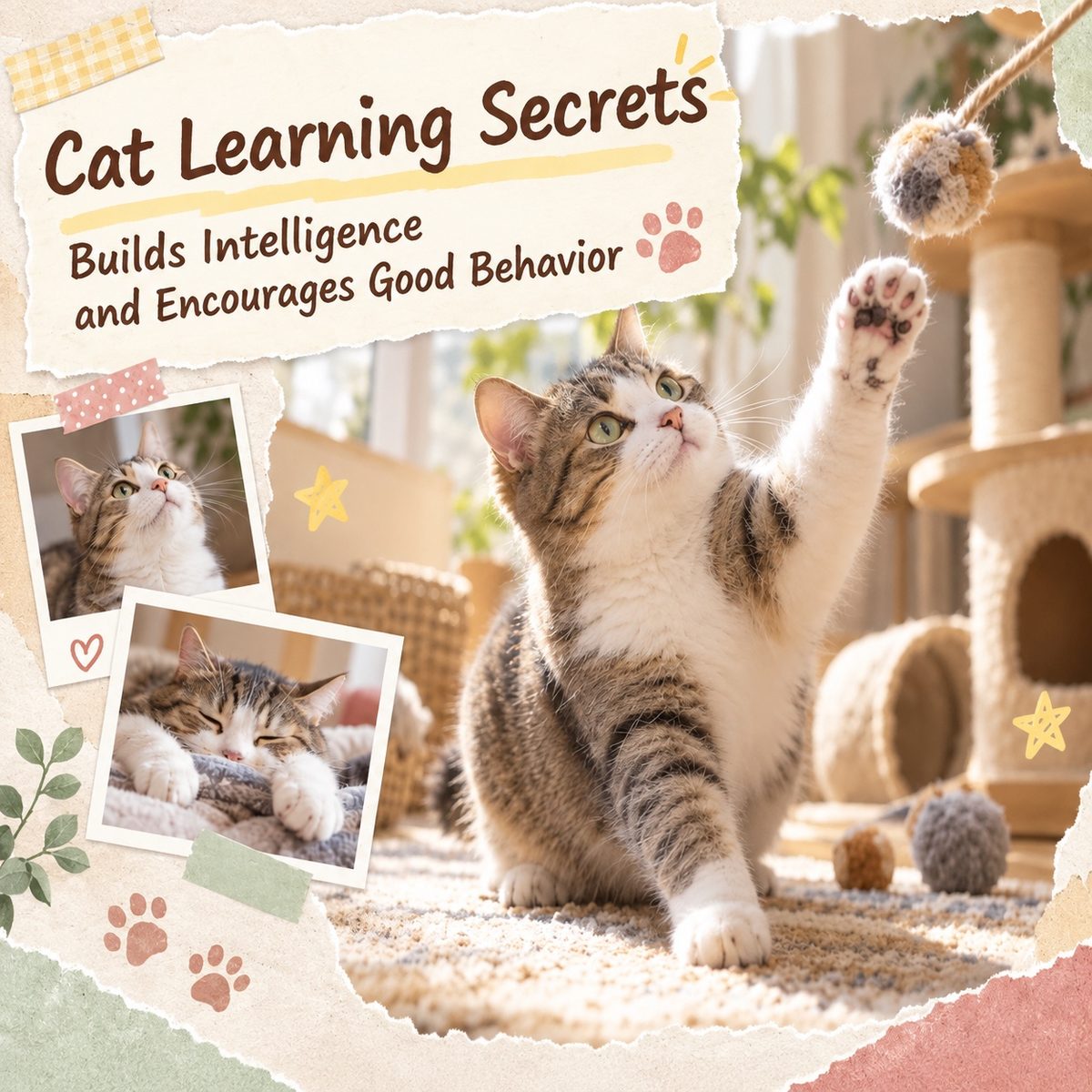
Quick answer: Cats have around 300 million neurons, and their intelligence is far beyond what most people imagine. They learn in 3 ways: observational learning (watch once and they've got it), trial-and-error learning (fall down, get back up), and conditioned-reflex learning (reward-driven). Most fascinating of all, cats "train" their owners — by observing, they work out your habits and weaknesses, then exploit them for their own benefit.
Has your cat ever opened a cupboard door by itself, waited for you to feed it at a specific time and place, or made you give in with a single look? If you thought cats were just "aloof" animals, you may have underestimated their intelligence. Research has found that cats' learning ability and memory far exceed what most people imagine. Today PetChill uncovers the high-IQ secrets of our feline friends.
Cats' Memory: Short-Term and Long-Term Running on Two Tracks
A cat's memory system works much like a human's, split into short-term and long-term memory. Long-term memory lets them remember the fixed positions of the litter box and food bowl, even after several months. Short-term memory helps them cope with sudden changes — for example, when you move the food bowl to another room, a cat can find the new spot very quickly.
Scientific studies indicate that a cat's short-term memory can last from a few minutes to a few hours, while long-term memory can last for years. This explains why a cat that has been to the vet clinic once will seem especially nervous every time it passes that place — it remembers the last experience!
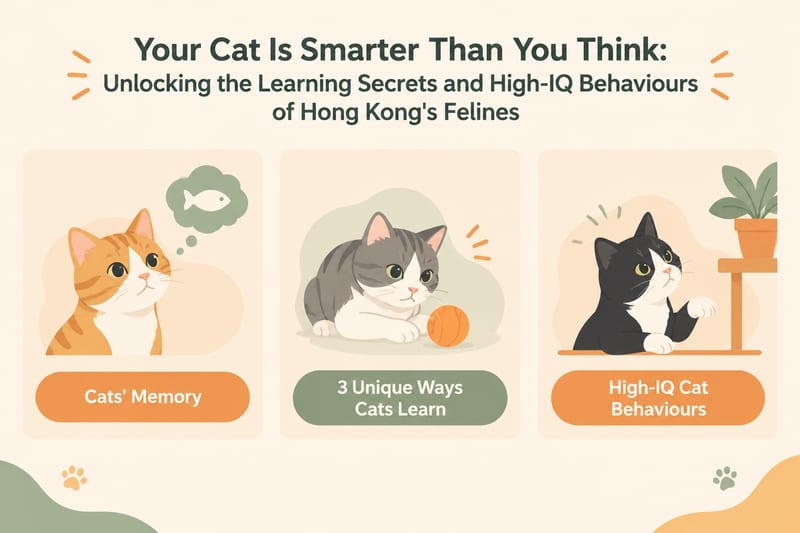
3 Unique Ways Cats Learn
| Learning style | How it works | Real-life example | Cognitive level |
|---|---|---|---|
| 🧠 Observational learning | Watch → imitate | Watches owner open a door → learns to use the door handle itself | Higher-level cognition |
| 🎯 Trial and error | Try → fail → try again | Kitten learning to jump → masters distance and force | Basic learning |
| 🏆 Conditioned reflex | Reward-driven association | "Sit → get a treat" → follows commands | Rational judgement |
1. Observational learning: watch once and they've got it
Cats are excellent observers. Research has recorded cats watching their owner open a door and then trying to imitate the action themselves. Some clever cats have even learned to hook a paw around the door handle! This "observe → imitate" style of learning is considered higher-level cognitive ability in the animal kingdom.
If your cat stares at you while you do things, don't assume it's just curious — it may be "learning the tricks of the trade"!
2. Trial-and-error learning: fall down, get back up
Like humans, cats learn new skills through "try → fail → try again". For example, when a kitten learns to jump, it may miss at first and fall, but after a few attempts it masters the correct distance and force calculation. This learning style lets cats adapt to all kinds of new environments and challenges.
3. Conditioned-reflex learning: reward-driven
Cats live by the philosophy of "what's in it for me?". Unlike dogs, cats don't cooperate to please their owner — they make a rational judgement first about whether it's worth acting. If you use treats as a reward, a cat will quickly learn the "sit → get a treat" association and cooperate with your commands.
| Learning style | How it works | Real-life example | Cognitive level |
|---|---|---|---|
| Observational learning | Watch → imitate | Watches owner open a door → learns to use the door handle itself | Higher-level cognition |
| Trial and error | Try → fail → try again | Kitten learning to jump → masters distance and force | Basic learning |
| Conditioned reflex | Reward-driven association | "Sit → get a treat" → follows commands | Rational judgement |
High-IQ Cat Behaviours: They're Training You!
This is the most interesting part — many cat owners may not realise they've already been "trained" by their cats!
Cats are masters at directing humans. Through sharp observation, they work out the household routines and their owner's weaknesses, then exploit them. For example:
- Whenever you sit down to eat, the cat jumps on the table and gives you a pitiful look — because it knows this trick works
- The cat makes a specific meow at a fixed time and place, because it has discovered this combination gets you up to feed it
- Some cats have even learned to press a particular switch or pull open a particular drawer, because they know what they want is inside
These behaviours aren't "instinct" — they're "skills" cats have acquired through observation and learning. In other words, your cat may understand you better than you think!
Cat vs Dog Intelligence: Each Has Its Strengths
Many people compare cat and dog intelligence. In fact, the two show their intelligence in different ways:
| Comparison | 🐶 Dog | 🐱 Cat |
|---|---|---|
| Number of neurons | About 500 million | About 300 million |
| Brain cortex density | Lower | Higher |
| Social learning | Good — actively follows commands | Weaker — judges independently |
| Problem solving | Relies on human guidance | Makes its own judgements and decisions |
| Learning motivation | To please the owner | Reward-driven (only does it if there's a benefit) |
| Training cooperation | High | Selective cooperation |
Research shows cats have about 300 million neurons. Although that's fewer than a dog's 500 million, cats have a higher density of neurons in the brain cortex, which makes them perform better on certain cognitive tasks. Put simply, cats aren't unintelligent — they just show their intelligence selectively. As one cat owner put it: "Dogs ask, 'What do you want me to do?' Cats ask, 'What's in it for me?'"
3 Little Games to Boost Your Cat's Intelligence
Want to stimulate your cat's brain development? These 3 simple games can help:
- Food-hiding game: Hide treats in different containers or locations and let your cat use its sense of smell and observation to find them
- Puzzle toys: Use toys that require thinking to get the treat out, exercising your cat's problem-solving ability
- Interactive play: Spend 10-15 minutes a day with a wand toy in a simulated hunting game to stimulate your cat's thinking and reactions
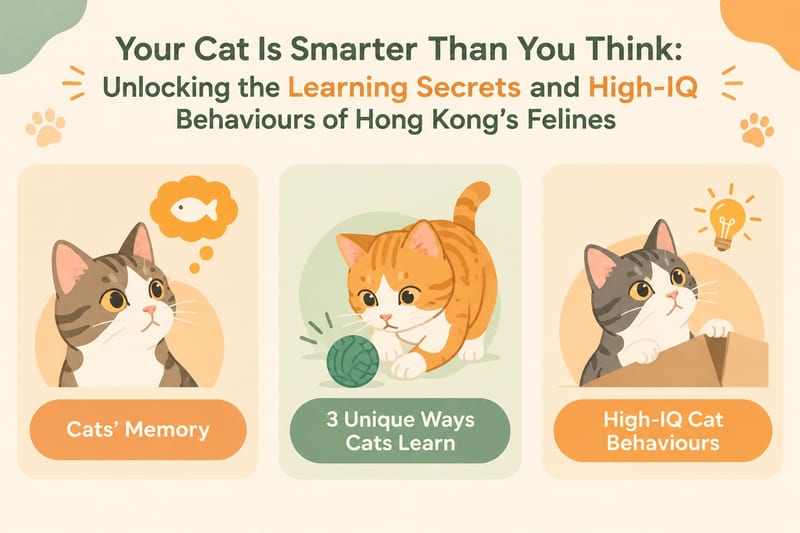
Hong Kong Small-Flat Practical Tips: 3 Ways to Boost Your Cat's Intelligence in 200 sq ft
Small living space in Hong Kong doesn't mean your cat can't play. Make good use of vertical space and everyday clutter, and you can still stimulate your feline's brain every day.
1. Treat trail on top of the wardrobe
Put a few freeze-dried treats in different corners on top of the wardrobe, then build a "staircase" out of cardboard boxes. Your cat has to jump two levels to find the treats, constantly calculating distance and force along the way — and getting some exercise too. Remember to move the spots every day so they don't memorise the route.
2. Shoebox maze
Don't throw away the shoeboxes from your clear-out. Cut holes of different sizes in the lids and put treats at the bottom of the boxes. Your cat has to use its front paws to "fish" the food out, training its problem-solving skills. Stack two or three shoeboxes together to make a maze; when you get home from work, just swap the boxes — no extra space needed.
3. Evening "hunting" session
Hong Kong people get home late from work. Use a small LED light or a red-dot pen to draw circles on the living-room floor, mimicking a cockroach's movements. Start at a fixed time every day, say 10 pm, and your cat will automatically "clock off" and wait for you to begin. After playing, remember to give a real reward (like a piece of freeze-dried treat) to reinforce the conditioned reflex.
Tip: If your cat is too clever and solves the game in two or three goes, seal the shoeboxes more firmly with tape, or put the wardrobe-top treats inside a small glass jar to increase the difficulty. Remember to tidy up before you finish each day so you don't kick the clutter in the middle of the night.
PetChill's Reminder
Cats' intelligence is far beyond what we imagine — they not only learn and remember, they also "train" their owners to do their bidding. Next time you find your feline boss making you give in with a single look, have a little smile: this is all part of their high-IQ behaviour!
To learn more about cat behaviour, keep following PetChill's latest articles!
Further Reading

 Feline Natural full guide →