
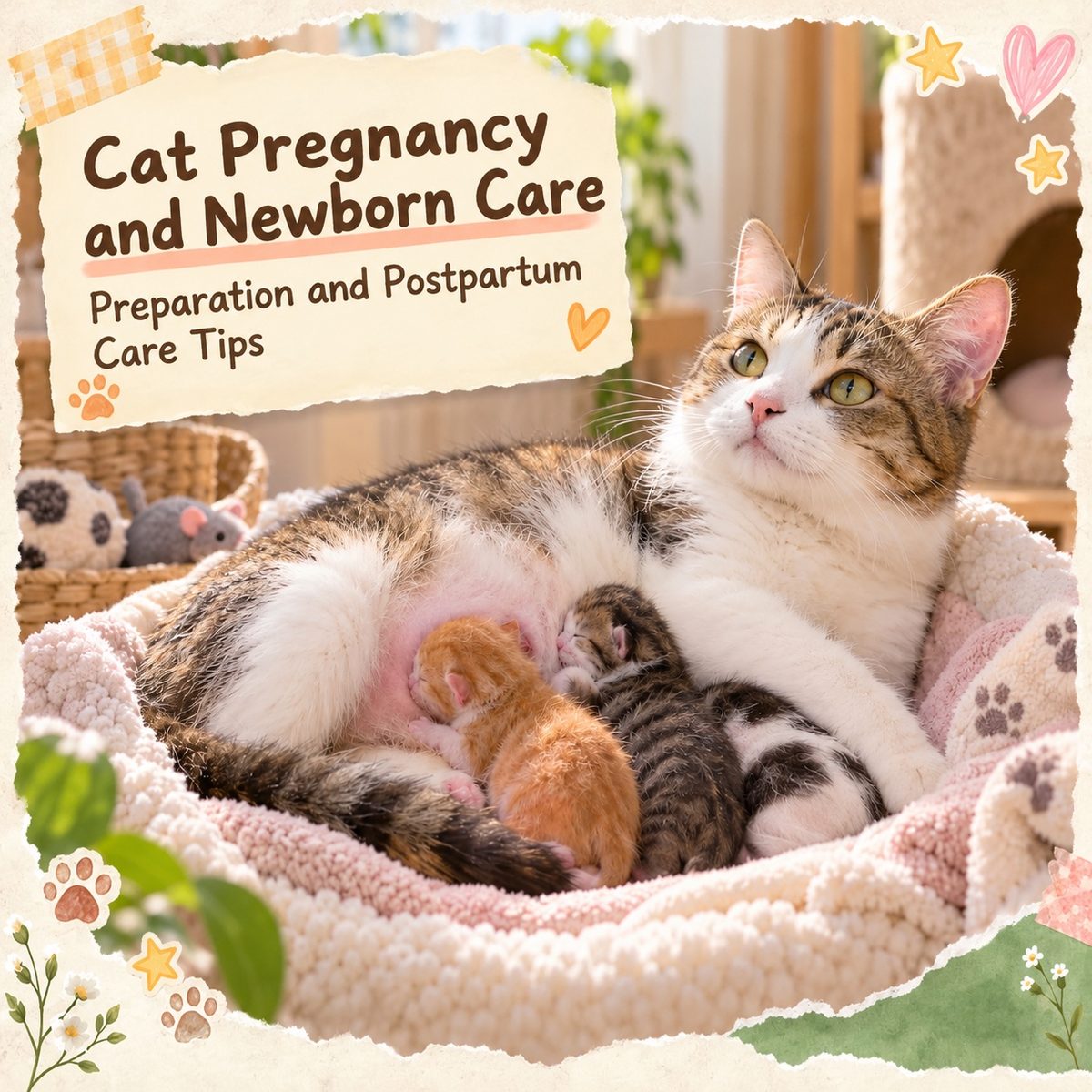
Quick answer: A cat's pregnancy lasts about 63-65 days. Signs include reddened nipples (week 3), a growing belly (weeks 6-7) and increased appetite. Prepare a quiet birthing area before birth; colostrum within the first 24 hours is vital for kittens' immunity. 1 to 4 years old is the ideal age for a cat to give birth.
Has your cat recently become extra clingy, eating more, and getting rounder by the day? Congratulations — you may soon be welcoming a litter of adorable kittens! Cat pregnancy and birth is an exciting yet nerve-wracking time, but many cat owners only have a vague idea about pregnancy signs, the birthing process and postpartum care. This article combines veterinary knowledge with key points from professional books to walk you through every critical stage of cat pregnancy and birth, so you can be fully prepared to welcome new life.
The basics of cat heat cycles and mating
Cats are induced ovulators, meaning they only ovulate during mating, so once mating is successful the chance of pregnancy is very high. If there is no mating, the heat period of about a week will repeat several times.
The heat cycle is controlled by daylight hours, and heat is most likely to occur in spring when days are longer. Notably, indoor cats may have longer heat periods than outdoor cats due to artificial lighting. Also, cats do not bleed during heat — if you notice bleeding, it is likely a sign of illness and you must take your cat to the vet as soon as possible.
Male cats usually reach sexual maturity at 6 to 8 months old, and unneutered males may show territorial behaviour such as spraying. If you do not plan to breed your cat, consider neutering at the appropriate time to avoid accidental pregnancy and reduce the risk of reproductive system diseases.
Cat pregnancy signs: how to tell if your cat is pregnant
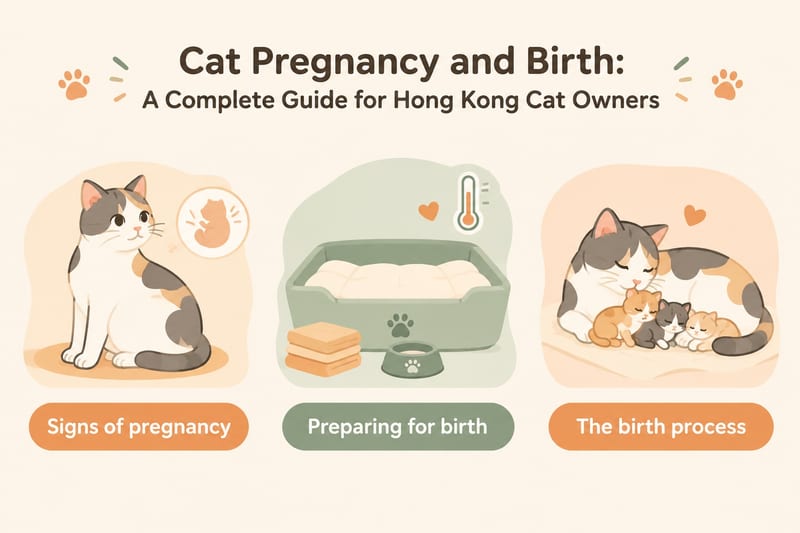
In the first three to four weeks after mating, a successfully pregnant queen will not show obvious physical or behavioural changes. Signs only gradually appear after four weeks:
Early signs (3 to 4 weeks after mating)
- Nipples turn red and enlarge: around the third week of pregnancy, the queen's nipples will visibly turn pink
- Behavioural changes: becomes quieter, more clingy, and stays close to home
- Less vigorous activity: no more climbing and jumping around
Mid-to-late signs (6 to 7 weeks after mating)
- Mammary glands swell: breasts visibly enlarge
- Belly grows: close to birth the belly can be twice its normal size
- Increased appetite: weight gain of up to 300 g per week
- Longer sleep: needs more rest
How to confirm pregnancy
Pregnancy can be confirmed by ultrasound around 30 days. If you suspect your cat is pregnant, it is best to take her to the vet for a professional check rather than guessing.
Optimal age for birth and gestation length
Queens may start their heat cycle as early as 5 months old, but it is best to wait until about 1 year old to breed, as the physical burden is lower at that age. Once a queen is over 5 years old (for senior cat care, see Complete Guide to Senior Cat Care), giving birth places a greater burden on the body, so giving birth between 1 and 4 years old is ideal.
A cat's gestation period is at least about two months (around 63 to 65 days). Because cats ovulate during mating, almost all matings result in pregnancy.
Preparing for birth: creating a safe birthing area for the mother cat
As the due date approaches, you need to prepare a comfortable birthing environment for the mother cat:
Choosing the birthing area
- Choose a quiet, not-too-bright corner of a room
- A cat cage, corrugated cardboard box or paper box can be used
- Line with pet pads for easy cleaning and replacement
- Keep warm and avoid direct draughts from vents
Essential items
- Sterilised scissors, cotton thread, gauze (in case the mother cat does not bite through the umbilical cord)
- Warm cat milk (to replenish the mother cat's energy)
- Clean towels (for warmth and wiping)
- Vet emergency contact details
Points to note
Experienced mothers may wait until the "last moment" to find a birthing spot, while first-time mothers may start looking weeks in advance. The owner's involvement can help the mother cat feel secure, and you can look for the most suitable birthing spot together.
The birthing process: how kittens are born
Normally, each kitten is born about every 10 to 30 minutes, with litters typically of 3 to 5. The birthing process has several stages:
Step 1: Contractions begin
The mother cat will show obvious restlessness, rapid breathing, and frequent licking of the genital area.
Step 2: Kittens are born
The mother cat bites open the amniotic sac, bites through the umbilical cord connecting to the placenta, and licks the fluids from the kitten's mouth, nose and body.
Step 3: Placenta is expelled
After each kitten is born, the placenta is expelled along with it. About 30 to 40 minutes after birth, the kitten's fur dries and it begins to suckle colostrum.
When the owner needs to help
- If the mother cat does not bite through the umbilical cord: tie sterilised cotton thread about 1 cm from the kitten's navel and cut from the placenta side
- If a kitten is weak: wipe its body with a warm towel to stimulate breathing and maintain body temperature
Postpartum care: the key to the health of mother and kittens
Caring for the mother cat after birth
- She will start eating within 24 hours after giving birth; provide food specially formulated for pregnant or nursing cats
- Nursing mothers need more food than usual
- She may be excited after birth; avoid excessive disturbance
Caring for newborn kittens
- Colostrum is very important: kittens must receive colostrum within 24 hours of birth to gain good immunity
- For 2 to 3 weeks after birth, the mother cat will have reddish-brown lochia discharge, which is normal
- The mother cat's uterus returns to normal within 28 days after birth
Newborn kitten growth milestones
| Age | Weight | Developmental features |
|---|---|---|
| 1 day | 100 to 120 g | Eyes closed, finds milk by smell |
| 1 week | 200 to 250 g | Kneads mother's breasts with front paws while nursing |
| 2 weeks | 250 to 300 g | Eyes begin to open, teeth growing |
| 3 weeks | About 500 g | Starts eating mushy weaning food |
| 4 weeks | 500 to 700 g | Milk teeth appear, starts play-fighting |
| 2 months | 700 to 1000 g | Very curious, needs vaccinations (see Complete Guide to Cat Vaccinations) |
| 3 months | 1000 to 1500 g | Permanent teeth appear, personality differences emerge |
Neonatal isoerythrolysis: the hidden risk in purebred cat breeding
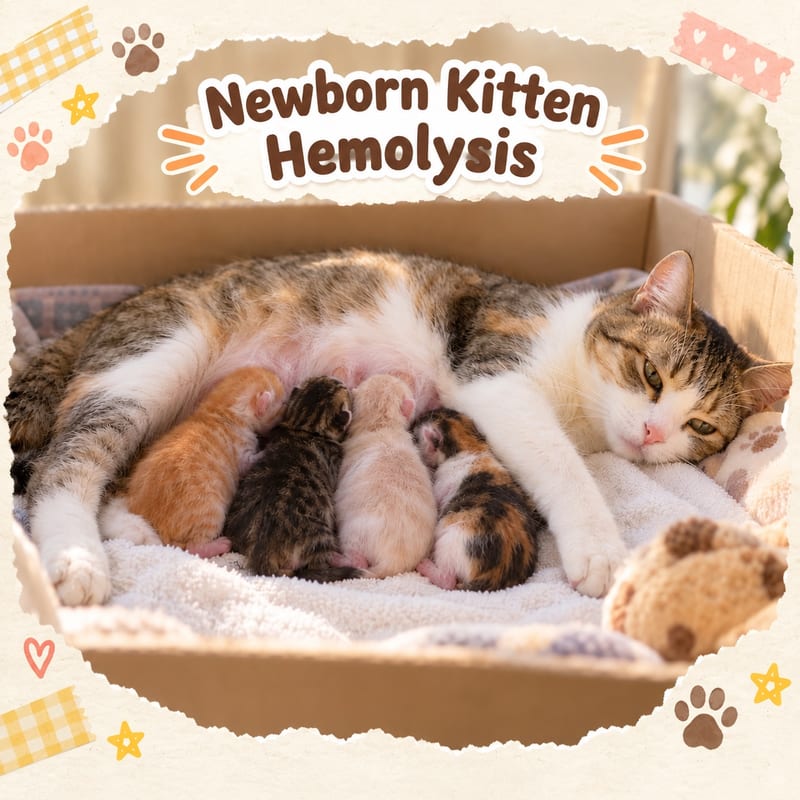
Purebred cat breeding requires special attention to the risk of "neonatal isoerythrolysis". If a blood type B queen is mated with a blood type A male, the kittens may suffer severe haemolytic reactions after drinking colostrum, and may even die.
Prevention methods:
- Blood type testing before breeding
- Avoid mating type B queens with type A males
- If in doubt, consult a professional veterinarian or breeder
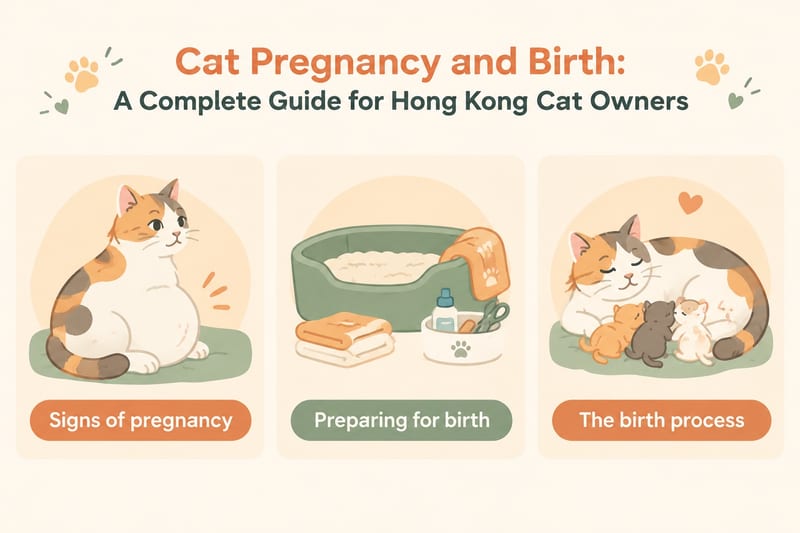
Practical guide for Hong Kong: local steps from pregnancy testing to postpartum support
In Hong Kong's high-density living environment, cat pregnancy and birth require more down-to-earth strategies. First, once pregnancy is suspected, contact a licensed vet clinic as soon as possible to book an ultrasound — most local clinics require booking 3–5 days in advance, and clinics in areas like Mong Kok and Causeway Bay are especially busy, so do not wait until week 6 to act. If you live in public housing or a tenement building, immediately check windows, balconies and vents, and install kitten safety nets (mesh smaller than 1.5 cm) to prevent the mother cat from climbing and falling due to anxiety before giving birth. The birthing area does not need to be luxurious: a deep cardboard box (1.5 times the cat's height) with old T-shirts cut into strips as bedding is enough; the key is to keep it away from lift lobbies, corridors and directly under air-conditioners. Hong Kong's humid summers require special attention to balancing ventilation and dryness in the birthing area: place an absorbent pad at the bottom of the box and cover with a bamboo mat, changing it twice daily to prevent mould growth from lochia leakage. For postpartum care, local vets generally recommend a follow-up visit within 3 days after birth to confirm uterine contraction and check for retained placenta; if the mother cat refuses to nurse or a kitten's weight does not increase for 2 consecutive days, go to the clinic immediately rather than waiting until the next day. In addition, all licensed clinics in Hong Kong stock cat colostrum replacer (not cow's milk), which can be obtained immediately if the mother cat cannot produce milk. Finally, a reminder: under the Agriculture, Fisheries and Conservation Department's Animal Welfare Ordinance, breeders must ensure the mother cat's health and the proper placement of offspring; unprepared spontaneous breeding may breach liability clauses, so check the official guidelines in advance.
📌 Key summary
-
✅ From week 3 of pregnancy, nipples visibly turn pink — the earliest observable physical sign
-
✅ Before birth, set up the birthing area in a quiet, draught-free corner with soft lighting, avoiding noisy spots like the living room or corridor
-
✅ Colostrum must be taken within 24 hours of birth, otherwise basic immunity cannot be established
-
❌ Do not judge pregnancy yourself — ultrasound can only confirm after 30 days; do not delay a vet visit by guessing
-
❌ Bleeding during heat is not normal; see a vet immediately if there is any bleeding — it is not a sign of heat
-
❌ Giving birth before 1 year old or after 4 years old significantly increases the physical burden and should be avoided
-
Pregnancy length: about 63-65 days; ultrasound can confirm 30 days after mating
-
Three main signs: nipples turn pink (week 3), belly doubles in size (weeks 6-7), weight gain up to 300 g per week
-
Best age for birth: 1 to 4 years old; risk is higher for births over 5 years old
-
Colostrum is key: kittens must receive colostrum within 24 hours of birth to have immunity
-
Emergency: if the mother cat does not bite through the umbilical cord, tie sterilised cotton thread about 1 cm from the navel and cut
PetChill's Reminder
Cat pregnancy and birth is a natural process that requires careful care. If you do not plan to breed your cat, consider neutering at the appropriate time to avoid accidental pregnancy. If you decide to breed, please ensure you can take responsibility for all kittens and find reliable adoptive homes.
To learn more about cat health, keep following PetChill's latest articles!
❓ FAQ
Q: How long does a cat stay pregnant before giving birth? A: A cat's gestation period is about 63 to 65 days (around two months). Because cats are induced ovulators, once mating is successful the chance of pregnancy is close to 100%. Take your cat for an ultrasound at the vet around 30 days after mating to confirm.
Q: What should I prepare before my cat gives birth? A: Prepare a quiet, dimly lit birthing area (a cat cage or cardboard box works), line it with pet pads, and have sterilised scissors, cotton thread, gauze, warm cat milk and clean towels ready. Most importantly, have your vet's emergency contact details on hand.
Q: When can newborn kittens be weaned? A: Kittens can start eating mushy weaning food at around 3 weeks old, and can gradually transition once milk teeth appear at 4 weeks. At 2 months old they are very curious, and this is also the time for vaccinations. Remember kittens must receive colostrum within 24 hours of birth.
Q: How can I confirm my cat is pregnant? A: Pregnancy can be confirmed by ultrasound around 30 days. Licensed vet clinics in Hong Kong generally offer pregnancy ultrasound services, and most local clinics require booking 3–5 days in advance.
Q: When is the best time for a cat to give birth? A: 1 to 4 years old is the ideal age for a cat to give birth; the pregnancy cycle is about 63 to 65 days, and an ultrasound check around 30 days after mating is recommended to confirm.