
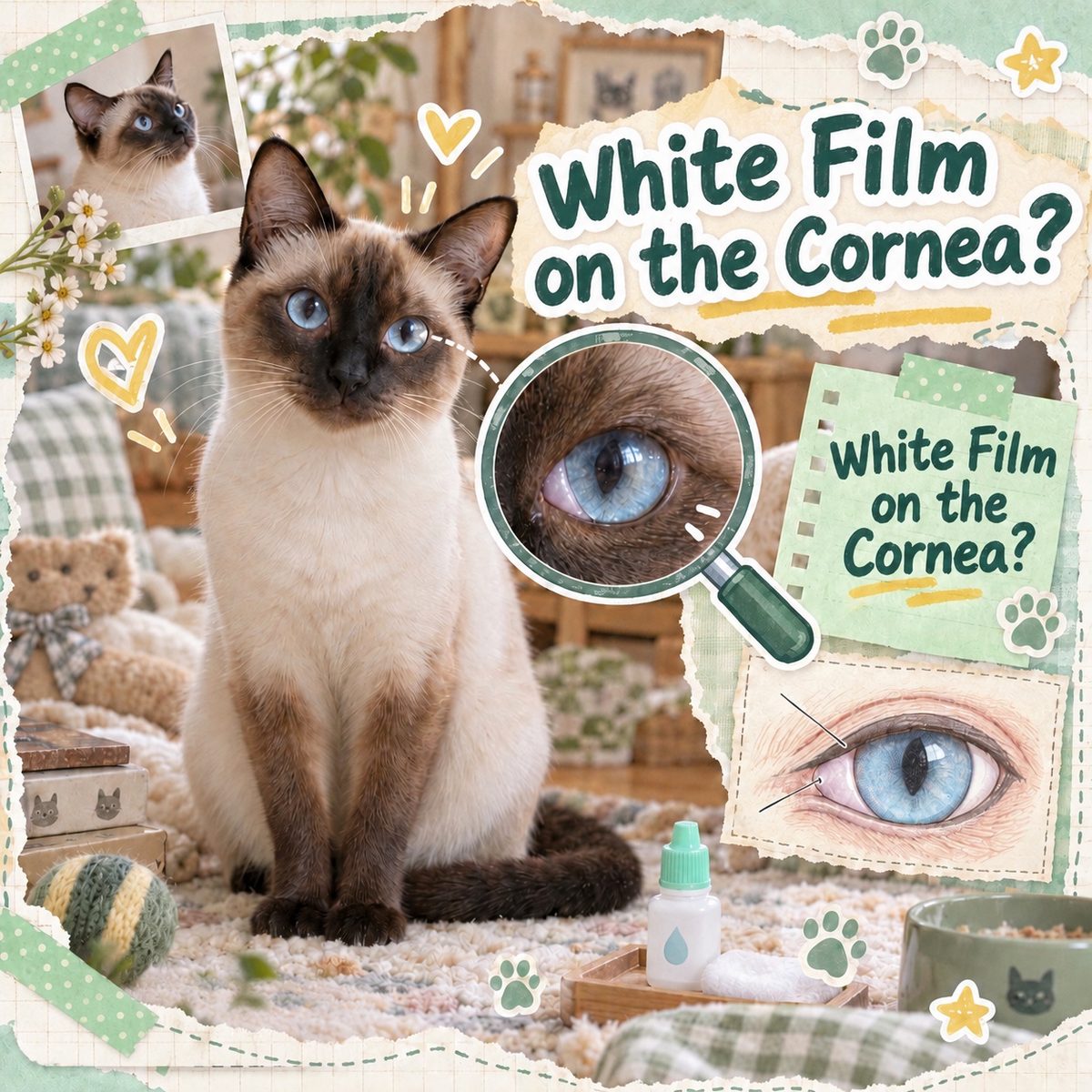
Quick answer: A white or pinkish-white membrane suddenly appearing in the inner corner of a cat's eye is a protruding 'third eyelid' (nictitating membrane). It is not just 'big eyes'—it is a health warning from the body. The 4 common causes: ① Wasting diseases (most common, both eyes protrude + weight loss and diarrhoea) ② Horner's syndrome (one eye protrudes + constricted pupil) ③ Haw's syndrome (young cats 1 to 3 years old, both eyes protrude but the cat is perfectly well) ④ Key-Gaskell syndrome (rarest, accompanied by constipation + dilated pupils). Key to differentiation = one eye or both eyes + presence of systemic symptoms; one eye protruding + constricted pupil + drooping eyelid requires an immediate vet visit. Never push the third eyelid back with your hand, and never use human eye drops on your own.
Key points
- The third eyelid is a cat's nictitating membrane; normally only faintly visible in the inner corner. Long-term exposure is a health warning, not 'big eyes'.
- Among the 4 major causes, wasting diseases are the most common, followed by Horner's syndrome.
- Rule of thumb: one eye protruding → prioritise neurological and ear problems; both eyes protruding → prioritise systemic diseases.
- Treatment focuses on 'treating the cause'—once the primary disease resolves, most third eyelids retract on their own; neurological cases generally take 1 to 2 months.
- A 1-minute, 5-step daily eye check plus regular deworming and health checks are the best prevention.
- Contraindications: do not push with your hand; do not use steroid-containing eye drops on your own (they worsen corneal ulcers).
Have you ever looked at your cat's eyes and suddenly noticed a white or pinkish-white membrane in the inner corner, as if a 'third eyelid' is covering the eyeball? This membrane is called the third eyelid (nictitating membrane). Normally it should be tucked in the inner corner and only faintly visible. If your cat's third eyelid is constantly exposed, or even covers half the cornea, this is not simply 'big eyes'—it is a health warning from the body. Today we will break down the causes of third eyelid protrusion, how to differentiate the symptoms, and when to take your cat to the veterinarian immediately.
What is the third eyelid? A cat's unique 'third layer of protection'
The third eyelid is a special structure that humans lack but cats have. Located in the inner corner of the eye near the nose bridge, it is a white tissue that can slide outward. It has three main functions:
- Tear secretion: The third eyelid contains lacrimal gland tissue that helps keep the eyeball moist.
- Tear distribution: With each blink, the third eyelid acts like a windscreen wiper, spreading tears evenly over the corneal surface.
- Eye protection: When cats rummage through bushes or fight, the third eyelid can cover the cornea to prevent injury.
The third eyelid has a group of muscles controlled by the sympathetic nervous system, which pulls the third eyelid back into the inner corner. Therefore, if the sympathetic nerves malfunction or the eyeball position changes, the third eyelid can 'pop out', causing what is known as prolapse of the third eyelid.
The 4 major causes of third eyelid protrusion
According to veterinary clinical classification, there are four main categories of causes for third eyelid protrusion in cats:
1. Wasting diseases (most common)
A cat's eyeball sits on a layer of fat in the eye socket. If a cat has chronic diarrhoea, tapeworm infestation, fever or poor appetite, the body consumes the orbital fat, thinning the fat layer and causing the eyeball to sink backward. The third eyelid then protrudes in both eyes simultaneously. These cases are usually accompanied by systemic symptoms: lethargy, weight loss, dry cornea, catarrhal conjunctivitis, etc. If your cat has persistent vomiting and diarrhoea, see the Cat Vomiting Guide to determine whether it is a gastrointestinal warning sign; for what temperature counts as fever and how to take a temperature correctly, see the Cat Fever Guide. In addition, older cats that 'eat a lot but keep losing weight' often have wasting conditions such as hyperthyroidism; refer to the Cat Hyperthyroidism Guide.
2. Horner's Syndrome
Caused by damage to the cervical sympathetic ganglion, characterised by unilateral third eyelid protrusion. Severe cases show constricted pupil on the same side, drooping eyelid, sunken eyeball, and a noticeably narrower palpebral fissure compared with the other eye. Causes may include trauma, otitis media, and in a few cases tumours (e.g., lymphosarcoma), so unilateral third eyelid protrusion must be examined by a veterinarian.
3. Haw's Syndrome
Most common in young cats aged 1 to 3 years. Causes may include direct injury such as head or neck trauma, or indirect damage from severe stress. It is also characterised by bilateral third eyelid protrusion, but the cat is otherwise completely healthy and active.
4. Key-Gaskell Syndrome
Cause unknown; it is an autonomic nervous system disorder. In addition to third eyelid protrusion, it is often accompanied by slowed gastrointestinal motility, constipation, dilated pupils and other systemic neurological symptoms. It is the rarest of the four but also the one requiring the closest follow-up.
How to differentiate? Comparison table of the 4 major causes
Many cat owners panic at the first sign of third eyelid protrusion, but the direction of observation is important. The table below lists the key differences among the four major causes:
| Cause | Typical age | Eyes affected | Accompanying features | Prognosis |
|---|---|---|---|---|
| Wasting diseases | Any age | Both eyes simultaneously | Weight loss, diarrhoea, fever, lethargy, poor appetite | Usually recovers on its own after treating the primary disease and improving nutrition |
| Horner's syndrome | Any age | One eye | Constricted pupil, drooping eyelid, sunken eyeball, narrowed palpebral fissure | Except for tumour causes, most recover within 1 to 2 months |
| Haw's syndrome | Young cats 1 to 3 years | Both eyes simultaneously | Active and lively, no systemic symptoms | Mostly good; takes 1 to 2 months to gradually retract |
| Key-Gaskell syndrome | Any age | Both eyes simultaneously | Constipation, dilated pupils, slowed gastrointestinal motility | Rarest; may require long-term treatment and follow-up |
Simple memory aid:
- Both eyes protruding + systemic symptoms (diarrhoea, fever, lethargy, weight loss) → highly likely a wasting disease; treat the primary disease first.
- One eye protruding + constricted pupil + drooping eyelid → suspect Horner's syndrome; see a veterinarian immediately to investigate neurological and ear problems.
- Both eyes protruding but the cat is healthy and active → possibly Haw's syndrome; still recommend booking an examination to confirm.
- Third eyelid protrusion + dilated pupils + constipation → be alert for Key-Gaskell syndrome; seek veterinary care as soon as possible.
Treatment approach: mainly treat the cause
Third eyelid protrusion itself usually does not need direct 'treatment'; the focus is to find and address the underlying disease:
- Caused by wasting diseases: Treating the cause is the priority. Once the primary disease resolves and strength returns, the third eyelid will return to its normal position on its own. If conjunctivitis is present, the veterinarian will prescribe antibiotic eye drops 1 to 3 times daily.
- Horner's / Haw's syndrome: Retraction of the third eyelid takes longer (about 1 to 2 months). Apart from tumour-related causes, the prognosis is generally good. The veterinarian may prescribe vitamin B1 and C to support nerve repair.
- ⚠️ Never buy eye drops and use them indiscriminately: Steroid-containing eye drops can worsen the condition if there is a corneal ulcer; medication must follow veterinary instructions.
5-step daily eye check (1 minute per day)
Prevention is better than helps manage. It is recommended to do a simple check daily while interacting with your cat:
- Look at the third eyelid: In good light, check the inner corner; normally only a thin white edge should be visible.
- Look at the sclera: Is the conjunctiva red or congested? Any abnormal discharge?
- Look at the pupils: Are both pupils the same size? Is the light reflex normal?
- Look at discharge: Has the eye discharge suddenly increased, turned yellow or thickened?
- Look at behaviour: Is the cat squinting, rubbing its eyes, avoiding light, or tearing frequently?
For daily care, you can follow the Pet Daily Care Guide for ear and eye cleaning steps, grooming and nail-trimming schedules, making the eye check a daily routine.
If you notice the trio of runny nose + sneezing + heavy eye discharge, beware of feline viral rhinotracheitis (cat flu) and seek veterinary care early.
PetChill's Reminder
The third eyelid is a barometer of a cat's health—its protrusion is not an eye problem but mostly a systemic problem. A 1-minute daily eye check, together with regular deworming and health checks, can nip serious illness in the bud. If your cat's eye area is often wet or has heavy discharge, remember to clean gently with pet-specific eye cleaning products; do not wipe randomly with human wet wipes.
To learn more about cat health, stay tuned for PetChill's latest articles!
References: 'Cat Family Medicine Encyclopedia' chapter on third eyelid protrusion (Book OCR #3387), 'Cat Health Check Guide' (#7891, #7897), 'Cat Vision and Eye Structure' (#6027). This article is for reference only and cannot replace veterinary diagnosis; if your cat has unilateral third eyelid protrusion, abnormal pupils or depression, please seek veterinary care immediately.
 Fuji One full guide →

