
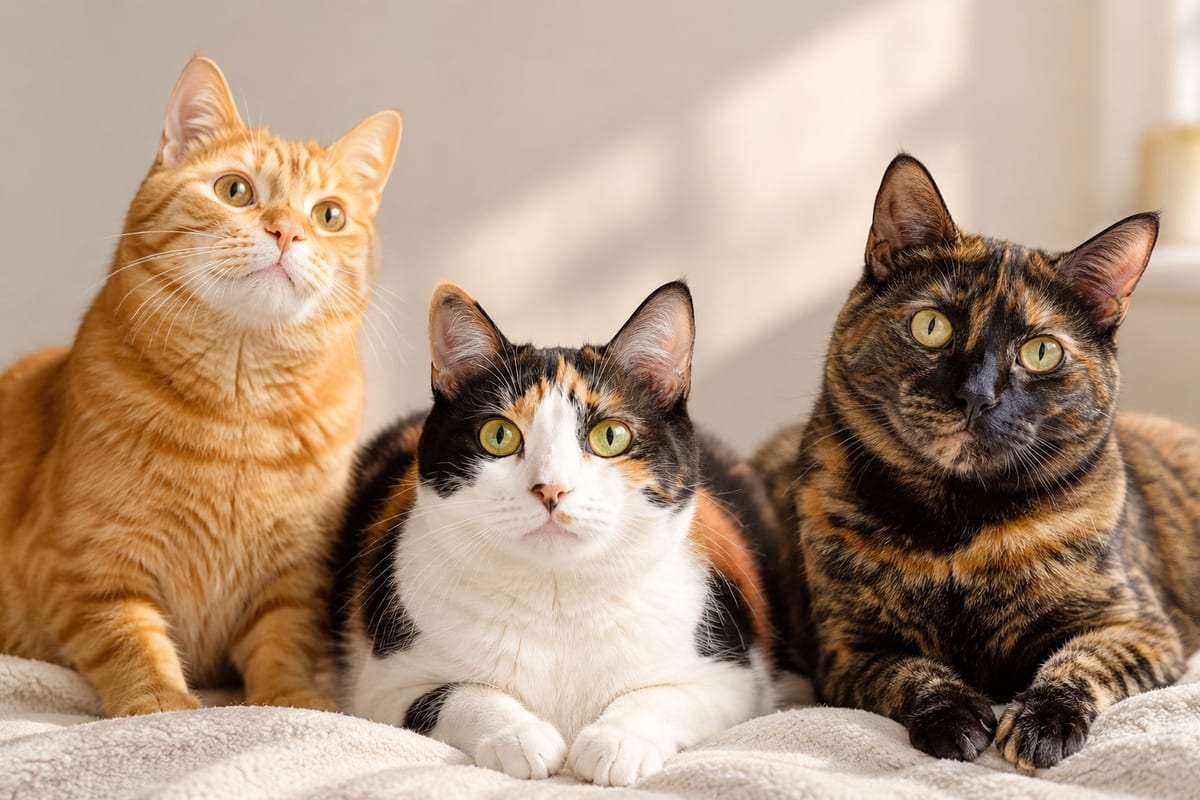
Have you noticed that the orange cats around you always seem extra lively and playful, while calicos carry a touch of cool aloofness? It's no coincidence! There's an unexpected genetic link between a cat's coat colour and its personality. This time, PetChill takes you deep into the genetic code behind cat coat colours, unveiling the mystery between patterns and personality.
Quick answer: There really is a genetic link between a cat's coat colour and personality — the orange gene sits on the X chromosome, which is why calicos and tortoiseshells are almost all female (only 1 male in every 3,000 calicos). CFA judge Joan Miller's long-term research found that orange cats are generally livelier and "crazier" than black cats — the so-called "Orange Gene Theory". But coat colour is only one reference point for personality; every cat is an individual, so don't judge by colour alone.
How do coat colour genes affect cat personality?
A cat's coat colour is determined by multiple genes working together, and some of these genes happen to sit near regions that influence behaviour. Joan Miller, an all-breed judge for the Cat Fanciers' Association (CFA), has studied feline personality traits for years and found that cats with orange coats are generally "crazier and more energetic" than those with black coats.
This finding is known as the "Orange Gene Theory". Miller points out that the Cheshire Cat in the classic tale Alice's Adventures in Wonderland is in fact a red tabby, and its madcap image is certainly memorable. While rigorous scientific evidence has yet to fully confirm a causal link between coat colour and personality, the observations of countless cat owners and breeders support this intriguing connection.
Personality traits of five common coat colours
- Orange cats (red tabby): Widely recognised as the most lively, sociable and notably food-obsessed — no wonder those "big orange" memes are everywhere online
- Black cats: Calm, independent and confident, often described as "mysteriously elegant", and extremely loyal to their owners
- White cats: Relatively quiet and gentle, sensitive and delicate; some white cats may carry hereditary hearing traits
- Calico cats (black, orange and white): Changeable in mood and strong-willed, dubbed the "queens of the cat world" — occasionally affectionate but never overly clingy
- Tortoiseshell cats (black and orange mix): Distinctive character, blunt temperament, love and hate in equal measure, very affectionate with those they trust
Quick-reference table: five coat colours and personalities
| Coat colour | Personality keywords | Sex-linked genetic traits | Care notes |
|---|---|---|---|
| Orange cats (red tabby) | Lively, sociable, big appetite | Male-to-female ratio about 2:1 (orange gene on X chromosome) | Prone to overweight; watch portions and schedule meals |
| Black cats | Calm and independent, highly loyal, mysteriously elegant | Even sex ratio | Strongly attached to owners; not suited to being left alone for long periods |
| White cats | Quiet and gentle, sensitive and delicate | Even sex ratio | Blue-eyed white cats have a higher risk of congenital deafness |
| Calico cats | Strong-willed, queens of the cat world, occasionally affectionate | Almost 100% female (male calicos 1/3000 and mostly infertile) | Male calicos should have extra health checks |
| Tortoiseshell cats | Distinctive character, love-hate clear, affectionate with trusted people | Almost 100% female | Need enough personal space |
This table is compiled from CFA judges' observations and the collective experience of countless cat owners. It can serve as one reference dimension when choosing a cat, but remember: individual differences always outweigh group statistics.
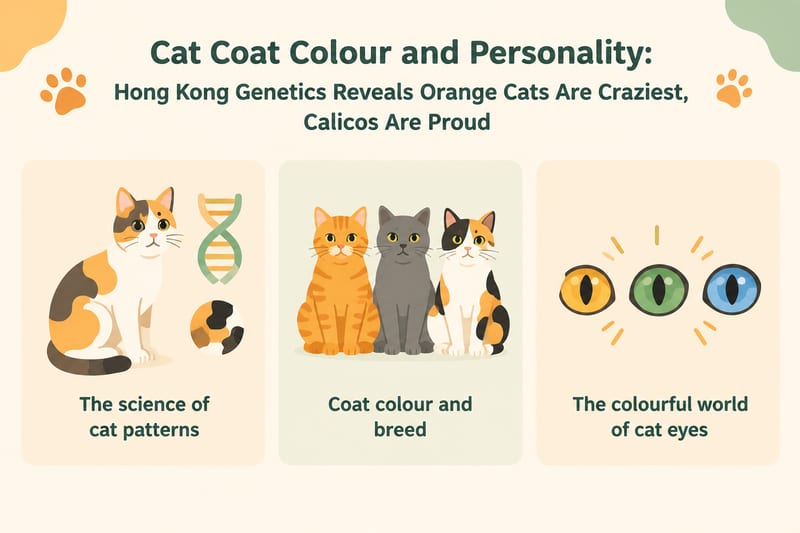
The secret relationship between the orange gene and sex
This is the most interesting part! The orange gene is intimately tied to a cat's sex because it sits on the X chromosome.
Female cats have two X chromosomes (XX), so they can carry both black and orange coat genes at once, producing the distinctive calico or tortoiseshell pattern. Male cats have only one X chromosome (XY), so their coat can be either black or orange — never both.
This genetic mechanism explains a fascinating phenomenon in the cat world: calicos and tortoiseshells are almost all female! Only about 1 male appears in every 3,000 calicos, and these rare male calicos are usually infertile due to chromosomal abnormalities. So when you see a calico, you can be fairly sure it's a "she", not a "he".
The science of cat patterns: tabby, solid and pointed
Beyond colour, the formation of patterns is likewise a genetic masterpiece. A cat's coat consists of an undercoat and guard hairs, and pattern variation depends on how pigment is distributed through the hair:
- Tabby: The most classic cat pattern, further divided into mackerel, classic tabby and spotted. The tabby gene exists in almost all cats — even solid-coloured kittens may show faint tabby markings in their early weeks
- Solid: Pigment is evenly distributed through each hair, creating a uniform colour. Common solids include black, blue (grey), cream and red
- Pointed: The signature pattern of Siamese and Ragdoll cats, with darker colour on the face, ears, legs and tail and a lighter body. This pattern is temperature-related — warmer areas have lighter pigment, cooler extremities darker
- Smoke: Looks solid, but the base of each hair is actually silvery white — a hidden surprise revealed only when the cat runs
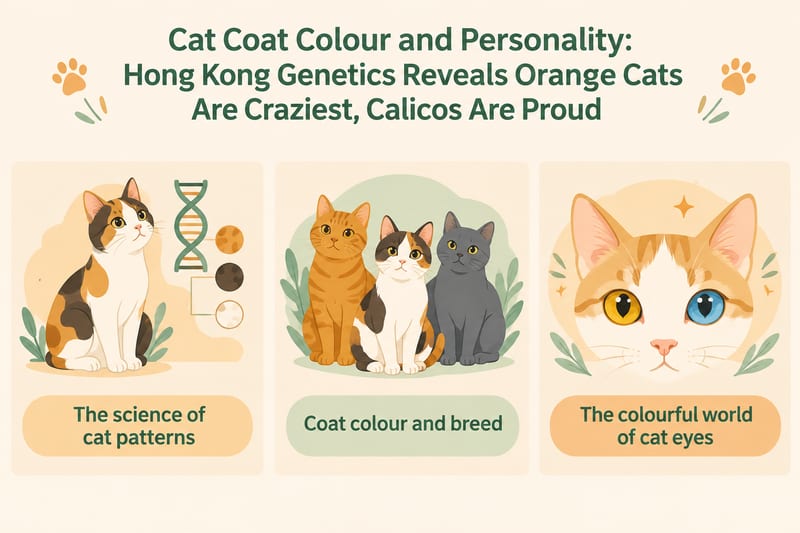
Coat colour and breed: which decides which?
Many cat owners ask: "Does orange mean orange cat?" The answer is no. Orange coats appear in more than 40 breeds — American Shorthair, British Shorthair, Exotic Shorthair, Maine Coon and Persian all have red individuals. Strictly speaking, "orange cat" is an umbrella term for a coat colour, not a breed. Likewise, pointed does not equal Siamese: Ragdolls, Birmans and Oriental Shorthairs all carry the pointed gene, differing only in size and coat length.
This distinction matters because personality is shaped by three things together: breed genes + coat colour genes + upbringing. Take orange, for example: American Shorthairs are usually steady and grounded, while Maine Coons are famously the "gentle giants". So when using coat colour to choose a cat, it's best to look at breed traits too, so you find the companion that best fits your lifestyle.
One more reminder: while the white coat and blue eyes combination is beautiful, it is genetically linked to the gene involved in inner-ear development (the KIT gene), so blue-eyed white cats have a higher rate of congenital deafness. If your white cat doesn't respond when called, it may not be aloofness — consider a hearing assessment early on.
The colourful world of cat eyes: they see things differently from you
Speaking of coat colour, we must mention the world of colour as cats see it. A cat's retina has only two types of cone cells, so it can distinguish only blue and green; red essentially doesn't exist for them. In other words, the vividly colourful world you see looks more like soft blue-green tones to a cat.
Yet a cat's motion detection is extraordinary — even if prey 50 metres away moves just 4 millimetres per second, a cat can pinpoint it. This superb motion vision, combined with vertical slit pupils, makes cats born crepuscular hunters.
The practical value of understanding coat colour
What practical help does knowing the link between coat colour and personality offer cat owners?
First, when choosing a cat you can use coat colour as one personality reference (but not the only criterion). For example, if you want a lively, interactive cat, an orange cat may be a good choice; if you prefer a quiet, independent companion, a black or white cat may suit you better.
Second, understanding the inheritance rules of coat patterns can help assess a cat's health. For example, male calicos may have chromosomal abnormalities and need extra health attention; pure white cats need watching for hereditary hearing and vision issues.
PetChill's Reminder
While the link between coat colour and personality is fascinating, every cat has its own unique character, so don't judge them by colour alone. Whether it's the liveliness of an orange cat, the calm of a black cat or the aloofness of a calico, every cat of every colour deserves your care and understanding.
Key takeaways
✅ The orange gene sits on the X chromosome, so calicos and tortoiseshells are almost all female (odds of a male calico about 1/3000) ✅ "Orange Gene Theory": CFA judge Joan Miller's long-term observations found orange cats generally livelier than black cats ✅ Patterns are determined by pigment distribution: four main types — tabby, solid, pointed (temperature-influenced) and smoke ✅ Cats have only two types of cone cells and see the world in blue-green tones, but their motion vision can catch movement of 4 millimetres per second from 50 metres away ✅ Coat colour can be a personality reference when choosing a cat, but individual differences always outweigh group statistics ❌ Don't judge a cat by its colour alone, and never feed without limits because "orange cats are greedy" ❌ Male calicos often have chromosomal abnormalities; if you meet one, pay extra attention to fertility and health issues
More cat trivia
PetChill has these other cat behaviour and health features that complement this article:
- The Complete Guide to Cat Body Language | Tail, Expression and Posture: 3 Key Signals to Read Your Cat's Mind
- Why Can Cats Jump So High? The Hunting Instinct Explained | Paws, Tail and Night Vision: 3 Secret Weapons
- Cat Kneading 2.0 | From Kitten Instinct to Adult Code: 8 Fun Facts + Behaviour Decoder
- Can Cats Taste Sweetness? 10 Fun Facts About Cat Tongues and Taste
Every cat deserves to be understood. PetChill offers cat nutrition, toys and care products to help you look after your cat, whatever its colour.
 Instinct full guide →
 Almo Nature full guide →
 Fuji One full guide →

