

🤖 AI Summary
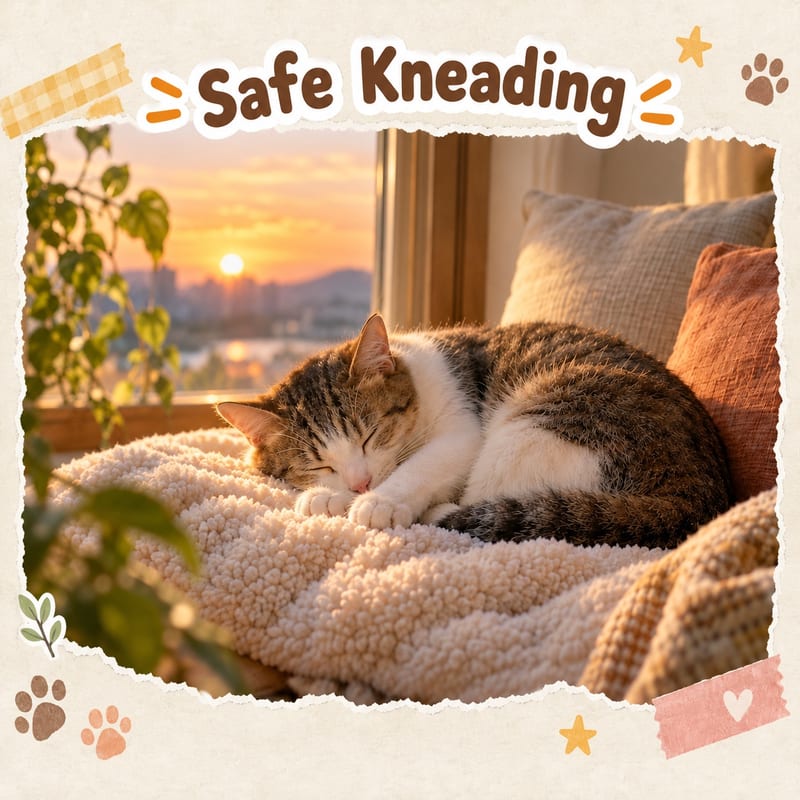
Kneading is the action of a cat alternately pressing its front paws, originating from the kitten's instinct to stimulate milk secretion. When an adult cat kneads, it's a signal of extreme security, and may also combine scent-marking, nesting instinct, self-soothing and other meanings.
• This 2.0 upgrade: 8 fun facts + kneading posture decoding table + dealing with pain points
• 3 correct reactions when being kneaded (trim nails!)
• If it suddenly stops kneading and seems low, think health first
Quick answer: Cat kneading is the kittenhood instinct of pressing on the mother cat's belly to stimulate milk, retained into adulthood as a 'security confirmation action'. Kneading you = it sees you as a mother-level source of security. Correct reaction: keep nails trimmed, put a blanket down, don't push it away. Purring, drooling and a spaced-out gaze are all part of the 'very relaxed' package.
Contents
-
What is kneading?
-
Why cats knead: 6 reasons explained
-
Kneading posture × mood decoding table
-
8 fun facts
-
Correct reactions when being kneaded (and dealing with pain points)
-
Red/green checklist: normal kneading vs what to watch for
-
FAQ
Does your cat often jump onto your lap, alternately press its front paws, half-close its eyes and purr? That's 'kneading'—one of the most heart-melting cat behaviours. But have you ever wondered why an adult cat still does this kitten action? Behind it lies deep trust in you and an evolutionary story.
What is kneading?
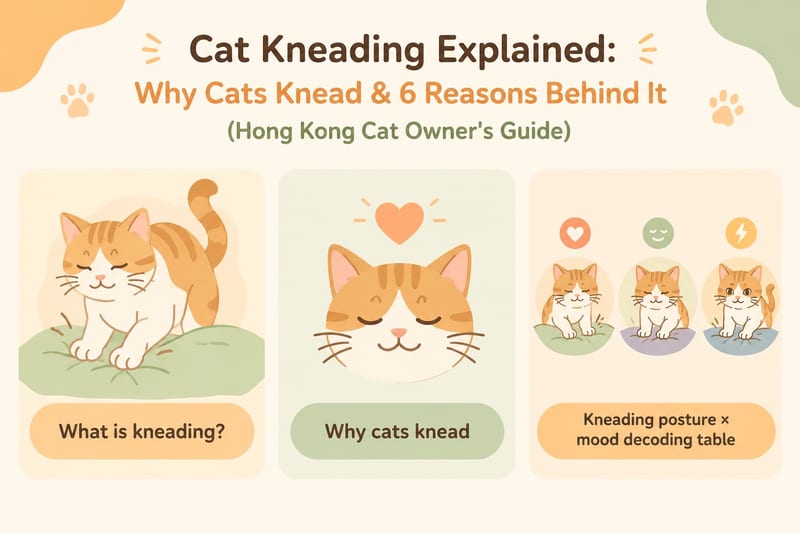
Kneading (foreign cat owners nickname it 'making biscuits' because it looks like kneading dough) is when a cat uses both front paws to alternately press a soft surface: a blanket, pillow, your belly, your thigh—anything can be its 'dough'.
The classic kneading scene: the cat squints, looks blissful, purrs, and rhythmically presses its front paws—sometimes drooling and zoning out, as if its soul has left its body. This action is one of the happiest expressions of a cat, and the story behind it starts from the moment it was born.
Why cats knead: 6 reasons explained
1. Continuation of kitten instinct (origin)
Newborn kittens, before their eyes open, press alternately around the mother's teats with their front paws to stimulate milk—a survival instinct. After weaning this action should disappear, but many cats retain it as a trigger for 'returning to the safest state'. Animal behaviourists generally believe: a kneading cat is bringing itself back to the kittenhood security of 'with mum, no fear'.
2. Scent marking: you're included in the territory
Cats have scent glands in their paw pads. Kneading also leaves their scent on objects/you—once it kneads you, you're 'its person'.
3. Nesting instinct (evolutionary throwback)
Wild felines (including lions) paw flat grass and leaves before sleeping to make a comfortable nest. A domestic cat kneading blankets and bedding may be the home version of this nesting instinct.
4. Self-soothing
The rhythm of kneading has a calming effect—when anxious or sleepy, a cat may knead the bedding, like a human child needing a comfort blanket to fall asleep.
5. Preparing to sleep
Many cats knead a few times → turn around a few times → lie down to sleep; the whole sequence is their 'bedtime ritual'.
6. Hormonal signal (unneutered females)
An unneutered female in heat will knead + raise her rear + drag—kneading in this context isn't affection, it's hormones. It disappears after neutering.
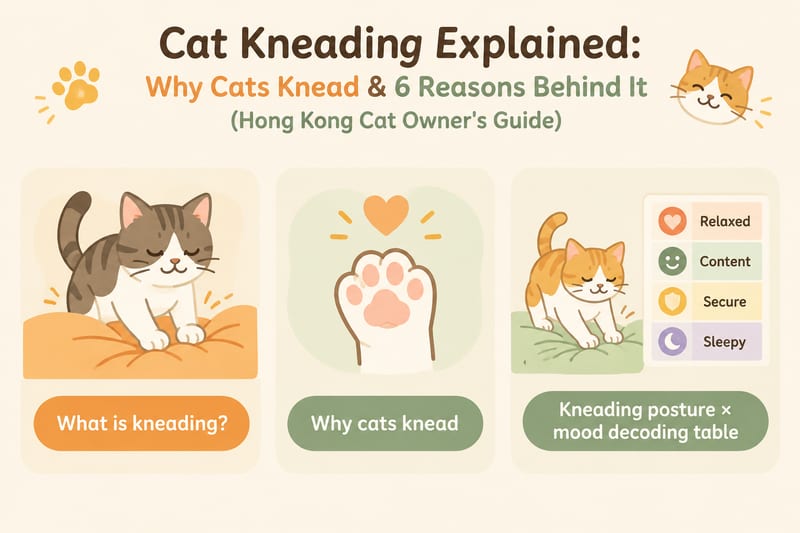
Kneading posture × mood decoding table
| Companion signal | Interpretation | Trust level |
|---|---|---|
| Squinting + purring + slow rhythm | Extremely relaxed, classic happy kneading | ★★★★★ |
| Kneading your belly/thigh | Treats you as a mother-level security source | ★★★★★ |
| Kneading until drooling, eyes glazed | Completely zoned out, back to kitten state | ★★★★★ |
| Biting the blanket edge while kneading | Full replay of kitten suckling memory | ★★★★☆ |
| Front paws forward, back paws kicking (mostly back legs) | That's 'kicking', mostly play-prey mode, not kneading | Play mode |
| Fast, forceful kneading + standing stiff, not lying down | Possibly a female in heat (with raised rear and dragging) | Hormonal signal |
8 fun facts
-
Not all cats knead—cats weaned early or hand-reared may never knead; it doesn't mean they don't love you, just that the memory wasn't stored.
-
Kneading and purring are twins—they usually appear together; some studies suggest the purring frequency (25-150Hz) can promote tissue healing, hence the idea of a 'cat self-healing mode'.
-
Lions and tigers knead too—big cats also retain this juvenile behaviour; zoo lions kneading blankets is a classic sight.
-
Most cats 'test the temperature' first—they press a few times with their front paws to test the surface softness, like testing if a bed is good to sleep on.
-
Some cats knead the air—pressing vigorously on the 'void' above the bedding, their brain has filled in the perfect dough.
-
Pupils dilate slightly during kneading—an autonomic response to relaxation and pleasure.
-
Both male and female cats knead—it's not about gender, but about 'kittenhood experience + security'.
-
They usually sleep after kneading—kneading + turning + lying down is a complete 'goodnight trio'; seeing it means they've chosen this spot as their nest.
Correct reactions when being kneaded (and dealing with pain points)
Being chosen as the 'dough' is an honour, but nails and 'pain points' are real issues:
Correct approach:
- Trim nails regularly—90% of kneading pain is a nail issue; trimming is the foundation of 'safe kneading'
- Put a blanket down—place a thick blanket between your thigh/belly and the cat to cushion the pressure without pushing it away
- Gently stroke in rhythm—stroke once each time it kneads, syncing the soothing; it will become even more blissful
- Let it finish—most cats will lie down and sleep after a few minutes; don't interrupt
Wrong approach:
- ❌ Pushing away or shouting when it hurts—it doesn't understand 'pain', only that 'expressing love was rejected', which really damages trust
- ❌ Playing with it or moving around while it's kneading
- ❌ Laughing and jerking away even through trousers when it kneads your belly—big movements scare it
Special handling of pain points: If the kneading spot has a wound, post-surgery area (unhealed neutering wound), or a pregnant belly—use a blanket as a full barrier, or guide it to knead a nearby dedicated blanket; don't reject it directly.
Red/green checklist: normal kneading vs what to watch for
| Situation | Verdict | Action |
|---|---|---|
| Squinting, purring, slow kneading, then lying down to sleep | 🟢 Classic happy kneading | Just enjoy |
| Kneading blanket + suckling/biting blanket, occasional | 🟢 Kitten memory replay | Normal, watch it doesn't swallow fur |
| Sudden big increase in kneading/frantic non-stop kneading | 🟡 Over-self-soothing from stress | Check environmental changes (see stress article) |
| Kneading + excessive suckling/biting to swallowing fur/fabric | 🟡 Pica tendency | Put fabrics away, ask vet if needed |
| Always loved kneading but suddenly stops completely + low energy/poor appetite | 🔴 Possible pain (joints/mouth) not wanting to move | See vet |
| Senior cat's legs give way/avoids front paws when kneading | 🔴 Sign of joint problem | See vet |
This article is for reference only and cannot replace veterinary diagnosis. If you have health concerns, please consult a registered veterinarian.
Hong Kong small-flat practicalities: how to let your cat knead safely without wrecking the home
Hong Kong homes are small; when a cat kneads it may knead your MacBook, new sofa, or even through a thin blanket onto your waist. Here are the 'three treasures for safe kneading' designed for Hong Kong people:
1. Designated kneading zone Pick a fixed corner (e.g. foot of the bed or top of the wardrobe), lay a thick towel + catnip spray (the article suggests a blanket to cushion pressure; here we reinforce a fixed location). Before bedtime each day, actively carry the cat to that zone and gently stroke its spine with your fingertips to build the conditioned reflex 'this is the dough spot'. After about a week, it will go there automatically to start work.
2. Portable defence mat Hong Kong people like to sit on the sofa eating takeaway, and cats like to knead thighs. Prepare a foldable flannel blanket (30×40cm is just right), keep it in the coffee table drawer. When the cat comes close, immediately spread it on your lap—it blocks nails without stopping your drama binge. Fold it back after eating; it takes no space.
3. Red/green light observation chart Print the article's 'red/green checklist' reduced and stick it on the fridge door:
- Green: squinting and purring—you keep scrolling your phone.
- Yellow: frantic frequent kneading—immediately check if it's upstairs renovation noise, a new perfume smell, or plug in a Feliway diffuser.
- Red: suddenly stops kneading + poor appetite—immediately call your usual 24-hour vet (e.g. CityU Veterinary Medical Centre or Kowloon Animal Hospital), don't wait.
Finally, remember to trim nails every two weeks; while the cat sleeps, use the 'press-paw method' to gently push out the nail and cut the transparent tip, then reward with a small treat. Hong Kong is humid; after trimming you can wipe with drying powder to reduce nails becoming brittle from moisture. That achieves the triple win of 'happy cat, pain-free human, scratch-free home'.
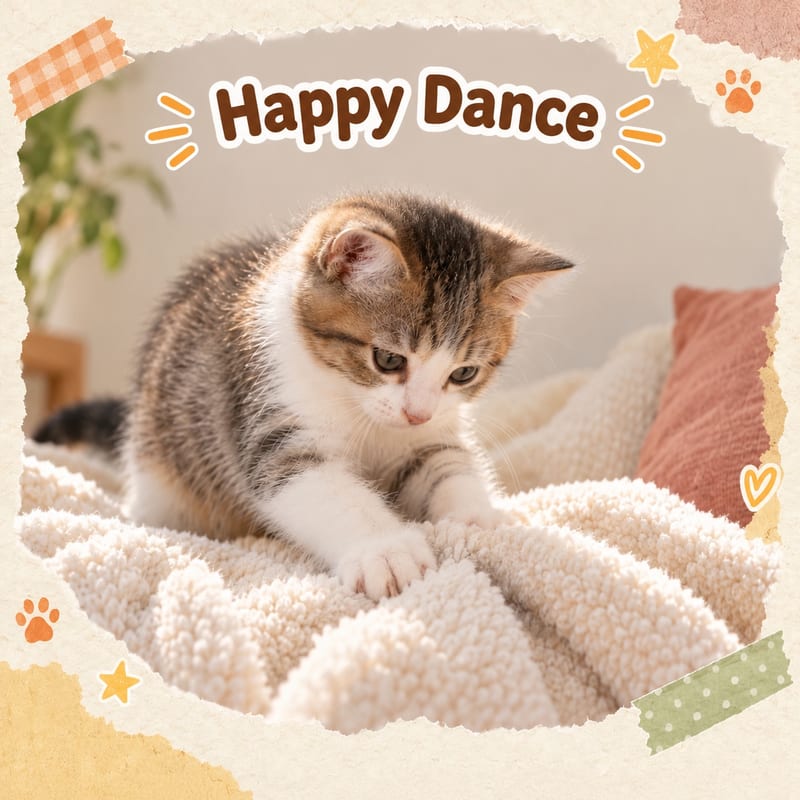
What is kneading? Decoding the cat's 'happy dance'
Kneading (English: kneading or 'making biscuits') is when a cat rhythmically presses soft surfaces with its front paws alternately—your thigh, a blanket, a cushion, even the air. The action usually repeats every 1-2 seconds, and the cat half-closes its eyes, clearly in a very comfortable state.
3 typical features of kneading
- Rhythmic pressing: front paws alternately press down, once every 1-2 seconds, sometimes claws extended
- Accompanied by purring: most cats purr while kneading, showing extreme satisfaction
- Half-closed eyes: relaxed gaze, slightly closed, fully immersed in comfort
Interestingly, some cats drool while kneading. Animal behaviourists believe this is linked to the memory of suckling milk as a kitten—the cat may associate the pleasure of kneading with the image of the mother secreting milk, and thus drool unconsciously.
The science of kneading: 5 reasons you must know
1. Continuation of kitten instinct
The most fundamental reason for kneading can be traced back to a cat's infancy. Newborn kittens press the mother's abdomen with their front paws to stimulate milk secretion. This action is closely linked to the fullness and security brought by suckling. Even after weaning, the kitten still remembers this comforting feeling.
2. Trust and love for the owner
Adult cats transfer this kitten-to-mother communication behaviour to their owner. When your cat kneads your thigh, it is actually treating you as a mother-like presence, expressing similar feelings. This can be said to be the highest level of trust a cat shows humans.
3. Territory-marking instinct
Cats have sweat glands in their paw pads and secrete pheromones when kneading. This behaviour is like 'stamping' you, telling other animals: 'This person is mine!' So if your cat often kneads you, to some extent it has already made you its exclusive territory.
4. Evolutionary throwback: nesting instinct
Another theory is that kneading comes from wild cats' nesting behaviour. Wild cats use their claws to flatten grass and leaves to build a temporary nest. This explains why cats usually lie down after kneading—they are actually 'making the bed'.
5. Stress relief and self-healing
The purring frequency during kneading is between 25-150 Hz. This frequency range is not random—research from North Carolina State University College of Veterinary Medicine indicates that a 25 Hz vibration frequency helps bone tissue repair, while 50-150 Hz reduces soft tissue swelling and promotes wound healing. In other words, every time a cat kneads with purring, its body is undergoing a 'self-physiotherapy'. This mechanism explains why cats recover relatively quickly from fractures—they are born with a vibration healing system.
Purring frequency and therapeutic effects during kneading
| Frequency range | Physiological effect | Research source |
|---|---|---|
| 25 Hz | Promotes bone tissue repair | North Carolina State University College of Veterinary Medicine |
| 50-100 Hz | Reduces soft tissue swelling | Journal of the Acoustical Society |
| 100-150 Hz | Relieves muscle tension, reduces stress | Multiple animal behaviour studies |
These research data show that kneading is not just emotional expression but also a survival mechanism cats evolved—promoting body recovery through vibration frequency while releasing endorphins for pleasure.
What to do when kneading hits a pain point?
Although kneading is cute, claws extended during kneading can really hurt. Here are the correct ways to respond:
Correct approach
- Trim nails regularly: keeping nails neat is the most effective method. Recommended every 2-3 weeks
- Place a thick blanket: put a thick blanket or cushion on your thigh to protect your skin while giving the cat a soft kneading surface
- Gentle redirection: if the cat presses too hard, gently lift its front paws onto the blanket; don't push it away
- Enjoy the moment: kneading is a trust behaviour; let it finish if possible
Wrong approach
- Shouting: makes the cat feel rejected and damages trust
- Sudden pushing away: the cat may be startled and associate kneading with negative experience
- Punishment: any form of punishment harms the human-cat relationship
- Forcibly trimming nails while kneading: the cat is most relaxed when kneading; don't scare it by trimming then
If the cat is too enthusiastic and its claws really dig into the skin, the gentlest approach is to stand up and slowly walk away. After a few interruptions of its lazy enjoyment, it will learn to retract its claws.
Which cats especially love to knead?
| Cat type | Kneading frequency | Possible reason |
|---|---|---|
| Kittens | Very high | Strongest instinct, not yet weaned memory |
| Bottle-fed/rescue cats | Medium to high | May see the new owner as a substitute mother |
| Cats raised from young | Medium | See the owner as a mother figure |
| Senior cats | Medium | May show kitten behaviour due to cognitive decline |
| Multi-cat households | Depends on individual | May knead other cats rather than humans |
Research finds that kittens separated from their mother early (adopted before 8 weeks) knead more frequently as adults, because subconsciously they are still seeking that missing motherly love.
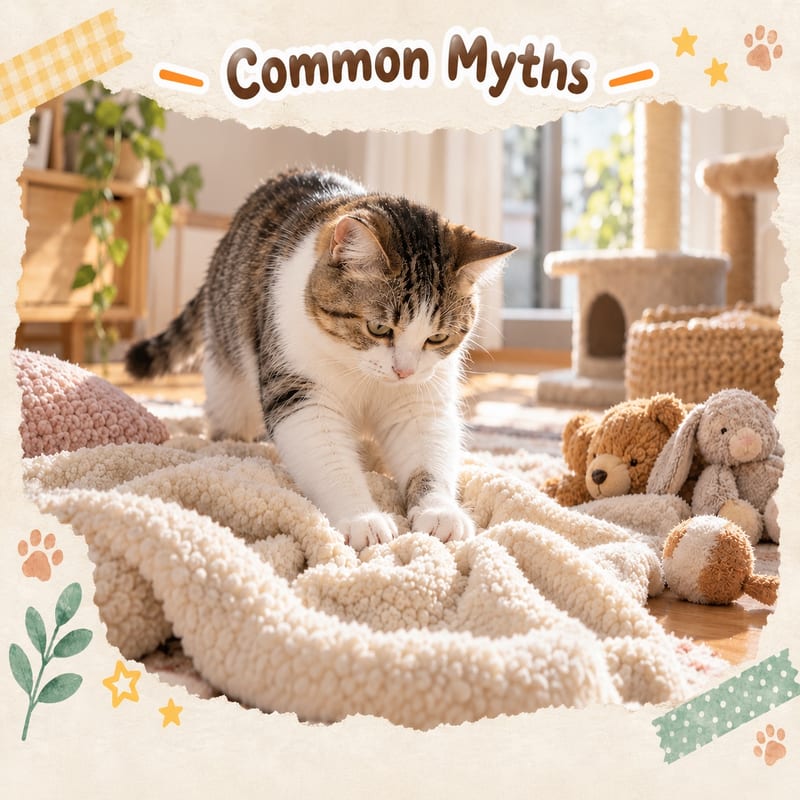
Common myths about kneading
Myth 1: Kneading means the cat wants food
Many people immediately bring out treats when they see kneading, thinking the cat is hungry. In fact, kneading has no direct relation to appetite. Although kittens kneading does stimulate the mother's milk, adult cats knead purely for emotional expression and stress relief, not 'hunger'. If you feed every time it kneads, it may lead to overeating.
Myth 2: Only certain breeds knead
Kneading is a common behaviour of all felines, unrelated to breed. Whether British Shorthair, Ragdoll, Siamese or mixed breed, any cat with a normal kittenhood can knead. Breed differences only affect the frequency and expression of kneading, not the existence of this instinct.
Myth 3: Cats only knead people
Cats knead many things—soft blankets, cushions, pillows, even other cats. Some cats even knead the air because they are so immersed in comfort that they don't need a surface. They knead people simply because the owner's thigh is the closest, most trusted 'soft surface'.
PetChill's Reminder
Cat kneading is the most sincere expression of love for you; every knead tells you: 'I trust you, I feel safe by your side'. Next time your cat jumps onto your lap and starts its 'happy dance', put down your phone and enjoy this warm moment.
To learn more about cat behaviour, keep following PetChill's latest articles!
Further reading
📌 Key summary
- ✅ Kneading = extreme security signal, not aggression
- ✅ Trim nails + put a blanket = safely enjoy being kneaded
- ❌ Pushing away/shouting damages trust
- ✅ If it suddenly stops kneading + low energy, think health problems first
- ❌ A female in heat kneading isn't affection, it's hormones
- ✅ Senior cat's legs giving way during kneading needs a vet
- Kneading is an instinctive behaviour continued from kittenhood, representing safety, satisfaction and trust
- The purring frequency of 25-150 Hz has been shown to have bone repair and stress-reducing effects
- Regular nail trimming and placing a thick blanket are the best ways to deal with kneading claw pain
- Kneading doesn't mean hunger, nor is it breed-related—all felines have this behaviour
- Don't shout, suddenly push away or punish during kneading; it damages trust
- Kittens separated from their mother early knead more frequently as adults, compensating for missing motherly love
- Your cat kneading your thigh means it sees you as the most trusted presence; cherish this moment
🆕 2026 update: 5 major causes of kneading, when it's abnormal
Direct answer: Kneading is the kitten's instinct to press the mother's belly to stimulate milk, retained into adulthood as a social behaviour of 'security confirmation + scent marking'. Most cases are completely normal; the only things to watch are 'continuing to suck fabric into adulthood' and 'suddenly changing from not kneading to frantic kneading'.
5 major causes of kneading
| # | Cause | Mechanism | Common manifestation | Triage |
|---|---|---|---|---|
| 1 | Continuation of kitten suckling instinct | Front paw pressing stimulates milk, bound to security | Alternately kneading your thigh or blanket | 🟢 Normal |
| 2 | Scent marking | Glands in paws; kneading = making resources 'theirs' | Especially kneads new beds, new blankets | 🟢 Normal |
| 3 | Self-soothing | Repetitive rhythmic action lowers tension | Increases before vet visits, after moving house | 🟡 Watch for stressors |
| 4 | Nesting/preparing to rest | Tidying soft surfaces before sleep | 5–10 minutes before sleep | 🟢 Normal |
| 5 | Heat behaviour | Hormonal influence, may be accompanied by calling, raised rear | More common in unneutered females | 🟡 Consider neutering (see vet) |
| — | Pain/discomfort | Very rare: repeated pressing with abdominal discomfort | Accompanied by refusal to eat, hiding, low energy | 🔴 Seek help |
🟢🟡🔴 Triage guide
| Situation | Triage | Advice |
|---|---|---|
| Kneads daily, sleeps after, normal energy and appetite | 🟢 | No action needed; trimmed nails are enough |
| Kneads until slight drooling, eyes glazed | 🟢 | Part of relaxation; just wipe dry |
| Kneads + suckles blanket, over 10 minutes daily | 🟡 | Provide alternatives (dedicated blanket, chew toys), watch for swallowing fabric |
| Adult cat suddenly starts frequent kneading + suckling | 🟡 | Check recent environmental changes (moving, new family member, routine change) |
| Kneading intensity increases, accompanied by calling, raised rear | 🟡 | For unneutered cats, consider vet assessment for neutering |
| Kneads a fixed spot (e.g. abdomen), cries when touched | 🔴 | Possible pain; arrange vet check |
| Kneads + refuses food, hides over 48 hours | 🔴 | Seek veterinary care the same day |
What owners can do (specific actions)
- Trim front claws every 2–3 weeks (cut only the transparent tip about 1–2mm, avoid the pink blood vessel), reducing the sting when kneaded; reward with treats in stages.
- Set up a dedicated blanket (about 60×80cm is enough), placed where you often sit; praise the cat when it kneads the blanket, gradually guiding it from 'kneading you' to 'kneading the blanket'.
- If kneading hurts, put a towel down (2–3 layers) to cushion pressure; don't push the cat away—pushing interrupts the security connection.
- Put away fabrics it suckles: store wool, socks, string-like items to avoid intestinal blockage from swallowing.
- Two 10-minute play sessions daily: satisfy hunting needs, stabilise overall mood, and reduce nighttime behaviour problems.
Sources (supplementary)
- AAFP/ISFM Feline Environmental Needs Guidelines (five pillars of environmental needs)
- International Cat Care: Problem behaviour in cats
- International Cat Care: Handling and interactions
 Feline Natural full guide →