Quick Answer
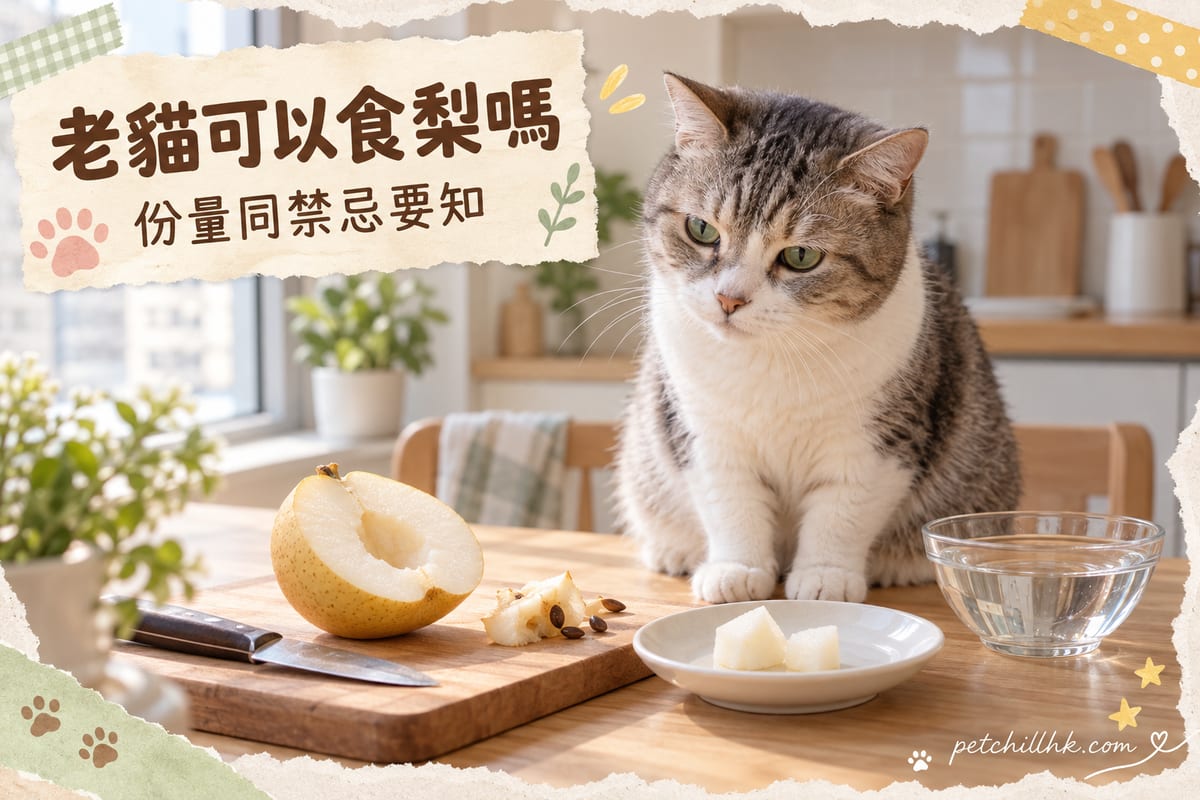
- Senior cats can eat a small amount of pear flesh, but the upper limit is about 10 g per 4.5 kg body weight per day, i.e. 1 to 2 one-centimetre cubes, no more than 2 to 3 times a week.
- Removing the core and seeds is the first step, not optional: pear seeds and core contain cyanogenic glycosides, which can release cyanide if chewed and swallowed, and the core also poses a choking risk.
- Feed only room-temperature, peeled, fresh flesh cut to under 1 cm; never feed pear juice, canned pears in syrup, dried pear or pear jam.
- Diabetic cats, obese cats, cats with a history of pancreatitis and cats with sensitive stomachs should not be fed pear; cats with kidney disease should be checked with a veterinarian first.
- Pear has no nutritional necessity for cats; fruit is only a treat, and the general principle is that it should not exceed 10% of daily total calories.
- For the first trial, feed only 1 cube, then observe for 24 to 48 hours for vomiting, diarrhoea and changes in energy; only consider it acceptable if there are no issues.
- If a senior cat shows vomiting, diarrhoea, bloating, drooling or lethargy after eating pear, take it to a veterinarian the same day; if in doubt in any situation, ask a veterinarian first.
Pear itself is not a toxic food for cats — the American Society for the Prevention of Cruelty to Animals (ASPCA) pet toxicity database lists pear as a fruit non-toxic to cats and dogs, so a senior cat stealing a small bite of pear flesh generally will not be poisoned and does not require an immediate emergency visit. But "non-toxic" and "suitable to eat" are two completely different things: cats are obligate carnivores, pear provides no essential nutrients for cats, and the only practical effect of a senior cat eating pear is the intake of sugar, water and a little fibre.
This article clarifies three practical questions: what the portion limit is, how to prepare it safely, and which senior cats should not touch even a single cube. A senior cat's body is different from a young adult cat — declining kidney function, increased risk of insulin resistance, worn teeth, slower gastrointestinal motility — so the same bite of pear carries a completely different cost for a 3-year-old cat and a 15-year-old cat. Below we cover the portion table, preparation steps, contraindications and a 48-hour post-feeding observation checklist; if in doubt at any step, ask a veterinarian first and do not rely on online remedies. For an overall senior cat care framework, see Senior Cat Care Guide.
1. Can Senior Cats Eat Pear? The Value and Risks of Pear for Cats
To answer "can senior cats eat pear", we must separate two layers: toxicology (will it cause poisoning) and nutrition (is it necessary, is it worth it).
First, toxicology. Pear flesh does not contain known toxic components for cats, so accidental ingestion of a small amount of flesh is not an emergency; the truly risky parts are seeds, core, stem and leaves, which contain cyanogenic glycosides that can release hydrogen cyanide when chewed and broken down. One or two crushed seeds are usually not enough to cause obvious poisoning in an adult cat, but this "usually" is not worth gambling on — especially as senior cats have reduced liver and kidney metabolism, and the core itself poses a physical obstruction and choking risk.
Next, nutrition. Cats are obligate carnivores; nutrients such as taurine, arachidonic acid and vitamin A must come from animal tissues, and their bodies are not designed to need fruit. General nutritional data for pear: per 100 g of flesh, about 85% is water, about 10 g sugar (mainly fructose and glucose), about 3 g dietary fibre, and about 57 kcal. The same numbers are good for humans (low calorie, fibre), but for cats it means "water plus sugar plus a little fibre" — none of which are things a senior cat needs pear to supplement.
Senior cats have additional considerations: reduced ability to concentrate urine, so water and electrolytes need control; poorer insulin sensitivity, so sugar load should be conservative; worn teeth, so even biting small pieces can hurt; slower gastrointestinal motility, so more fibre can easily cause diarrhoea. So the conclusion is simple: pear can occasionally be a very small treat, but it cannot be a health supplement, and certainly not a laxative. A healthy senior cat with a meat-based main meal and sufficient water is already more important than any fruit.
As for "pear moistens the lungs, promotes urination, relieves constipation", these are human claims and cannot be directly applied to cats. The table below breaks down each component of pear to clarify how limited the benefits are and how real the risks are.
| Component/Item | Limited benefit for senior cats | Actual risks and limitations |
|---|---|---|
| Water (about 85%) | An extra water source for senior cats that drink little | Cannot replace drinking water; relying on fruit for hydration means taking in sugar too |
| Dietary fibre (about 3 g/100 g) | A very small amount may help bowel movement | Too much fibre causes diarrhoea and bloating; constipation in senior cats needs the real cause investigated |
| Sugar (about 10 g/100 g) | High palatability, encourages eating | Blood sugar fluctuations, obesity, dental plaque buildup |
| Vitamin C, potassium | Beneficial for humans | Cats can synthesise vitamin C themselves; potassium must be controlled according to kidney function, cannot be added arbitrarily |
| Soft texture | Easy for senior cats with bad teeth to bite | Sweetness can make senior cats picky, leading to refusal of main meal |
| Calories (about 57 kcal/100 g) | A trick to tempt appetite when appetite is poor | About 6 kcal per 10 g flesh, absolutely cannot replace a meal |
After reading the table, it is clear that the "benefits" of pear for senior cats are all conditional and limited; the risks are real and common. In particular, constipation is the most commonly misused reason: the main causes of constipation in senior cats are usually insufficient water intake, slower bowel movement, hairball accumulation, old pelvic injuries or dehydration from kidney disease — these problems will not be solved by eating a few cubes of pear, and delayed treatment can worsen to the point of enema or even surgery. If a senior cat has not passed stool for several days, cries in pain when defecating, or the litter tray only has small dry hard stools, the correct action is to see a veterinarian, not feed fruit.
2. Daily Portion Limit: A Conservative Limit Based on Body Weight
Portion is the core hard standard of this article. The following limits are conservative limits set by the editorial team based on the general veterinary nutrition principle that "treats should not exceed 10% of daily total calories", and further considering senior cat metabolism and gastrointestinal tolerance; they are not "recommended amounts" — in practice you can omit pear entirely.
| Senior cat weight | Maximum per serving (peeled, cored flesh) | Maximum times per week | Additional requirements |
|---|---|---|---|
| Under 3 kg (small or thin) | About 5 g (1 one-centimetre cube) | 1 to 2 times | Investigate the cause in thin senior cats first; do not use treats to mask it |
| 3 to 5 kg | About 10 g (1 to 2 cubes) | 2 to 3 times | Reduce the day's main meal by about 6 kcal |
| 5 to 7 kg | About 10 g, do not increase | 1 to 2 times | Overweight senior cats are advised not to feed at all |
| Over 7 kg | 0 to 5 g | 0 to 1 time | Discuss a weight loss plan with a veterinarian first |
Why 10 g? A 4.5 kg senior cat needs about 200 to 250 kcal per day, 10% is 20 to 25 kcal, and 10 g pear flesh is only about 6 kcal, far below the limit. This gap is intentional — it leaves room for you to count the main meal and other treats, and also leaves room for the senior cat's stomach. For senior cats, it is better to feed less than more.
In practice, there are four points:
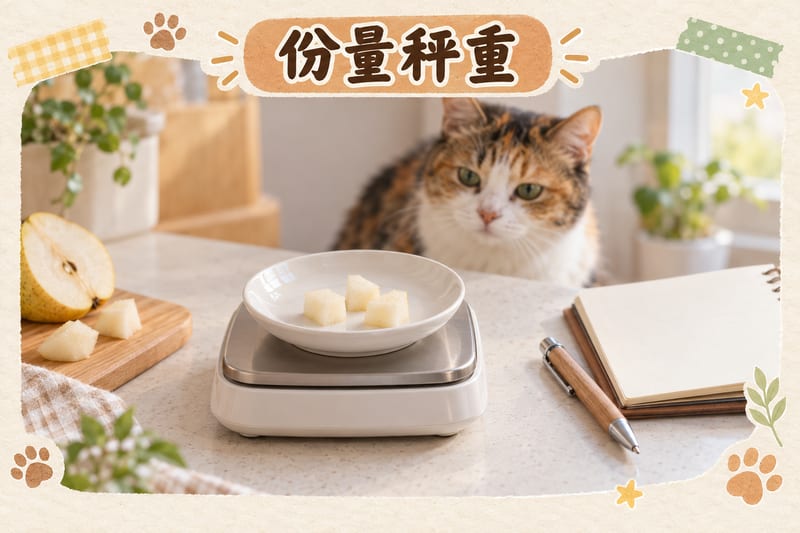
- Use a scale, not "a bite". A household kitchen scale accurate to the gram is most reliable; without a scale, use "1 one-centimetre cube is about 5 g" as a conversion basis.
- Feed only 1 cube the first time. Then watch for vomiting, diarrhoea, bloating, itching for 24 to 48 hours; only consider "this cat can eat it" after several consecutive times without problems.
- Do not feed daily. Too high a frequency will create picky eating habits; once a senior cat thinks "there will be something sweet later", it will eat its main meal even worse. For senior cats with poor appetite, do not use fruit to tempt them; see Senior Cat Poor Appetite Guide for management.
- Recalculate if there is chronic disease. For senior cats with diabetes, kidney disease, pancreatitis or heart disease, the limit cannot be set by yourself; always "ask a veterinarian first if in doubt", and let the veterinarian decide based on blood test results and medications whether pear can be fed and how much.
3. 5 Steps to Prepare Pear: Removing Core and Seeds Is the First Step
The same pear, prepared differently, can carry very different risks. The table below clarifies which parts are acceptable and which are not.
| Part/Product | Can it be fed? | Reason |
|---|---|---|
| Flesh (peeled, cored, cut small) | Yes, very small amount | Sugar and fibre are already at the upper limit of burden for senior cats |
| Skin | Not recommended | Pesticide residues and fruit wax may not be thoroughly cleaned; senior cats have sensitive stomachs |
| Core | No | Hard and large, risk of obstruction and choking |
| Seeds | No | Contain cyanogenic glycosides, can release cyanide when chewed |
| Stem, leaves | No | Also contain cyanogenic glycosides, risk if cats chew them |
| Pear juice, concentrated pear juice | No | No fibre, concentrated sugar, easy to overconsume |
| Canned pears in syrup | No | Added sugar and syrup, high blood sugar burden |
| Dried pear | No | Concentrated sugar, small volume easy to overeat, some contain sulphur dioxide |
| Pear jam, baby food containing pear | No | Mostly added sugar or mixed with other ingredients |
Preparation steps are as follows, each can be completed within a minute:
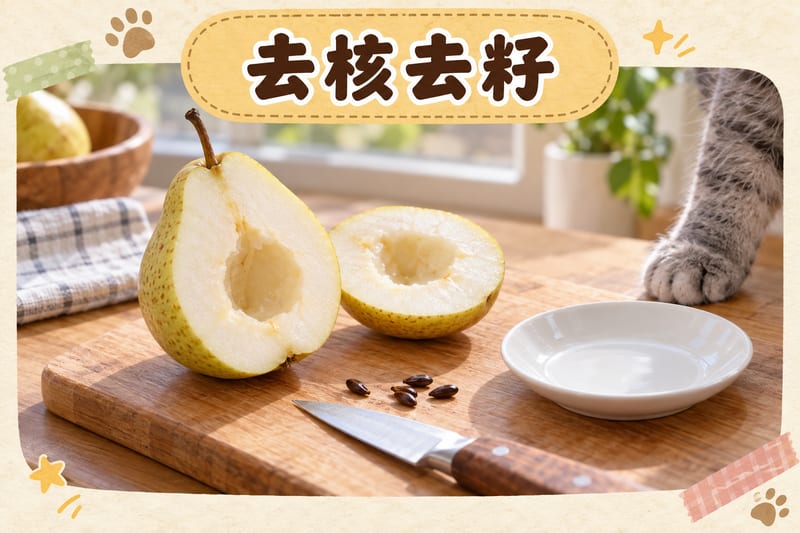
- Wash and peel: Rinse under running water for 30 seconds, then peel. Peeling is the main defence; do not assume washing is enough.
- Cut across and remove core: Cut the pear across, use the tip of a knife to cut around the core and remove the whole core; do not chop and leave fragments.
- Pick out all seeds: Check one by one to ensure no seed fragments remain on the flesh; this is the most important step in the whole article.
- Cut to under 1 cm: Cut into cubes or shred finely; for senior cats with bad teeth, cut to about 2 mm.
- Bring to room temperature and weigh: Always bring out of the fridge and warm to room temperature (about 20 to 25°C); cold food can cause gastrointestinal upset; weigh before feeding to confirm within the limit.
One final note: do not add any seasoning. Sugar, honey, yoghurt, milk must not be added — cats are generally lactose intolerant, and dairy will raise the risk of diarrhoea further.
4. Which Senior Cats Should Avoid It or Ask a Veterinarian First
The same cube of pear carries completely different risks for senior cats with different medical histories. For the following 8 situations, follow the table directly; do not judge for yourself that "a little should be fine".
| Senior cat situation | Recommendation | Reason |
|---|---|---|
| Diabetes, unstable blood sugar, on insulin | Do not feed | Sugar causes blood sugar fluctuations, interferes with insulin dose adjustment |
| Chronic kidney disease | Ask a veterinarian first | Water, potassium, phosphorus must be controlled according to blood test results; cannot add on your own |
| History of pancreatitis, high blood lipids | Do not feed | Any non-main-meal food may trigger recurrence |
| Obese or losing weight | Do not feed | About 6 kcal per 10 g flesh, must deduct from main meal, not worth it |
| Gingivitis, stomatitis, missing teeth | Do not feed, or cut to under 2 mm | Chewing pain and choking risk; pain can cause refusal of main meal |
| Sensitive stomach, prone to diarrhoea, inflammatory bowel disease | Do not feed | Fructose and sugar alcohols easily cause diarrhoea and bloating |
| Currently on medication (heart, thyroid, anti-epileptic, etc.) | Ask a veterinarian first | Dietary changes may affect drug efficacy and monitoring results |
| Previous sensitivity to fruit, itchy skin, recurrent ear inflammation | Do not feed | No need to take risks for a treat |
Among these 8, diabetes and pancreatitis are the hardest contraindications; no need to discuss portion — just do not feed. Senior cats with kidney disease or on long-term medication must ask a veterinarian, because "a little fruit" at the edge of kidney function or during drug monitoring can make blood test data difficult to interpret, and what is delayed in the end is the treatment decision. This is the practical meaning of "ask a veterinarian first if in doubt".
By the way, regarding joints and mobility: if a senior cat cannot jump onto the bed or has difficulty getting in and out of the litter tray, this will affect water intake and appetite, which is another line of problems; see Senior Cat Arthritis Care Guide.
5. Common Feeding Mistakes and Senior Cat Main Food Choices
The following are the most common mistakes made by Hong Kong cat owners, each of which can be avoided.
| Mistake | Actual risk | Correct approach |
|---|---|---|
| Letting them bite the core and seeds | Cyanogenic glycosides may release cyanide; core can cause obstruction | Thoroughly remove core and seeds, cut small before feeding |
| Feeding canned pears in syrup or pear juice | Concentrated sugar, blood sugar fluctuations, diarrhoea | Feed only fresh peeled, cored flesh, very small amount |
| Using pear as a laxative | Delays the real cause of constipation (dehydration, kidney disease, hairballs) | See a veterinarian for constipation, do not rely on fruit |
| Using pear as a main meal or meal replacement | Severe deficiency of protein, taurine | Main food should still be cat food meeting senior cat needs |
| Cutting a large piece at once | Choking, diarrhoea, uncontrolled portion | Under 1 cm, maximum 1 to 2 cubes per time |
| Feeding straight from the fridge | Gastrointestinal upset, vomiting | Warm to room temperature before feeding |
| "About a bite" without a scale | Actual portion can vary several times | Use a kitchen scale, 1 one-centimetre cube is about 5 g |
| Increasing the amount because they are willing to eat | Picky eating, refusal of main meal, weight gain | Keep to the limit of 2 to 3 times a week, do not increase |
A senior cat's nutrition should come from main food meeting senior cat needs; fruit is only an optional treat. Below are examples of senior cat formulas available in the online store:
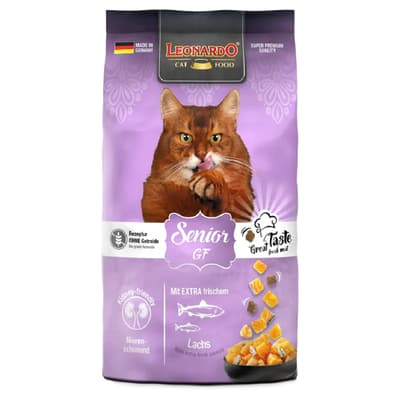
- Leonardo Cat Food Grain-Free Senior Cat Food 7.5kg — HK$798
- Leonardo Cat Food Grain-Free Senior Cat Food 1.8kg — HK$269
Prices and stock are subject to the online store's current listed prices.
Note: When changing food, transition gradually over 7 to 14 days; do not switch all at once. If a senior cat is on a veterinary prescription diet (e.g. kidney disease, diabetes prescription), do not change the food on your own; ask a veterinarian, because the prescription formula ratios are designed for the condition.
6. What to Observe in the 48 Hours After Feeding
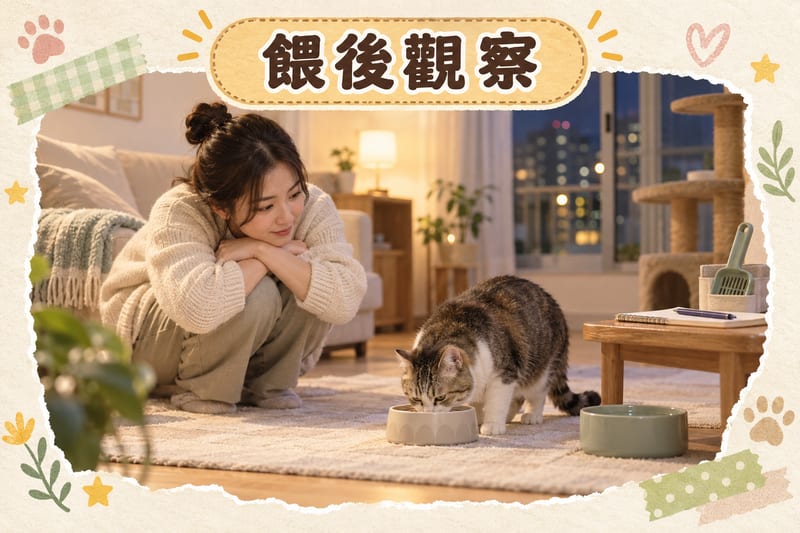
Feeding pear is not the end of the matter, especially as senior cats' reactions to food changes can be delayed. Below is an observation checklist you can follow.
- Gastrointestinal: Record any vomiting (how many times, what was vomited), any diarrhoea, stool shape and frequency. One mild soft stool can be observed further; persistent diarrhoea requires a same-day veterinary visit.
- Appetite: Whether the next meal is finished. If picky eating starts or they wait for treats, stop feeding fruit for at least a week immediately.
- Energy and activity: Whether they respond, can jump to usual places, any sudden hiding. Hiding is a common sign of discomfort in cats.
- Oral: Any drooling, head tilting when chewing, pawing at the mouth. These are signs of dental pain or stomatitis.
- Skin and ears: Itching, facial swelling, recurrent ear redness — although pear allergy cases are rare, if they occur, stop feeding and seek veterinary care.
- Weight: Weigh once a week at the same time, record the number. Weight trend in senior cats is more valuable than any single meal amount.
If any of the following occurs, do not wait; contact a veterinarian the same day: vomiting more than once, persistent diarrhoea, hard and painful abdomen, rapid breathing, facial or eyelid swelling, drooling, lethargy, hiding for more than half a day, complete refusal to eat for more than 12 to 24 hours. If you suspect they have chewed and swallowed the core or a large number of seeds, also treat it as obstruction symptoms such as vomiting, not eating, constipation, and seek veterinary care as soon as possible — do not induce vomiting yourself, and do not feed oil or milk; leave management to the veterinarian.
Further Reading
- Senior Cat Care Guide | Diet, Joints, Kidneys, Regular Check-ups (2026)
- Senior Cat Care Complete Guide | Hong Kong Cat Owner Practical Edition
- Senior Cat Poor Appetite | 8 Causes and Ways to Improve Appetite
- Senior Cat Arthritis Care Guide | Essential Reading for Hong Kong Cat Owners
For emergencies, contact a veterinarian immediately; this article is for reference only and cannot replace veterinary diagnosis.
Information checked as of 2026-10-12Source: PetChill Editorial Team
 Fuji One full guide →


 Wellness Core full guide →