
Quick answer: A cat breathing 16–30 times per minute while resting quietly is normal; if it stays above 40, or there's open-mouth panting or purple gums, go to the vet immediately.
A cat breathing 16–30 times per minute while resting quietly is normal; persistently above 40, open-mouth breathing, or purple gums are warning signs to see a vet immediately.
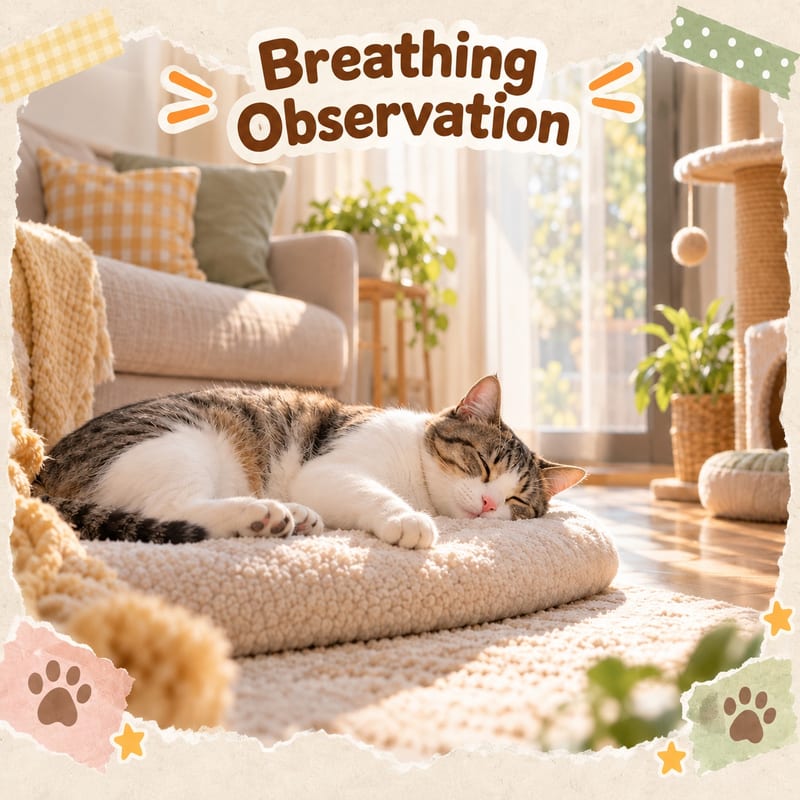
Many cat owners think a cat is healthy as long as it doesn't cough or pant, but breathing is actually the most direct indicator of a cat's condition. Learning to measure breathing rate and recognise abnormal signals can help you spot potential illness early—and in a critical moment, it could save your cat's life.
What is a normal breathing rate for cats?
Cats have a higher metabolic rate than humans and are much smaller in weight and size, so their breathing rate is naturally faster—don't judge by human standards. Generally, a cat's normal resting breathing rate is 16–30 breaths per minute; when asleep or fully relaxed, it can drop to 15–25 breaths per minute. As long as breathing is even, quiet, and the mouth is closed, it's within the normal range.
Quick reference table for breathing and heart rate
| Indicator | Normal range | Abnormal warning level | How to measure |
|---|---|---|---|
| Resting breathing rate | 16–30 breaths/min | >40 breaths/min | Watch belly rise and fall for 15 sec ×4 |
| Sleeping breathing rate | 15–25 breaths/min | >30 breaths/min | Watch belly rise and fall for 15 sec ×4 |
| Heart rate | 120–240 beats/min | <100 or >260 beats/min | Palm on left chest for 15 sec ×4 |
| Comfortable room temperature | 25–29℃ | >35℃ | Indoor thermometer |
How to measure your cat's breathing correctly
The method is simple—four steps:
- Pick the right moment — measure when your cat is resting quietly or asleep, not after exercise, excitement or stress
- Watch the belly — the belly rises and falls with each breath; one up-and-down counts as one breath
- Count for 15 seconds — use your phone timer and count the rises and falls in 15 seconds
- Multiply by 4 — multiply the 15-second count by 4 to get the per-minute breathing rate
If it's hard to see the movement, gently place your palm on your cat's chest to feel it. It's best to measure several times a day over several days and take the average for accuracy. For heart rate, gently press your palm on the left chest (below the base of the left front leg) and likewise count for 15 seconds and multiply by 4.
What counts as one breath? Many cat owners lose count halfway: the belly rises and then falls—that complete cycle is one breath. Don't count an up-and-down as two, or your number will be double and give you a fright. It's best to measure when your cat is lying on its side with limbs relaxed, as it's clearest; if it's moving around or purring, measure another day.
When not to worry too much?
In a few situations, faster breathing is a normal physiological response and not an immediate emergency: just after running and playing, hot weather, being startled, or stress at the vet clinic. The key is the "baseline at rest"—wait 10 minutes for your cat to fully settle before measuring; that's the meaningful number.
6 major abnormal breathing signs to watch for
Once you're familiar with normal breathing patterns, the following abnormal signs are easier to spot. What these 6 warning signs have in common is that they "won't get better on their own"—the longer you wait, the harder it is to reverse, so it's better to worry unnecessarily than to misread the situation.
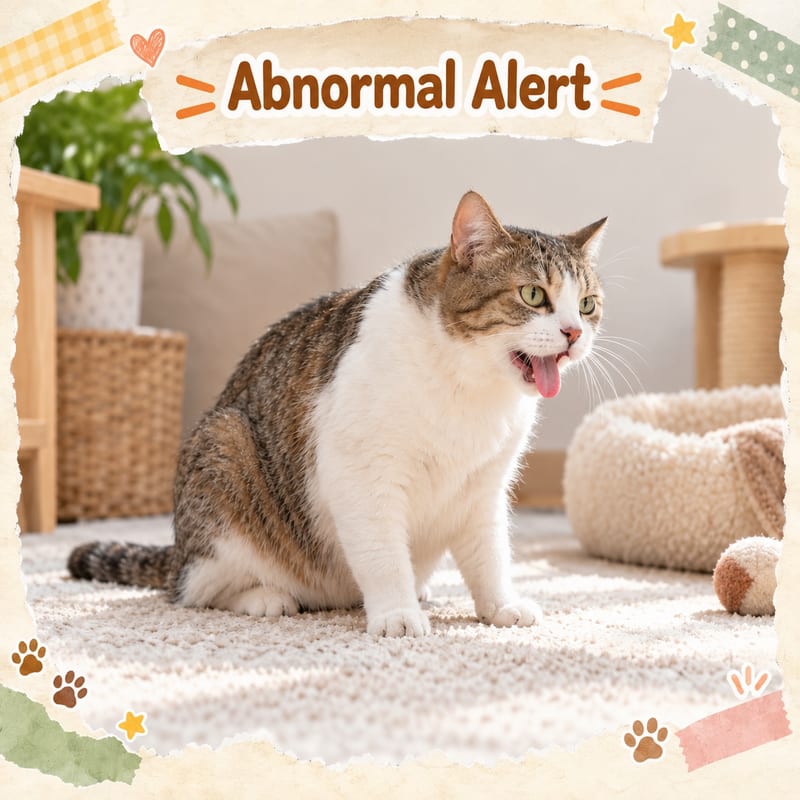
- Open-mouth breathing: Unlike dogs, cats normally breathe only through their nose. Panting with an open mouth, or even stretching the neck to breathe, is a very clear warning sign that may indicate airway obstruction, excessive heart/lung strain, or extreme distress—see a vet promptly
- Rapid breathing: Persistently above 40 breaths per minute at rest needs special attention; if your cat also breathes fast while asleep, refuses to lie on its side and lies flat instead, or has lethargy or poor appetite, see a vet promptly
- Forceful belly breathing: Normal breathing should be gentle and quiet; if the belly moves forcefully, with the chest and abdomen heaving like a bellows, it may be difficulty breathing
- Wheezing sounds: Wheezing, whistling or crackling sounds when breathing may indicate airway or lung problems. They're easiest to hear when the room is quiet; if you can hear a "hissing" sound from a metre or two away, that's clearly abnormal
- Abnormal posture: Stretching the neck, lying low, front legs spread, refusing to lie on the side—these postures are a cat's attempt to open its airway to help itself breathe. If your cat is clearly sleepy but keeps holding a "tripod" low posture, it's worth noting
- Lip or gum colour change: Blue-purple or pale colour indicates oxygen deprivation—an emergency; take your cat to the vet immediately
How seasons and environment affect breathing
A cat's breathing is affected by room temperature and humidity. The most comfortable room temperature for cats is 25–29℃. Hong Kong summers are hot and humid; when it's hot, cats lose heat through their paw pads and their breathing rate speeds up slightly. In dry winter weather, some cats may cough occasionally.
If you notice occasional coughing in winter, you can try running hot water in the bathroom to create steam for your cat to inhale moist air, which can help soothe respiratory discomfort. However, if symptoms persist, worsen, or there's a retching posture, take your cat to the vet—don't dismiss it as "nothing serious". Flat-faced breeds (such as Persians and Exotic Shorthairs) have shorter nasal structures and are naturally more prone to snoring and laboured breathing; owners should establish a personal baseline for them so abnormal changes can be compared.
When to see a vet?
Take your cat to the vet promptly in the following situations:
- Resting breathing rate persistently above 40 breaths per minute
- Accompanied by lethargy or a marked drop in appetite
- Open-mouth breathing that doesn't resolve on its own
- Lip or gum colour change (blue-purple, pale)
- Difficulty breathing accompanied by coughing or sneezing
- Sudden abnormal breathing with no previous similar episodes
Remember, cats are very good at hiding discomfort. By the time you notice abnormal breathing, the problem may have been present for a while, so daily observation is really important. Before the appointment, it's best to film a short video of your cat's breathing on your phone and bring your recorded numbers so the vet can quickly assess the situation; early signs of chronic heart, lung or kidney problems are very subtle—you can also refer to PetChill's cat kidney disease guide to learn about other hidden warning signs.
What you can do starting today
- Measure your cat's breathing once tonight while it's asleep and note the number as a baseline
- Set a 15-second timer on your phone and measure 1–2 times a week, keeping a record
- Check your home temperature; in hot summers keep it ventilated and ensure plenty of drinking water
- Post "open-mouth breathing, purple gums = go to vet immediately" on the fridge or somewhere visible
Breathing observation is a zero-cost, zero-tool health monitoring method—just over ten seconds a day helps you guard your cat's most important vital sign. Rather than regretting it after your cat collapses, start tonight and spend a minute learning its normal rhythm. With a baseline number, you have the cheapest and most effective home health monitor. To learn more everyday cat care tips, see PetChill's cat dental care guide and water fountain buying guide.
This article is for reference only; consult a registered veterinarian for any concerns.

Further reading
- Cat night vision and eyesight →
- Cat medication tips →
- Cat vaccination schedule →
- Cat poop observation guide →
- Complete guide to cat hairballs →
📌 Key summary
- ✅ 16–30 breaths/min at rest is normal
- ✅ Count belly rises and falls for 15 sec ×4 is the simplest
- ❌ Measuring after exercise or stress gives a higher number
- ❌ Open-mouth breathing won't resolve on its own—see a vet immediately
- ✅ Record a personal baseline to spot abnormalities
- ❌ Occasional winter cough isn't trivial; if it persists, see a vet