
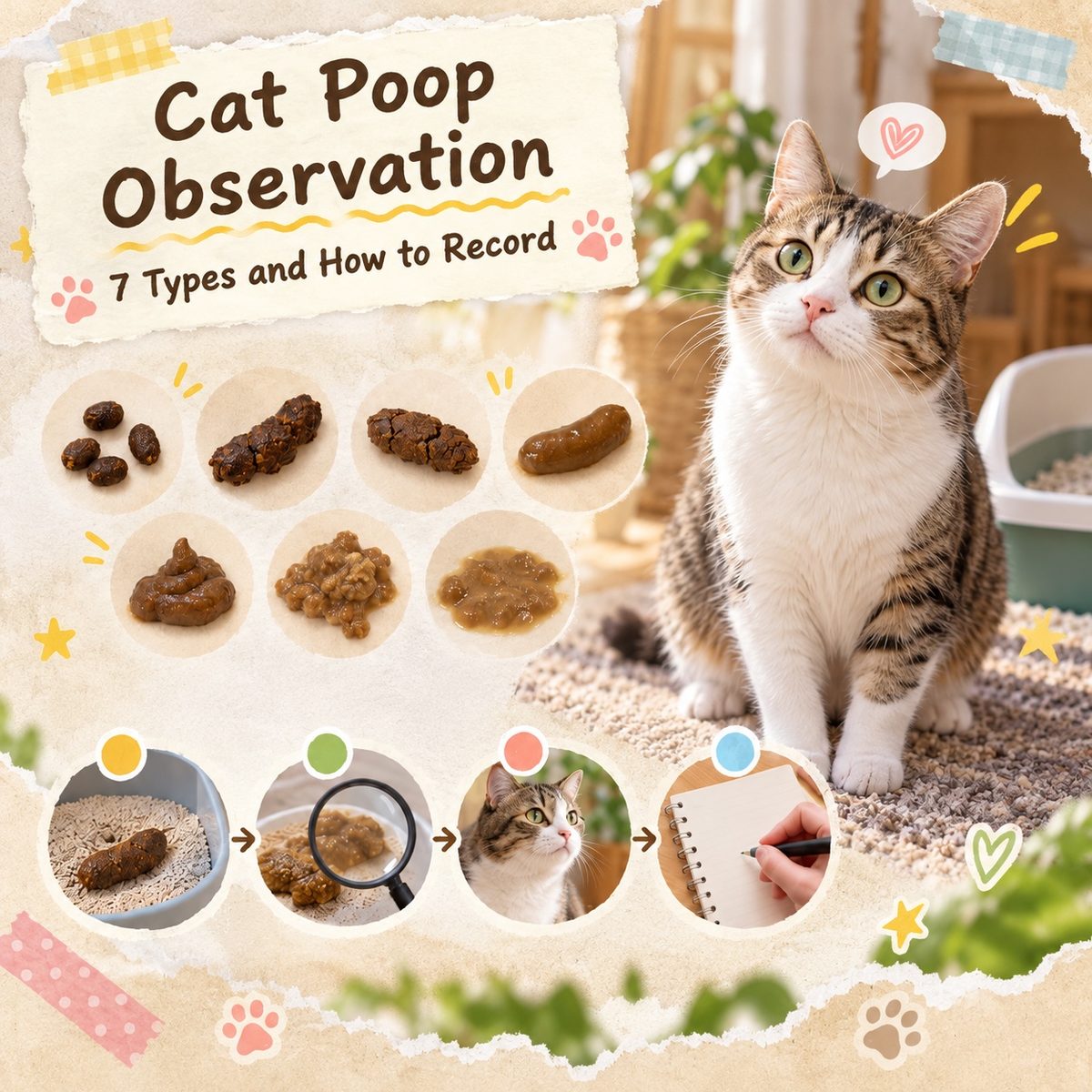
Quick answer: Observe your cat's poop across 7 types (banana-shaped, firm segments, sheep droppings, log-shaped, soft stool, mushy stool, watery stool) and use the 4-step "pick, look, sniff, record" method. A few minutes a day builds a systematic health-monitoring habit. Normal poop should be banana-shaped or firm segments, and consistent records are more useful than a single observation.
Cats won't tell you directly that their tummy feels off, but their poop, appetite, water intake and energy levels can all leave signals worth noticing. As the end product of digestion and metabolism, poop reflects information on many fronts and is one of the important clues for observing your cat's digestive system and day-to-day health.
That said, poop is only one part of health observation — you can't diagnose a disease from a single stool. What's genuinely useful is ongoing observation and recording of changes.
Why observe your cat's poop?
When your cat's poop suddenly changes, don't look at the stool alone — look at it alongside your cat's recent life situation. Stool condition can be affected by:
- Diet: type of food, brand changes, changes in eating habits
- Water intake: how much your cat drinks directly affects stool moisture and firmness
- Gut condition: the gut's own motility and digestive function
- Living environment: moving house, a new family member, a change in litter box location
- Emotions and stress: cats are sensitive to environmental change
- Bowel movements: frequency and whether there's any difficulty
- Overall condition: appetite, water intake, energy
So poop observation isn't a standalone act — it's part of overall health monitoring.
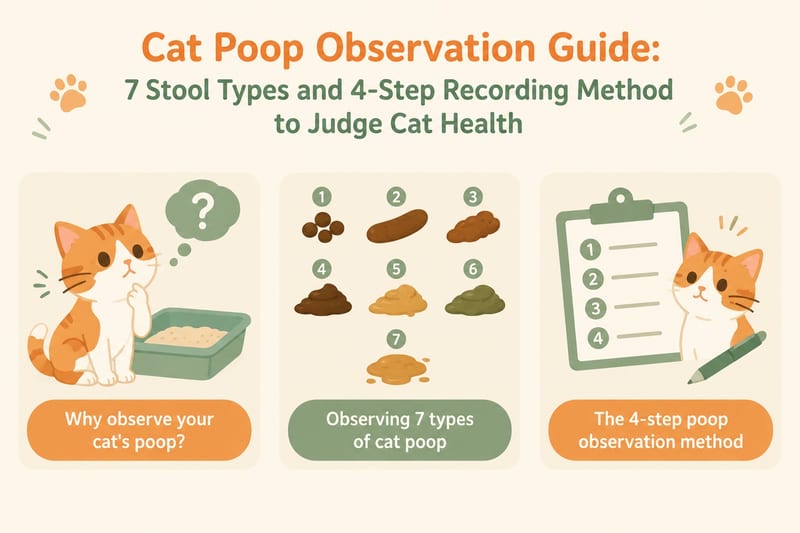
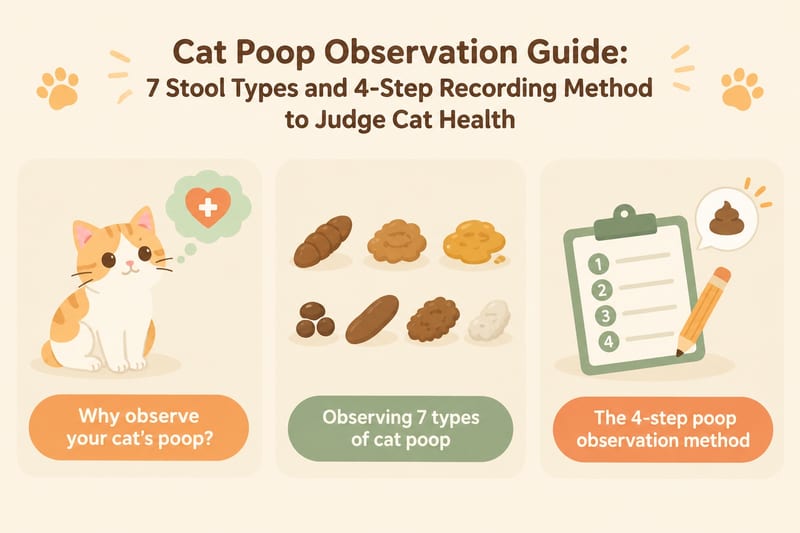
Observing 7 types of cat poop
Here are 7 common stool types, from the more ideal to the ones to watch, to help you build basic observational awareness.
| Stool type | Description | Health meaning | Suggested action |
|---|---|---|---|
| 🍌 Banana-shaped | Complete log, even shape, moderately soft | A more ideal everyday state | Keep current diet and lifestyle |
| 🧱 Firm segments | Formed but firmer, in segments | Normal range, slightly hard | Keep an eye on water intake |
| 🫘 Sheep droppings | Small round pellets, fairly dry and hard | Possibly not drinking enough | Increase water intake, keep observing |
| 🪵 Log-shaped | Log-shaped but firmer, slightly wet | Normal range, slightly wet | Watch for dietary changes |
| 🍮 Soft stool | Has shape but soft, easily spread | Watch gut condition | Observe 1-2 days; if it persists, consult a veterinarian |
| 🥣 Mushy stool | Paste-like or clumped, high moisture | Gut may be uncomfortable | Keep observing, record frequency |
| 💧 Watery stool | Liquid, no complete shape | Needs attention | Consult a veterinarian |
1. Banana-shaped poop
This is the reference for a more ideal, fully formed everyday stool. It's a complete log, even in shape, formed, with some softness, not overly dry or hard, and doesn't fall apart.
2. Firm segment poop
Still formed, but firmer and more solid than banana-shaped. It keeps a complete shape, in segments or logs, firmer in texture than banana-shaped, not loose soft stool, and the shape is still clearly recognisable. Changes in this stool type and texture can serve as a reference for daily observation.
3. Sheep dropping poop
Small round pellets, fairly dry and hard, not easily forming a complete log. Sheep droppings can be one signal to check water intake, but you can't conclude it's definitely dehydration, since stool appearance can also be affected by diet, gut motility, living environment and other factors.
4. Log-shaped poop
Still clearly log-shaped, wood-like, with a degree of completeness. It isn't as soft as banana-shaped, nor as far as soft or mushy stool, and its shape is still clearly recognisable. Log-shaped poop is generally classed as "slightly on the wet side" and can be one of the categories in everyday stool observation.
5. Soft stool
It may still hold some shape, but is clearly softer than normal formed stool, easily deformed, and may spread or stick when cleaning up. If it happens occasionally, keep observing; if it persists, also watch appetite, water intake, energy and other body changes.
6. Mushy stool
It struggles to hold a complete log, is paste-like or clumped, wetter, easily spread, and less formed than ordinary soft stool. This stool type needs closer ongoing observation than ordinary soft stool; record how often it occurs and how long it lasts.
7. Watery stool
Almost no complete shape, noticeably more moisture, liquid or near-liquid, no longer able to hold the structure of normal formed stool. If it persists, or comes with lethargy, reduced appetite, vomiting or obvious dehydration, consider seeking veterinary assessment.
| Stool type | Description | Health meaning | Suggested action |
|---|---|---|---|
| Banana-shaped | Complete log, even shape, moderately soft | A more ideal everyday state | Keep current diet and lifestyle |
| Firm segments | Formed but firmer, in segments | Normal range, slightly hard | Keep an eye on water intake |
| Sheep droppings | Small round pellets, fairly dry and hard | Possibly not drinking enough | Increase water intake, keep observing |
| Log-shaped | Log-shaped but firmer, slightly wet | Normal range, slightly wet | Watch for dietary changes |
| Soft stool | Has shape but soft, easily spread | Watch gut condition | Observe 1-2 days; if it persists, consult a veterinarian |
| Mushy stool | Paste-like or clumped, high moisture | Gut may be uncomfortable | Keep observing, record frequency |
| Watery stool | Liquid, no complete shape | Needs attention | Consult a veterinarian |
The 4-step poop observation method: pick, look, sniff, record
A simple, practical daily observation routine:
Step 1: Pick
When cleaning up, note how complete the stool is and try to keep its original form — don't break the sample apart while cleaning.
Step 2: Look
Observe the colour, shape, size, texture and completeness of the stool. Use a magnifying tool for a closer look if needed.
Step 3: Sniff
Note the smell, but smell is only one part of daily observation — you can't diagnose disease from smell alone.
Step 4: Record
Write down your observations, including date, time, stool type, colour, firmness, bowel movements, appetite, water intake and energy. Consistent records make it easier to spot changes in your cat's stool.
Set up a poop observation log
We suggest keeping the following simple record for your cat, filling it in for a few minutes each day:
- Date and time
- Stool type (refer to the 7 categories above)
- Stool colour
- Stool texture
- Stool size
- Any difficulty passing stool
- Today's appetite
- Today's water intake
- Today's energy
- Any recent food changes
- Any recent environmental changes
- How long the abnormality has lasted
Single observation vs ongoing records
A very important idea: don't jump to conclusions from one abnormal stool. For example, if you notice soft stool for the first time today, record it first, keep observing the next day to see whether it continues, and watch appetite, water intake and energy before deciding whether further action is needed.
"Trends" are usually more useful than "single observations". If stool condition keeps changing or recurs, it's worth paying closer attention.
How gut health relates to poop
Gut health shouldn't be judged by poop alone. Diet, gut condition, gut microflora, metabolism, environment, emotions and stress all affect your cat's digestive system. Poop is just one observation window; a truly comprehensive health assessment needs information from many angles.
Regular health checks for your cat, combined with daily poop observation, appetite records, water intake monitoring and energy observation, are the most effective way to manage health.
🟢🟡🔴 Red-line triage table: when abnormal poop means see a vet now
| Observation | 🟢 Observe at home 24 hours | 🟡 See a vet within 24 hours | 🔴 Emergency now |
|---|---|---|---|
| Stool type | Slightly soft but formed (like soft ice cream) | Watery diarrhoea, 3+ times a day | Persistent watery diarrhoea, completely unformed |
| Colour | Normal dark brown | Yellowish, greenish, grey-white | Black tarry or bright red (bleeding) |
| Contents | A little hair | Obvious mucus, undigested food | Lots of mucus, actual parasites, foreign body fragments |
| Smell | Normal | Abnormally pungent | Extremely foul with bloody stool |
| Energy and appetite | Normal | Slightly reduced eating, less active | Complete refusal to eat, lethargy, fever |
| Dehydration | Normal skin elasticity | Skin springs back slightly slowly | Skin doesn't spring back, sunken eyes |
| Vomiting | None | Occasional once | Persistent vomiting at the same time (dehydration risk rises sharply) |
| Cat's age | Adult, healthy | Kitten or senior | Kitten diarrhoea (can dehydrate and kill very fast) |
Acute vs chronic diarrhoea triage table
| Category | Duration | Common causes | Approach |
|---|---|---|---|
| Acute | Less than 2 weeks | Food switching, eating something wrong, parasites, viruses, bacteria, stress | Most improve with dietary adjustment and supportive care; except red-line symptoms |
| Subacute | 2–3 weeks | Unresolved infection, food intolerance | Needs veterinary assessment |
| Chronic | More than 3 weeks | Food allergy, inflammatory bowel disease (IBD), parasites, gut flora imbalance, tumours | Needs systematic workup (blood tests, faecal tests, imaging) |
Triage key point: Chronic diarrhoea can't be handled by "observation". Long-term diarrhoea causes poor nutrient absorption, weight loss and dehydration, so the root cause must be found.
How to choose probiotics
Probiotics can help some cats with gut flora imbalance, but they're not a helps manage-all:
| Consideration | Practical advice |
|---|---|
| Target species | Choose a cat-specific formula (dog or human formulas may not suit the strains and doses) |
| Strain labelling | Choose products that clearly state strain names and CFU counts |
| When to use | More commonly used during food transitions, after antibiotic courses, or with mild soft stool |
| Not a substitute | Not a substitute for deworming, antibiotics or prescription food — if there are parasites or infection, probiotics won't help |
| Consult a vet | Cats with chronic diarrhoea or immune problems should consult a veterinarian before use |
Dehydration test (essential during diarrhoea)
The most dangerous complication of diarrhoea is dehydration, especially in kittens and senior cats:
- Skin elasticity test: gently pinch the skin between the shoulder blades and release; it should spring back immediately
- Gum check: lift the upper lip and press the gum; it should be moist and pink, regaining colour within 1–2 seconds of pressing
- Eyes: obviously sunken = moderate to severe dehydration
- Urine output: noticeably fewer urine clumps, or no urine for more than 12 hours = warning sign
If any of the above is abnormal, seek veterinary care immediately.
Sources
- International Cat Care — Diarrhoea in cats — causes, assessment and care principles for diarrhoea in cats
- International Cat Care — Cats and poisons — household toxins that can cause diarrhoea and emergency handling principles
Disclaimer
This article is general pet health information and cannot replace veterinary diagnosis or treatment. Poop observation is a home screening method; the actual cause (parasites, bacteria, viruses, food intolerance, gut disease, etc.) must be confirmed by a veterinarian through testing. Never give human anti-diarrhoea medicine or antibiotics on your own. If the stool is black and tarry or contains a lot of bright red blood, diarrhoea lasts more than 24 hours, or comes with vomiting or refusal to eat, go to a 24-hour emergency animal hospital immediately.
Hong Kong veterinary fee reference (published on clinic websites)
- Hong Kong Leo Animal Medical Centre (LAMCVET, Yau Ma Tei): basic consultation $350 | night consultation $600 | emergency consultation $600 | referral consultation $600 (official fee schedule)
- Creature Comforts (East District Animal Hospital / Tseung Kwan O Veterinary Clinic): Tseung Kwan O from $420 | East District daytime (8am–9pm) from $370 | evening (9pm–12am) from $550 | late-night emergency (12am–8am) from $1,100 | home visits from $1,050 (official information)
Consultation fees cover only the consultation and basic examination; blood tests, imaging, medication and hospitalisation are charged separately and quoted by the clinic based on the actual situation. Prices are subject to the clinic's latest announcement; this article is for reference only.
Disclaimer
This article is general pet health information and cannot replace veterinary diagnosis or treatment. Every cat's condition, medical history and medication contraindications differ; any assessment of symptoms and treatment plan (including drug type, dosage and course length) must be decided by a registered veterinarian after an in-person consultation. If your cat shows any red-line symptoms in this article, go to a veterinary clinic or 24-hour emergency animal hospital immediately. The fee information is excerpted from clinic official websites; prices may change at any time and are subject to the clinic's latest announcement.
Further reading
- Full article index
- PetChill pet supplies
- Cat symptom self-check guide (12 major symptoms quick reference + red-line triage table) — compare the severity of each symptom at a glance
- What to do about cat constipation — constipation and diarrhoea can occur together
- What to do about cat dehydration — how to replace fluids lost through diarrhoea
- Cat vomit colour triage — pay extra attention when vomiting and diarrhoea occur together
- Early symptoms of cat kidney disease — gut problems in senior cats may be linked to kidney disease
📌 Key takeaways
-
✅ Banana-shaped and firm segment poop are the ideal everyday stools
-
✅ Sheep droppings suggest you should watch water intake more closely
-
✅ Mushy or watery stool needs ongoing observation and recording
-
❌ Don't diagnose from a single stool
-
❌ Smell can only support observation, not serve as diagnosis
-
✅ Observing stool type (7 categories) helps you understand your cat's digestive system
-
✅ The 4-step "pick, look, sniff, record" method is simple and practical — a few minutes a day is enough
-
✅ Consistent records are more useful than single observations
-
✅ Poop observation is part of overall health monitoring; you can't judge disease from poop alone
-
❌ Don't jump to conclusions from one abnormal stool
-
❌ Don't ignore other observations like appetite, water intake and energy
-
❌ If watery stool persists, consult a veterinarian — don't delay
 Almo Nature full guide →