
🤖 AI Summary
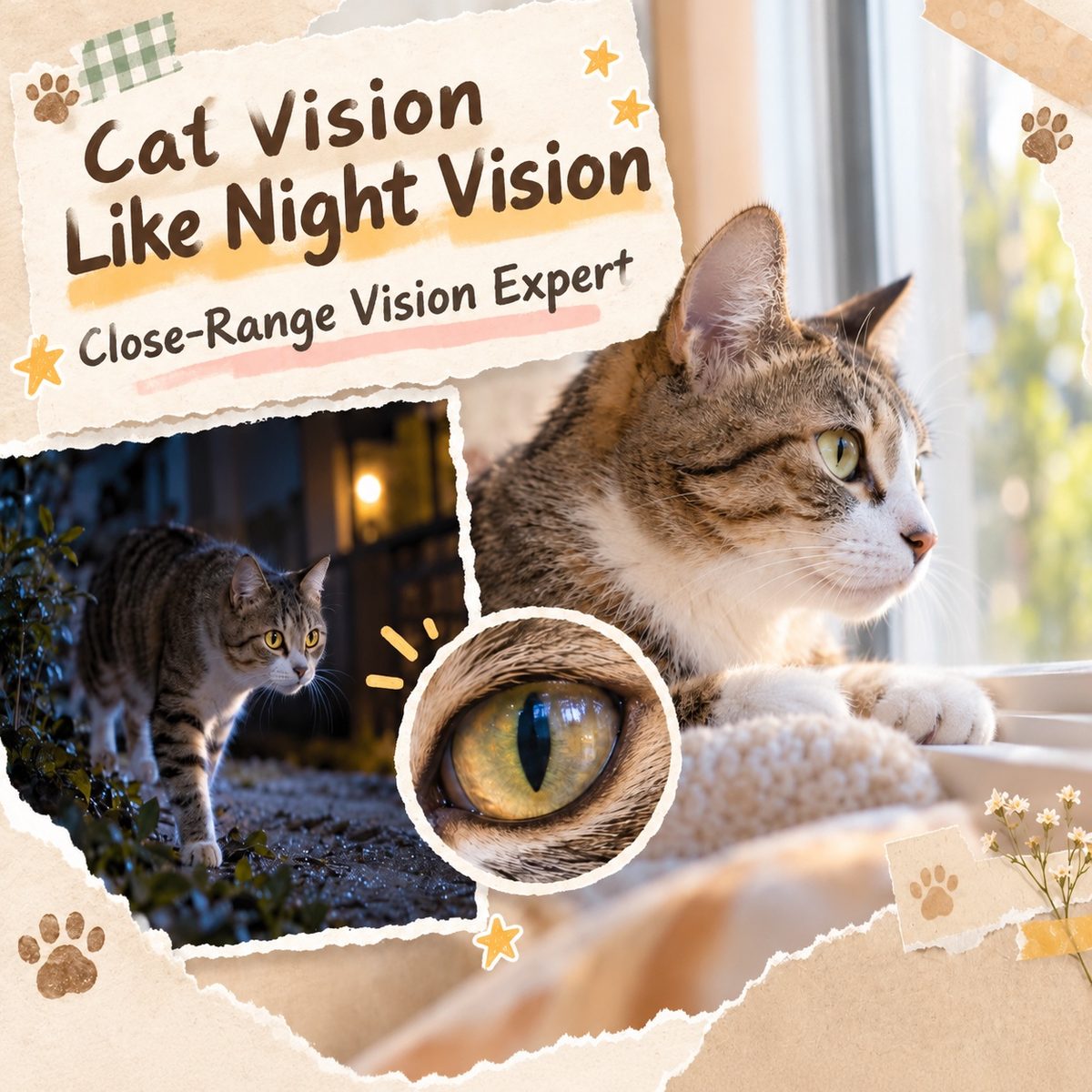
The science of cat vision explained: cats are seriously nearsighted — their eyesight is only 1/10 that of humans, but their night vision is 6 times better. Cats have a tapetum lucidum that reflects light and boosts night vision. Their field of view is 200 degrees — wider than a human's 180 degrees. Cats are colourblind — they can only tell blue and green apart, not red. A cat's vision is designed for hunting — they can see fast-moving objects.
• Cats are seriously nearsighted — eyesight only 1/10 that of humans
• Night vision 6 times better than humans — thanks to the tapetum lucidum reflecting light
• Cats are colourblind — they can only tell blue and green apart
Quick answer: The science of cat vision explained: cats are seriously nearsighted — their eyesight is only 1/10 that of humans, but their night vision is 6 times better. Cats have a tapetum lucidum that reflects light and boosts night vision. Their field of view is 200 degrees — wider than a human's 180 degrees. Cats are colourblind — they can only tell blue and green apart, not red. A cat's vision is designed for hunting — they can see fast-moving objects.
Contents
-
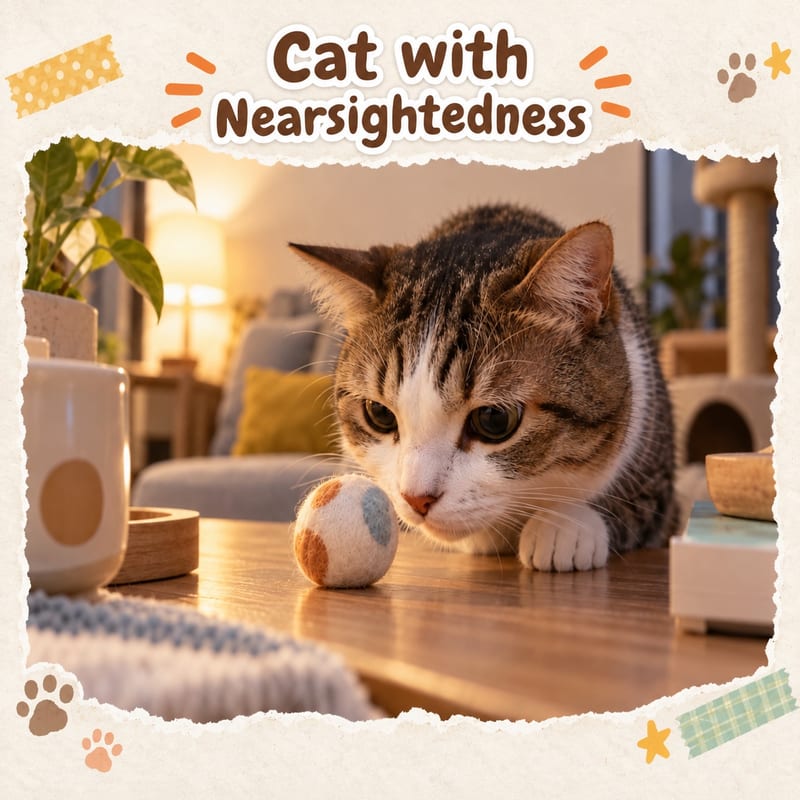
Are cats seriously nearsighted? A cat's eyesight is 1/10 that of humans
-
A cat's night vision — 6 times better than humans
-
A cat's field of view — 200 degrees
-
Are cats colourblind? A cat's colour vision
-
A cat's vision is designed for hunting
-
FAQ
What colours do cats see? The key points in 30 seconds
The world cats see isn't black and white, but it's very different from a human's colour palette. Research shows cats are dichromatic animals: their retina has only two types of cone cells, corresponding to blue and green channels; reds and oranges collapse into greyish-yellow tones for them. The table below sums it up in 30 seconds, then we'll break down each point.
| Colour | Roughly what a cat sees | What a human sees | Key contrast |
|---|---|---|---|
| Red | Dark grey, brownish grey | Bright red | Cats can't tell red; a red toy is just grey to them |
| Orange | Yellow-grey, darker | Orange | Usually lumped into yellow/grey |
| Yellow | Pale yellow-grey | Bright yellow | Roughly distinguishable, but low saturation |
| Green | Grey-green, teal-grey | Green | There is a green channel, but it's not the same green humans see |
| Blue | Blue | Blue | The closest match; cats see blue most clearly |
| Purple | Blue-grey | Purple | Mostly treated as a shade of blue |
| Black, white, grey | Clear | Clear | Grey-scale contrast is a cat's main tool for judging objects |
| Light-dark contrast | Sensitive | Sensitive | Cats rely on light and shade for outlines more than colour |
Three key points to remember:
- Blue-green are real colours — the main colours cats see are blue, grey and green; red, orange and purple all collapse into grey tones.
- Light and shade lead — a cat's sensitivity to contrast and movement is higher than its sensitivity to colour.
- Choose blue-green — toys, water bowls and litter trays in blue-green tones are easiest to notice; red is almost decorative.
Remember this: Cats aren't completely black-and-white colourblind, but they won't appreciate the red dried-fish-coloured litter tray you bought them — to their eyes it's just a grey blob.
Cat vision comparison table: night vision, nearsightedness, farsightedness, colour vision
The same pair of eyes, four completely different directions of ability. It's generally accepted that cat vision is specialised for low light, motion and a wide angle, at the cost of distant detail and colour. The table below compares them all at once:
| Visual item | What a cat sees | What a human sees | Practical meaning |
|---|---|---|---|
| Night vision | About 6 times a human's (tapetum reflects light) | Average | Cats still move around freely after lights out |
| Farsightedness | About 20/100–20/200; blurry beyond 6 metres | 20/20; clear at 30–60 metres | They recognise people by smell and sound, not by looks |
| Near focus | Clearest at about 20–30 cm | About 25 cm | The comfortable distance for feeding, grooming and close interaction |
| Colour vision | Two channels: blue and green | Red, orange, yellow, green, cyan, blue, purple | Red toys look close to grey to cats |
| Field of view | About 200 degrees | About 180 degrees | Peripheral movement is easier to notice |
| Binocular overlap | About 90–120 degrees | About 140 degrees | Narrower range for depth judgement |
| Motion detection | Extremely sensitive | Moderate | Fast-moving objects catch their attention most easily |
| Light-dark adaptation | About 7 minutes to adjust in the dark | About 30 minutes | Cats adapt from light to dark much faster |
Note: the above are reference ranges commonly cited in the literature and by veterinary ophthalmologists. Each cat is affected by age, breed and eye disease; the numbers are reference values, not examination standards.
Practical application: why cats chase light sources at night and need to get close to eat
Once you know the features of cat vision, many odd everyday behaviours make sense:
| Behaviour | Visual explanation | What you can do |
|---|---|---|
| Chasing laser dots and car-light reflections at night | High-contrast moving light points fall right into the motion-detection and low-light range | Finish play with a feather wand so the cat feels it has 'caught' something |
| Needing to get close to food to eat | Near focus is 20–30 cm; a bowl placed too far away can't be focused on | Place bowls flat and low, at least 15 cm from the wall |
| Paws food out of the bowl | Narrow depth judgement range makes the bottom of the bowl hard to judge | Choose shallow, wide-rimmed bowls |
| Afraid to jump when the light is dim | Distant detail is blurry and edges can't be judged | Add a small night light that stays on at corners and on top of cabinets |
| Only reacting to toys that move | Stationary objects are almost invisible to cats | Sweep a wand toy quickly along the floor to mimic prey movement |
| Not recognising you after a haircut or change of clothes | Cats recognise people by smell, voice and gait | Give them a few days to adjust; don't force cuddles |
Owner tip: To train a cat to play with toys, move fast, keep it low to the ground and bring it within 30 cm — the success rate is far higher than raising it high and waving it slowly.
When to see a vet: eye red flags and eye exam costs for cats
Don't wait in the following situations — book an appointment as soon as possible:
| Red-flag symptom | Possible cause | Recommended timeframe |
|---|---|---|
| Persistent redness or swelling of the whites of the eyes or eyelids | Conjunctivitis, foreign object in the eye | Within 24 hours |
| Copious yellow-green discharge | Infection, blocked tear duct | Within 24 hours |
| Cloudy, blue-white eyeball | Corneal ulcer, cataract | Same day |
| One pupil larger than the other | Nerve or intraocular pressure problem | Same day (emergency) |
| Head-swinging, bumping into walls, afraid to jump | Sudden vision loss | Within 3 days |
| Bloodshot, visibly swollen eyeball | Glaucoma, trauma | Same day (emergency) |
| Blood-tinged streaks in the whites of the eyes | Trauma, clotting problem | Same day (emergency) |
Hong Kong eye exam cost reference (2026):
| Item | Approximate cost |
|---|---|
| Routine check-up including eye exam | HK$300–600 |
| Slit-lamp / fluorescein stain examination | HK$400–800 |
| Eye pressure measurement (suspected glaucoma) | HK$300–600 |
| Specialist ophthalmology referral (including initial examination) | HK$800–1,500 |
| Corneal ulcer conjunctival flap surgery | HK$4,000–9,000 |
| Cataract surgery (one eye) | HK$8,000–15,000 |
Cats aged 7 and over should have an eye and general check-up every six months; when one eye is affected, the other usually already shows early signs, and early detection costs far less to manage.
How cat vision changes with age: an eye exam timetable from kitten to senior
A cat's vision changes with age; following a timetable is the safest approach:
| Age | Visual characteristics | Recommended check | Approximate cost |
|---|---|---|---|
| 2–12 weeks | Eyes gradually adapt to light; colour vision not fully mature | Eye check alongside first vaccination | HK$0–200 (usually included with vaccination) |
| 6 months | Vision roughly stable | Pre-neutering check including fundus | HK$300–600 |
| 1–3 years | Adult level | Annual check-up + eye exam | HK$300–600 |
| 4–7 years | Early changes begin | Annual check-up + eye pressure | HK$500–900 |
| 8 years and over | Rising risk of cataract and glaucoma | Every six months: eye pressure + slit lamp | HK$600–1,200 per visit |
Three things to watch daily that cost nothing:
- Are both pupils the same size? One larger than the other needs an immediate vet visit — don't wait.
- Bumping into furniture? Suddenly afraid to jump or walking to one side may mean declining vision.
- Eye colour: turning from clear to cloudy or blue-white is a sign of corneal or cataract problems.
Three home lighting budget plans: frugal, standard, safe
What cats see relies heavily on ambient light to make up for poor distance vision. The same home can be set up in three ways:
| Item | Frugal | Standard | Safe |
|---|---|---|---|
| Hallway night light | 1 × 3W warm light (HK$30) | 2 × motion-sensor lights (HK$120) | Whole-home sensor light strip (HK$400) |
| Window lighting | Keep sheer curtains for natural light (HK$0) | Windowsill plant light (HK$150) | Timer windowsill light (HK$300) |
| Teaser toys | Blue-green feather wand (HK$25) | Blue-green flash wand + laser pointer (HK$80) | Interactive automatic teaser machine (HK$350) |
| Food bowl | Shallow ceramic bowl (HK$40) | Wide-rimmed neck-protection bowl (HK$120) | Angled stainless steel bowl set (HK$260) |
| Annual eye exam | Alongside check-up (HK$300) | Check-up + eye pressure (HK$600) | Six-monthly specialist check (HK$1,600) |
| First-year total | About HK$395 | About HK$950 | About HK$2,930 |
How to choose: If you rent or are on a tight budget, start with a night light and blue-green toys — these two offer the best value; if you want to avoid large ophthalmology bills, go for 'Standard' plus a six-monthly eye exam.
Four common misconceptions about cat vision
Before deciding, clear up these four common misunderstandings:
| Common misconception | Reality |
|---|---|
| Cats can see perfectly in complete darkness | The tapetum only reflects residual light; in total darkness (e.g. a sealed dark compartment) cats can't see either |
| Cats are completely colourblind and only see black and white | It's generally accepted that cats have at least two colour channels, blue and green, just a narrower range than humans |
| Cats chasing light points at night are being naughty or disobedient | It's a normal response of their visual specialisation (motion + low-light detection), not a behavioural problem |
| Poor eyesight means the cat is incapable | Distant detail is poor, but motion detection, night vision and field-of-view width all beat humans |
| A cat not interested in red toys means it doesn't like them | It simply can't see red clearly; switch to blue-green and it responds immediately |
In summary: What cats see isn't 'a human eye that's a bit worse' — it's a different setup: low light, motion and wide angle come first, while colour and distant detail give way. Home lighting, toy colours and bowl distances should follow this setup, not human habits.
Are cats seriously nearsighted? A cat's eyesight is 1/10 that of humans
Cats are seriously nearsighted — their eyesight is only 1/10 that of humans.
Features of a cat's eyesight:
- A cat's vision is 20/100 to 20/200 — a human's is 20/20
- A cat needs to be within 6 metres to see something a human can see from 30–60 metres away
- Cats are seriously nearsighted — they can't see things far away
Why cats' eyesight is like this:
- A cat's eyes are designed for hunting — they need to see fast-moving objects
- A cat's eyes have more rod cells — to sense light and motion
- A cat's eyes have fewer cone cells — to sense colour and detail
The impact of a cat's eyesight:
- Cats can't see things far away — they are seriously nearsighted
- Cats can't see detail — their eyesight is only 1/10 that of humans
- Cats can't see colour — they are colourblind
A cat's night vision — 6 times better than humans
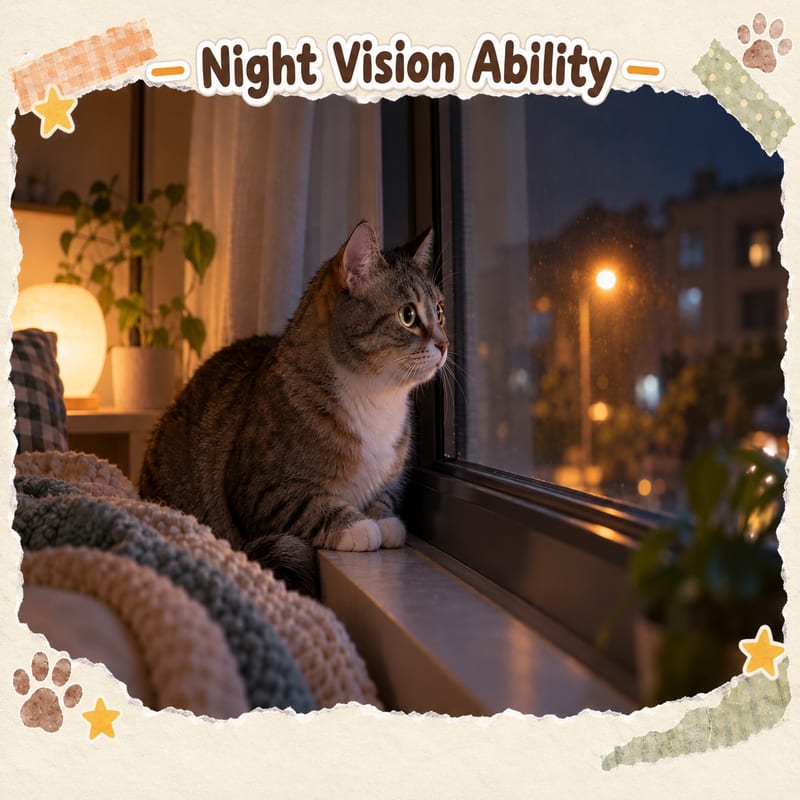
A cat's night vision is 6 times better than a human's — their eyes have a tapetum lucidum.
What the tapetum lucidum does:
- The tapetum lucidum is a reflective layer — located behind the retina
- It reflects light — boosting night vision
- It makes a cat's eyes glow in the dark — green or yellow
Why cats have such good night vision:
- A cat's eyes have more rod cells — to sense light
- A cat's eyes have a tapetum lucidum — to reflect light
- A cat's pupils can dilate — to take in more light
The benefits of a cat's night vision:
- Hunting — cats can hunt in the dark
- Alertness — cats can stay alert in the dark
- Activity — cats can move around in the dark
A cat's field of view — 200 degrees
A cat's field of view is 200 degrees — wider than a human's 180 degrees.
Field of view comparison:
| Species | Field of view | Binocular vision |
|---|---|---|
| Human | 180 degrees | 140 degrees |
| Cat | 200 degrees | 90–120 degrees |
| Dog | 240 degrees | 30–60 degrees |
Features of a cat's field of view:
- A cat's field of view is 200 degrees — wider than a human's
- A cat's binocular vision is 90–120 degrees — allowing depth perception
- A cat's field of view is designed for hunting — they can see fast-moving objects
The benefits of a cat's field of view:
- Hunting — cats can see fast-moving objects
- Alertness — cats can see their surroundings
- Activity — cats can see objects around them
Are cats colourblind? A cat's colour vision
Cats are colourblind — they can only tell blue and green apart, not red.
Features of a cat's colour vision:
- A cat's eyes have two types of cone cells — sensing blue and green
- A cat's eyes have no red cone cells — they can't tell red
- Cats are red-green colourblind — they can't tell red from green
The impact of a cat's colour vision:
- Cats can't tell red — red looks grey to them
- Cats can't tell green — green looks grey to them
- Cats can only tell blue and green apart — blue and green look blue and green to them
The benefits of a cat's colour vision:
- Hunting — cats don't need to tell colours apart; they need to tell movement apart
- Alertness — cats don't need to tell colours apart; they need to tell light apart
- Activity — cats don't need to tell colours apart; they need to tell shapes apart
A cat's vision is designed for hunting
A cat's vision is designed for hunting — they can see fast-moving objects.
Features of a cat's vision:
- Cats can see fast-moving objects — their eyes have more rod cells
- Cats can detect motion — their eyes can sense movement
- Cats can hunt in the dark — their night vision is 6 times better than a human's
The benefits of a cat's vision:
- Hunting — cats can see fast-moving objects
- Alertness — cats can detect motion
- Activity — cats can move around in the dark
The impact of a cat's vision:
- Cats are seriously nearsighted — they can't see things far away
- Cats are colourblind — they can't tell red
- A cat's night vision is 6 times better than a human's — they can hunt in the dark
Hong Kong small-flat practicalities: creating a safe, fun visual environment for seriously nearsighted cats
Hong Kong homes are small and cats are seriously nearsighted. To keep them safe and happy at home, you don't need a big renovation — just remember three words: near, motion, light.
Near: place things at 1.5 m or below Cats can't see far, so toys and cat trees are best placed within their line of sight. Put teaser wands and toy mice on the floor or coffee table, away from windowsills, so they don't misjudge a jump because they can't see clearly.
Motion: 3 interactive sessions of 5 minutes a day Cats make up for poor eyesight by sensing fast movement. Take 5 minutes in the morning, after work and before bed to sweep a blue or green teaser wand quickly left and right along the floor, mimicking small prey, to stimulate their hunting instinct.
Light: make good use of natural light + night lights Hong Kong flats are densely packed; closing the curtains during the day turns the home into a dark room. Keep sheer curtains open for light during the day, and at night put a warm night light in the hallway (3W is enough) — with the tapetum reflecting light, cats can see clearly and won't bump into things because it's too dark.
Simple checklist
- Toy colours: choose blue and green tones, avoid red.
- Floor clutter: tidy up once a day to reduce tripping hazards.
- High routes: add non-slip mats on top of bookcases and wardrobes so cats don't slip due to poor vision.
Follow these three steps and even a 300 sq ft flat can give a seriously nearsighted cat a safe space to burn energy and live comfortably.
Further reading
- All articles index
- PetChill pet supplies
- Cat medication tips →
- Cat vaccination schedule →
- Cat ringworm (dermatophytosis) treatment →
- Cat poop observation guide →
- Complete guide to cat hairballs →
📌 Key takeaways
- ✅ A cat's eyesight is only 1/10 that of humans; they see clearly only up close
- ✅ Night vision is 6 times better, thanks to the tapetum lucidum reflecting light
- ✅ A 200° field of view is wider than a human's, helping detect movement nearby
- ❌ Don't expect cats to recognise distant stationary objects
- ❌ Red toys are just a grey blur to them
This article is compiled from breed consensus and clinical care guidelines; individual cats and dogs vary widely. For health problems, consult a registered veterinarian first.
 Fuji One full guide →

