
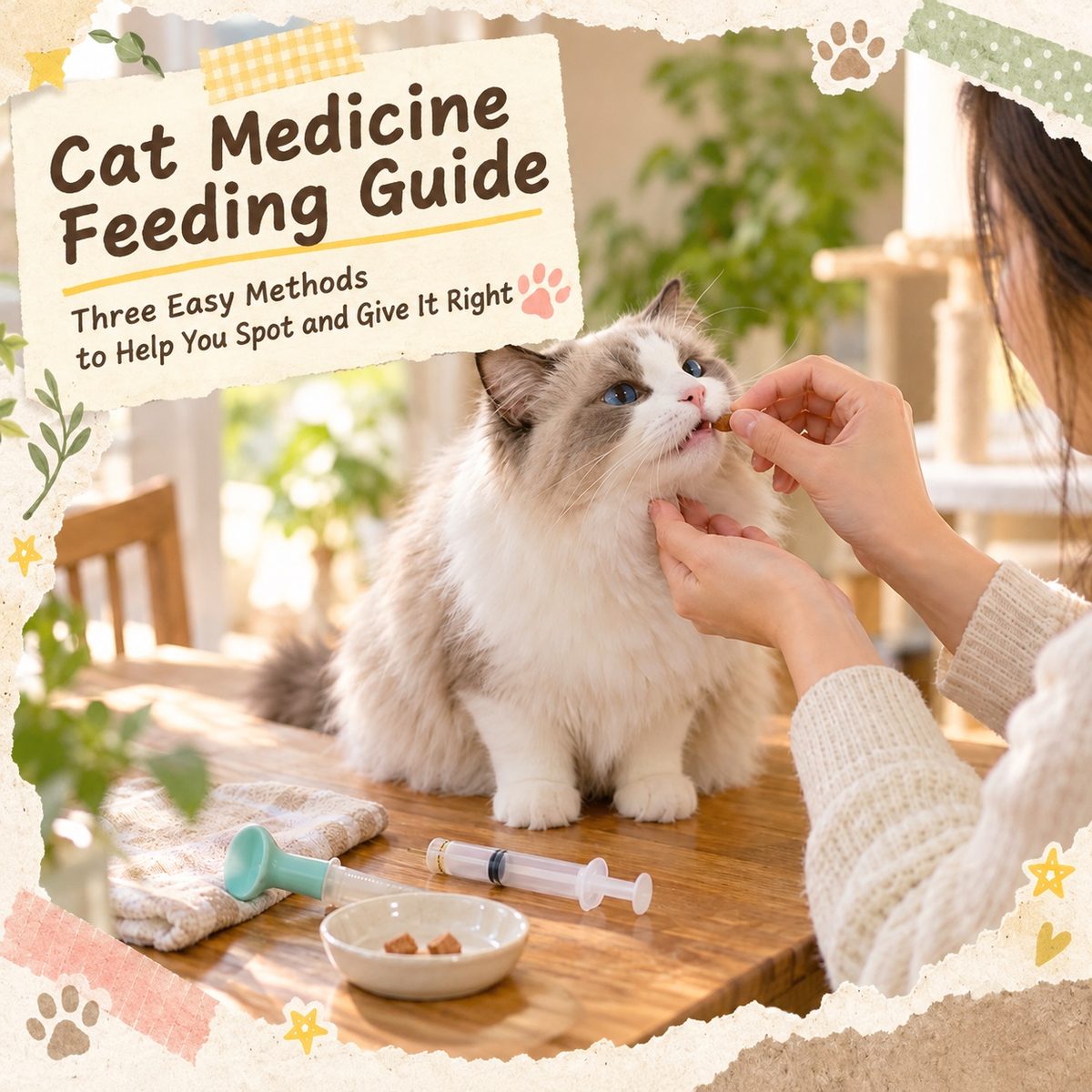
Quick answer: Successful cat medication depends on choosing the right method (manual, hiding in treats, or pill popper), acting swiftly (complete within 30 seconds), and always finishing with water. Match the method to your cat's personality; for resistant cats, a pill popper is fastest and most reliable—no need for forceful restraint.
The core conclusion for giving cats medicine: choose the right method + act fast + finish with water, and you can get it done in 30 seconds without a battle.
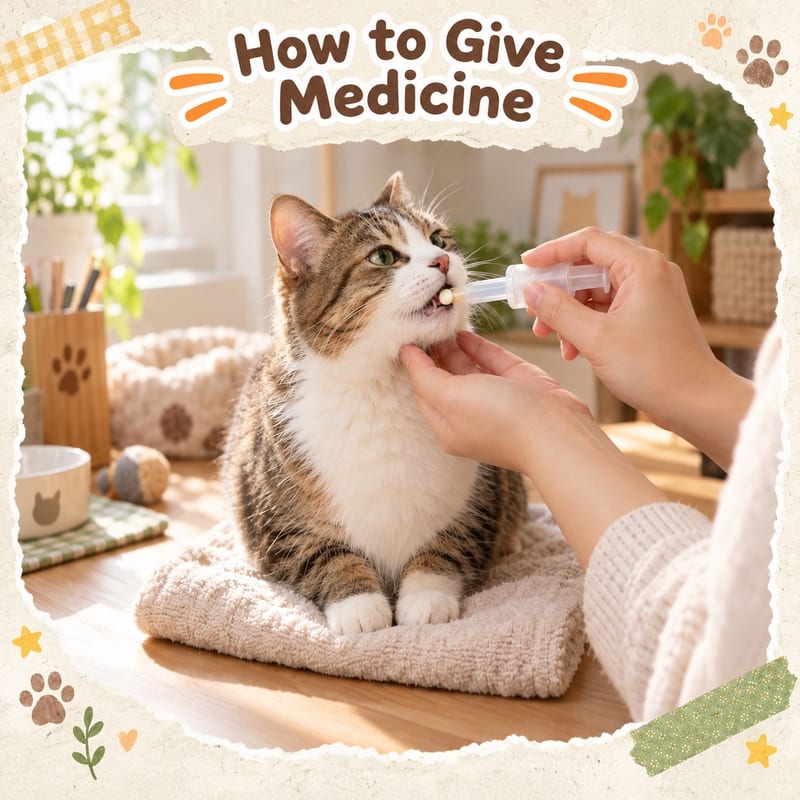
When a cat is ill, it needs medicine on time, but in many households, each medication session turns into a "human-cat war." In fact, the difficulty isn't the cat—it's the method. This article covers 3 major methods, 5 common mistakes, and daily touch training tips to help you upgrade from "restraining the cat and forcing pills" to "your cat willingly opening its mouth."
Why is giving cats medicine so difficult?
Cats instinctively resist having their mouths restrained, and the bitter taste and foreign object sensation of medicine make them struggle, shake their heads, and even scratch or bite. There are three main reasons for failure:
- Lack of experience: Unfamiliar with the correct technique, movements not swift enough—the longer it drags, the more scared the cat becomes.
- Cat is tense: No prior touch adaptation training; as soon as you touch the mouth or nose, they bolt.
- Wrong method: Choosing the wrong approach, such as using treats that don't fully cover the pill or forcing a pill popper from the front.
Improve these three points one by one, and the success rate will noticeably increase. For gentle cats, manual or treat-hiding methods work; for resistant cats, a pill popper is fastest and least damaging to your relationship.
Before giving medicine, two things to do: First, ask your veterinarian about the relationship between the medicine and meals—before or after food, how many times a day, and what to do if a dose is missed. Second, prepare all tools within arm's reach—medicine, treats, syringe, pill popper—all on the table at once. Don't restrain the cat and then look for things; prolonging the wait only makes the cat more anxious.
Method 1: Manual pill giving—which cats is it suitable for?
Suitable for cats that are relatively cooperative and won't struggle violently. The key is "fast, accurate, close mouth," aiming to finish in 10 seconds.
Step-by-step:
- Secure the head: Use your left index finger and thumb to hold the cat's cheekbones, gently tilt the head up so the chin and neck are in a straight line, and gently open the mouth with your right hand.
- Place the pill: Hold the pill between your thumb and index finger and place it at the base of the tongue—too far forward and the tongue will easily push it out.
- Close mouth to swallow: Quickly close the mouth; you can gently blow a puff of air toward the nostrils to trigger the swallowing reflex.
- Give water: Use a syringe to give a small amount of drinking water from the side of the mouth to help the medicine go down and prevent capsules from sticking to the throat or esophagus.
Reminder: The faster the whole process, the better. Hesitating or holding the cat for ages without inserting the pill only makes the cat more nervous and makes it harder next time.
Method 2: How to hide pills in treats most reliably?
If your cat is not wary of food, hiding the pill in a treat is the gentlest choice, especially for food-motivated, good-natured cats.
- Use cat treats, hairball gel, or meat paste to completely wrap the pill into a small ball.
- Give it directly to the cat and watch to see if it actually swallows.
Notes:
- First ask your veterinarian whether the medicine can be taken with food—some require an empty stomach.
- The coating must be complete; once they smell the medicine, many cats will lick and walk away.
- Beware of "fake eating": clever cats may hold the pill in their mouth and secretly spit it out later. After feeding, check the floor nearby for "evidence."
Suitable for capsules and small pills; not suitable for liquid medicine or strongly flavored powders. For cats on long-term medication, turn the treat-wrapping into a daily mini-training so they associate "a little something to eat = something good happens."
Another often-overlooked detail: the treats used to wrap the pill count toward daily calories, especially for cats on kidney prescription diets or weight control. It's best to ask your veterinarian which treat is suitable for wrapping pills, so you don't hit the medication target but exceed calories.
Method 3: How to use a pill popper and give liquid medicine?
For more resistant cats, a pill popper (pill gun) is the most successful tool—one person can handle it.
- Test fire first: Before use, test fire into the air once to confirm the plunger distance and avoid the pill getting stuck.
- Enter from the side: Insert from the side of the mouth, not straight from the front.
- Aim at the base of the tongue: Fire toward the back of the tongue; the cat will reflexively swallow.
- Close mouth immediately: As soon as the pill is in, close the mouth.
- Finish with water: Use a syringe to give water to ensure the medicine is completely swallowed.
Liquid medicine (or powder dissolved in water) using a syringe or dropper: draw up one dose → secure the head and tilt slightly up → slowly inject from the side of the mouth → if the volume is large, give in several portions. Never push forcefully all at once, to avoid liquid entering the trachea and causing aspiration pneumonia. After giving, put the cat down and act normally; don't stare at it just because you've just medicated it, to avoid associating "being watched" with "a bad experience."
5 common medication mistakes—how many do you make?
| Mistake | Consequence | Correct approach |
|---|---|---|
| Not test-firing the pill popper | Pill won't come out, cat gets scared | Test fire into the air before each use |
| Holding the head too tightly | Pain makes resistance worse | Gently hold the cheekbones |
| Not placing the pill at the base of the tongue | Cat easily pushes it out | Ensure the pill reaches the back of the tongue |
| Not closing the mouth in time | Cat spits the pill out in front of you | Close the mouth immediately after firing |
| Not giving water after | Capsule sticks to throat, foaming at the mouth | Always give a little water with a syringe |
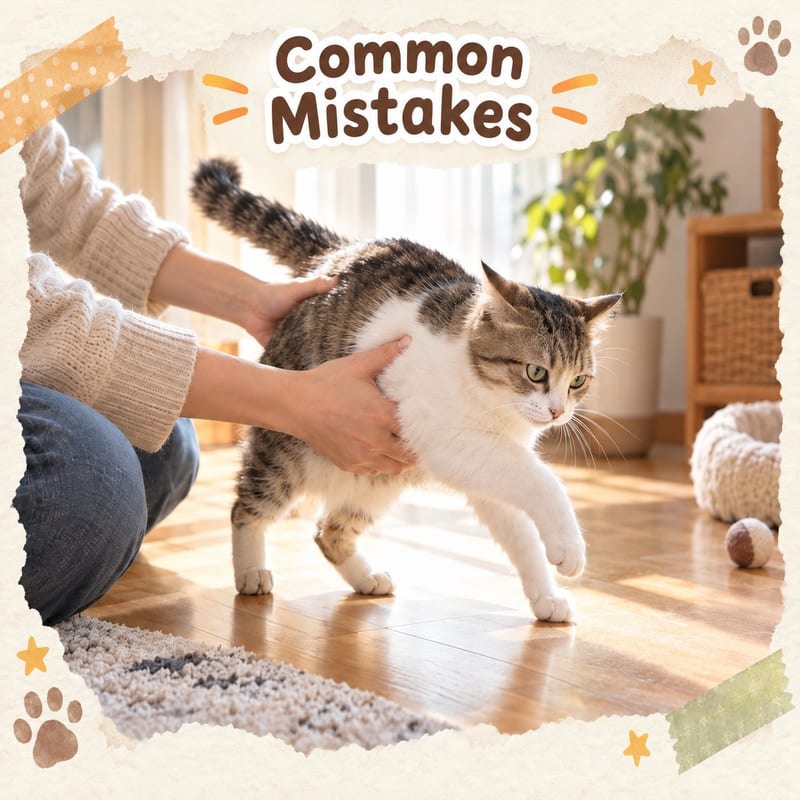
Daily touch training makes medication easier
Getting your cat used to having sensitive areas touched from a young age makes giving medicine, brushing teeth, and trimming nails much easier when they grow up. Key areas to train:
- Nose tip: Gently stroke to get them used to facial touch.
- Around the mouth: Gently lift the upper lip and touch the teeth to prepare for medication and oral care.
- Legs: Gently squeeze from the base of the leg to the toes, covering each toe and paw pad.
- Back: Stroke gently along the direction of the fur.
- Chest and belly: Gently lift the body from behind and stroke the chest and abdomen.
Training should be gradual and not too long each time. If the cat becomes tense or resistant, stop immediately and give a treat to build a positive association.
What to observe after medication? When to see a vet?
Giving the medicine isn't the end—remember to observe:
- Whether the pill is spat out, or any medicine remains in the mouth.
- Any abnormality in energy levels.
- Allergic reactions: continuous drooling, vomiting, rapid breathing, facial swelling.
If any of these allergic signs appear, or if appetite and energy noticeably decline for several days after medication, contact your veterinarian immediately. If you miss a dose, don't double the next dose on your own—call the clinic first to ask whether to skip or make up, because the risk of overdose for some medicines is more serious than a missed dose. For particularly resistant cats, split the task between two people: one holds the body, one focuses on giving the medicine. If it's really unmanageable, take your cat to the vet clinic and ask a nurse to demonstrate once; you'll feel much more confident doing it at home.
What you can do starting today
- Prepare a pill popper and a needleless syringe, and keep them within easy reach.
- Spend 1 minute daily on touch training around the mouth to build the habit before medication is needed.
- Always give a treat after medication so "medicine = something good."
- Set a phone alarm for medication times; don't stop or increase the dose on your own.
If your cat needs long-term medication, besides medication techniques, diet also matters. You can refer to PetChill's cat kidney disease diet guide and new cat owner checklist.
This article is for reference only. For medication arrangements and difficulties, please consult a registered veterinarian.
Further reading
- Cat vaccination schedule →
- Cat ringworm (dermatophytosis) treatment →
- Cat vomit color chart →
- Cat poop observation guide →
- Cat hairball complete guide →
📌 Key takeaways
- ✅ Aim to complete the whole process within 30 seconds; the longer it drags, the more tense the cat and the lower the success rate.
- ✅ The pill must be placed at the base of the tongue; too far forward and it's easily pushed out by the tongue.
- ✅ Always test-fire the pill popper into the air before each use to ensure the pill comes out smoothly.
- ✅ After medication, always give a little water from the side of the mouth with a syringe to prevent capsules from sticking to the throat or esophagus.
- ❌ Don't force the pill popper or syringe straight from the front; insert from the side of the mouth.
- ❌ Don't assume the cat has swallowed the pill—observe for spitting out or leftover medicine on the floor.