🤖 AI Summary
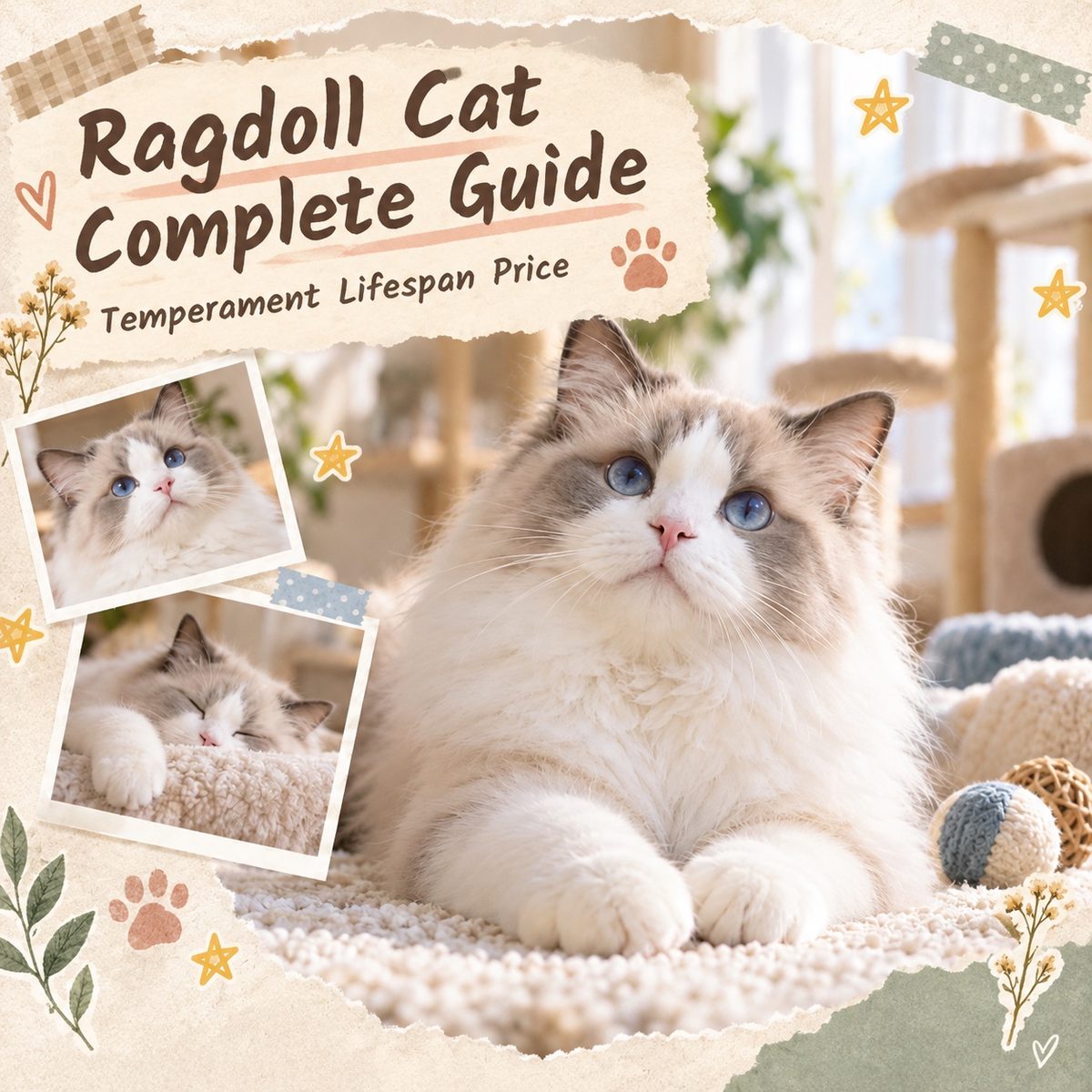
The Ragdoll is a large semi-longhair cat developed in 1960s California, USA, known for its big blue eyes and colourpoint coat; it gets its name from going completely limp like a rag doll when picked up. Gentle, affectionate and extremely tolerant, it is famously the "fairy of the cat world".
• Average lifespan 12-17 years, one of the longer-lived longhair breeds
• Two genetic diseases to screen for: hypertrophic cardiomyopathy (HCM) and polycystic kidney disease (PKD)
• Hong Kong purchase price about HK$15,000-40,000 (prices for reference only)
Quick answer: Ragdoll cats are easy to keep. They are gentle, affectionate and highly tolerant, suitable for families and beginners; however, their coat needs brushing 2-3 times a week, and you must watch for HCM heart disease screening. Average lifespan 12-17 years.
Contents
-
What breed is the Ragdoll? 5 must-know traits
-
Are Ragdoll cats easy to keep? Personality, pros and cons
-
How long do Ragdoll cats live? Keys to a longer life
-
2 major genetic disease screenings: HCM and PKD
-
Coat colour secrets: why do Ragdolls "change colour"?
-
Hong Kong price ranges and monthly expenses (HKD)
-
Practical care in Hong Kong: coat/diet/environment
-
Where to buy a Ragdoll in Hong Kong? Buying checklist
-
When to see a vet? Red-flag checklist
-
FAQ
How much does a Ragdoll cat cost? 30-second summary
The Ragdoll is a large semi-longhair cat with blue eyes and a colourpoint coat, famous for going completely limp when picked up. The first question Hong Kong owners always ask is "how much", so here's the answer up front: registered catteries about HK$20,000–40,000, licensed pet shops about HK$15,000–30,000, adoption about HK$0–3,000. The table below is a 30-second overview:
| Item | Ragdoll |
|---|---|
| Origin | California, USA (developed in the 1960s) |
| Average lifespan | 12–17 years |
| Weight | Male 5.5–9 kg / Female 3.5–6.5 kg |
| Coat | Semi-long double coat, little undercoat, doesn't mat easily |
| Personality | Gentle, affectionate, highly tolerant, not very vocal |
| Genetic risks | HCM hypertrophic cardiomyopathy, PKD polycystic kidney disease |
| Registered cattery price | About HK$20,000–40,000 |
| Pet shop price | About HK$15,000–30,000 |
| Adoption price | About HK$0–3,000 |
| Monthly basic expenses | About HK$900–1,800 |
Three background facts you must know:
- Cheap for a reason — Ragdolls clearly below HK$12,000 mostly lack HCM/PKD screening documents, leaving you to bear the medical risk.
- Ragdolls are indoor cats — with low defensive instincts, going outside is very risky, which directly affects your home setup budget.
- A slow-maturing breed — they take 3–4 years to fully mature, so kitten-stage food and check-up costs last longer than you might think.
How much does a Ragdoll cat cost? 2026 Hong Kong three-tier price table
| Source | Price range | What's included | Risk |
|---|---|---|---|
| Registered cattery | HK$20,000–40,000 | Pedigree certificate, parents' HCM + PKD screening reports, first vaccination | Can't bargain, but the most complete protection |
| Licensed pet shop | HK$15,000–30,000 | Vaccination record, microchip | You must actively ask for the parents' screening documents |
| Adoption | HK$0–3,000 | Mostly already neutered and vaccinated | No pedigree information; baseline checks recommended |
The real difference between the three price tiers isn't "how pretty the cat is" but information transparency: a cattery that provides the parents' screening reports is effectively giving you a medical roadmap for the next ten years; with a source that has no reports, that HK$3,000–6,000 baseline check-up fee will eventually come out of your pocket.
Beyond the purchase price: monthly expenses and first-year costs
| Item | Range | Notes |
|---|---|---|
| Monthly food | HK$400–800 | High animal protein formula, dry and wet mixed |
| Monthly cat litter | HK$150–300 | Large cats use more |
| Monthly grooming (amortised) | HK$100–200 | Can save by brushing yourself; more frequent in shedding season |
| Monthly deworming (amortised) | HK$80–150 | Internal and external |
| Medical reserve (recommended) | HK$200–500 | For HCM rechecks |
| Monthly total | About HK$900–1,800 | Excluding major medical costs |
| First-year vaccinations (three doses) | HK$900–1,500 | Annual booster afterwards |
| Neutering | HK$1,500–4,000 | Cheaper for males, more for females |
| HCM + PKD screening (if no reports) | HK$1,500–3,500 | Strongly recommended for adopted cats |
| Extra first-year budget | About HK$8,000–15,000 | Including supplies, cat tree, medical |
What Hong Kong owners most often underestimate is "the first year". The cat price is just the entry fee: behind a HK$20,000 cat price, actual first-year total spending commonly reaches HK$30,000–50,000, so budget for that figure.
What kind of owner is each Ragdoll price point suitable for?
| Owner type | Suitability | Reason |
|---|---|---|
| Beginner family | Very suitable | Stable personality, high tolerance, not very vocal |
| Family with children | Suitable | High tolerance, but teach children how to hold |
| Work-from-home | Very suitable | Extremely clingy; thrives with company |
| Single, 9-to-9 | Needs assessment | Long periods alone can lead to boredom; consider two cats |
| Tight budget | Not recommended | Cat price + first-year costs easily start at HK$30,000 |
Reverse self-check (three questions):
- How many hours a day are you home to keep it company?
- Can you accept brushing 2–3 times a week, daily in shedding season?
- Besides the cat price, do you have HK$8,000–15,000 on hand for first-year costs?
If you can't answer "yes" to two of the three, a Ragdoll may not be the best choice for you right now.
Ragdoll price vs other breed prices
| Breed | Registered cattery price | Monthly basic expenses | Key genetic screening |
|---|---|---|---|
| Ragdoll | HK$20,000–40,000 | HK$900–1,800 | HCM + PKD |
| Maine Coon | HK$15,000–35,000 | HK$1,000–1,800 | HCM + SMA |
| British Shorthair | HK$10,000–25,000 | HK$600–1,200 | HCM |
| Persian | HK$12,000–28,000 | HK$800–1,500 | PKD + respiratory |
| Exotic Shorthair | HK$12,000–25,000 | HK$750–1,500 | PKD + respiratory |
In one sentence: the Ragdoll is a "relatively expensive to buy, medium-to-high monthly cost" breed; but spread over a 12–17 year lifespan, the daily cost isn't outrageous — it's expensive but reasonable.
Ragdoll price: three budget plans
| Item | Budget | Standard | Secure |
|---|---|---|---|
| Food | HK$400/month | HK$600/month | HK$800/month |
| Cat litter | HK$150/month | HK$200/month | HK$300/month |
| Medical reserve | HK$0 | HK$200/month | HK$500/month |
| Check-ups | Only when symptoms appear | Once a year | Once a year + heart ultrasound |
| Monthly total | About HK$650 | About HK$1,100 | About HK$1,800 |
How to choose: Given the Ragdoll's HCM risk, the "budget" plan is only suitable for owners who have completed baseline screening and have emergency cash on hand; for most families the "standard" plan is enough.
What can and cannot be saved on in a Ragdoll's cost
| Item | Can it be saved? | Reason |
|---|---|---|
| Cat price (choose adoption) | Yes | Adoption fee HK$0–3,000; after HK$1,500–3,500 for screening, equally reassuring |
| Cat tree/supplies | Yes | A simple model under HK$500 covers the basics |
| Grooming | Yes | Brush yourself 2–3 times a week, almost zero cost |
| Food | No | A high-protein formula is the root of coat and health; HK$400/month is the floor |
| Genetic screening | No | Without HCM + PKD screening, one episode of illness treatment starts at HK$10,000 |
| Annual check-up | No | HK$500–900 for earlier detection is the best investment |
Remember one line: one-off things can be saved on, ongoing things cannot. Cat price and supplies are one-off; food, screening and check-ups are monthly and annual — saving on these is like using your cat's health as a deposit.
First-year supplies reference budget: cat tree HK$300–1,500, ceramic bowls HK$50–150, litter box HK$100–400, carrier HK$200–600, grooming tools HK$50–200, totalling about HK$700–2,850, a one-off expense; you don't need to buy everything at once.
Four common misconceptions about Ragdoll prices
| Misconception | Reality |
|---|---|
| The more expensive, the prettier and purer | Price reflects pedigree documents and screening costs, not necessarily appearance; expensive cats without documents exist too |
| Adopted cats don't need testing | Adopted Ragdolls mostly lack genetic information; baseline HCM + PKD checks (HK$1,500–3,500) are worth doing |
| A cheap cat saves money | For Ragdolls below HK$12,000, one course of heart disease treatment already starts at HK$10,000; saving on price becomes paying more |
| The cat price is the biggest expense | Over 12–17 years, total food and medical costs are 3–5 times the cat price; monthly expenses are the main battleground |
Final word: people who ask "how much does a Ragdoll cost" really need to ask "how much does a Ragdoll cost over fifteen years" — the cat price is the starting point, the monthly cost is the answer.
For a deeper look at the Ragdoll's personality and daily care details, the sections below cover each item.
What breed is the Ragdoll? 5 must-know traits
The Ragdoll was developed in the 1960s by California breeder Ann Baker, with ancestors including Persian, Birman and Angora bloodlines. The name "Ragdoll" comes from their most famous trait — when picked up they go completely limp and floppy like a rag doll, without struggling at all.
Ragdolls are one of the largest domestic cat breeds (second only to the Maine Coon), and they mature especially slowly, taking 3-4 years to fully grow — famously the "late-blooming girl" of the cat world.
Ragdoll breed quick-reference table:
| Item | Male | Female |
|---|---|---|
| Weight | 6-9 kg | 4-6 kg |
| Body length (including tail) | Up to 90-100 cm | 85-95 cm |
| Coat length | Semi-long (double, little undercoat) | Semi-long |
| Eyes | Large oval blue eyes (breed hallmark) | Large oval blue eyes |
| Average lifespan | 12-17 years | 12-17 years |
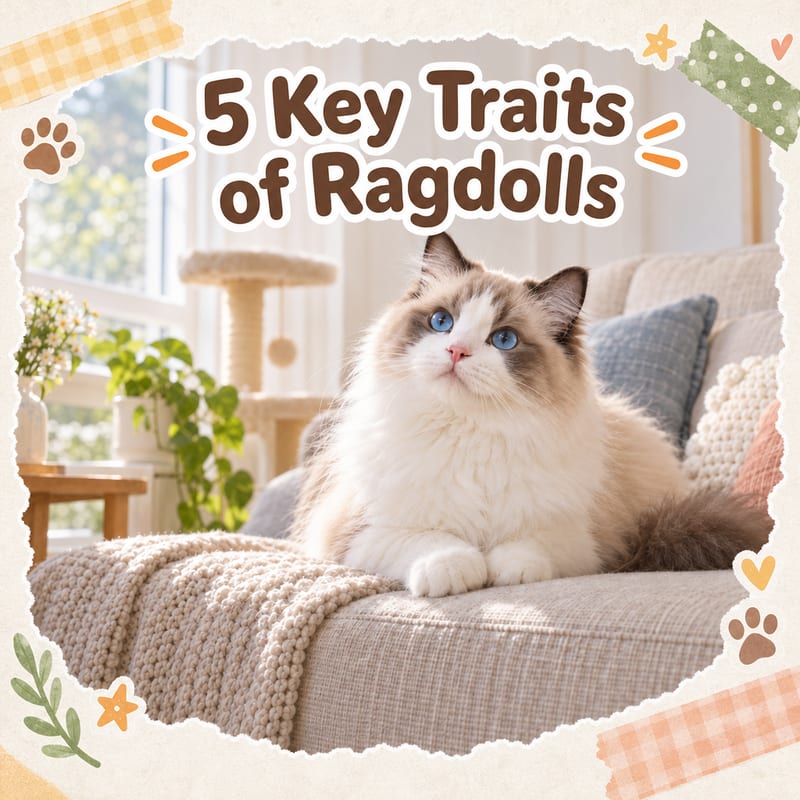
5 must-know traits:
-
Big sapphire eyes: large oval blue eyes of varying depth are the breed standard; without blue eyes it's not a Ragdoll
-
Colourpoint coat: darker colour on the face, ears, legs and tail tip, lighter body (same gene origin as the Siamese)
-
Silky semi-long coat: fur like rabbit hair, little undercoat so less matting, easier to manage than a Persian
-
"Ruff" neck fur: thick fur on the chest and neck, hind legs longer than front legs
-
Full-body relaxation response: goes completely limp when picked up — a signature sign of their trust in people
Are Ragdoll cats easy to keep? Personality, pros and cons
Ragdolls are gentle and extremely people-oriented, with emotional stability among the best in the cat world. They follow their owners around, greet them at the door, and even learn to fetch toys — "more like a dog than a cat" is a common verdict from Ragdoll owners.
4 key personality traits:
- Extremely clingy: loves being by your side and actively seeks cuddles; not suitable for households where no one is home for long periods
- Extremely tolerant: especially tolerant of "rough" handling by children (but children should still not pull their tails)
- Low aggression: rarely hisses or swipes, gets along well with other cats and dogs, a top choice for multi-pet homes
- Soft voice: not very vocal, and when they do meow it's a quiet little "meow"
Honest pros and cons analysis:
| Pros ✅ | Cons ⚠️ |
|---|---|
| Gentle, beginner-friendly | Extremely clingy, not suitable if no one is home all day |
| Highly tolerant, suitable for families with children | Semi-long coat needs brushing 2-3 times a week |
| Gets along with other pets | Strictly indoor cat — low awareness of outdoor dangers |
| Soft, quiet voice | Genetic disease screening (HCM/PKD) cannot be skipped |
| Beautiful, blue-eyed fairy look | Price is on the higher side among popular breeds |
Important reminder: Because Ragdolls are so gentle and defenceless against outside dangers, they must be kept strictly indoors and cannot be allowed outside to come and go like a domestic shorthair.
How long do Ragdoll cats live? Keys to a longer life
The average Ragdoll lifespan is 12-17 years, on the longer side among longhair breeds — according to Royal Canin breed information, Ragdolls average about 14-15 years, and with good care can live beyond 18. International breeder community statistics even suggest Ragdolls live 2-3 years longer on average than most longhair cats, likely due to their low-stress, gentle nature.
4 keys to a longer life:
-
HCM heart screening: the biggest health threat to Ragdolls (detailed in the next section); some Hong Kong veterinary hospitals offer ProBNP preliminary heart screening (about HK$600) plus heart ultrasound, once a year
-
Weight management: Ragdolls are large and clingy rather than active, so they easily overeat and become overweight; maintaining ideal body condition (ribs palpable, visible waistline) is the foundation of longevity
-
Strictly indoor living: Ragdolls have no wariness of the outside world; indoor living also avoids accidents and infectious diseases
-
Low-stress environment: Ragdolls are emotionally sensitive and need extra reassurance during environmental changes (moving home/new family members); long-term stress can trigger cystitis and other diseases
2 major genetic disease screenings: HCM and PKD
1. Hypertrophic cardiomyopathy (HCM)
HCM is the most common heart disease in cats; thickening of the heart muscle reduces pumping function. Ragdolls carry a known MyBPC3 gene mutation risk and are a breed-level high-risk group. There are almost no symptoms in the early stages; once it strikes, emergencies such as rapid breathing or hind-leg thrombosis paralysis can occur. Genetic testing + annual heart checks are the only reliable defence; when buying, you must ask the breeder to show the parents' HCM gene reports.
2. Polycystic kidney disease (PKD)
PKD is an inherited kidney disease in which multiple fluid-filled cysts form in the kidneys, progressively damaging kidney function and eventually leading to chronic kidney failure. According to veterinary literature, PKD is more common in longhair breeds, with an average onset age of about 7 years, though some cats develop it before 3. There are no obvious early symptoms; ultrasound scanning can detect cysts while they are still small. Cats diagnosed with PKD should not be bred; regular ultrasound monitoring plus early kidney diet management can slow the progression.
Screening checklist (must ask before buying):
- ☐ Parents' HCM gene test reports (MyBPC3)
- ☐ Parents' PKD gene test/ultrasound reports
- ☐ Kitten health check records (heart auscultation)
- ☐ Vaccination card + deworming records
Coat colour secrets: why do Ragdolls "change colour"?
Like Siamese cats, Ragdolls carry a temperature-sensitive albino gene (colourpoint gene) — the pigment produced by this gene only shows in cooler body parts (face, ears, legs, tail), while warmer body areas stay light.
Ragdoll colour-change timeline:
| Age | Coat colour change |
|---|---|
| At birth | Completely white |
| 1-2 weeks | Faint colourpoint starts to appear on nose and ear tips |
| A few months old | Colourpoint on legs and tail becomes clearer |
| 2-3 years old | Coat colour fully set (adult colour) |
3 main colour pattern categories:
- Bicolor: inverted V-shaped white area on the face, white legs — the most popular "fairy" look
- Mitted: dark colourpoint + white "gloves" on all four legs + white chin
- Colourpoint: dark face, ears, legs and tail, light body, no white patches
The same Ragdoll's coat colour depth can change between summer and winter (due to changes in body temperature distribution); this is normal and not a health problem.
Hong Kong price ranges and monthly expenses (HKD)
Ragdoll purchase price ranges in Hong Kong (2026, for reference only; individual breeder quotes prevail):
| Source | Price range | Notes |
|---|---|---|
| Registered breeder (with genetic screening) | HK$20,000-40,000 | Pedigree certificate + HCM/PKD reports |
| Pet shop (AFCD licensed) | HK$15,000-30,000 | Ask for vaccination card + source |
| Online low-price ads | HK$8,000-12,000 | ⚠️ Beware: mostly no genetic screening |
Ragdolls are among the higher-priced popular breeds in Hong Kong, mainly because qualified breeders face high genetic testing costs. Ragdolls seen online for "under HK$10,000" very likely have no HCM/PKD screening — future heart disease medical costs can easily run into six figures, making a cheap cat the most expensive choice.
Monthly expense budget (adult Ragdoll, HKD):
| Item | Monthly cost | Notes |
|---|---|---|
| Cat food (high-protein formula) | $500-900 | Large size, moderate appetite |
| Cat litter | $200-350 | Large litter box |
| Grooming (self-brushing) | $0-100 | Slicker brush + pin brush |
| Toys/miscellaneous | $100-200 | Teaser wand + scratching post |
| Basic total | About $800-1,550 | Excluding medical |
| Heart check (annual) | About $600-2,000/year | ProBNP preliminary to ultrasound |
Practical care in Hong Kong: coat/diet/environment
Coat care (the most important task for Ragdoll owners):
Ragdolls have a semi-long double coat. The good news is little undercoat and silky fur make them much easier to manage than Persians; the bad news is that during shedding season (spring and autumn) it's still "snowing fur".
| Period | Frequency | Tool |
|---|---|---|
| Normal | 2-3 times a week | Slicker brush |
| Shedding season | Once a day | Slicker brush + pin brush |
3-step brushing (vet-recommended routine): Calm the cat first → start from the neck and brush along the coat → use a pin brush for thick undercoat (hold parallel to the fur to avoid scratching the skin) → finally the belly and "pants". During shedding season, use hairball products to prevent hairballs.
Diet points: High animal protein formula (protein ≥35%); adult Ragdolls about 60-80 g of dry food daily split into two meals; Omega-3 helps maintain a silky coat. Ragdolls mature slowly (fully mature at 4 years), so kittens need enough nutritious kitten food; don't switch to adult food too early.
Environment setup:
- Strictly indoor; doors and windows must have sturdy cat screens
- Ragdolls aren't big climbers, but they still need a cat tree/window perch to watch the world
- A clingy breed — leave several spots next to you (a cat bed beside the sofa)
- Scratching post essential (protects furniture + healthy claw care)
Where to buy a Ragdoll in Hong Kong? Buying checklist
Where to buy:
- Registered breeder: Hong Kong has local TICA/CFA registered catteries with transparent parents' health records; higher price but the most protection
- Licensed pet shop: must have an AFCD licence; observe the kitten's alertness and environmental hygiene on site
- Refuse: online sellers asking for deposits based only on photos, "promotions" at less than half market price, or "home breeders" who refuse to show genetic reports
5-step on-site buying check:
-
Visit in person: see the parents (preview adult size + personality) and the cattery environment
-
Observe the kitten: alert and lively, clean eyes and nose, no matted fur or bald patches
-
Verify documents: pedigree certificate (TICA/CFA) + HCM/PKD gene reports + vaccination card + microchip
-
Feel the body: firm frame, no bloated belly (sign of worms)
-
Ask about diet: get the food it was originally eating; transition slowly
Ragdoll vs Maine Coon: how to choose? Both are large, gentle longhair cats. Ragdolls are more clingy and quiet with easier coats; Maine Coons are more active and trainable with higher exercise needs. For a "soft cuddly companion" choose a Ragdoll; for "play and explore together" choose a Maine Coon. On genetic disease: Ragdolls test HCM + PKD, Maine Coons test HCM + SMA.
When to see a vet? Red-flag checklist
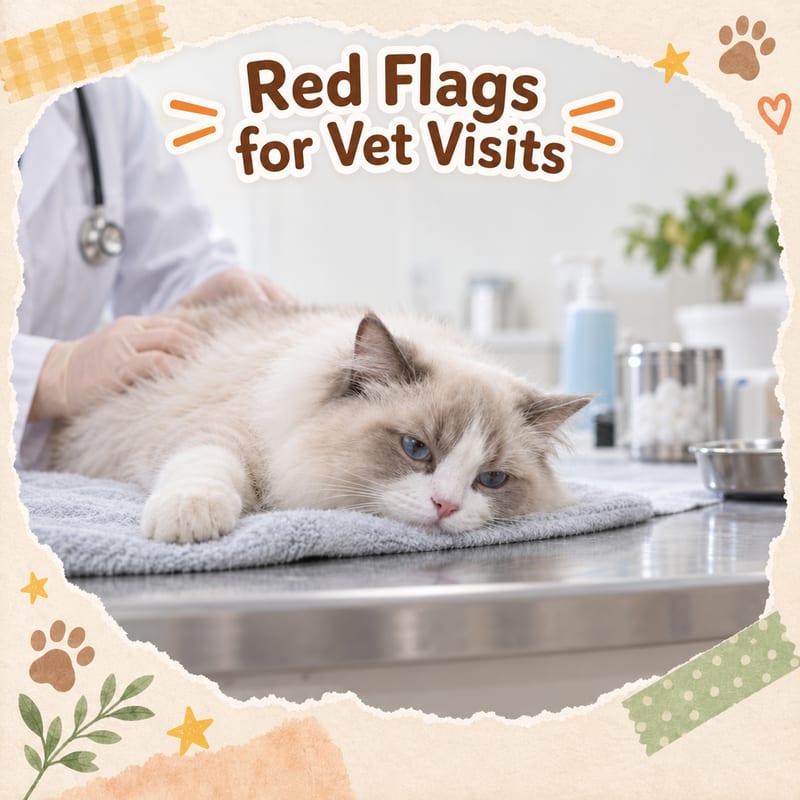
If a Ragdoll shows any of the following, contact a veterinarian directly:
- ⚠️ Rapid breathing or open-mouth breathing (over 40 breaths per minute at rest) — HCM emergency signal
- ⚠️ Sudden hind-leg weakness or crying in pain — a blood clot blocking blood vessels; every second counts
- ⚠️ Increased drinking and urination + weight loss — kidney disease warning (especially watch PKD cats)
- ⚠️ Not eating at all for 24 hours — cats not eating can trigger fatty liver
- ⚠️ Coat suddenly lightening + lethargy — possibly circulation or endocrine problems
This article is for reference only and cannot replace veterinary diagnosis. If you have health concerns, consult a registered veterinarian.
Further reading
- All article index
- PetChill pet supplies
- Ragdoll complete guide (personality, care, Hong Kong adoption) →
- Ragdoll colour pattern guide →
- Ragdoll disadvantages explained →
📌 Key takeaways
- ✅ Blue eyes + colourpoint are the breed hallmarks; without blue eyes it's not a Ragdoll
- ✅ Extremely clingy personality, suitable for companion-oriented families
- ✅ Lifespan 12-17 years, long-lived among longhair cats
- ❌ Must be kept indoors; no wariness outdoors
- ❌ Online cats under HK$10,000 mostly lack genetic screening
 Royal Canin full guide →