
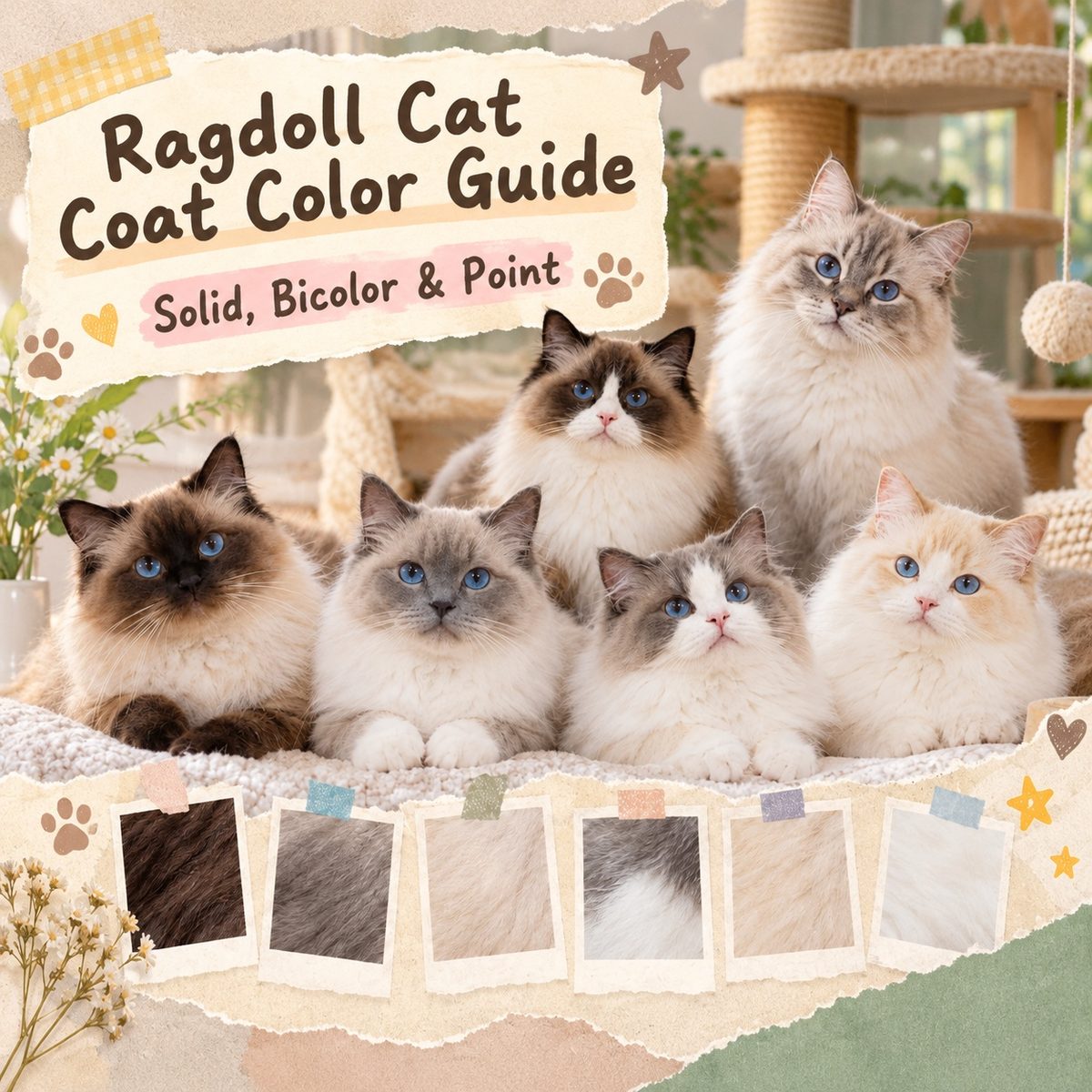
Quick answer: Ragdoll patterns = 6 body colours × 3 patterns (colourpoint, mitted, bicolor), plus lynx variants. The most common day-to-day are seal and blue; all Ragdolls are near-white at birth, with colour developing gradually on the face and limbs, and full coat colour often taking over 2 years to settle. There is no recognised pure black Ragdoll.
Want to know Ragdolls inside out? Start with the Ragdoll breed profile and the complete Ragdoll guide.
What are Ragdoll patterns? 30-second summary
Ragdoll pattern is a concept of "body colour × marking pattern": 6 recognised body colours (seal, blue, chocolate, lilac, red, cinnamon) combined with 3 basic patterns (colourpoint, mitted, bicolor), and lynx variants can be layered on top. The table below gives you the full picture first; later we break down care and price differences item by item.
| Item | Ragdoll pattern quick reference |
|---|---|
| Recognised body colours | 6: seal, blue, chocolate, lilac, red, cinnamon |
| Basic patterns | 3: colourpoint, mitted, bicolor |
| Variants | Lynx can be layered on any body colour |
| Official combinations | Dozens of names |
| Most common in Hong Kong | Seal, blue (bicolor and mitted most sought-after) |
| Coat at birth | Near all-white, extremities colour with age |
| Colour set | About 2 years, late-colouring lines up to 3–4 years |
| Weight reference | Male 5.5–9 kg / female 4–6.5 kg |
| Lifespan | 12–15 years |
Before choosing a pattern, remember one thing: pattern only affects appearance and grooming details, not personality or health. Health always depends on parental screening documents, not on how pretty the face markings are.
Ragdoll pattern prices and monthly costs (2026 Hong Kong market)
Different patterns command real price differences in the Hong Kong market—bicolor and rare colours carry obvious premiums, but the premium buys "rarity", not "health". The table below reflects general 2026 Hong Kong market rates; ask about each item clearly before paying a deposit:
| Item | Range | Notes |
|---|---|---|
| Seal / blue (colourpoint) | HK$10,000–18,000 | Most common, ample supply, more room to negotiate |
| Seal bicolor / blue bicolor | HK$15,000–28,000 | Social media effect, highest premium pattern |
| Mitted | HK$12,000–20,000 | Symmetry of white socks affects price |
| Rare colours (cinnamon, lilac) | HK$18,000–35,000 | Rare does not mean healthier; still check screening documents |
| Adoption (mostly crossbreeds) | HK$0–2,000 | Usually already neutered and vaccinated |
| Vaccines (first-year three doses) | HK$900–1,500 | Annual booster thereafter |
| Neutering | HK$1,800–4,000 | Long-haired large cats cost slightly more in anaesthesia |
| Monthly food | HK$400–800 | Large cats eat more |
| Monthly cat litter | HK$150–300 | Low-dust litter recommended for long-haired cats |
| Grooming supplies amortised | HK$50–150 | Comb, dematting tool, wet cotton pads |
| Medical reserve (recommended) | HK$300–600 | Amortised HCM and kidney screening |
| Monthly total | About HK$900–1,850 | Excludes emergency medical costs |
A common miscalculation: bicolor cats have more white areas, adding about HK$600–1,200 per year in cleaning supplies and grooming. These "pattern surcharges" are small but real money—include them in your budget.
Ragdoll pattern quick-reference table: price, white areas and care priorities
For the same pattern, price, amount of white and daily effort all differ. The table below combines the three focuses of this article (price, colour development, care) into one table; check it before paying a deposit:
| Pattern | 2026 Hong Kong price reference | White areas | Daily care priorities | Choosing tips |
|---|---|---|---|---|
| Colourpoint (seal, blue) | HK$10,000–18,000 | No white patches | Wipe eye discharge, deep-clean oily facial markings | Best for first-time owners who dislike grooming |
| Mitted | HK$12,000–20,000 | Four white socks plus white chin | Wipe white socks and chin, use ceramic food bowls | Symmetry of white socks affects price |
| Bicolor (seal bicolor, blue bicolor) | HK$15,000–28,000 | Inverted-V face mask, white belly and legs | Wipe face and paws with wet cotton pads, add sheer curtains to window sleeping spots | Most photogenic, but accept daily face wiping |
| Rare colours (cinnamon, lilac) | HK$18,000–35,000 | Depends on pattern pairing | Check for yellowing, avoid prolonged direct sun | Rare does not mean healthier; screening documents first |
| Adoption (mostly crossbreeds) | HK$0–2,000 | Not necessarily | Based on actual coat colour | Usually already neutered and vaccinated |
Three condensed points: all patterns need 5–10 minutes of daily brushing, increasing to 15 minutes in shedding season; coat colour is set around 2 years, late-colouring lines up to 3–4 years; the price premium buys "rarity", not "health".
Which Ragdoll pattern suits you?
| Your situation | Suggested pattern | Reason |
|---|---|---|
| First-time owner, dislike grooming | Seal / blue colourpoint | Dark facial markings hide dirt, less white |
| Love taking photos for posts | Blue bicolor / seal bicolor | Inverted-V white face is photogenic, but accept daily face wiping |
| Home has lots of dark furniture and clothes | Dark colours (seal) | Light fur shows most on dark fabric |
| Want something unique | Chocolate / lilac | High premium; remember health documents first |
| Limited budget | Adopt a crossbreed or colourpoint | Save the money for a medical reserve |
Reverse self-check (three questions):
- Can you give 5–10 minutes of brushing daily, increasing to 15 minutes in shedding season?
- Can you accept that your cat's coat colour before two years old will not look the same as now?
- Are you willing to set aside an extra HK$300–600 per month for a medical reserve beyond the "pattern premium"?
If you answer "no" to two of the three, we suggest choosing the most common seal or blue colourpoint, or even considering adoption—pattern is the purchase reason most people regret.
Ragdoll patterns compared with other breeds
| Breed | Pattern system | Coat colour changes | Grooming frequency | Hong Kong price reference |
|---|---|---|---|---|
| Ragdoll | 6 body colours × 3 patterns | Yes (set around 2 years) | Daily brushing | HK$10,000–35,000 |
| Siamese | Single colourpoint system | Yes (temperature-sensitive) | Twice weekly | HK$8,000–20,000 |
| British Shorthair | Solid / shaded / bicolor | No | 2–3 times weekly | HK$8,000–30,000 |
| Persian | Dozens of solid patterns | No | Daily brushing + eye wiping | HK$10,000–25,000 |
| Domestic shorthair | Unrestricted | No | Once weekly | Adoption HK$0–2,000 |
Ragdolls are one of the few breeds whose coat colour keeps changing until two years old, completely unlike the "what you see is what you get" of British Shorthairs and Persians—the look on adoption day is not the look when grown.
Ragdoll pattern care schedule
| Pattern | Daily | Weekly boost | Special points |
|---|---|---|---|
| Bicolor | Wipe face and paws with wet cotton pads | Brush 3 times to boost undercoat | White fur yellows easily; add sheer curtains to window sleeping spots |
| Mitted | Wipe white socks and chin | Check white socks for trapped litter | Prone to black chin; use ceramic food bowls |
| Colourpoint (dark markings) | Wipe eye discharge | Deep-clean oily facial markings | Visible sebum; avoid scented wet wipes |
| Light colours (cinnamon, lilac) | General brushing | Check for yellowing | Avoid prolonged direct UV exposure |
Brushing time is the same for all patterns: 5–10 minutes daily, increasing to 15 minutes in shedding season (April–May, September–October). The only difference is cleaning effort for white areas.
Ragdoll pattern terminology: understand what sellers say
Buying groups and catteries often use nicknames, and beginners are easily confused. The comparison table clarifies at a glance:
| Term | Actual meaning | Choosing tips |
|---|---|---|
| Blue bicolor | Blue × bicolor pattern | Most popular in recent years, highest premium |
| Seal bicolor | Seal × bicolor pattern | Strongest light-dark contrast, most photogenic |
| Lynx | Any body colour with lynx markings | M-shaped tabby markings visible on face |
| Van | Bicolor variant with very high white proportion | Some associations classify it as bicolor |
| High white | Descriptive term for large white area | Not an official classification; write the official name in the contract |
| Flame | Colloquial term for red series | Official name is Red / flame point |
| Mitted fault | Asymmetrical white socks or no white chin | Appearance detail, does not affect health |
| Incomplete colourpoint | Insufficient or broken colour on extremities | Judge only before two years; kittens not reliable |
Inconsistent terminology is the biggest trap in buying communication: before paying a deposit, ask the seller to write the full official name (e.g. Seal Bicolor) in the contract—verbal nicknames do not count.
After choosing a Ragdoll pattern: four steps to prepare before bringing the cat home
Pattern decided, next comes practical action. Do the four steps in order:
- Find a veterinarian—choose a clinic familiar with felines and register in advance; book the first check within a week of bringing the cat home (about HK$500–900), including heart and lung auscultation and faecal examination.
- Prepare supplies by pattern—bicolor and mitted need wet cotton pads and ceramic food bowls; light colours need sheer curtains on window sleeping spots; all patterns need a comb and dematting tool (about HK$150–300).
- Set photo record points—take a front-facing photo monthly in the same spot and lighting to track colour development; by two years you will have a complete "colouring record", also handy for following up with the cattery on pedigree description.
- Join breed groups—Hong Kong Ragdoll owner groups can help you compare colour development with cats of the same age, so you do not scare yourself with "why is it so light".
The focus of the first month is not "watching colour" but building trust and routine. Coat colour will change over the next two years; anxiety will not make it colour faster.
Four most common Ragdoll pattern misconceptions
| Misconception | Reality |
|---|---|
| Bicolor is definitely prettier and more valuable than colourpoint | Patterns have no hierarchy; the premium is only market supply and demand; colourpoint is the breed's most classic look |
| Rare colours (cinnamon, lilac) mean healthier pedigree | Rare only means low gene frequency, zero correlation with health; screening documents are the proof |
| The kitten's current colour is the final colour | The colourpoint gene takes about 2 years to set; kitten photos are only a "preview" |
| Asymmetrical white socks are a health defect | It is an appearance fault detail with zero impact on health or personality; pet-grade cats need not worry |
Remember the last point: when choosing a Ragdoll, choose health and pedigree documents first, then personality, and only then pattern. Reversing the order is the buying method most people regret.
First understand the mechanism: why Ragdolls "colour themselves in"
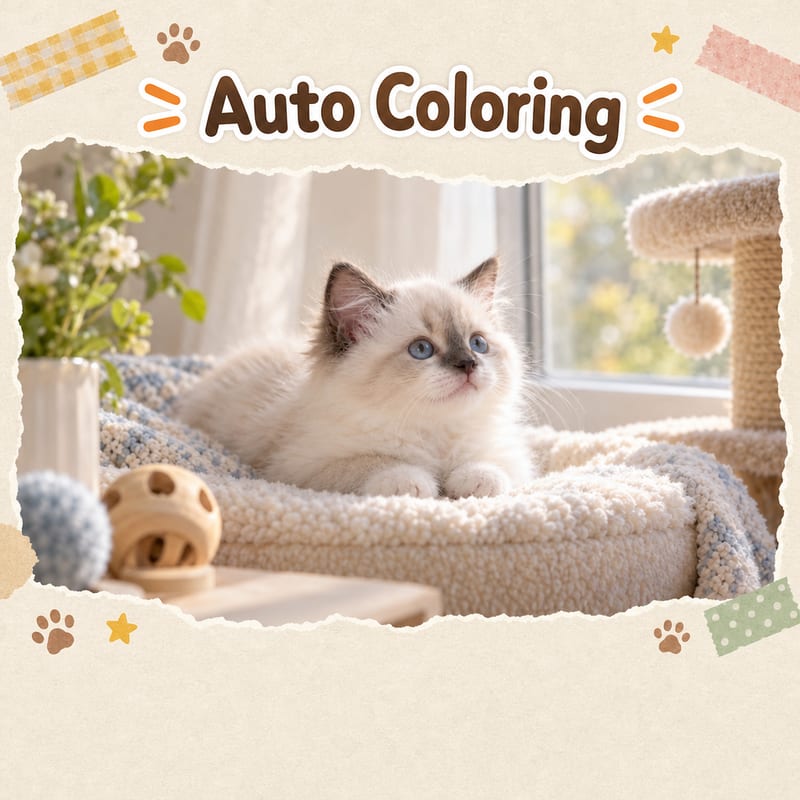
All Ragdoll colours are built on the same gene—the colourpoint gene (temperature-sensitive albinism): the enzyme that produces melanin is inactive in the warmer trunk and only acts at the cooler extremities (face, ears, limbs, tail). That is why Ragdolls are near-white at birth (in a thermostatically warmed environment), and colour begins at the extremities weeks later, deepening with age.
This mechanism explains three common questions:
- Coat colour change in Ragdolls is a normal physiological phenomenon—colder weather makes colour darker; fever or anaesthesia may temporarily lighten it.
- Ragdoll colour classification depends on "depth" not just "hue"—the same cat sleeping by the fridge for a winter will have noticeably darker facial markings.
- Kittens are too young to judge final colour—when a seller says "this one will be bicolor when grown", treat it as a prediction until two years old.
The six colour series: from most common to rarest
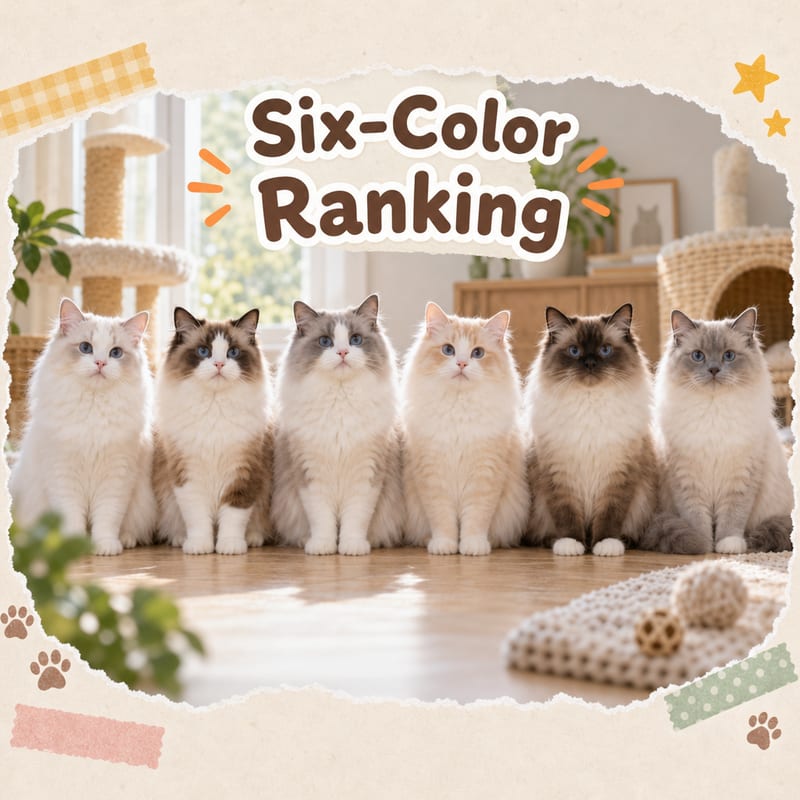
The International Cat Association (TICA) and the Cat Fanciers' Association (CFA) both recognise 6 basic Ragdoll body colours, combined with three patterns: colourpoint, mitted and bicolor:
| Colour series | Features | Commonness in Hong Kong |
|---|---|---|
| Seal | Face, ears and limbs dark brown, almost black; body cream | Most common |
| Blue | Slate grey-blue facial markings, body light grey-white | Very common |
| Chocolate | Warm grey-brown facial markings, soft contrast | Moderate |
| Red | Orange-gold facial markings, body creamy white to apricot | Less common |
| Cinnamon | Warm ginger-brown, lightest and warmest tone | Rare |
| Lilac | Cool grey-purple facial markings with pink undertone | Rare |
Multiplied further: lynx variants can be layered on any colour series, e.g. "seal lynx mitted". The combinations add up to dozens of official names, but the most common on the street are actually just seal and blue across the three patterns.
What comes up when you search "black Ragdoll"
Many people search "black Ragdoll"—the answer is: there is no recognised pure black Ragdoll. The closest is seal colourpoint, whose dark facial markings look almost black-brown in dim light. If you see a fully black "Ragdoll" with large dark areas on the body too, it is most likely a domestic shorthair crossbreed or a sales tactic using a breed name; pedigree documents are the only proof.
How to tell mitted, bicolor and colourpoint apart
- Colourpoint: face, ears, limbs and tail coloured, trunk all white, no white patches at all. The most "classic" but locally less common than bicolor.
- Mitted: four white socks, white chin, tail may be white. Usually no white on the back.
- Bicolor: inverted-V white face mask, white belly, white legs, largest white area. "Blue bicolor" and "seal bicolor" are the most popular Ragdoll looks on social media in recent years.
Care differences by pattern
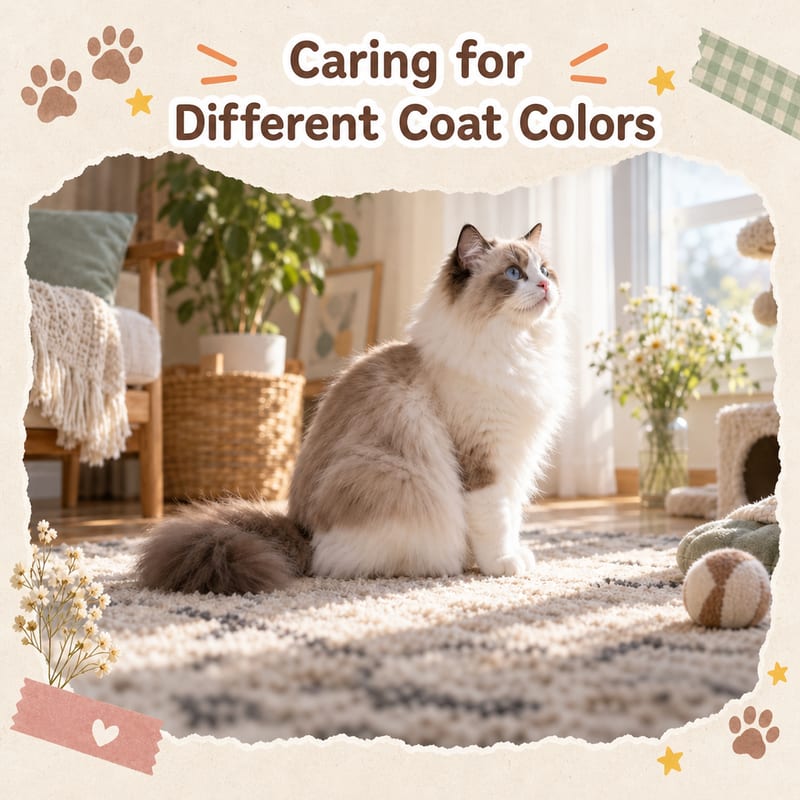
Brushing requirements are the same for all: 5–10 minutes daily. But small pattern-related differences are worth knowing early:
- White areas (bicolor V face, mitted white socks) show stains easily: food spills, litter tracked from the box—wipe face and paws daily with wet cotton pads, use glass or ceramic food bowls, avoid plastic (harbours bacteria and causes black chin).
- Dark facial markings (seal) show sebum oiliness clearly; clean deeply regularly with cat-specific cleaning products, do not use human wet wipes (fragrance and pH unsuitable for cats).
- Light colours (cinnamon, lilac) are harder to photograph—not a concern—but prolonged UV exposure yellows light fur; a sheer curtain on window sleeping spots is the most practical fix.
- Long-haired shedding season—all patterns shed, and light fur is especially visible on dark clothes—think twice when buying clothes (joking); the practical solution is daily brushing.
Choosing a colour: three honest truths
- Do not pay a premium for a "rare colour" cat without screening—cinnamon and lilac are uncommon, not so precious that health checks should be sacrificed.
- Colour before two years is a "work in progress"—sellers use pretty kitten photos to set a lifetime price; you need to know this yourself.
- Pattern has zero correlation with personality—do not believe "bicolors are especially clever" or "colourpoints are especially quiet"; personality depends on parents and upbringing, a consensus in breed behaviour descriptions.
How to assess colour when buying: three checkpoints at three months, six months and two years
Many people regret their colour choice because kitten coat colour is a "dynamic preview". Here is how to look at three time points:
- Two to three months (at adoption): face and ears begin to colour but very lightly; final colour cannot be judged at this stage, only the "colour direction" (dark brown or light grey). Ask the cattery for recent photos of the parents—more informative than the kitten itself.
- Around six months: facial markings and limb colour are roughly discernible, contrast trend clear. If the face and ears are still very light and the body yellowish, it may be a later-colouring chocolate or cinnamon line—not a problem.
- Around two years: colour approaches its final form; only then is it appropriate to assess against the breed standard item by item (symmetry of facial markings, height of white socks, position of inverted V, etc.).
Two more popular terms: "blue bicolor" is blue + bicolor pattern, slate grey facial markings with a large white face—the most popular Ragdoll look on social media; "asymmetrical mitted white socks" is a fault-level minor flaw with zero impact on a pet cat's health or personality, but if you plan to show, write it clearly in the contract.
Why mixed colour, white patches and "incomplete colourpoint" happen
Some Ragdolls have a small white patch on the chest or asymmetrical facial markings; this is mostly natural expression of polygenic inheritance, not a colouring failure. Watch for the opposite: if a "Ragdoll" has large random white patches, eyes that are not blue, or no colour on the extremities at all, it is very likely not a Ragdoll or is a crossbreed—pattern records and TICA/CFA pedigree registration documents are the final proof; do not pay based on "looks like" alone.
Frequently asked questions
Q: How many colours do Ragdolls have? A: 6 body colours times 3 patterns, plus lynx variants, giving dozens of official combinations. The most common day-to-day are seal and blue across the three patterns.
Q: Is it normal for Ragdolls to be born white? A: Completely normal. The colourpoint gene only colours the cooler extremities, and full colour takes 1–2 years or longer.
Q: Do black Ragdolls exist? A: There is no recognised pure black. The closest is dark seal facial markings; a fully black "Ragdoll" is usually a crossbreed or mislabelled.
Q: Should I see a doctor if the coat suddenly lightens? A: Temporary lightening after fever, anaesthesia or pregnancy is a known physiological phenomenon. But if accompanied by lethargy, poor appetite or dull coat, consult a registered veterinarian.
Q: Is bicolor the hardest to care for? A: White areas stain easily, requiring daily face and paw wiping and ceramic food bowls; brushing frequency is the same as other patterns.
Q: How do you tell mitted from bicolor? A: Look at white proportion: mitted = white socks + chin; bicolor = inverted-V face mask + white belly and legs, much more white overall.
Q: What pattern is a black Ragdoll? A: There is no recognised pure black. The closest is seal colourpoint—face, ears and limbs dark brown, almost black, but the body is cream; a fully black "Ragdoll" is usually a crossbreed or mislabelled.
Q: What is the difference between Ragdoll colour and pattern? A: Colour = 6 basic body colours (seal, blue, chocolate, lilac, red, cinnamon); pattern = marking distribution (colourpoint, mitted, bicolor). The two multiply for the full name, e.g. seal × bicolor is seal bicolor.
Q: How do you tell colourpoint from mitted? A: Look at white proportion: colourpoint has no white patches at all; mitted has white socks plus white chin, usually no white on the back. White area from least to most is colourpoint, mitted, bicolor.
Key takeaways
- ✅ Ragdoll colour = 6 body colours × 3 patterns (colourpoint/mitted/bicolor) plus lynx variants.
- ✅ Due to the colourpoint gene, all Ragdolls are near-white at birth, with extremities colouring with age and body temperature.
- ✅ There is no recognised pure black Ragdoll; "black Ragdolls" are mostly crossbreeds or sales talk.
- ✅ Slight coat colour changes with weather and health status are normal; sudden changes with symptoms require a vet visit.
- ✅ Patterns with more white areas need frequent face and paw wiping; choose ceramic or crystal food bowls.
- ✅ Pattern does not determine personality; always prioritise health screening and pedigree documents when choosing a cat.
Related articles
- Ragdoll personality and intelligence analysis
- Ragdoll price and adoption full guide
- Key points for keeping Ragdolls in Hong Kong
- Ragdoll disadvantages explained: monthly costs and solutions (Hong Kong)
- Ragdoll weight chart: monthly standards during growth + male-female differences + BCS self-check
- Long-haired cat cleaning and care supplies: visit PetChill pet supplies for cat wet cotton wipes, ceramic food bowls and grooming comb series.
Colour naming and standards follow current TICA/CFA breed standards; for individual health assessment please consult a registered veterinarian.



